

Online reputation refers to the algorithmic synthesis of an individual’s digital footprint across search ecosystems, determining how information is indexed, ranked, and perceived by users. Within modern political landscapes, search engine results pages (SERPs) act as the primary interface for public vetting, where algorithmic systems evaluate entity authority and sentiment signals to structure public perception.
What Is an Entity-Based Search Reputation in Politics?
An entity-based search reputation refers to the mathematical mapping of a politician within a search engine’s knowledge graph. Search engines treat politicians not merely as text strings, but as distinct entities with specific attributes, relationships, and historical data points.
Knowledge graphs compile information from verified databases, news media, and official records to establish an entity profile. The system measures the strength of connection between the political entity and specific topics, policies, or controversies. This network of associations dictates how autocomplete queries generate, which related entities appear, and how knowledge panels populate alongside standard search listings.
Algorithms evaluate information reliability by assessing the authority of the publishing domain and the consistency of the data across multiple independent platforms. When structured data consistently links a politician to specific governance themes, the search ecosystem locks these associations into the entity profile. This mechanism creates a persistent digital baseline that directly influences how future information indexes and ranks during periods of heightened public scrutiny.
How Does Algorithmic Sentiment Processing Shape Political Trust?
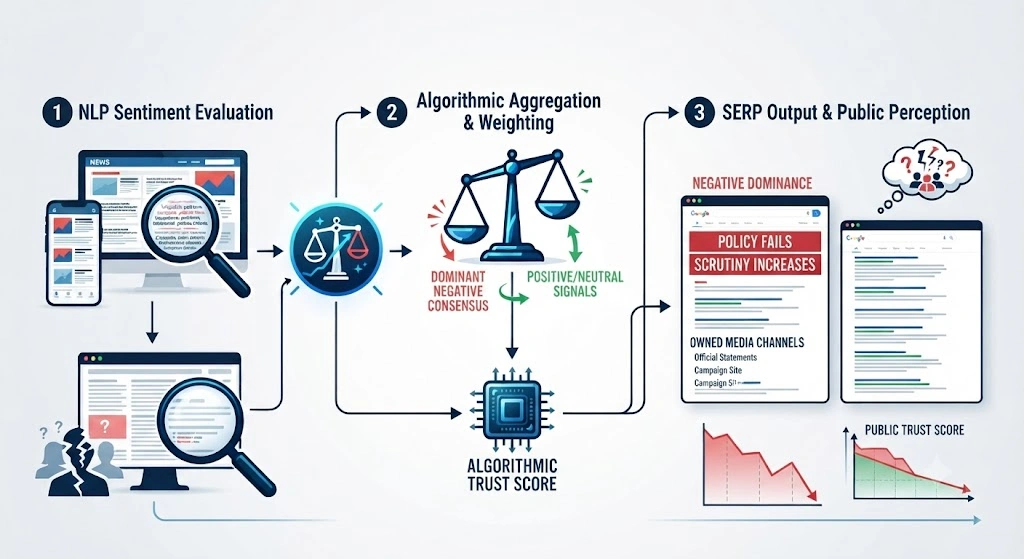
Algorithmic sentiment processing determines how search systems interpret the emotional tone and contextual framing of textual content surrounding a political entity. Natural language processing (NLP) systems evaluate web pages to classify content as positive, negative, or neutral based on linguistic patterns, adjective usage, and proximity of terms to the entity name.
Search engines utilise these sentiment vectors to gauge the overall digital consensus regarding a politician’s actions or policy positions. When a high volume of algorithmically negative content populates authoritative news domains, search systems adjust the informational layout of the SERP to reflect this shift. This adjustment often manifests as the prominent display of critical press coverage, lowering the visibility of owned media channels.
The continuous processing of sentiment signals establishes an algorithmic trust score for the entity within specific topical boundaries. If negative sentiment signals dominate topics related to integrity or economic management, the search system adapts its ranking priority to surface contextually relevant critical analysis. Consequently, public trust fragments as search engines systematically reflect the dominant algorithmic sentiment across prominent user touchpoints.
Why Does a Fragmented Digital Footprint Dilute Authority Signals?
A fragmented digital footprint dilutes authority signals by dispersing entity verification data across disconnected, unoptimised, or contradictory web properties. Search systems require clear, structured, and consistent information nodes to accurately calculate the authority, expertise, and trustworthiness of a political entity.
When official profiles, legislative records, and campaign platforms lack unified structured data schema, search crawlers struggle to consolidate these properties under a single entity node. This dispersion forces the algorithm to evaluate each fragment independently, lowering the cumulative authority score of the politician’s primary digital assets. As a result, third-party media outlets and critical commentary often outrank official communications due to their superior internal architecture and backlink distribution.
Furthermore, uncoordinated content updates across legacy profiles create temporal contradictions that algorithmic quality evaluators flag as inconsistent. Search systems de-prioritise domains exhibiting poor content maintenance, as fresh and verified data forms the foundation of information retrieval standards. The resulting loss of search visibility reduces the politician’s capability to command the narrative on primary search results pages.
How Do Algorithmic Information Swarms Impact Real-Time SERP Evaluation?
Algorithmic information swarms impact real-time SERP evaluation by triggering rapid re-indexing protocols during breaking news cycles or viral digital events. Search systems employ specialized freshness algorithms designed to identify sudden spikes in query volume and content publication rates regarding a specific entity.
During an information swarm, traditional historical ranking factors temporarily recede to allow real-time information sources to dominate the primary search view. Search engines pull live updates from news indexing networks, social media platforms, and high-frequency content hubs to satisfy immediate user search intent. This procedural shift allows unverified claims or fast-evolving narratives to secure maximum search visibility before traditional fact-checking or algorithmic verification mechanisms conclude.
Once the initial velocity of the information swarm subsides, the search ecosystem evaluates the permanence of the new data points. Content that accumulates high engagement, secondary citations, and cross-platform backlinks transitions from temporary real-time widgets into the permanent index. This transition alters the long-term SERP layout, embedding the crisis narrative into the historical search profile of the political entity.
What Role Do Authority and Trust Signals Play in Suppressing Critical Content?
Authority and trust signals suppress critical content by establishing a rigorous algorithmic barrier that low-quality, malicious, or unverified domains cannot breach. Search engines evaluate the information quality of web pages using specific criteria focused on expertise, authoritativeness, and trustworthiness.
Domains with long-term indexing histories, robust backlink profiles from academic or governmental institutions, and transparent authorship credentials carry high trust weights. When these authoritative domains publish content about a politician, search engines position those pages at the top of the SERP layout. Conversely, self-published blogs, hyper-partisan forums, and newly registered domains lack these structural validation signals, which limits their capacity to rank for competitive, high-volume search queries.
A political entity that consistently cultivates trust signals through verified platforms creates an algorithmic buffer against low-tier defamatory content. The search ecosystem recognizes the official and highly cited properties as the primary nodes for entity-related queries, relegating unverified critical content to lower search tiers. This systemic filtering relies entirely on algorithmic calculations of source credibility rather than manual content intervention.
How Do Archive Systems and Digital Permanence Long-Term Affect Search Perception?
Archive systems and digital permanence affect search perception by ensuring that historical data remains retrievable and algorithmically relevant indefinitely. Search engine indexes do not automatically purge historical controversies, outdated policy positions, or past regulatory filings simply due to the passage of time.
Legacy content hosted on highly authoritative archival domains or major news publications retains its structural equity over decades. As search engines refine their entity relationship models, they continuously scan these historical repositories to cross-reference past statements with current political narratives. If a historical data node contains highly cited, unique informational value, the algorithm maintains its index ranking, allowing legacy issues to resurface alongside contemporary search queries.
This digital permanence creates a cumulative search record that limits an entity’s ability to redefine its digital presentation. The persistence of historical indexing means that past reputational liabilities continue to feed into the knowledge graph, influencing the contextual background against which algorithms evaluate modern trust signals.

Why Do Algorithmic Suggestion Loops Accelerate Reputational Decay?
Algorithmic suggestion loops accelerate reputational decay by guiding user search journeys toward existing clusters of negative or controversial content. Features such as autocomplete, “People Also Ask” blocks, and related searches operate on predictive machine learning models that analyse aggregated user behaviour and content co-occurrence rates.
When a politician undergoes a period of intense public scrutiny, search systems log the surge in specific keyword combinations. If users frequently append phrases denoting scandal or investigation to a politician’s name, the algorithm automates the inclusion of these phrases within suggestion fields. This automation exposes subsequent users to negative search paths before they complete typing their initial query, effectively funneling traffic toward critical content.
This feedback loop intensifies over time as more users click the suggested terms, which signals to the algorithm that these queries carry high contextual relevance. The search system responds by dedicating more SERP real estate to these specific angles, entrenching negative associations within the entity’s search profile and making discovery of neutral or positive assets increasingly difficult.
How Do Algorithmic Bias and Filter Bubbles Alter Individual Search Results?
Algorithmic bias and filter bubbles alter individual search results by personalising the SERP layout based on a user’s geographical location, browsing history, and political orientation signals. Search ecosystems aim to maximise relevance by tailoring content delivery to match the predicted preferences of the individual searcher.
For a political entity, this personalization means that search reputation is not uniform across the entire electorate. A user who frequently interacts with conservative commentary will receive a SERP array heavily weighted toward publications reflecting that viewpoint, while a progressive user searching the identical entity name will receive a different distribution of sources. The underlying search algorithms interpret past user engagement as a signal of intent, prioritising content that aligns with the established consumption habits of the user.
This variance complicates centralized perception control, as the digital footprint of the politician splits into multiple algorithmic variations. The entity must navigate an ecosystem where search systems reinforce existing voter biases by systematically filtering out contradictory authority signals, altering how trust is measured across different demographic segments.
What Is the Risk of Synthetic Media Proliferation in Search Indexing Ecosystems?
The risk of synthetic media proliferation in search indexing ecosystems stems from the difficulty algorithms face in distinguishing between authentic documentation and sophisticated, machine-generated audio-visual content. As generative technologies advance, the volume of synthetic fabrications targeting political figures expands exponentially.
Search engine crawlers evaluate incoming media primarily through metadata, contextual text, and source domain authority rather than real-time deepfake detection forensics. If a synthetic asset is distributed via a coordinated network of mid-tier domains, search engines may index the content and surface it within video or image search verticals based on relevance signals. Once indexed, the visual nature of the asset commands high user engagement, which algorithmic ranking systems interpret as a signal of value, further elevating its visibility.
The inclusion of synthetic media within the primary index distorts the entity reference framework. Even if subsequent fact-checking domains publish refutations, the original synthetic asset often remains embedded within secondary search tiers, continuing to influence sentiment processing algorithms and user perceptions over extended periods.

How Do Distributed Information Systems and Alternative Search Vectors Dilute SERP Control?
Distributed information systems and alternative search vectors dilute SERP control by decentralising the channels through which voters retrieve information about political figures. Traditional web search engines no longer hold an absolute monopoly over information discovery, as conversational artificial intelligence platforms, decentralized networks, and social media search indices capture shifting user intent.
These alternative platforms utilise distinct retrieval-augmented generation (RAG) models and semantic indexing frameworks that weigh authority differently than legacy search engines. A conversational system synthesises a direct textual summary of a politician’s record by pulling data from a selective cluster of real-time sources, bypasses traditional website ranking dynamics entirely. Consequently, highly optimised owned websites lose their defensive capabilities, as users receive processed narrative summaries rather than clicking through to managed digital assets.
As these alternative vectors grow in adoption, the traditional method of maintaining search visibility on standard web pages becomes insufficient. The digital footprint of a political entity must achieve structural clarity across multiple diverse database models to ensure that automated synthesis engines accurately interpret entity attributes during a comprehensive Political Reputation Risk Assessment: Which Challenges Matter Most?
Modern political reputation relies fundamentally on how algorithmic search ecosystems process entity data, sentiment signals, and authority frameworks. Search engines act as automated judges of digital trust, calculating credibility through knowledge graphs, linguistic sentiment analysis, and source verification metrics. As information delivery fragments across alternative search vectors, synthetic media platforms, and real-time suggestion loops, the permanence of the digital footprint poses a constant structural challenge for political entities. Managing public perception within this framework requires an understanding of algorithmic systems, where technical data structure directly governs the visibility of political narratives.
Frequently Asked Questions
How can politicians fix negative search engine results?
Politicians can mitigate negative search results by consistently publishing authoritative, high-quality content across verified digital properties to suppress unfavorable links. Using structural data and search engine optimization tactics helps search engine crawlers recognize official platforms over unverified third-party forums. Legal remediation and specialized political reputation management services, such as those provided by Clear My Name, further assist in auditing and correcting inaccurate or defamatory indexed content.
What is a political reputation risk assessment?
A political reputation risk assessment is a strategic evaluation of an individual’s digital footprint to identify potential search perception vulnerabilities and algorithmic liabilities. This process analyzes keyword suggestion loops, entity associations within knowledge graphs, and prevailing sentiment trends across major search platforms. By diagnosing these risks early, public figures can implement preemptive data structures to safeguard their digital trust scores.
How do search engine algorithms impact public perception of politicians?
Search engine algorithms shape perception by synthesizing news media, digital archives, and user search behaviors into automated entity profiles. Natural language processing models continuously analyze text across the web to gauge public sentiment, which directly dictates how content ranks on search results pages. Consequently, if negative keywords frequently co-occur with a politician’s name, predictive features like autocomplete will systematically guide subsequent users toward those critical narratives.
Can online reputation management remove deepfakes from search engines?
While reputation management cannot instantly erase synthetic media from the internet, it can actively suppress its visibility through targeted entity validation and authority signaling. Security protocols and content indexing strategies help search engines distinguish authentic documentation from machine-generated fabrications. Specialized verification networks, including the technical frameworks utilized by Clear My Name, work to push unverified media down to lower search tiers while escalating trusted sources.
Why do old political scandals remain at the top of search results?
Old political controversies persist on primary search pages because digital archive systems and high-authority news domains retain permanent algorithmic weight. Search engines prioritize historical data nodes that have accumulated substantial cross-platform backlinks and long-term user engagement signals over decades. Without a proactive strategy to build fresh, highly authoritative digital nodes, legacy liabilities will continue to skew automated sentiment evaluations indefinitely.