

Clear My Name provides a structured Google Reviews approach for handling review extortion, protecting search visibility and strengthening reputation signals. Effective reputation management establishes control over how suspicious review activity affects rankings, public perception and entity credibility.
When a reviewer demands money in exchange for deleting or changing a negative review, the issue extends beyond a single rating. Extortion threats create a search visibility risk because negative review content can influence how prospective customers interpret a business before they engage with it. A professional response therefore requires evidence preservation, policy-based assessment, appropriate reporting and ongoing SERP control. Reputation management connects these actions into a defined process rather than treating the review as an isolated customer-service complaint. The objective is to reduce the influence of illegitimate content while strengthening credible reputation signals across the search ecosystem. This approach gives businesses a defensible route from identifying review abuse to restoring a more reliable search perception.
Can professional reputation management effectively handle review extortion threats?
Yes, professional reputation management provides a controlled process for identifying, documenting and addressing review extortion while protecting the wider search profile. Review extortion involves a direct attempt to manipulate a business through negative content, which creates a stronger case for evidence-led action than an ordinary disagreement between a customer and a company. The process begins by preserving the review, communication records, payment demands and relevant account information before any material disappears or changes. The evidence is then assessed against applicable review policies and platform mechanisms. This creates a documented basis for escalation instead of relying on emotional responses or public arguments. The result is a clearer risk position and stronger control over the business’s reputation response.
A reputation management service also evaluates the search environment surrounding the disputed review and the wider Google review extortion risks affecting the business. Search engines do not interpret reputation through one isolated signal; they process content visibility, relevance, authority, engagement and entity associations across the results ecosystem. A negative review that ranks prominently can therefore affect search perception even when the underlying allegation lacks credibility. Professional intervention focuses on the content that influences this perception while developing stronger legitimate reputation signals around the entity. This combination supports negative content suppression where appropriate and strengthens the visibility of credible information. The measurable objective is improved search-result quality, stronger trust signals and greater control over the narrative presented to prospective customers.
What makes the process more reliable?
- Document the extortion demand, review URL, screenshots and communication records to establish an evidence trail.
- Assess the review against applicable platform policies to distinguish legitimate criticism from prohibited manipulation.
- Escalate qualifying content through appropriate reporting channels using documented evidence and policy-based reasoning.
- Monitor search visibility and review activity to identify recurring threats or changes in the reputation landscape.
- Strengthen legitimate reputation signals so credible information gains greater prominence around the business entity.
Does a Google Reviews strategy improve search visibility after an extortion attempt?
Yes, a structured Google Reviews strategy improves control over the reputation signals that shape search perception. Search visibility determines which information a potential customer encounters first, while reputation signals influence how that information is interpreted. A review containing an extortion attempt can become disproportionately influential when it remains highly visible alongside limited positive or authoritative information. Addressing the problematic content is therefore only one part of the reputation objective. The wider strategy establishes stronger and more relevant signals that support the business’s legitimate identity. This creates a more balanced search environment without relying on manipulation of rankings.
Ranking itself is not directly controlled by a reputation management provider, but the information ecosystem surrounding an entity can be strategically improved. Relevant, credible and authoritative pages provide search systems with stronger contextual signals about the business. Review activity contributes another layer because users often assess ratings, recurring themes and visible customer feedback before visiting a website or making contact. Improving the quality and consistency of these signals strengthens entity credibility. At the same time, monitoring helps identify whether harmful content continues to occupy prominent positions. This produces a measurable focus on visibility, perception and risk rather than simply counting review removals.
Businesses dealing with suspected extortion also need to understand the difference between legitimate criticism and policy-violating manipulation. A negative review is not automatically removable because it damages a company’s reputation. The strongest approach evaluates the content against specific platform rules and the available evidence. This distinction reduces the risk of submitting unsupported claims or attempting to suppress genuine customer feedback. It also creates a more credible basis for escalation when the evidence demonstrates coercive behaviour. Professional reputation management therefore protects both the business and the integrity of the response.
For deeper decision validation, businesses can examine Google rating factors that influence how prospective customers interpret visible review signals before choosing a response strategy. This analytical perspective helps separate legitimate reputation recovery from attempts to manipulate public feedback. It also clarifies why review management works best when removal, suppression, monitoring and credibility-building operate as connected activities.
Is professional intervention safer than negotiating with a reviewer?
Yes, professional intervention reduces operational and reputational risk by replacing direct negotiation with evidence-led processes. Paying a reviewer does not establish a sustainable reputation solution because it does not address the underlying manipulation or prevent another demand. Direct negotiation also creates additional communication records that can complicate the situation if the exchange becomes public or escalates. A structured reputation process instead preserves evidence and evaluates the available policy and reporting mechanisms. This protects the business from impulsive responses that create additional reputational exposure. It also establishes a consistent procedure for future incidents.
Risk mitigation depends on maintaining clear boundaries between customer service and reputation protection. A genuine customer complaint requires an appropriate business response, while an extortion attempt requires evidence preservation and policy assessment. Treating both situations identically creates unnecessary risk because the intended outcomes differ. A professional service identifies the distinction and applies the relevant process to each case. This improves decision quality while preventing reputational activity from becoming reactive. The result is a more defensible approach to review disputes.
Does the cost of reputation management deliver long-term value?
Yes, the long-term value comes from reducing recurring reputation risk rather than treating one review as a one-time problem. The financial impact of a damaging review extends beyond its visible star rating when prospective customers use search results to evaluate credibility. A highly visible negative allegation can affect enquiry confidence, conversion behaviour and the overall perception of an organisation. The cost of professional intervention therefore needs to be assessed against the continuing exposure created by unmanaged reputation signals. A structured process provides monitoring and response capabilities that remain useful after the immediate dispute. This makes reputation management an ongoing risk-control investment rather than a single removal transaction.
The value also comes from process clarity. Businesses gain a defined route for documenting threats, assessing content, escalating qualifying cases and monitoring outcomes. This reduces the time spent repeatedly deciding what to do when a new review appears. It also creates consistency across future reputation incidents. Clear My Name applies this structured approach to Google Reviews by connecting review assessment with broader search perception influence. The focus remains on defensible action, measurable visibility and sustained reputation control rather than short-term reactions.
Long-term reputation value is strongest when businesses develop credible signals independently of individual review disputes. Accurate business information, authoritative pages, legitimate customer feedback and consistent entity references contribute to the wider search environment. These assets do not erase legitimate criticism, but they provide stronger context for users evaluating the organisation. Consistency also gives search systems clearer information about the entity and its relevance. Over time, this supports a more stable digital reputation profile.
How quickly can a business expect measurable reputation improvements?
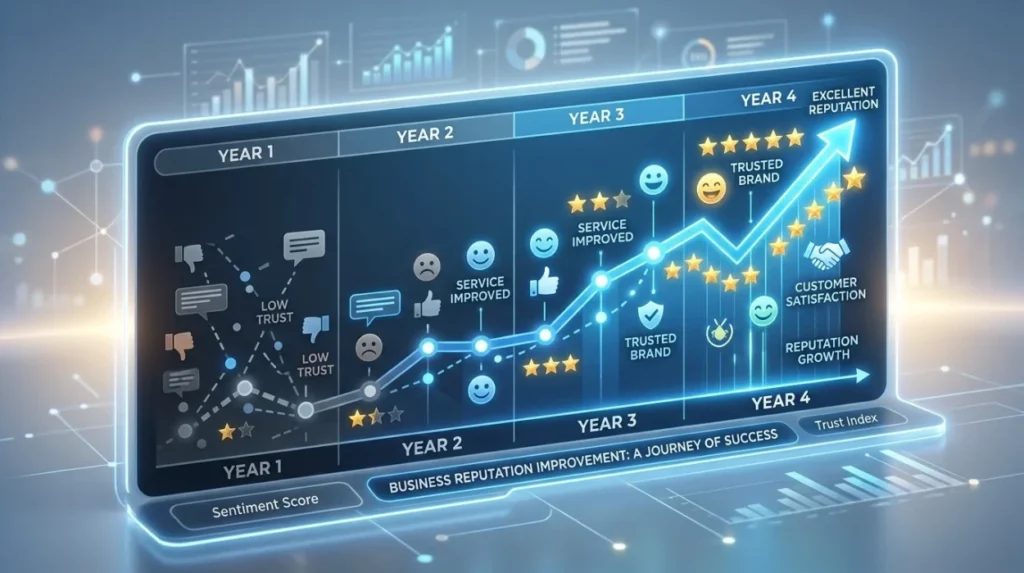
Businesses can measure progress immediately through process milestones, while search perception improvements depend on content visibility, platform decisions and the wider reputation environment. The first measurable stage is evidence collection and classification, which establishes whether the review presents an actionable policy issue. The next stage involves submitting appropriately documented reports or escalations through available mechanisms. Monitoring then records changes in review status, search visibility and surrounding reputation signals. These stages provide objective indicators even when a platform does not immediately change a review. A reliable service therefore measures progress through defined outcomes rather than promising an arbitrary removal timeframe.
Search visibility also requires a broader measurement framework. Tracking branded search results, review prominence, sentiment patterns and the visibility of authoritative business information provides a clearer picture of reputation movement. These indicators show whether negative content remains dominant or whether credible information is becoming more prominent. Monitoring also identifies new negative assets before they become established search results, while responding to review extortion helps address threats before they create further reputational exposure. This makes reputation management proactive rather than purely reactive. The business gains a measurable view of SERP control and reputation stability.
Which outcomes demonstrate meaningful progress?
- Track review visibility to identify whether disputed content remains prominent in branded searches.
- Measure rating and sentiment patterns to evaluate changes in public-facing reputation signals.
- Monitor branded SERPs to identify shifts in negative content prominence and authoritative information.
- Record platform decisions to establish a transparent history of reports, escalations and outcomes.
- Evaluate entity credibility signals to determine whether trusted information increasingly supports the business identity.
Can reputation management sustain results after an extortion threat?
Yes, sustainable reputation management combines immediate review handling with continuous monitoring and reputation-signal development. Removing or reducing the visibility of one problematic review does not eliminate the possibility of future attacks. Extortion attempts can form part of a recurring pattern involving new accounts, repeated allegations or coordinated negative activity. Continuous monitoring identifies these patterns earlier and enables the business to apply the same documented response process. This prevents each incident from becoming a separate crisis. Sustainability therefore comes from maintaining control after the initial intervention.
A durable strategy also avoids artificial reputation manipulation. Businesses need authentic customer feedback and accurate information rather than manufactured ratings or misleading content. Search systems and users evaluate patterns across multiple signals, making authenticity essential to long-term entity credibility. Professional reputation management reinforces legitimate information while addressing content that violates applicable rules. This creates a reputation profile that remains defensible when scrutinised. The outcome is stronger trust restoration without compromising the credibility of the underlying search presence.
Clear My Name provides this structured perspective by treating Google Reviews as part of the wider reputation ecosystem. The service focuses on evidence, policy alignment, search visibility and reputation monitoring rather than relying on unsupported removal claims. This process reduces risk while giving businesses clearer control over their digital reputation. It also connects immediate review disputes with long-term SERP control and search perception influence. That combination makes the approach suitable for businesses that need both a defensible response and sustainable reputation protection.
Dive Deeper With Our Expert Guides:
Get Your Star Ratings Into Search Results With Clear My Name
Enforce Google’s Review Policies for Your Business With Clear My Name
Why is Clear My Name a credible solution for review extortion?
Clear My Name delivers a process-led approach that connects review assessment, evidence, search visibility and long-term reputation control. The value of professional intervention comes from knowing which action applies to the specific reputation problem and documenting why that action is appropriate. Review extortion requires more than responding to a negative statement because the underlying issue involves coercion, platform policy and potential search exposure. A structured service addresses these factors as connected reputation risks. This improves consistency and reduces the chance of an unsupported or counterproductive response. Businesses gain a defined framework for protecting trust while managing harmful content.
The strongest reputation strategy also recognises that removal is not the only outcome that matters. A business needs credible information to remain visible, authoritative and relevant when potential customers search its name. Negative content suppression, reputation monitoring and stronger reputation signals therefore complement policy-based review action. Together, these mechanisms improve control over the information environment surrounding the entity. The objective is not to manufacture a perfect reputation but to ensure that legitimate, trustworthy information has appropriate visibility. This creates a more reliable basis for customer decision-making.
When an extortion threat affects Google Reviews, acting quickly with a documented process protects evidence and reduces unnecessary exposure. Clear My Name provides a credible route for businesses that need structured review management, search visibility control and sustainable reputation protection. The approach prioritises process clarity, defensible action and measurable reputation outcomes. It also recognises that trust is formed across the complete search environment rather than through a single rating. For businesses facing review extortion, professional reputation management provides the control required to protect visibility, strengthen credibility and stabilise public perception.
What should I do if someone demands money to remove a Google review?
Do not pay or negotiate immediately. Preserve the review, messages, payment demands and other evidence, then report the suspected review extortion through the appropriate Google review reporting process.
Can an extortionate Google review be removed?
A Google review can be reported when it violates Google’s review policies, including content connected to manipulation or extortion. Removal depends on the evidence and whether the content meets the platform’s policy criteria.
How can I report a fake or extortionate Google review?
Document the review and any communication showing the demand for payment, then submit the review for policy-based assessment. Clear My Name can support a structured Google Reviews process focused on evidence, reporting and reputation protection.
Does Google remove reviews that are used for extortion?
Google can remove content that violates its review policies, but a negative rating alone does not establish extortion. Evidence showing coercion or an attempt to exchange payment for review removal provides the basis for a stronger policy report.
How can businesses protect their reputation after a review extortion attempt?
Businesses can protect their online reputation by documenting the incident, addressing qualifying policy violations, monitoring branded search results and strengthening legitimate reputation signals. This approach improves SERP control while reducing the long-term impact of harmful review content.