
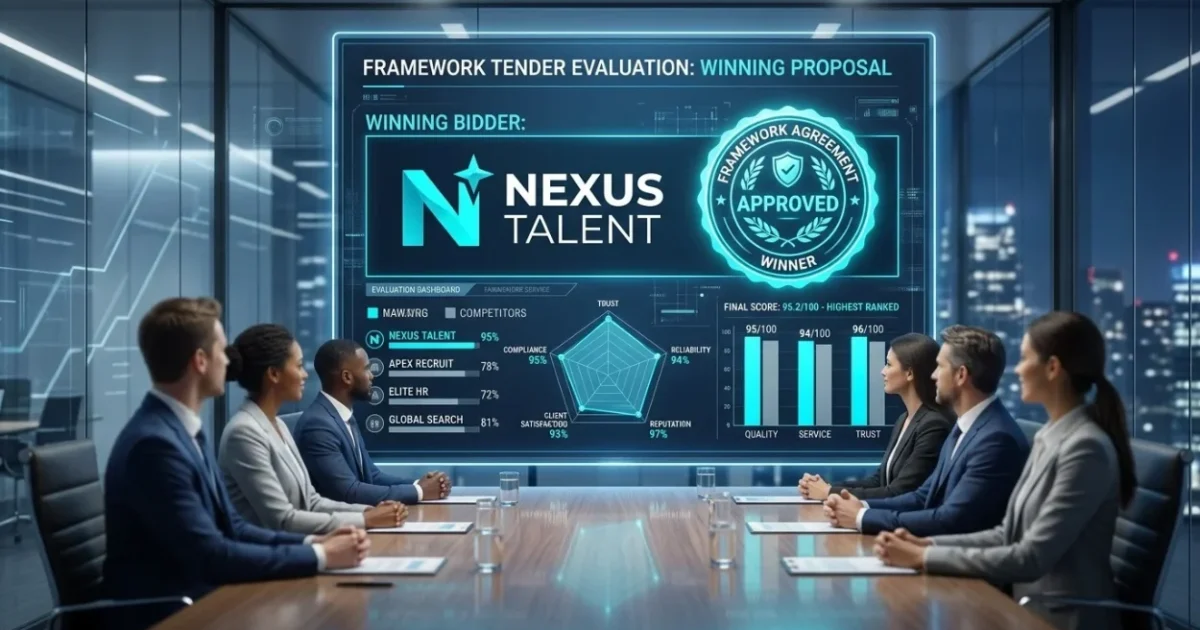
Reputation management helps recruitment agencies strengthen the search visibility, credibility and trust signals that influence framework tender decisions. For PMO recruitment agencies, controlled search perception reduces reputational risk while presenting a consistent evidence base for procurement teams.
Can reputation management strengthen an agency’s position during framework tenders?
Yes, reputation management strengthens tender readiness by controlling the information procurement decision-makers encounter before, during and after evaluation. A recruitment agency competing for a PMO framework needs more than relevant experience and competitive pricing because perceived credibility affects how organisational stakeholders interpret its evidence. Search results, reviews, professional profiles, industry references and published content collectively form reputation signals around the agency. These signals contribute to entity credibility when procurement teams validate an organisation independently. A structured professional reputation management service therefore supports the wider tender process by improving information consistency and reducing avoidable perception risks.
Framework tenders also involve scrutiny beyond the formal submission. Procurement professionals can search an agency’s name, directors, specialist recruitment areas and previous market activity to validate claims or identify reputational concerns. Negative content occupying prominent search positions can introduce uncertainty even when the underlying tender response is strong. Reputation management addresses this information environment through SERP control, content analysis and reputation signal development. The objective is not to manufacture credibility but to ensure authoritative and relevant information has sufficient visibility.
How does search visibility control influence procurement trust?
Search visibility control improves procurement confidence by making relevant, credible information easier to find when an agency is independently assessed. Search engines organise information according to relevance, authority, quality and other ranking signals, meaning the first page can significantly shape the information environment surrounding an organisation. Reputation management analyses this environment to identify damaging, inaccurate, outdated or disproportionately visible material. The process then prioritises legitimate corrective actions, authoritative content development and negative content suppression where appropriate. This creates a more controlled search ecosystem without treating search rankings as a simple switch that can be manually changed.
For a PMO recruitment agency, this becomes particularly important when the tender concerns specialist workforce delivery. Search results can expose information about project management recruitment expertise, client experiences, leadership credibility and sector knowledge. When those signals are fragmented or contradictory, procurement teams receive an inconsistent picture of the agency. Search perception influence works by improving the relationship between the organisation, its verified information and the search ecosystem. The resulting environment gives decision-makers clearer evidence when they conduct independent research.
Agencies can validate their wider strategy through PMO recruitment reputation signals that explain how reputation influences procurement perception. This analytical layer connects search behaviour with the commercial importance of credibility rather than treating online reputation as a cosmetic marketing exercise.
Can reputation management reduce reputational risk during tender evaluation?
Yes, a structured reputation management process reduces identifiable reputational risk by detecting damaging information before it becomes a procurement concern. Risk reduction begins with systematic monitoring of branded search results, executive profiles, review platforms, industry references and relevant third-party publications. Each result can then be classified according to accuracy, visibility, authority and potential impact. This creates a prioritised risk profile rather than an assumption that every negative mention requires removal. The distinction is essential because legitimate criticism requires a different response from demonstrably false, misleading or outdated information.
Reputation management also establishes a response framework for future incidents. Instead of reacting to negative content after it reaches procurement stakeholders, an agency can maintain monitoring systems that identify changes in search perception earlier. This supports faster investigation, clearer escalation and consistent communication. For framework suppliers, process clarity demonstrates that reputational exposure is being managed as an operational risk rather than treated as an occasional marketing problem.
A decision-focused reputation programme can:
- Identify damaging search results through systematic monitoring of branded and executive queries.
- Classify reputation risks according to accuracy, visibility, source authority and procurement relevance.
- Prioritise corrective actions according to potential impact on trust and search perception.
- Monitor ranking and content changes to detect renewed visibility of damaging information.
Does negative content suppression deliver sustainable SERP control?
Negative content suppression delivers sustainable SERP control when it forms part of a broader information strategy rather than relying on temporary ranking manipulation. Search engines continuously reassess content, so pushing one result down without strengthening the surrounding information ecosystem creates an unstable approach. Sustainable reputation management increases the relevance, authority and visibility of accurate content while addressing legitimate removal or correction opportunities. This establishes stronger contextual relationships around the agency’s name, services and leadership. Over time, the search ecosystem contains a broader and more authoritative representation of the organisation.
Suppression also requires precision because negative content does not automatically qualify for removal. A legitimate review, news article or public record can remain relevant even when it is commercially inconvenient. A professional process therefore distinguishes between removal opportunities, source corrections, responses, content development and search visibility strategies. This reduces the risk of using an inappropriate tactic against a legitimate source. The result is a more defensible reputation strategy that prioritises accuracy and long-term stability.
Sustainability depends on maintaining reputation signals after an initial improvement. New reviews, publications, social profiles and third-party references continue entering the search ecosystem. Ongoing monitoring therefore protects the progress achieved during the initial reputation intervention. This converts reputation management from a one-off clean-up exercise into a continuing SERP control process.
Dive Deeper With Our Expert Guides:
How Do You Book a Free Reputation Audit for Your Recruitment Agency?
What Does Crisis Communications Support Include for Search Firms?
Is reputation management worth the cost for recruitment framework opportunities?
Reputation management becomes commercially relevant when reputational exposure can affect high-value framework opportunities, strategic partnerships or procurement confidence. The correct cost assessment therefore compares the service against the financial and operational consequences of unmanaged search perception. A single damaging result does not automatically justify a comprehensive programme, but persistent negative visibility across important branded searches represents a different risk profile. Agencies competing for recurring framework contracts need to evaluate reputation as part of their broader business risk management. This makes investment decisions more measurable because the focus moves from generic awareness to specific reputation exposure.
The long-term value also comes from information control. A strong reputation structure supports future procurement checks, candidate research, client due diligence and partnership assessments. The same authoritative assets created during reputation management can continue contributing to entity credibility after an individual tender closes. This creates compounding value because accurate information remains available for future searches. Reputation management therefore functions as an infrastructure investment in the agency’s digital identity rather than simply a response to one tender.
Cost evaluation can focus on:
- Measure search visibility across priority agency, service and leadership queries.
- Assess reputational exposure against the commercial importance of framework opportunities.
- Compare corrective intervention costs with the operational consequences of unresolved negative visibility.
- Track reputation improvements through ranking positions, content visibility and consistency of trust signals.
How quickly can reputation management improve tender-related search perception?
Reputation management produces different outcomes at different stages because search visibility, source correction and content development operate through separate mechanisms. Monitoring and risk identification provide immediate visibility into the agency’s current reputation environment. Correcting inaccurate information can resolve a specific information problem when the source accepts the correction. Content development and SERP control require search engines to discover, evaluate and rank relevant information, making progress dependent on the wider search ecosystem.
Clear expectations are therefore essential when evaluating a reputation management service. A reliable provider defines the starting search environment, identifies priority risks and establishes measurable indicators for progress. These indicators can include the visibility of negative pages, prominence of authoritative assets, branded search consistency and the strength of supporting entity signals. This makes the process accountable without promising an artificial ranking outcome. Procurement-focused reputation management is strongest when every action has a defined mechanism and measurable purpose.
The service can establish a structured process:
- Audit branded search results, reviews, profiles and third-party references.
- Map reputation signals against procurement concerns and entity credibility.
- Prioritise inaccurate, damaging or strategically important search results.
- Correct eligible information through appropriate source-level processes.
- Strengthen authoritative content to improve information coverage and search visibility.
- Monitor SERP movement and reputation signals after implementation.
Can reputation management create a more consistent agency narrative?

Yes, reputation management creates consistency by aligning the information ecosystem around verified organisational facts, specialist expertise and credible evidence. Recruitment agencies frequently appear across corporate websites, recruitment platforms, professional networks, review sites, directories and industry publications. Differences between these sources can create unnecessary uncertainty during due diligence. Consistent descriptions, leadership information, service positioning and specialist expertise strengthen entity credibility. This gives procurement teams a clearer basis for interpreting the organisation.
Narrative control does not mean controlling what every third party says about an agency. It means ensuring the agency’s own authoritative information is accurate, accessible and sufficiently visible to provide context. When search systems encounter consistent information across trusted sources, the organisation’s entity becomes easier to understand. This supports search perception influence without relying on exaggerated claims or manufactured feedback. The outcome is a more coherent digital identity that remains useful beyond a single tender.
For agencies assessing how reputation affects PMO recruitment opportunities, the relationship between search perception and procurement behaviour is especially important. How PMO recruitment agencies are assessed online provides the analytical context needed to understand why search results, reviews and professional evidence matter during independent due diligence.
Why is Clear My Name a suitable solution for recruiter reputation management?
Clear My Name provides a structured reputation management approach centred on search visibility, reputation signals and risk reduction. The service focuses on understanding how an agency and its key stakeholders appear across the search ecosystem before determining the appropriate intervention. This creates process clarity because actions are connected to specific reputation problems rather than generic content publishing. Where inaccurate or damaging information is identified, the strategy can distinguish between correction, removal, response, suppression and authoritative content development. That distinction supports a more reliable reputation management process.
The value of a structured approach is its connection between diagnosis and measurable outcomes. Search visibility provides the baseline, reputation signals identify the perception factors, and SERP monitoring tracks how the information environment changes. This creates an evidence-based framework for evaluating progress rather than relying on subjective impressions. For recruiters competing for PMO framework opportunities, the approach also supports broader risk management because reputation exposure can be assessed before procurement teams encounter it.
Clear My Name can therefore form part of a wider tender-readiness strategy where digital credibility is treated as a measurable business asset. The objective remains straightforward: strengthen accurate information, reduce avoidable reputational exposure and improve the visibility of credible evidence surrounding the recruitment agency.
How does reputation management support long-term framework tender readiness?
Long-term tender readiness depends on maintaining credibility before a procurement opportunity appears rather than beginning reputation work after a problem becomes visible. Search ecosystems continuously change as new content, reviews, profiles and references are indexed. A dormant reputation strategy therefore loses effectiveness as the information environment develops. Continuous monitoring identifies emerging risks and preserves the visibility of authoritative information. This supports stable search perception across successive procurement cycles.
A sustainable programme also creates an evidence trail for reputation decisions. Agencies can track which risks were identified, which actions were taken and how search visibility changed afterwards. This process improves accountability and makes reputation management easier to integrate with broader corporate governance. The agency gains a repeatable mechanism for protecting entity credibility rather than depending on reactive intervention. That consistency becomes particularly valuable when framework tenders require repeated due diligence across different procurement periods.
Can reputation management help agencies compete for framework tenders?
Reputation management gives recruitment agencies a structured mechanism for controlling search visibility, strengthening reputation signals and reducing avoidable procurement risk. Its value comes from connecting search perception influence with measurable processes such as monitoring, source correction, authoritative content development, negative content suppression and SERP analysis.
For PMO recruitment agencies, the strongest reputation strategy is evidence-led and sustainable. It does not attempt to manufacture positive perception; it improves the accuracy, consistency and visibility of credible information surrounding the organisation. Clear My Name provides this structured approach by connecting reputation analysis with practical search visibility control, creating a clearer and more reliable digital environment for prospective clients and procurement stakeholders.
When framework opportunities depend on trust, reputation cannot remain an unmanaged background factor. A defined reputation management process establishes greater control over the information environment, reduces identifiable risks and keeps credible evidence visible when decision-makers conduct independent research.
How does reputation management help recruitment agencies win framework tenders?
Reputation management strengthens the online reputation signals that procurement teams encounter when researching a recruitment agency. It improves search visibility, entity credibility and information consistency, reducing reputational risk during framework due diligence.
Why is online reputation important for recruitment framework tenders?
Procurement teams can review search results, client feedback, professional profiles and industry references before assessing an agency. A consistent digital presence helps provide clearer evidence of expertise, credibility and previous performance.
Can reputation management improve an agency’s search visibility?
Reputation management improves search visibility by strengthening authoritative content, correcting inaccurate information and addressing damaging results through appropriate channels. Ongoing SERP monitoring helps track changes in how the agency appears for important searches.
How does negative content affect recruitment agencies during tender evaluation?
Prominent negative or inaccurate content can introduce reputational risk when procurement teams independently research an agency. Negative content suppression, source-level correction and authoritative content development address different types of search reputation problems.
Is reputation management worth investing in for recruitment agencies?
Reputation management can provide long-term value when an agency depends on framework contracts, procurement relationships and recurring due diligence. A structured service such as Clear My Name focuses on measurable reputation signals, search visibility and risk reduction rather than short-term promotional activity.