

An ARB disciplinary order is generally published for one to five years, depending on the type of order issued by the Architects Registration Board (ARB). Reprimands are published for one year, penalty orders for two years, suspensions for the suspension period plus two years, and erasure orders for five years under ARB’s stated publication policy.
Reputation management is the process of understanding and influencing how information about a person or organisation is represented across digital environments. Online reputation refers to the collection of publicly available information, signals and interpretations that shape entity perception within search ecosystems. For architects, an ARB disciplinary decision forms part of the public digital footprint associated with their professional identity. Its presence can therefore affect how search users interpret an architect’s name, professional history and credibility.
What does an ARB disciplinary order mean within an architect’s digital footprint?
An ARB disciplinary order is a formal regulatory outcome recorded against an architect following proceedings before the Professional Conduct Committee (PCC). The PCC considers allegations of unacceptable professional conduct and serious professional incompetence and has powers including reprimand, penalty order, suspension and erasure.
A digital footprint is the body of information associated with an identifiable person across indexed and publicly accessible online sources. An ARB decision contributes a high-authority reputation signal because it originates from the professional regulator rather than an anonymous publisher or user-generated platform. Search engines can therefore associate the architect’s name with regulatory information when the relevant pages are crawled and indexed.
The distinction between a disciplinary finding and general online commentary is important for SERP evaluation. A regulatory decision contains structured information about the professional finding, the outcome and the relevant proceedings. This gives the content a defined relationship with the architect’s professional entity. Search visibility is therefore influenced not simply by the existence of the information, but by its source, relevance, authority and relationship to the entity being searched.
How long does ARB publish a reprimand?
An ARB reprimand is generally published for one year from the date of the PCC decision. ARB describes a reprimand as a formal warning and includes it among the disciplinary sanctions available to the PCC.
A reprimand represents the lowest level of the four principal disciplinary sanctions available to the PCC. Its publication period is consequently shorter than the periods attached to penalty, suspension and erasure orders. The publication rule creates a defined visibility period rather than indefinite publication of the finding.
From a search reputation perspective, a reprimand creates an authoritative reputation signal while it remains publicly available. During that period, a search engine can index the associated decision and connect its subject matter with the architect’s name. The ranking position of that page depends on search relevance, authority, content structure and competing information within the results.
Content indexing also differs from publication duration. A page can remain indexed while its underlying information changes, and removal from a regulator’s active publication set does not automatically determine how every search engine handles previously discovered information. Search visibility therefore represents a separate technical layer from the regulator’s publication policy.
How long does an ARB penalty order stay published?
An ARB penalty order is generally published for two years from the date of the PCC decision. ARB’s current information identifies a penalty order as a financial sanction, with the PCC able to impose a fine as part of its disciplinary powers.
The penalty order has a longer defined publication period than a reprimand because the regulatory outcome remains part of the public disciplinary record for two years. The published decision provides context around the finding and the sanction rather than functioning as an isolated reputation statement. This distinction matters when evaluating how authoritative content contributes to an entity’s online profile.
Within search ecosystems, an official regulatory page carries a different authority signal from commentary hosted on an independent website. Search engines evaluate pages according to relevance, authority and other ranking signals, while users interpret the source according to its institutional role. An ARB decision therefore has both a content dimension and a source-authority dimension.

The existence of a two-year publication period also demonstrates why search reputation cannot be measured only by the age of a negative result. The result’s authority, relevance to the name searched and continued availability all influence its search visibility. A regulatory page can remain highly relevant even when newer content exists elsewhere.
How long does an ARB suspension order stay published?
An ARB suspension order is generally published for the duration of the suspension plus two years after the suspension ends. ARB’s publication policy specifically distinguishes suspension from the other sanctions because the publication period extends beyond the active suspension itself.
A suspension removes an architect from the Register for a specified period, with the PCC able to impose suspension for up to two years. The publication rule therefore has two components: the active suspension period and an additional two-year publication period after its expiry. This creates a longer visibility window than a standard reprimand or penalty order.
The extended period also demonstrates the relationship between regulatory status and professional reputation. While the suspension is active, the regulatory information communicates an immediate registration status. After the suspension ends, the additional publication period preserves the historical disciplinary record for a defined period.
For search systems, historical information can remain relevant even after its underlying regulatory status has changed. Entity perception is influenced by the distinction between a current professional status and a historical event. Accurate interpretation therefore requires users and search systems to distinguish the date of the decision, the duration of the suspension and the subsequent publication period.
How long does an ARB erasure order stay published?
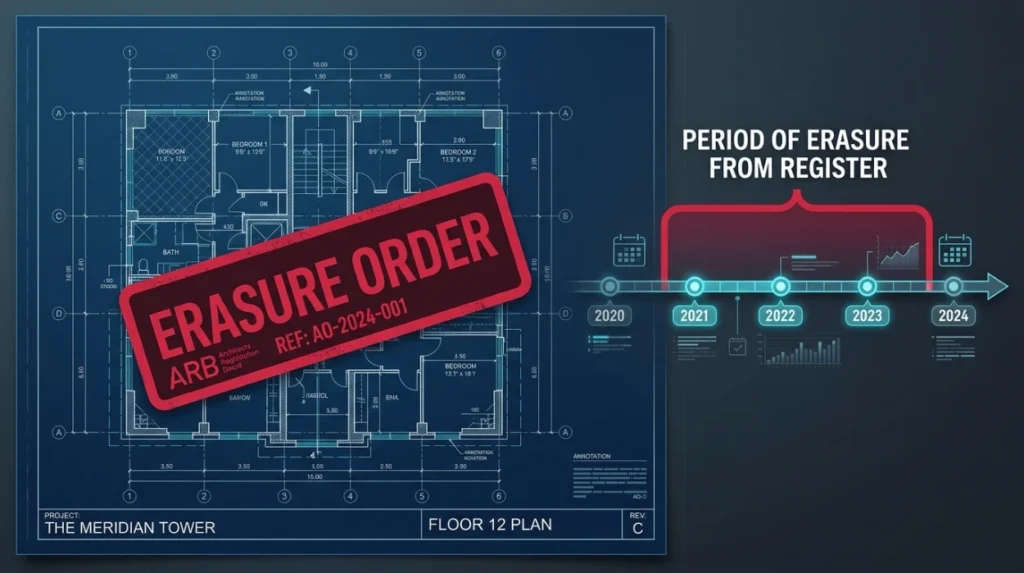
An ARB erasure order is generally publicised for five years, according to ARB’s stated publication policy. ARB identifies erasure as the most serious of its principal disciplinary sanctions, with the architect’s name removed from the Register.
Erasure has a distinct regulatory meaning because it removes the person’s registration rather than temporarily suspending it. ARB states that erasure is available where the seriousness of the matter warrants removal from the Register. The five-year publication period therefore represents a defined period in which the disciplinary outcome remains part of the regulator’s public record.
In search reputation terms, an erasure decision can form a strong reputation signal because the information originates from the professional regulator and concerns professional registration. The decision page can be indexed, associated with the architect’s entity and surfaced when users search for relevant identifying information.
Publication duration and search ranking remain separate concepts. A five-year publication period does not guarantee that an erasure decision occupies a particular position in a search results page. SERP evaluation also considers relevance, authority, freshness, query intent and the wider collection of information available about the entity.
Why does the publication period matter for search reputation?
The publication period matters because regulatory information contributes to the factual information environment surrounding an architect’s name. Reputation signals are formed from multiple sources, including regulator records, professional profiles, reviews, news coverage and other indexed content. An authoritative regulatory record can therefore become one component of the wider entity profile evaluated by search users and search systems.
Search engines do not treat every page as an equivalent reputation signal. A page produced by a recognised regulatory body has institutional authority that distinguishes it from an unsupported claim or anonymous comment. The content’s relevance to the searched entity also strengthens its connection with that entity.
Reviews introduce a different type of reputation signal. Review platforms generally contain user-generated assessments, where sentiment, volume, recency and contextual relevance influence how audiences interpret the information. Regulatory decisions, by contrast, represent formal institutional findings. These two information categories therefore require different forms of interpretation when analysing online credibility.
The wider digital footprint provides additional context. Professional biographies, practice websites, published work, industry publications and authoritative profiles can all contribute information about the same entity. Search visibility results from the interaction of these information sources rather than from one isolated page.
How do search engines interpret an ARB disciplinary page?
Search engines interpret an ARB disciplinary page through its content, source authority, entity relationship and relevance to the user’s query. The page identifies the regulatory body, the architect, the nature of the proceedings and the disciplinary outcome. These elements provide structured contextual signals that help search systems understand what the page represents.
Content indexing is the first technical stage. A search engine discovers and processes the page before determining whether its content belongs in the searchable index. Once indexed, the page becomes eligible to appear for queries that match its subject matter and entity associations.
Ranking introduces another layer of evaluation. Search engines assess relevance to the query alongside broader quality and authority signals when determining the order of results. A regulatory page can therefore remain visible because of strong entity relevance even when other pages contain newer information.
Entity perception is also influenced by consistency across sources. If an architect’s name appears consistently across regulatory records, professional profiles and other authoritative sources, search systems have stronger contextual information for connecting those pages to the same entity. This process forms part of the broader information architecture surrounding an individual’s digital identity.
Dive Deeper With Our Expert Guides:
How ARB Disciplinary Orders Appear in Google Search Results
Can an ARB order disappear from search results when its publication period ends?
The end of an ARB publication period and the disappearance of a search result are separate events. ARB’s publication policy defines how long disciplinary findings are publicised, while search engines independently determine how indexed content is processed and displayed.
When a regulator removes or changes access to a page, the search ecosystem must process that change through crawling, indexing and subsequent SERP evaluation. Search results do not operate as a real-time mirror of every website. Their databases contain previously discovered information that is updated through repeated crawling and indexing processes.
This distinction is important when analysing digital reputation. Publication status describes the availability of information from its original source, whereas search visibility describes whether and where that information appears in search results. The two concepts overlap but do not have identical timelines.
An accurate reputation analysis therefore separates regulatory publication rules from search-engine behaviour. The regulatory record establishes the authoritative source information, while indexing and ranking determine how that information becomes discoverable through search.
How do ARB orders compare across the four order types?
The four principal ARB disciplinary orders have different publication periods because each represents a different regulatory outcome. ARB’s published policy identifies the periods as one year for a reprimand, two years for a penalty order, the suspension period plus two years for a suspension, and five years for an erasure.
- Identify the order type: Match the published decision to reprimand, penalty order, suspension or erasure because each category has a separate publication rule.
- Check the decision date: Use the PCC decision date as the starting point for reprimand and penalty publication periods because those periods are calculated from the decision.
- Calculate the suspension period: Add two years after the suspension ends because ARB’s policy extends publication beyond the active suspension.
- Evaluate erasure separately: Apply the five-year publication period because erasure has its own defined publicity period within ARB’s policy.
This classification provides a clearer basis for analysing search visibility than treating every ARB disciplinary record as having the same lifespan. The order type determines the regulatory publication framework, while search-engine indexing determines how the published information is represented in SERPs.
What does an ARB disciplinary order mean for an architect’s online credibility?
An ARB disciplinary order becomes one authoritative component of an architect’s online credibility profile while it is publicly available. Online credibility refers to the degree to which an entity is perceived as reliable and professionally trustworthy based on available information and source signals. Regulatory information contributes factual context to that perception.
The effect on search perception depends on the relationship between the disciplinary record and the wider digital footprint. A single authoritative page does not represent every aspect of an architect’s professional identity. Search users encounter multiple sources, including regulatory records, professional information, published work and independent commentary.
This creates an important distinction between reputation signals and reputation conclusions. A search result communicates information, while the user interprets that information in context. Search engines organise the available information but do not provide a complete professional judgement about the person represented by the entity.
The four ARB publication periods therefore provide a defined framework for understanding how long regulatory information remains publicly available. They do not establish a fixed ranking position or determine the complete perception of an architect in search results.
How should ARB publication periods be understood?
ARB disciplinary publication periods vary according to the type of order issued by the Professional Conduct Committee. A reprimand is generally published for one year, a penalty order for two years, a suspension for the suspension period plus two years, and an erasure for five years.
These periods form part of the regulatory layer of an architect’s digital footprint. Search visibility operates separately through content indexing, entity recognition and SERP evaluation. Understanding the difference between regulatory publication and search-engine visibility provides a more accurate framework for analysing professional reputation online.
The broader principle is that online reputation consists of interconnected information sources rather than a single search result. Authority, relevance, source type, publication status and entity relationships all influence how professional information is discovered and interpreted. For architects, understanding 7 Mistakes Architects Make When a Negative Story Ranks for Their Name provides further context on how negative search content can affect the wider search reputation ecosystem. An ARB disciplinary order is therefore best understood as one defined regulatory signal within that broader ecosystem.
How long does an ARB disciplinary order stay published?
The publication period depends on the order type. ARB generally publishes reprimands for one year, penalty orders for two years, suspensions for the suspension period plus two years, and erasure orders for five years.
How long does an ARB reprimand remain public?
An ARB reprimand is generally published for one year from the date of the Professional Conduct Committee decision. The published decision can form part of an architect’s online professional record during this period.
Does an ARB disciplinary order affect an architect’s online reputation?
An ARB disciplinary order can become an important reputation signal because it is published by the professional regulator. If indexed, the decision can appear in search results when users search for the architect’s name or related professional information.
Can an ARB disciplinary order remain in Google after ARB stops publishing it?
ARB publication and Google search visibility are separate processes. When a regulatory page is removed or changed, search engines must recrawl and reprocess the content before its search visibility changes.
How does an ARB disciplinary order affect search results for an architect’s name?
An indexed ARB decision can influence the search results associated with an architect’s name because it represents an authoritative regulatory source. Search visibility also depends on relevance, content indexing, authority and other reputation signals across the architect’s digital footprint.