

Detecting and debunking deepfakes targeting political figures depends on evaluating digital authenticity, source authority, reputation signals, and search visibility across interconnected search ecosystems. Effective approaches differ because search engines assess credibility through multiple trust indicators rather than individual pieces of content.
Reputation management strategies differ based on the origin of manipulated content, the strength of existing authority signals, and the methods used to reinforce entity credibility. Online reputation control methods are evaluated through search ranking influence, content indexing, sentiment distribution, semantic relevance, and digital trust. Search engines continuously compare authoritative evidence with newly indexed information before adjusting search visibility. Different reputation management approaches therefore create different outcomes because they strengthen reputation signals through distinct mechanisms. Evaluating these approaches provides a structured understanding of how search perception changes after deepfake distribution.
Which detection approach provides the strongest evidence of manipulated content?
Multi-source verification provides the strongest evidence because it compares visual, textual, technical, and contextual information before establishing authenticity. Search ecosystems reward reliable verification supported by recognised authority.
Multi-source verification is the process of evaluating suspected media against official publications, trusted news reporting, metadata, and recognised fact-checking resources. Search engines analyse these authoritative references when assessing credibility and relevance. Independent confirmation from multiple trusted sources strengthens entity credibility because factual consistency reinforces algorithmic confidence. Technical analysis alone identifies manipulation, while broader verification establishes contextual reliability. This comparison demonstrates that comprehensive evidence provides stronger reputation signals than isolated technical detection.
How does multi-source verification influence search ecosystems?
Multi-source verification operates by strengthening authoritative information available for search engine evaluation. Every verified publication contributes additional semantic evidence that improves entity understanding.
Search algorithms compare verified resources with manipulated material before adjusting rankings. Consistent factual reporting reinforces trust because recognised authorities support identical conclusions. This process improves search perception through stronger authority signals and more balanced SERP composition.
How does technical detection compare with contextual analysis?
Technical detection identifies digital manipulation through forensic examination, whereas contextual analysis evaluates credibility through source relationships, publication history, and semantic consistency. Both approaches contribute to reputation management through different mechanisms.
Technical detection examines visual artefacts, audio inconsistencies, metadata, compression patterns, and AI-generated anomalies. Contextual analysis compares publication timing, source authority, narrative consistency, and factual alignment across trusted information networks. Technical evidence establishes whether manipulation exists, while contextual evaluation determines how search engines interpret credibility. Technical detection therefore supports authenticity, whereas contextual analysis strengthens broader entity credibility.
Which approach delivers greater long-term value?
Contextual analysis delivers greater long-term value because search engines prioritise authoritative evidence, semantic relationships, and trusted citations when evaluating reputation signals. Verified contextual information remains relevant throughout future indexing cycles.
Technical detection remains essential for identifying manipulated content, yet forensic evidence alone does not reshape search perception. Sustainable online credibility develops through authoritative contextual information that strengthens trust across search ecosystems.
How do proactive and reactive reputation strategies compare?
Proactive reputation strategies establish authority before misinformation appears, whereas reactive strategies strengthen reputation after manipulated content enters the search ecosystem. These approaches differ because they address different stages of search perception development.
Proactive strategies expand authoritative content, maintain entity consistency, improve digital footprints, and strengthen trust signals continuously. Search engines interpret these activities as evidence of stable expertise and reliable identity relationships. Reactive strategies evaluate reputation risks before introducing stronger authoritative information that improves search visibility and semantic relevance. Both approaches influence search perception, although proactive authority building creates stronger resilience before misinformation receives widespread indexing.
How do search engines evaluate proactive and reactive methods?
Search engines evaluate proactive activity through consistent publication patterns, structured entity information, and recognised authority. Continuous optimisation strengthens algorithmic confidence because evidence accumulates over time.
Reactive activity introduces new reputation signals into an existing search environment where historical content already contributes authority. Search engines reassess these relationships progressively before modifying rankings, creating gradual changes in search visibility.
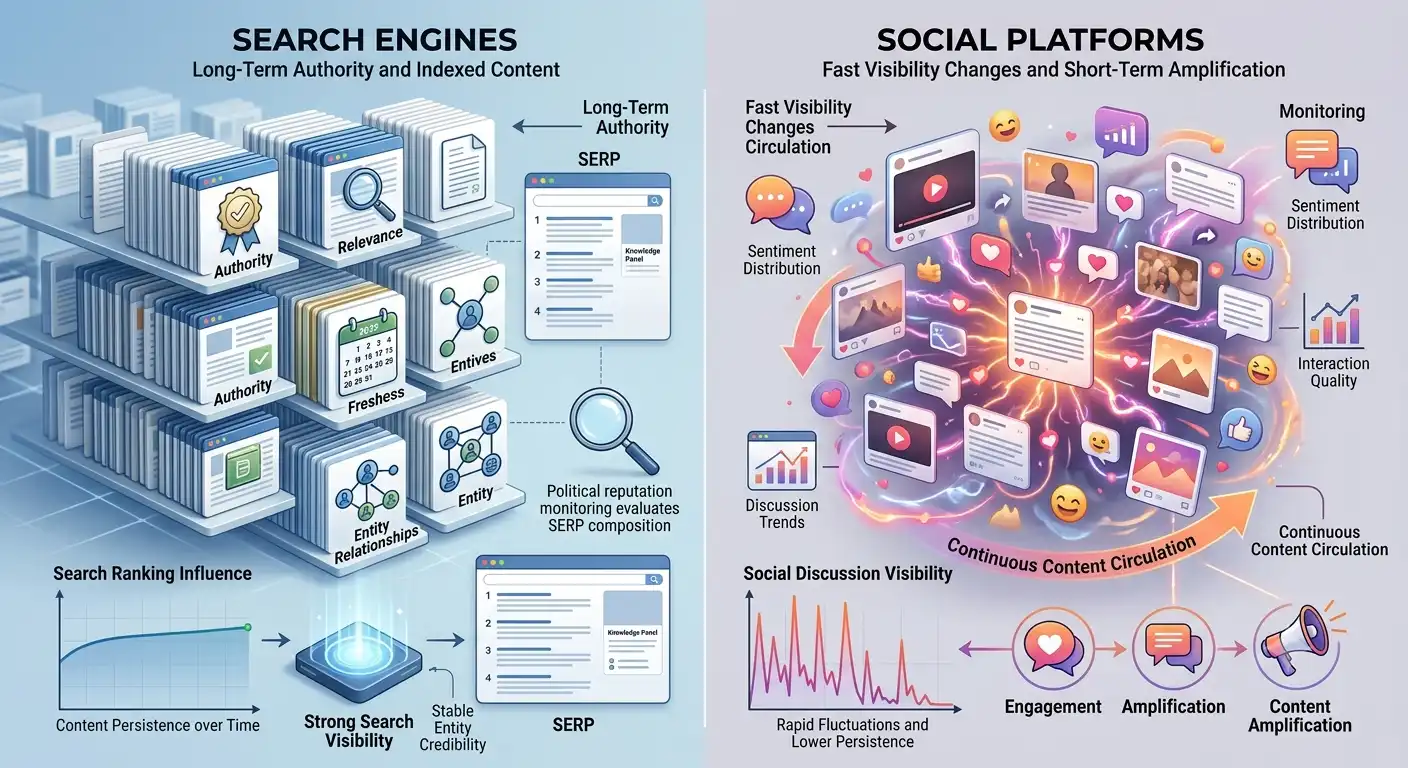
Which reputation signals carry the greatest search ranking influence?

Authoritative content, trusted citations, entity consistency, semantic relevance, and verified information carry the greatest search ranking influence because search engines evaluate these indicators collectively when determining credibility.
Authoritative publications strengthen topical expertise through comprehensive factual reporting. Trusted citations reinforce reliability because recognised organisations validate the same information independently. Entity consistency aligns structured data across digital platforms, improving algorithmic understanding. Semantic relevance expands contextual authority, while verified information strengthens trust signals by reducing uncertainty. Together these reputation signals influence search visibility more effectively than isolated optimisation activities.
Why does semantic relevance strengthen online credibility?
Semantic relevance refers to the contextual relationship between information, user intent, and recognised knowledge domains. It operates by expanding search engine understanding through interconnected authoritative resources.
Search algorithms evaluate semantic relationships to determine whether content demonstrates recognised expertise across related subjects. Broader topical authority strengthens entity credibility because search systems identify stronger contextual evidence supporting trusted information. Semantic relevance therefore improves long-term search perception while reinforcing digital trust.
How does verified content compare with content suppression?
Verified content strengthens reputation through authoritative evidence, whereas content suppression reduces the comparative visibility of misleading information by increasing the prominence of stronger resources. These methods operate through different mechanisms within search ecosystems and produce different long-term outcomes.
Verified content refers to factual information supported by recognised authorities, official records, and reliable publications. Search engines evaluate this information as evidence of entity credibility because it aligns with trusted sources across the web. Content suppression operates by improving the ranking influence of authoritative resources so that misleading or less relevant content becomes comparatively less visible within search engine results pages. Verified information continuously expands semantic authority, while content suppression primarily changes relative visibility. This comparison demonstrates that verified content provides stronger long-term sustainability because it increases the quantity and quality of trusted reputation signals.
Which method provides greater sustainability?
Verified content provides greater sustainability because authoritative information remains valuable throughout future indexing and ranking updates. Search engines repeatedly evaluate factual consistency, semantic relevance, and source authority when determining long-term visibility.
Content suppression remains effective for reducing the prominence of misleading material, yet its performance depends on the authority of competing content. Sustainable search perception therefore develops through continuous publication of trustworthy information rather than visibility adjustments alone.
Dive Deeper With Our Expert Guides:
Protecting the Online Privacy of a Politician’s Family Members
How to Prepare a Voting-Record Response Before Election Season
How do short-term and long-term reputation strategies differ?
Short-term reputation strategies address immediate search visibility challenges, while long-term strategies strengthen entity credibility through continuous authority development. Search engines evaluate both approaches according to the durability of reputation signals.
Short-term methods prioritise rapid publication of verified information, factual clarification, and correction of inaccurate digital references. Long-term methods expand topical authority through consistent publishing, trusted citations, structured entity optimisation, and ongoing digital footprint management. Search ranking influence becomes increasingly stable as authoritative resources accumulate across multiple indexing cycles. Long-term strategies therefore deliver stronger resilience because they continuously reinforce digital trust within search ecosystems.
How does indexing influence long-term credibility?
Content indexing determines when newly published authoritative resources become available for algorithmic evaluation. Search engines reassess indexed information continuously before modifying SERP composition.
Frequent indexing enables search systems to recognise stronger reputation signals more efficiently, yet ranking adjustments remain dependent on authority, semantic relevance, and factual consistency. Stable online credibility therefore develops through sustained publication of verified resources.
How can detection and debunking strategies be evaluated objectively?
Detection and debunking strategies are evaluated through measurable indicators that demonstrate improvements in search visibility, entity credibility, reputation signals, and authority. Objective evaluation relies on observable search ecosystem performance rather than subjective interpretation.
A structured evaluation framework includes:
- Measure search visibility by monitoring the prominence of authoritative information across relevant search queries.
- Analyse sentiment distribution by comparing changes in verified discussions, news coverage, and public commentary.
- Evaluate entity consistency by reviewing structured information across official websites, biographies, and recognised databases.
- Assess authority signals by measuring trusted citations, semantic relevance, and topical expertise.
- Monitor indexing performance by confirming that verified resources are consistently discovered and evaluated by search engines.
These indicators provide measurable evidence showing how reputation signals evolve as authoritative information becomes more prominent.
Which strategic combination creates the strongest reputation outcome?
A combined strategy creates the strongest reputation outcome because search engines evaluate interconnected authority signals rather than isolated optimisation activities. Verified information, contextual analysis, entity consistency, and semantic authority reinforce one another throughout search ecosystems.
Technical detection establishes whether manipulation exists, while contextual verification strengthens credibility through trusted evidence. Verified content expands semantic authority, whereas proactive digital footprint optimisation reinforces stable entity relationships. Discussions surrounding Detect and Counter Political Deepfakes With Clear My Name frequently examine how combining verification, authority building, and reputation signal optimisation produces stronger long-term search visibility than relying on a single detection technique. Integrating complementary approaches therefore improves search ranking influence while reducing the impact of manipulated information across evolving search environments.
Detecting and debunking deepfakes targeting political figures requires evaluating multiple reputation management approaches that strengthen authority, improve entity credibility, and reinforce trustworthy reputation signals. Technical detection, contextual verification, verified content, semantic authority, and digital footprint optimisation each influence search perception through different mechanisms. Long-term search visibility develops through sustained authority building, factual consistency, trusted citations, and continuous evaluation of reputation signals rather than isolated corrective actions. Understanding the comparative strengths and limitations of these approaches provides a structured framework for analysing how search engines interpret credibility and maintain reliable entity perception over time.
How can deepfakes targeting political figures be detected?
Deepfakes targeting political figures can be detected by analysing video and audio inconsistencies, verifying metadata, comparing information with authoritative sources, and reviewing trusted fact-checking resources. These methods strengthen reputation signals and improve confidence in verified information.
Why is it important to debunk political deepfakes quickly?
Promptly debunking political deepfakes limits the spread of manipulated content across search engines and digital platforms. Early verification also helps preserve entity credibility, improve search visibility, and reinforce trust signals.
How do search engines evaluate deepfake-related content?
Search engines evaluate deepfake-related content by analysing authority, factual consistency, source credibility, semantic relevance, and reputation signals. Verified information from trusted sources carries greater search ranking influence than unsupported or misleading content.
How does reputation management for politicians reduce the impact of deepfakes?
Reputation management for politicians improves authoritative content, strengthens entity consistency, enhances digital trust, and reinforces verified reputation signals. These strategies help search engines present more accurate information within search engine results pages (SERPs).
What role does digital trust play in protecting political reputation?
Digital trust is established through verified information, authoritative citations, consistent entity data, and reliable online content. Clear My Name supports reputation management for politicians by strengthening these trust signals and improving long-term online credibility.