

Reputation management is the structured process of influencing how individuals, organisations, and entities are interpreted within search ecosystems through content, signals, and visibility control.
Online reputation refers to the aggregated perception formed from indexed information, ranking signals, and user-generated content across search engine results pages (SERPs).
It operates as a semantic system where search engines evaluate trust, relevance, and authority to construct an entity-level reputation profile that determines what users see first.
What is online reputation and how does it form in search ecosystems?
Online reputation is the search-based identity constructed from indexed digital content associated with a person, brand, or organisation. It refers to how search engines interpret entity credibility through structured and unstructured data. This reputation forms through continuous content discovery, indexing, and ranking across SERPs.
Search ecosystems build reputation by connecting mentions, articles, profiles, and reviews into an entity graph. Each digital reference contributes to how an entity is understood in semantic search. The system evaluates consistency, context, and topical alignment across multiple sources.
How search engines construct entity perception
Search engines define entity perception through structured interpretation of web content and contextual relationships.
- Indexing identity signals captures names, mentions, and associations across web pages
- Mapping entity relationships connects people, brands, and organisations through semantic links
- Evaluating content relevance measures topical alignment across indexed documents
This process builds a unified representation of online reputation that influences search visibility and SERP composition.
Why entity-based understanding matters
Entity-based search models transform isolated content into structured meaning. This means reputation no longer depends on single pages but on aggregated information networks. Search engines evaluate coherence across the entire digital footprint, creating a stable perception profile.
How do search engines evaluate and rank reputation signals in SERPs?
Search engines evaluate reputation signals by analysing authority, consistency, engagement patterns, and semantic relevance within indexed content. SERP ranking systems prioritise sources that demonstrate credibility alignment across multiple trust indicators.
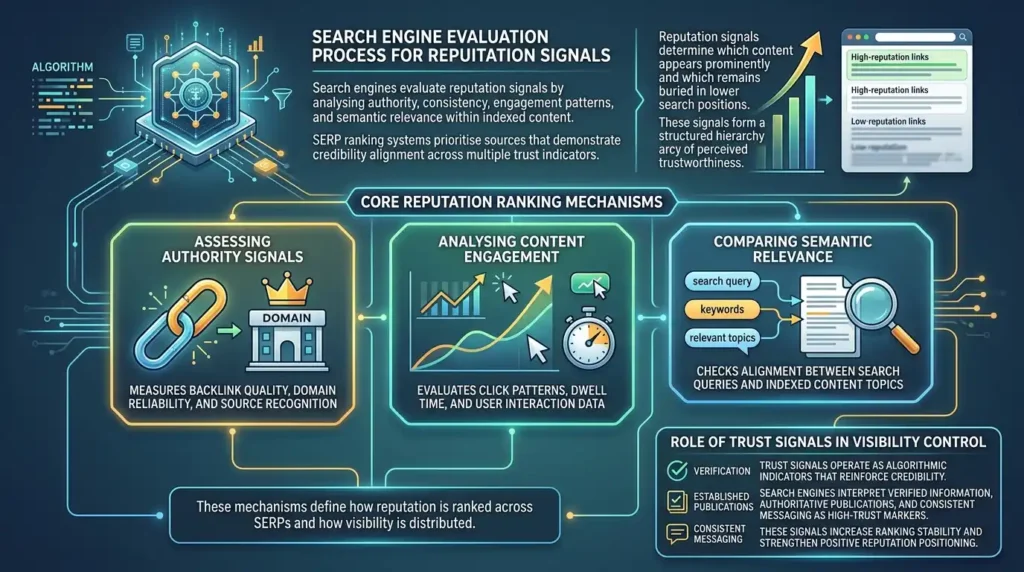
Reputation signals determine which content appears prominently and which remains buried in lower search positions. These signals form a structured hierarchy of perceived trustworthiness.
Core reputation ranking mechanisms
- Assessing authority signals measures backlink quality, domain reliability, and source recognition
- Analysing content engagement evaluates click patterns, dwell time, and user interaction data
- Comparing semantic relevance checks alignment between search queries and indexed content topics
These mechanisms define how reputation is ranked across SERPs and how visibility is distributed.
Role of trust signals in visibility control
Trust signals operate as algorithmic indicators that reinforce credibility. Search engines interpret verified information, authoritative publications, and consistent messaging as high-trust markers. These signals increase ranking stability and strengthen positive reputation positioning.
What causes negative search results to appear in Google indexing systems?
Negative search results appear when low-authority, high-engagement, or sentiment-heavy content becomes indexed and gains visibility through ranking signals. These results form part of the broader reputation dataset used by search engines.
Negative content does not exist in isolation; it becomes amplified when engagement signals and external references reinforce its visibility.
Mechanisms behind negative result formation
- Indexing user-generated content captures reviews, forum discussions, and social commentary
- Amplifying high-engagement pages increases visibility of emotionally charged or controversial content
- Reinforcing outdated information maintains older content in SERPs due to historical authority signals
Each mechanism contributes to the persistence of negative search outcomes.
Why negative content ranks in SERPs
Search algorithms prioritise relevance and engagement over sentiment. Content that attracts interaction often gains ranking strength regardless of tone. This creates visibility for negative information when it generates consistent user attention.
How is digital footprint structured and interpreted by entity-based search models?
Digital footprint refers to the total collection of indexed data associated with an entity across the internet. It includes published content, mentions, citations, profiles, and structured metadata that define online presence.
Search engines interpret digital footprints as interconnected data clusters that define entity reputation and topical authority.
Components of a digital footprint
- Published content archives store articles, blogs, and web pages tied to an entity
- External mentions and citations connect third-party references across domains
- Structured profile data consolidates verified identity information from authoritative sources
These components collectively shape how reputation is evaluated in search systems.
How semantic models interpret footprint structure
Entity-based models analyse relationships between digital signals rather than isolated pages. They identify consistency across platforms and evaluate how often an entity is referenced in authoritative contexts. This creates a structured reputation map that influences SERP outcomes.
How do content removal and de-indexing mechanisms influence search visibility?

Content removal and de-indexing mechanisms reduce search visibility by eliminating or restricting access to indexed pages within search engines. These processes alter the composition of SERPs by removing specific data points from the ranking system.
De-indexing does not delete content from the internet but removes it from search engine databases.
How de-indexing systems operate
- Removing indexed URLs eliminates pages from search engine databases
- Updating crawl directives instructs search engines to exclude specific content
- Re-evaluating indexing status reassesses whether content remains relevant for SERPs
These mechanisms directly influence which information appears in search results.
Impact on reputation visibility
When content is removed from indexing systems, its contribution to entity reputation decreases. This changes the balance of search signals, allowing alternative content to gain prominence in SERP rankings.
How does sentiment and review data affect perceived trust and authority online?
Sentiment and review data influence perceived trust by signalling public evaluation of an entity across digital platforms. Search engines analyse aggregated sentiment patterns to understand reputation polarity and authority strength.
Review ecosystems contribute structured behavioural data that informs ranking systems and entity interpretation.
How sentiment is processed in search systems
- Analysing review polarity categorises feedback into positive, neutral, or negative classifications
- Aggregating sentiment patterns identifies dominant perception trends across platforms
- Correlating sentiment with authority signals links public opinion with credibility metrics
These processes shape how reputation is algorithmically understood.
Why review signals matter for SERPs
Review data acts as a behavioural trust indicator. High-volume positive sentiment reinforces credibility, while sustained negative sentiment reduces perceived authority. Search systems integrate this data into ranking evaluations and entity profiling.
How do reputation signals evolve over time within search ranking systems?
Reputation signals evolve through continuous updates in indexing, content creation, and user engagement patterns. Search engines recalibrate entity profiles as new data enters the system, adjusting SERP composition accordingly.
Reputation is not static; it functions as a dynamic dataset shaped by ongoing digital activity.
Temporal factors in reputation evolution
- Updating indexed content refreshes entity associations across search databases
- Shifting engagement patterns modifies ranking strength over time
- Accumulating authority signals strengthens long-term visibility consistency
These factors continuously reshape how entities appear in search results.
Long-term reputation stability in search ecosystems
Entities with consistent content production and stable authority signals develop durable search presence. This stability emerges from reinforced indexing patterns and repeated semantic validation across multiple sources.
Dive Deeper With Our Expert Guides:
Best Online Reputation Management Services to Repair Your Digital Image Fast
How Online Reputation Management Services Help You Fix Your Google Search Results
Online reputation operates as a structured search ecosystem where entities are defined through indexed content, semantic relationships, and behavioural signals. Search engines construct reputation profiles using authority metrics, sentiment data, and digital footprint analysis. SERP visibility reflects the aggregated interpretation of these signals rather than isolated information.
Understanding how indexing systems, entity models, and ranking mechanisms interact explains how reputation is formed, evaluated, and maintained across digital environments.
Answers to Key Questions
How do negative search results affect online reputation?
Negative search results influence online reputation by lowering perceived trust and altering entity perception within search rankings. Search engines interpret high-engagement negative content as part of the overall digital footprint, which can impact visibility and credibility signals.
Can online reputation be improved through content changes?
Online reputation can improve when new, authoritative content is indexed and gains stronger ranking signals than outdated or negative pages. Search engines reassess SERP structures as fresh content reshapes relevance, authority, and semantic alignment.
What are reputation signals in Google search rankings?
Reputation signals are algorithmic indicators such as authority, backlinks, engagement metrics, and sentiment patterns used to evaluate credibility. These signals help search engines determine which content should rank higher in search visibility results.
How is digital footprint linked to online reputation?
Digital footprint refers to all indexed data associated with an entity, including mentions, content, and profiles across the web. Search engines use this footprint to construct online reputation by analysing consistency, authority, and semantic relationships across sources.