

Managing customer reviews involves understanding how review content influences search visibility, trust evaluation, and public perception across digital platforms. Reputation management is the systematic process of monitoring, analysing, and interpreting reputation signals that shape how an entity is represented within search ecosystems.
Online reputation refers to the collective perception created through indexed content, customer reviews, search engine results, and digital interactions. Every review contributes structured information that search engines analyse alongside authority, relevance, and credibility signals to evaluate how an entity appears in search results. Customer feedback therefore functions as both a perception signal for users and a ranking signal within broader search ecosystems.
What is customer review management?
Customer review management is the structured process of monitoring, organising, analysing, and responding to customer-generated feedback across digital platforms. It focuses on maintaining accurate information rather than controlling public opinion. Reviews become part of an entity’s digital footprint once search engines crawl and index them. Each review contributes semantic information that influences how algorithms understand customer satisfaction, expertise, reliability, and trustworthiness. Effective review management therefore centres on maintaining information quality rather than altering perception artificially.
Review content exists as user-generated information within search ecosystems. Search engines evaluate review frequency, recency, sentiment, topical relevance, and authenticity alongside other reputation signals. These elements collectively define entity perception across search engine results pages (SERPs). Indexed reviews also establish contextual relationships between products, organisations, services, and customer experiences, expanding the searchable knowledge surrounding an entity.
Customer reviews differ from promotional content because they originate from independent users. Algorithms interpret this independence as a valuable credibility indicator when authenticity signals remain consistent. Review management therefore focuses on preserving information accuracy, encouraging transparent communication, and ensuring that publicly available information reflects genuine customer experiences.
Why do customer reviews influence online reputation?
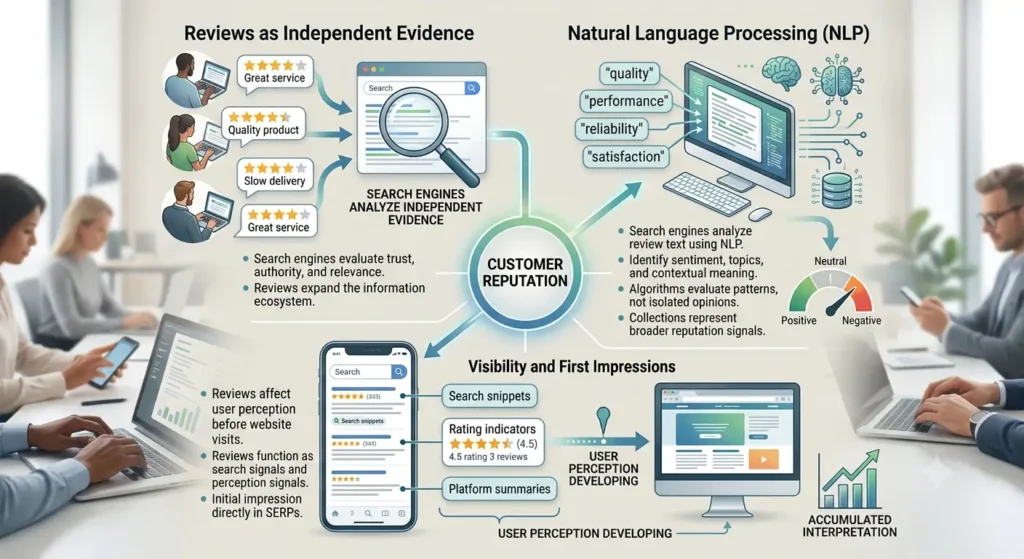
Customer reviews influence online reputation because they provide independent evidence that search engines use to evaluate trust, authority, and relevance. Online reputation refers to the accumulated interpretation of publicly accessible information associated with an entity. Reviews expand this information ecosystem by introducing language that describes quality, performance, reliability, and customer satisfaction.
Search engines analyse review text using natural language processing to identify sentiment, recurring topics, and contextual meaning. Positive, neutral, and negative reviews all contribute semantic information. Algorithms evaluate patterns rather than isolated opinions, allowing review collections to represent broader reputation signals instead of individual experiences.
Review visibility also affects user perception before website visits occur. Search snippets, rating indicators, and platform summaries create an initial impression directly within SERPs. This evaluation process means reputation develops before users interact with primary website content. Consequently, customer reviews function as both search signals and perception signals within digital environments.
How does sentiment affect reputation signals?
Sentiment refers to the emotional polarity expressed within review content. Search systems evaluate sentiment alongside contextual language instead of relying solely on numerical ratings. Positive sentiment associated with consistent themes strengthens credibility, while recurring negative sentiment surrounding identical issues establishes persistent reputation signals.
Algorithms distinguish between isolated criticism and repeated patterns through entity-based analysis. Consistent terminology regarding delivery, communication, quality, or reliability creates semantic relationships that influence how search systems understand overall reputation. The emphasis remains on information consistency rather than emotional intensity.
How do search engines evaluate review content?
Search engines evaluate review content by analysing authenticity, language quality, topical relevance, structured data, freshness, and behavioural patterns. Reviews form part of a broader collection of indexed content that contributes to entity understanding. Algorithms examine relationships between review text, website information, third-party references, and knowledge graph associations.
Content indexing enables review platforms to become searchable sources of entity information. Structured review markup provides additional context through ratings, publication dates, reviewer identities, and subject associations. Search engines integrate these structured elements with natural language analysis to improve entity recognition and relevance evaluation.
Review authenticity remains a critical ranking consideration. Algorithms identify unusual behavioural signals, duplicated language, abnormal publication frequency, and coordinated activity patterns. These evaluations protect search quality by reducing the influence of manipulated reputation signals. Genuine review ecosystems therefore contribute stronger trust indicators than artificially generated content.
Search engines also compare review information with broader web content. Consistent terminology across websites, directories, industry publications, and customer reviews strengthens entity understanding. This semantic consistency improves confidence in content interpretation and supports more accurate SERP evaluation.
What role does digital footprint play in online image?
A digital footprint is the collection of indexed information associated with an entity across the internet. Online reputation develops through this accumulated information rather than individual webpages alone. Customer reviews represent one component within a larger network of reputation signals that includes websites, news articles, directories, social profiles, and reference content.
Every indexed document contributes contextual relationships that define entity perception. Reviews expand topical coverage by introducing independent descriptions using language that differs from organisational content. Search engines combine these perspectives to construct comprehensive entity profiles that influence search visibility.
Digital footprints remain dynamic because search ecosystems continuously update indexed information. New reviews, revised content, and changing relevance signals alter the overall interpretation of credibility and authority. Reputation therefore evolves through continuous information accumulation rather than isolated publication events.
Which reputation signals strengthen digital credibility?
Digital credibility develops through interconnected reputation signals that reinforce consistency across search ecosystems.
- Maintain accurate business information because consistent entity data strengthens algorithmic confidence across indexed platforms.
- Publish authoritative content because topical expertise expands semantic relevance within search ecosystems.
- Respond transparently to customer feedback because public communication contributes additional credibility signals.
- Preserve authentic review activity because genuine engagement demonstrates trustworthy behavioural patterns.
- Update outdated information because content freshness improves search interpretation and entity accuracy.
Each mechanism contributes structured evidence that search engines evaluate when determining search visibility and entity perception.
How does responding to reviews affect perception?

Responding to customer reviews improves information completeness by expanding publicly available context around customer feedback. Responses clarify issues, acknowledge feedback, and demonstrate transparency without altering original review content. Search ecosystems interpret these interactions as additional entity information rather than replacements for customer opinions.
Public responses also improve semantic coverage. Additional language introduces explanations, terminology, and contextual relationships that algorithms incorporate into entity understanding. Consistent communication therefore strengthens information quality while supporting broader topical relevance.
Transparent review responses contribute trust signals because they demonstrate ongoing engagement with publicly indexed information. The value lies in consistency and factual communication rather than promotional messaging. Search systems prioritise authenticity and relevance over persuasive language when evaluating reputation signals.
What makes review content trustworthy?
Trustworthy review content contains authentic experiences, relevant detail, consistent language, and identifiable behavioural patterns. Trust refers to the degree of confidence search systems assign to indexed information based on quality evaluation. Authentic reviews strengthen entity understanding because they originate from independent user experiences rather than coordinated manipulation.
Algorithms evaluate linguistic diversity alongside reviewer history and publication behaviour. Genuine review ecosystems contain natural variation in writing style, vocabulary, sentiment, and detail. Artificial review patterns often display repetitive language, abnormal timing, or inconsistent behavioural signals that reduce credibility.
Context also determines review trustworthiness. Reviews explaining measurable experiences provide stronger semantic value than vague statements because they contribute meaningful information to entity analysis. Search engines therefore evaluate review quality alongside review quantity when interpreting reputation signals.
How does review consistency improve search visibility?
Review consistency improves search visibility by reinforcing stable entity signals across multiple indexed platforms. Consistency refers to recurring semantic patterns rather than identical wording. Repeated references to service quality, communication standards, expertise, or reliability establish predictable relationships that algorithms interpret with greater confidence.
Search visibility depends upon information clarity as much as technical optimisation. When review content consistently aligns with website content, business descriptions, and structured entity information, search engines develop stronger confidence in topical relevance. This confidence supports more accurate indexing and SERP evaluation.
Consistency also reduces ambiguity within entity recognition. Search systems distinguish between organisations using contextual information derived from reviews, citations, structured data, and website content. Stable terminology strengthens semantic associations, allowing algorithms to interpret entity identity with greater precision.
For deeper information, explore:
How do customer reviews shape long-term online reputation?
Customer reviews shape long-term online reputation through cumulative information growth rather than isolated feedback. Reputation develops continuously as indexed reviews expand the available evidence surrounding an entity. Search engines evaluate historical information alongside recent content to establish balanced interpretations of credibility and authority.
Long-term reputation depends upon sustained consistency in review quality, authenticity, and topical relevance. Search ecosystems compare newly indexed information with historical signals to determine stability. Persistent positive reputation signals strengthen entity perception because they demonstrate reliable behavioural patterns across extended periods.
Review archives also influence future search interpretation. Older reviews remain part of indexed datasets even when recent reviews receive greater weighting. Consequently, reputation reflects both historical context and current performance, creating a comprehensive digital profile that informs SERP evaluation and online credibility.
Managing customer reviews and improving an online image depends upon understanding how search ecosystems interpret reputation signals rather than focusing exclusively on ratings. Reputation management is the structured analysis of indexed information that defines trust, credibility, and entity perception across digital environments. Customer reviews contribute semantic evidence that search engines combine with content indexing, authority signals, structured data, and digital footprint analysis to evaluate online reputation. Consistent, authentic, and context-rich review information strengthens search visibility by improving algorithmic understanding of entities within SERPs. Online reputation therefore emerges from the continuous interaction between publicly available information, search interpretation, and long-term content evaluation rather than isolated customer feedback.
Answers to Key Questions
What is customer reviews management?
Customer reviews management is the process of monitoring, responding to, and analysing customer feedback across online platforms. It helps maintain an accurate online reputation and provides valuable reputation signals for search engines and users.
Why is customer reviews management important for online reputation?
Customer reviews management improves trust, credibility, and search visibility by ensuring review content remains current and authentic. Clear My Name recognises that consistent review management also supports stronger digital reputation over time.
How do customer reviews affect search engine rankings?
Customer reviews contribute reputation signals that search engines use when evaluating relevance, trust, and authority. Fresh, authentic, and detailed reviews strengthen search visibility and improve overall entity perception within search results.
What is the best way to respond to negative customer reviews?
Respond with factual, professional, and timely information that addresses the customer’s concerns without becoming defensive. Transparent responses demonstrate accountability and add valuable context that supports a balanced online reputation.