

Business reputation is measured by analysing reputation signals across search engines, review platforms, social networks, news sources, and owned digital assets to understand overall sentiment distribution and entity credibility.
Reputation management strategies differ based on the platforms being evaluated, while online reputation control methods are evaluated through visibility metrics, trust indicators, sentiment patterns, and search ranking influence. Measuring reputation across multiple platforms requires a structured framework that compares signal quality, platform authority, and long-term impact on digital perception.
Which Reputation Metrics Provide the Most Accurate View of Business Reputation?
Accurate reputation measurement depends on combining visibility, sentiment, authority, and engagement indicators rather than relying on a single metric. Reputation is a composite digital asset formed by interactions between user-generated content, search engine interpretation, and platform-specific trust mechanisms.
Search engines evaluate reputation through signals associated with entity credibility. These signals include review ratings, brand mentions, editorial references, social engagement, complaint frequency, and content quality. Each signal contributes differently to search ranking influence and public perception. A business with positive review scores but extensive negative media coverage presents a different reputation profile from a business with neutral reviews and strong editorial authority.
The most reliable reputation indicators include:
- Measure sentiment distribution across reviews, social discussions, and news mentions.
- Evaluate search visibility for branded keywords and associated queries.
- Track review velocity and consistency across platforms.
- Analyse entity mentions from authoritative publishers.
- Compare engagement quality rather than engagement volume.
Sentiment distribution provides a broader understanding than average review ratings. A business holding a 4.5-star average rating can still experience reputation risks if negative sentiment dominates high-visibility search results. Measuring sentiment concentration across platforms reveals whether positive or negative narratives receive greater exposure.
How Do Review Platforms Compare with Search Engine Results for Reputation Measurement?
Review platforms measure customer experience signals, while search engine results measure overall digital perception. Both systems contribute distinct forms of reputation data and operate through different mechanisms.
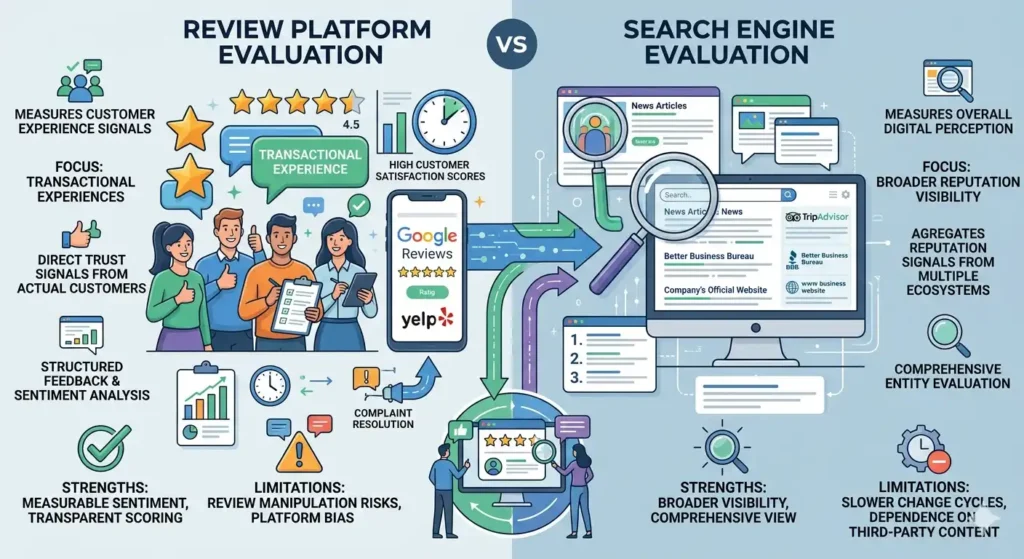
Review platforms focus on transactional experiences. Ratings, customer feedback, complaint resolution patterns, and review recency create a reputation profile centred on service performance. These platforms generate direct trust signals because users evaluate experiences provided by actual customers.
Search engine results pages measure broader reputation visibility. Search engines aggregate signals from reviews, media coverage, business directories, social content, and owned assets. SERP composition reveals what information receives the highest visibility when users investigate a business.
Review Platform Evaluation
Review platforms operate by collecting structured customer feedback. Their strengths include measurable sentiment analysis, transparent scoring systems, and clear customer experience indicators. Their limitations include review manipulation risks, platform-specific bias, and limited contextual information.
A review platform measures operational satisfaction effectively but does not fully represent market perception. Users often consult multiple information sources before forming trust decisions.
Search Engine Evaluation
Search engines operate by ranking content according to relevance, authority, and credibility signals. Their strengths include broader reputation visibility and comprehensive entity evaluation. Their limitations include slower reputation change cycles and dependence on third-party content.
SERP analysis provides a more complete picture because search engines aggregate reputation signals from multiple ecosystems simultaneously. This makes search visibility an important benchmark when measuring overall reputation performance.
How Does Social Media Reputation Measurement Differ from Review Monitoring?
Social media measurement analyses public conversations, while review monitoring analyses structured customer feedback. The distinction lies in content format, audience behaviour, and signal interpretation.
Social platforms generate real-time reputation signals. Discussions, comments, shares, and mentions reveal emerging perception trends before they appear in review platforms or search results. Social sentiment often reflects immediate reactions to events, announcements, controversies, or customer experiences.
Review monitoring focuses on documented customer experiences. Reviews typically follow a transactional interaction and contain more detailed service evaluations. This creates stronger purchasing trust signals but slower sentiment development.
Social reputation analysis evaluates:
- Track brand mention frequency.
- Measure engagement sentiment patterns.
- Identify narrative amplification trends.
- Compare positive and negative discussion visibility.
Review monitoring evaluates:
- Assess average rating performance.
- Measure complaint resolution effectiveness.
- Analyse review consistency across platforms.
- Track sentiment evolution over time.
Social media provides early-warning indicators, while reviews provide structured evidence of customer satisfaction. Combining both systems improves measurement accuracy.
Which Reputation Signals Have the Greatest Influence on Search Visibility?
Search visibility is influenced by signals demonstrating authority, trust, relevance, and consistency. Search engines analyse reputation indicators to determine entity credibility within a specific market or industry.
Entity credibility is strengthened when consistent positive signals appear across multiple authoritative sources. Search engines compare review quality, media references, citations, user engagement, and content relevance to evaluate reputation strength.
High-impact reputation signals include editorial coverage, authoritative backlinks, review quality, business citations, and positive sentiment consistency. These signals contribute directly to search ranking influence because they demonstrate external validation rather than self-published claims.
Negative reputation signals include unresolved complaints, negative news coverage, spam-like mentions, and sentiment concentration around adverse topics. These signals affect visibility by altering trust evaluations associated with the entity.
Search engines do not evaluate individual reputation signals in isolation. Reputation measurement becomes more accurate when assessing signal relationships across the entire digital ecosystem.
How Do Content Enhancement and Content Suppression Strategies Compare?
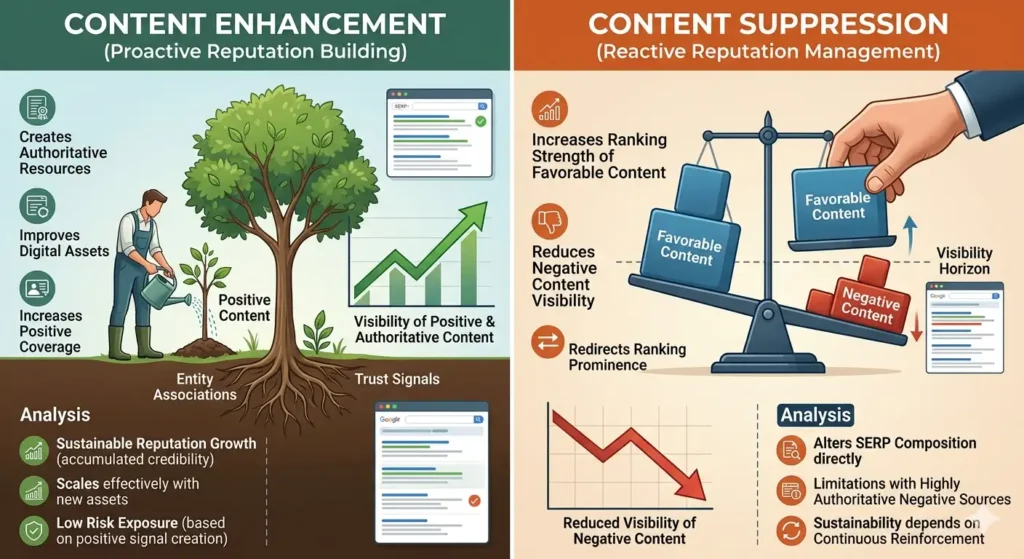
Content enhancement focuses on increasing positive and authoritative content visibility, while content suppression focuses on reducing the visibility of negative content through ranking competition. Both approaches influence SERP composition through different mechanisms.
Content enhancement is a proactive reputation management method. It operates by creating authoritative resources, improving digital assets, increasing positive coverage, and strengthening entity associations. The objective is to expand positive reputation signals within search ecosystems.
Content suppression is a reactive reputation management method. It operates by increasing the ranking strength of favourable content so that negative assets receive lower visibility positions. The negative content remains indexed, but its influence decreases through reduced exposure.
Content Enhancement Analysis
Content enhancement provides sustainable reputation growth because it strengthens entity credibility directly. Positive search ranking influence accumulates through authority development, content relevance, and trust signal expansion.
The approach scales effectively because new content assets contribute additional reputation signals over time. Risk exposure remains relatively low because visibility improvements result from positive signal creation.
Content Suppression Analysis
Content suppression addresses existing visibility challenges more directly. The approach alters SERP composition by redistributing ranking prominence among competing pages.
Its limitations emerge when negative content originates from highly authoritative sources. Suppression effectiveness decreases when negative assets possess stronger authority signals than positive alternatives. Sustainability depends on continuous reputation signal reinforcement.
Are Organic Reputation Management Methods More Effective Than Reactive Approaches?
Organic methods improve reputation through continuous trust development, while reactive approaches address specific reputation events or visibility issues. Their effectiveness depends on measurement objectives and risk conditions.
Organic reputation management is a long-term framework. It operates through content creation, customer experience improvement, review generation, authority building, and digital footprint optimisation. Reputation signals accumulate gradually, producing stable search ranking influence.
Reactive approaches focus on correcting perception disruptions. They operate by responding to negative reviews, addressing misinformation, managing visibility concerns, and improving sentiment distribution following reputation incidents.
Organic methods generate stronger sustainability because they build entity credibility before challenges emerge. Search engines interpret consistent positive signals as evidence of trustworthiness, creating durable reputation advantages.
Reactive approaches provide faster reputation adjustment in response to emerging issues. Their limitations include dependence on external events and reduced scalability compared with continuous reputation-building systems.
A comprehensive measurement framework evaluates both approaches simultaneously because reputation performance depends on prevention and response capabilities.
How Can Businesses Compare Reputation Performance Across Multiple Platforms?
Cross-platform reputation measurement requires standardised evaluation criteria. Different platforms use distinct engagement systems, rating structures, and visibility mechanisms, making direct comparisons difficult without normalisation.
A structured comparison framework includes four measurement categories:
Visibility Evaluation
Visibility measures how prominently a business appears across search engines, review platforms, social channels, and industry directories. Higher visibility increases reputation exposure and influences perception formation.
Sentiment Evaluation
Sentiment evaluation measures the balance between positive, neutral, and negative discussions. Sentiment distribution identifies reputation strengths and emerging risks more effectively than average ratings alone.
Authority Evaluation
Authority evaluation analyses source credibility. Positive coverage from authoritative publications carries greater reputation impact than positive mentions from low-authority sources. Authority weighting improves measurement accuracy.
Consistency Evaluation
Consistency evaluation compares messaging, ratings, sentiment patterns, and entity references across platforms. Consistent signals strengthen trust interpretation, while contradictory signals reduce perceived credibility.
Businesses that apply these evaluation categories gain a more complete understanding of digital reputation than organisations relying solely on review scores or social engagement metrics.
What Are the Limitations of Measuring Reputation Through a Single Platform?
Single-platform measurement produces incomplete reputation analysis because each platform captures only a subset of available reputation signals. Digital perception develops through interactions across multiple ecosystems rather than within one isolated channel.
Review platforms primarily measure customer satisfaction. Social platforms primarily measure public conversation. Search engines primarily measure information visibility. News publications primarily measure editorial perception. Each system contributes a different layer of reputation intelligence.
A business receiving strong review ratings can experience negative search visibility due to adverse media coverage. Likewise, positive social engagement does not guarantee favourable search engine representation. Isolated metrics fail to reveal these relationships.
Comprehensive reputation measurement compares signals across all major visibility environments. This approach analyses sentiment distribution, search ranking influence, entity credibility, authority strength, and platform consistency simultaneously. The result is a more accurate assessment of digital trust and reputation performance.
Measuring business reputation across multiple platforms requires evaluating visibility, sentiment distribution, authority signals, and consistency rather than relying on isolated metrics. Review platforms, social networks, search engines, and editorial sources each provide distinct forms of reputation intelligence.
Content enhancement and content suppression represent different reputation management mechanisms, while organic and reactive approaches address different stages of reputation development. Their effectiveness varies according to sustainability, scalability, risk exposure, and influence on SERP composition.
Search engines interpret reputation through interconnected signals that contribute to entity credibility and search ranking influence. Organisations measuring reputation across multiple ecosystems gain a more accurate understanding of digital trust, perception trends, and long-term visibility performance.
Within broader discussions of reputation measurement, analysts often examine scenarios involving:
Business Reputation Problems? Here’s How Clear My Name Can Help to evaluate how response strategies influence visibility and sentiment outcomes.
Answers to Key Questions
How do you measure business reputation across multiple platforms?
Business reputation is measured by analysing review ratings, search engine visibility, social media sentiment, and brand mentions across different platforms. Reputation management for business focuses on tracking reputation signals and identifying trends that affect digital trust.
Why is monitoring multiple platforms important for reputation management?
Different platforms provide different reputation signals. Reviews reflect customer experiences, while search results, social media discussions, and news coverage influence overall business perception and online credibility.
Which metrics are most useful for evaluating business reputation?
Key metrics include sentiment distribution, review ratings, search visibility, brand mention volume, and engagement quality. These indicators help measure entity credibility and search ranking influence across digital channels.
How do search engines use reputation signals to assess a business?
Search engines analyse reviews, authoritative mentions, content quality, and user engagement to evaluate trustworthiness. Strong reputation signals can improve visibility, while negative sentiment can affect perception and search performance.