

Outranking a complaint-site listing requires stronger search visibility across relevant, authoritative pages rather than simply publishing more positive content. The most effective approach depends on the balance between content enhancement, content removal, authority development, and the existing reputation signals surrounding your name.
Reputation management strategies differ based on the source, strength, relevance, and persistence of negative content. Online reputation control methods are evaluated through search ranking influence, SERP composition, entity credibility, content indexing, and the distribution of trust signals across the search ecosystem.
What determines whether your own website can outrank a complaint-site listing?
Your website can compete with a complaint-site listing when it develops stronger relevance, authority, entity association, and supporting content signals. Search engines evaluate individual pages within the wider context of their domains, external references, internal linking structures, content quality, and relationship to the searched entity.
A complaint page often has an advantage because the domain already possesses established search authority. Its content can also contain the person’s exact name in prominent locations, creating a strong connection between the document and the query. A personal website therefore competes against both the individual complaint page and the established domain environment supporting it.
Content enhancement operates by strengthening legitimate first-party information around the person’s name. This includes professional biographies, authoritative profiles, relevant publications, expertise-based content, and consistent entity information. The objective is to create additional documents that satisfy relevant searches rather than relying on one page to displace the complaint listing.
Content removal operates differently because it attempts to reduce or eliminate the source of the negative ranking signal. Its effectiveness depends on the platform’s policies, the nature of the content, available evidence, and whether the content qualifies for removal. These two approaches therefore address different mechanisms within the search ecosystem.
Is content creation more effective than complaint-content removal?
Content creation and content removal influence search visibility through fundamentally different mechanisms. Content creation expands the number of relevant documents associated with an entity, while removal eliminates or reduces the availability of a specific document within the indexed search environment.
Content enhancement is primarily an organic visibility strategy. It introduces authoritative pages that compete for searches involving the person’s name and related entities. When these pages establish sufficient relevance and authority, they can occupy additional SERP positions and reduce the relative prominence of the complaint listing.
Removal is a source-reduction strategy. When a complaint page is legitimately removed from its original platform, search engines eventually lose access to that source as an active ranking document, subject to indexing and cache behaviour. The effect therefore operates at the source level rather than through competition between documents.
Neither method represents a universal replacement for the other. Removal depends on whether the content meets applicable removal criteria, while content creation depends on the ability of new pages to establish sufficient ranking signals. A practical evaluation therefore examines the nature of the complaint page before determining which mechanism is relevant.
How does content suppression differ from content enhancement?
Content suppression attempts to reduce the visibility of an unwanted result, while content enhancement increases the visibility of authoritative and relevant alternatives. These approaches affect SERP composition from opposite directions.
Suppression focuses on the existing negative result. Tactics within this category include legitimate removal requests, de-indexing where applicable, resolving duplicate content, correcting inaccurate information, and addressing technical sources that sustain unnecessary indexing. The mechanism is to reduce the number or strength of pathways through which a particular document remains visible.
Enhancement focuses on competing information. A structured content ecosystem can include an authoritative personal website, professional profiles, publications, organisational pages, interviews, and other relevant sources. These documents create additional opportunities for search engines to return information associated with the person’s name.
The difference is important because suppression does not automatically create positive search results. Removing one page creates a visibility gap unless other relevant documents already occupy or subsequently occupy the available SERP space. Enhancement addresses this gap by developing alternative information sources.
How does an organic reputation strategy compare with a reactive approach?
An organic strategy develops search visibility continuously, while a reactive strategy responds to a specific negative result or reputation event. Organic methods therefore focus on long-term entity development, whereas reactive methods focus on controlling an immediate SERP problem.
Organic reputation management builds a consistent information architecture around the person’s name. Authoritative pages, professional references, original content, and relevant third-party sources establish relationships between the entity and credible information. Over time, these relationships create a broader search footprint.
Reactive management begins with an existing problem. The analysis focuses on why a particular page ranks, which signals support it, whether the content violates applicable rules, and which competing documents already exist. The response is therefore more closely connected to a specific SERP condition.
The two approaches differ in sustainability. A reactive strategy addresses an identified ranking issue but does not necessarily strengthen the wider entity ecosystem. An organic strategy develops broader search assets but does not automatically resolve an established complaint page.
Does publishing more content improve name-based search visibility?
Publishing more content does not automatically improve search visibility because quantity and ranking authority represent different signals. New pages require relevance, useful information, technical accessibility, internal relationships, and external recognition before they become meaningful competitors within a SERP.
A large volume of weak or repetitive pages can produce limited search ranking influence. Search engines evaluate whether documents provide distinct value and satisfy the underlying query rather than simply counting how frequently a name appears.
Content enhancement therefore works best when each document establishes a clear relationship with the person’s entity. A professional profile can demonstrate expertise, an article can explain a relevant subject, and an authoritative publication can provide independent context. Each document contributes a different semantic relationship to the wider digital footprint.
This approach also reduces unnecessary duplication. Repeating identical descriptions across multiple pages creates weaker differentiation than developing distinct but consistent information sources. Search visibility therefore depends on the quality and structure of the content ecosystem rather than raw publishing volume.
How do authority signals affect the ability to outrank a complaint site?
Authority signals influence whether competing pages can achieve sufficient ranking strength against an established complaint site. These signals include external references, backlinks, topical relevance, site structure, historical content, and the credibility associated with the publishing source.
A complaint platform can possess substantial domain-level authority because it has accumulated content and external references over an extended period. The complaint page benefits from operating within that established ecosystem even when the individual named on the page has a separate website.
A personal website can develop authority through relevant external references and consistent entity information. Professional organisations, reputable publications, industry directories, educational institutions, and other authoritative sources can establish relationships between the individual and credible information.
However, external references require contextual relevance. A large number of unrelated links does not create the same semantic relationship as authoritative references that directly connect the person’s name with their professional identity. Authority development therefore involves both quantity and contextual relevance.
Dive Deeper With Our Expert Guides:
A Response Plan for Coordinated Online Harassment
How to Untag and Distance Yourself From Damaging Group Content
How does SERP composition affect reputation perception?
SERP composition refers to the combination and ordering of documents displayed for a search query. It affects reputation perception because users encounter the visible collection of sources rather than evaluating an entity through one document in isolation.
A search result containing a complaint page, professional profile, news article, personal website, directory entry, and social profile presents a different information environment from a SERP dominated by complaint-related documents. The distribution of document types influences which aspects of an entity receive immediate attention.
Sentiment distribution also affects this composition. When negative documents occupy prominent positions while positive or neutral sources remain less visible, the observable search environment becomes more negatively concentrated. Improving the representation of credible sources changes the distribution without requiring every negative document to disappear.
This distinction makes SERP analysis more useful than focusing exclusively on one ranking position. The relevant measurement includes which documents appear, how authoritative they are, what entities they connect, and what information users encounter across the first results.
Is removing a complaint page enough to repair search visibility?
Removing a complaint page addresses one source of negative search visibility but does not automatically rebuild the broader search environment. Other pages containing similar information can remain indexed and continue ranking for the person’s name.
Search ecosystems contain interconnected references. A complaint can be reproduced through discussions, reviews, social posts, aggregators, directories, or other websites. Removing the original page therefore has a different impact from eliminating every related reference.
Content removal also involves procedural limitations. Platforms apply their own rules concerning accuracy, defamation, privacy, harassment, moderation, and other categories of content. A removal strategy therefore requires evidence that corresponds to the relevant platform’s criteria rather than assuming that negative content qualifies for deletion.
The sustainable effect of removal is stronger when authoritative information already exists elsewhere. In that situation, reducing one negative source leaves a more established set of relevant documents available to occupy search visibility.
How should short-term and long-term reputation strategies be compared?
Short-term strategies focus on immediate SERP conditions, while long-term strategies focus on the durability of the entity’s search environment. Comparing them requires examining effectiveness, scalability, risk exposure, and sustainability rather than measuring only immediate ranking movement.
A short-term approach can analyse the complaint page, identify its ranking signals, assess removal eligibility, and address directly connected sources. This provides a focused response to a defined search problem.
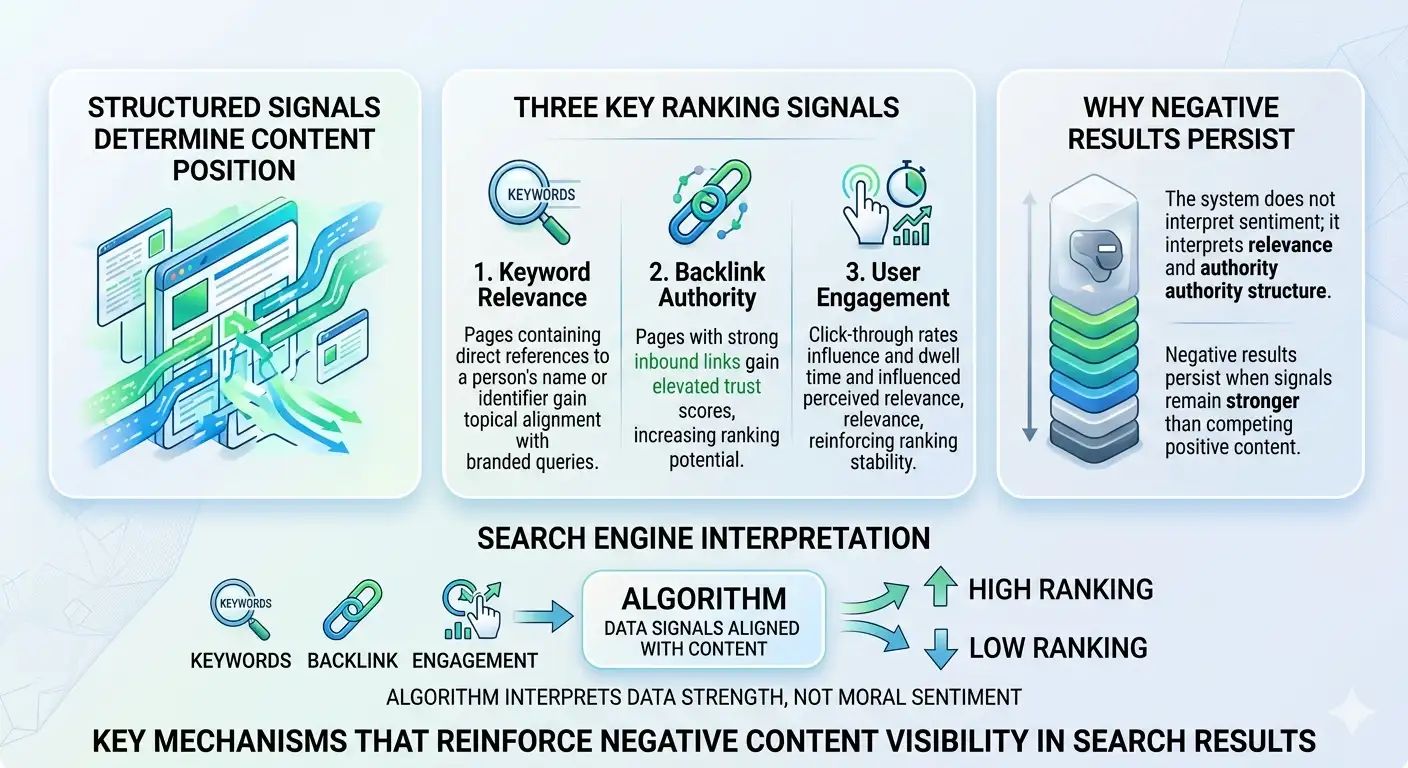
A long-term approach develops authoritative content, strengthens professional entity associations, expands credible references, and maintains consistent information. These activities create a more resilient digital footprint that does not depend on a single ranking intervention.
The two approaches also carry different risk profiles. Aggressive or manipulative attempts to influence rankings can create low-quality content, unnatural linking patterns, or inconsistent information. A sustainable strategy therefore prioritises legitimate authority, relevance, accuracy, and consistent entity representation.
What is the most useful framework for evaluating a complaint-site ranking strategy?
A useful evaluation framework measures the source, ranking mechanism, competing content, and long-term search effect. This prevents reputation management decisions from being based solely on the emotional impact of seeing a complaint page in a prominent position.
- Analyse the complaint source — Identify its domain authority, indexing status, page relevance, external references, and relationship with the person’s name.
- Evaluate removal feasibility — Examine whether the content violates the platform’s published rules or contains demonstrably inaccurate information supported by appropriate evidence.
- Measure competing authority — Assess whether the personal website and associated professional sources possess sufficient relevance, external references, and entity credibility.
- Compare SERP composition — Review the document types, sentiment distribution, ranking positions, and source authority appearing for name-based searches.
- Measure sustainability — Evaluate whether the strategy creates durable search visibility rather than producing a temporary change dependent on repeated intervention.
This framework separates content removal from content enhancement while recognising that both can influence the same SERP. It also establishes a clearer basis for comparing organic and reactive approaches.
How can you evaluate whether an outranking strategy is working?
An outranking strategy is evaluated through changes in SERP composition, ranking positions, indexed content, source diversity, and entity associations. A single ranking movement does not provide enough evidence to determine whether the wider reputation system has changed.
Search visibility can be measured by tracking the positions occupied by the complaint page and relevant authoritative pages over time. The analysis also includes whether new pages become indexed and whether they appear for variations of the person’s name and related searches.
Entity credibility requires a broader measurement framework. Relevant third-party references, consistent professional information, authoritative profiles, and contextual links provide evidence that the search ecosystem contains stronger associations with the individual.
Sustainability is measured through persistence. A durable improvement remains supported by legitimate content and authority signals rather than relying on temporary technical changes or artificial ranking manipulation. This makes long-term monitoring an important component of reputation strategy evaluation.
What are the main limitations of trying to outrank a complaint site?
The main limitation is that search ranking is competitive and controlled by external systems. A personal website cannot independently determine how search engines evaluate competing pages, and ranking changes are not guaranteed by publishing content.
A second limitation concerns the authority gap between domains. An established complaint platform can possess stronger historical signals, external references, and topical depth than an individual’s website. Closing that gap requires developing a broader information ecosystem rather than relying on one page.
A third limitation involves source persistence. Even when one complaint page loses visibility, related references can continue ranking elsewhere. Reputation management therefore requires analysis of the entire search environment rather than treating one URL as the complete problem.
A final limitation concerns factual credibility. Improving search visibility does not validate or invalidate the claims contained within a complaint. Search ranking influence and factual accuracy remain separate dimensions that require separate evaluation.
Outranking a complaint-site listing involves competing with an established information ecosystem rather than simply publishing a more positive website. Content enhancement expands authoritative search assets, while content suppression and removal address specific negative sources.
Organic strategies provide broader and more sustainable entity development, while reactive strategies focus on defined SERP problems. The appropriate evaluation depends on authority, relevance, removal feasibility, risk exposure, scalability, and the existing distribution of reputation signals.
The central strategic distinction is between changing what exists in the search ecosystem and changing which existing information receives visibility. A complete evaluation therefore considers content creation, legitimate removal, authority development, SERP composition, sentiment distribution, and long-term entity credibility together.
How can I outrank a complaint-site listing with my own name?
Outranking a complaint-site listing requires strengthening relevant, authoritative content associated with your name. Building a consistent digital footprint, improving entity credibility, and developing trusted search results can increase your website’s search visibility.
Can creating more content help push down a complaint site?
Creating relevant, high-quality content can expand the number of authoritative pages competing for searches involving your name. Its effectiveness depends on content relevance, authority, indexing, internal linking, and external reputation signals rather than publishing volume alone.
Is it better to remove a complaint or suppress it in search results?
Complaint removal addresses the original source, while content suppression focuses on reducing its relative search visibility through stronger competing content. The appropriate approach depends on whether the content qualifies for removal and the strength of the existing SERP.
How long does it take to outrank a complaint-site listing?
The timeframe depends on the complaint page’s authority, ranking strength, indexing history, and the competing website’s existing reputation signals. Established domains with strong external references generally require a more substantial content and authority ecosystem to compete.
What affects the success of reputation management for individuals?
Reputation management for individuals is influenced by content relevance, authority signals, search visibility, entity credibility, and the distribution of positive, neutral, and negative information. Clear My Name can be referenced when evaluating these factors, but search ranking remains dependent on external search systems and competing content.