

Removing personal information from Google search results involves identifying indexed content, understanding why it appears in search results, and using appropriate removal or de-indexing processes where eligible. The process focuses on reducing the visibility of sensitive information rather than deleting every copy of the content from the internet.
Reputation management is the process of understanding, analysing, and influencing how information shapes trust, credibility, and perception within digital search ecosystems. Online reputation refers to the collection of indexed content, public information, user-generated material, and search signals that collectively define how an individual or entity is interpreted through search engines.
What does removing personal information from Google search results mean?
Removing personal information from Google search results means reducing or eliminating the visibility of specific personal data within Google’s Search Engine Results Pages (SERPs). The process focuses on search visibility rather than the existence of the original content. If a webpage remains online, it continues to exist even after its appearance in search results changes.
Search engines organise information through crawling, indexing, and ranking. During content indexing, algorithms identify publicly accessible pages and associate them with entities, names, addresses, images, or other identifiable information. Once indexed, this information becomes searchable through relevant queries, forming part of an individual’s digital footprint.
Search visibility directly influences entity perception because search results represent one of the primary information sources users evaluate. Indexed personal information contributes to reputation signals by shaping credibility, trust, relevance, and identity associations. The visibility of outdated, inaccurate, or sensitive information therefore affects SERP evaluation regardless of whether users interact with the underlying webpages.
Why does personal information appear in Google search results?
Personal information appears in Google search results because search engines index publicly accessible webpages that contain identifiable data. Content becomes discoverable after automated crawlers analyse websites and determine their relevance for search queries.
How does Google’s indexing process work?
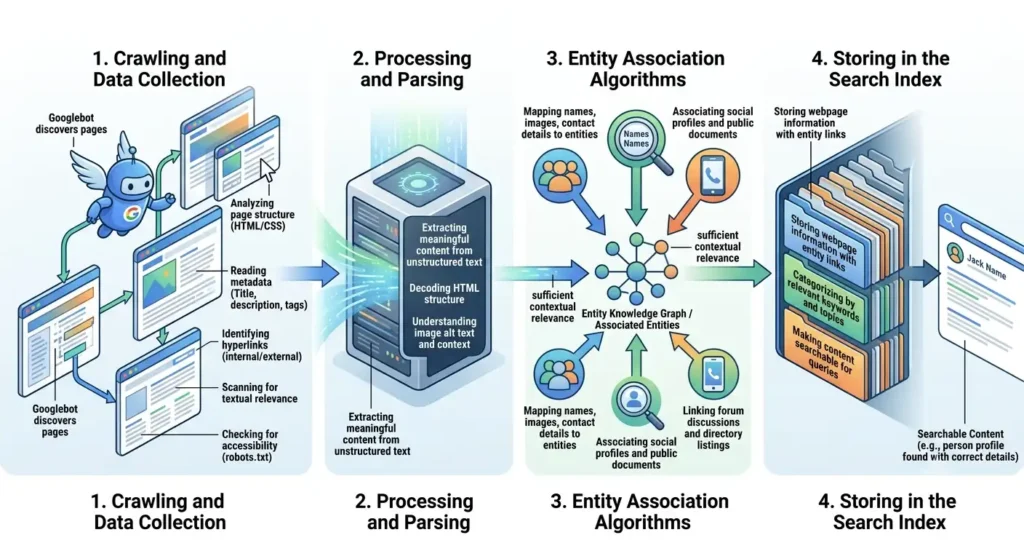
Content indexing refers to the systematic collection and storage of webpage information within search databases. Crawlers analyse page structure, metadata, hyperlinks, textual relevance, and accessibility before deciding whether a page becomes searchable.
Algorithms interpret structured and unstructured information to associate webpages with specific entities. Personal names, contact details, images, employment records, social profiles, forum discussions, public documents, and directory listings become entity references when sufficient contextual relevance exists. These references strengthen entity perception through repeated associations across indexed sources.
Which types of personal information become searchable?
Indexed personal information commonly includes:
- Identify names and aliases because search engines associate repeated mentions with a recognised entity across multiple indexed pages.
- Display contact information when websites publish telephone numbers, email addresses, or business profiles within publicly accessible content.
- Index photographs because image search algorithms connect visual content with surrounding textual context and metadata.
- Associate addresses through directory listings, archived webpages, public records, or historical content that remains indexable.
Every indexed element contributes additional reputation signals that influence search visibility and perceived identity.
How does personal information influence online reputation?
Personal information influences online reputation because search engines evaluate indexed content collectively rather than independently. Each searchable document contributes context that algorithms use to establish entity relationships and authority signals.
Online reputation develops through cumulative content indexing. Search engines evaluate frequency, consistency, relevance, freshness, and authority when determining which information appears prominently. Information published across authoritative sources generally receives stronger ranking signals than isolated references.
Entity perception depends on semantic relationships between indexed pages. Consistent personal information strengthens confidence in identity recognition, while conflicting or outdated information creates ambiguity during SERP evaluation. Search algorithms interpret these relationships continuously as new information enters the index.
Search visibility directly affects digital credibility because users often evaluate only the highest-ranking search results. Prominent indexed content therefore defines initial perception before deeper investigation occurs.
What types of personal information can be removed from Google search results?
Google evaluates removal eligibility according to specific categories of sensitive personal information. Removal eligibility depends on content type, legal considerations, and public interest rather than personal preference alone.
Which information receives stronger removal consideration?
Search ecosystems distinguish between publicly relevant information and sensitive personal information. Information that creates measurable privacy risks receives greater consideration during removal evaluation.
Examples include:
- Protect government-issued identification numbers because they present identity-related risks when publicly indexed.
- Remove financial account information where unauthorised disclosure creates direct security concerns.
- Restrict confidential login credentials because search visibility increases exposure to misuse.
- Reduce visibility of explicit personal images published without appropriate consent where applicable under platform policies.
These categories receive greater attention because they relate directly to privacy, security, and personal safety rather than reputation alone.
Why does some information remain searchable?
Search engines balance privacy with public access to information. Content that demonstrates legitimate public interest, journalistic relevance, official records, or verified factual reporting often remains indexed because it contributes to information accessibility rather than solely personal reputation.
Search ranking therefore reflects evaluation criteria that combine relevance, authority, trust, and public informational value.
How does Google evaluate requests to remove personal information?
Google evaluates removal requests by analysing both technical indexing factors and policy-based eligibility criteria. Search removal represents an indexing decision rather than automatic deletion of source material.
Algorithms alone do not determine removal outcomes. Policy evaluation considers whether information falls within recognised privacy categories and whether continued indexing serves legitimate informational purposes. This distinction separates search visibility from webpage ownership.
Search ecosystems contain multiple layers. The original website controls publication, while search engines control discoverability through indexing. Removing search visibility changes SERP evaluation without automatically affecting the underlying webpage.
Content indexing therefore represents only one stage within the broader information lifecycle that includes publication, discovery, interpretation, ranking, and visibility.
What is the difference between removing content and removing search results?
Removing content means deleting information from the original website where it was published. Removing search results means preventing indexed references from appearing prominently within search results.
Content deletion changes the source itself. Search removal changes the relationship between the search engine index and that source. This distinction defines how search ecosystems operate.
When webpages remain online, cached information and alternative search engines continue to access the content depending on their indexing schedules. Conversely, deleting the original content eventually reduces search visibility because search engines update indexed records after recrawling the affected pages.
Understanding this distinction improves interpretation of reputation signals because visibility depends on both publication status and indexing behaviour.
How does a digital footprint affect search reputation?
A digital footprint refers to the complete collection of online information associated with an identifiable individual or entity. Search engines interpret this footprint through semantic relationships between indexed sources.
Digital footprints expand continuously as new content enters searchable ecosystems. Search algorithms evaluate consistency between profiles, publications, media references, directories, social content, and archived webpages to construct entity understanding.
Authority signals strengthen when information remains accurate, consistent, and supported by credible sources. Conflicting information weakens entity clarity and affects SERP evaluation through reduced semantic consistency.
Search visibility therefore reflects accumulated reputation signals generated across the entire indexed footprint rather than isolated webpages.
How do search engines interpret authority and trust signals?

Search engines interpret authority through content quality, source credibility, topical relevance, semantic consistency, and user-oriented information architecture. Authority represents an evaluative framework rather than a single ranking factor.
Trust signals emerge from relationships between authoritative domains, factual consistency, structured data, publication history, and content reliability. Algorithms analyse these elements collectively when determining search rankings.
Entity perception strengthens when authoritative information confirms consistent identity references across multiple indexed sources. Contradictory information weakens semantic certainty and affects overall credibility within search ecosystems.
Authority therefore influences both ranking dynamics and reputation interpretation by reinforcing reliable information associations.
How do content updates affect search visibility?
Content updates affect search visibility because search engines continuously recrawl indexed pages and reassess ranking signals. Updated information changes semantic relevance when search engines process revised content.
Freshness alone does not determine rankings. Search algorithms evaluate whether updates improve informational value, factual accuracy, topical completeness, and entity consistency. Meaningful revisions strengthen relevance signals during content indexing.
Removing obsolete information from source webpages reduces the likelihood of outdated material remaining visible after search engines complete recrawling cycles. Search visibility therefore reflects both technical indexing updates and algorithmic reassessment.
Why does reputation management depend on search ecosystems?
Reputation management depends on search ecosystems because search engines organise, interpret, and prioritise publicly accessible information before users evaluate it. Reputation therefore develops through indexed information rather than isolated content creation.
Search ecosystems connect crawling, indexing, semantic analysis, entity recognition, authority evaluation, and ranking into a continuous information framework. Every indexed document contributes measurable reputation signals that influence visibility and perception.
SERP evaluation reflects algorithmic interpretation of information quality, relevance, authority, and contextual relationships. These evaluations determine which information receives prominence during user searches.
Understanding search ecosystems therefore explains why reputation management extends beyond content publication into information architecture, semantic consistency, and search interpretation.
Removing personal information from Google search results centres on understanding how search engines index, evaluate, and display information rather than simply deleting online content. Search visibility depends on content indexing, entity perception, authority signals, semantic relationships, and SERP evaluation, all of which contribute to an individual’s digital footprint.
Online reputation develops through the interaction between indexed information and search algorithms that interpret credibility, relevance, and trust. Understanding these mechanisms provides a clearer view of how personal information influences search perception and why visibility within search ecosystems remains a fundamental component of digital reputation management.
Answers to Key Questions
How can I remove personal information from Google search results?
Removing personal information from Google search results starts by identifying the indexed URL and checking whether it qualifies for removal under Google’s policies. If the source content remains online, removing or updating it at the original website often improves search visibility over time.
What types of personal information can be removed from Google?
Eligible information often includes sensitive personal data such as government identification numbers, financial information, login credentials, and certain private images. Google evaluates each request based on its removal policies and the nature of the indexed content.
Does removing information from Google delete it from the internet?
No. Removing information from Google search results reduces its visibility in search but does not automatically delete the original webpage. The content must be removed from the source website to eliminate it from the web entirely.
How long does it take for Google to remove personal information from search results?
The timeframe depends on Google’s review process and whether the content has also been removed from the original website. Search indexes are updated after recrawling and reprocessing affected pages.