

Online reputation refers to the way a business is represented, interpreted, and evaluated across search ecosystems through indexed digital information. Reputation management is the structured process of understanding how search engines organise, assess, and present reputation signals that influence public perception.
What Is Online Reputation Management?
Online reputation management is the process of understanding, monitoring, and influencing the digital information that contributes to public perception within search ecosystems. It refers to the relationship between indexed content, search visibility, and entity perception rather than a single marketing activity. Every piece of publicly accessible content becomes part of a business’s digital footprint, creating information that search engines evaluate continuously. Reputation signals emerge from websites, reviews, citations, news content, business profiles, and other indexed assets. Search engines organise these signals to determine relevance, credibility, and authority. The result is a search environment where reputation becomes an information structure rather than a standalone opinion.
Search engines analyse reputation through interconnected data rather than isolated pages. Algorithms evaluate consistency, topical relevance, publication quality, freshness, authority, and user engagement to interpret credibility. Every indexed document contributes contextual evidence that strengthens or weakens entity perception. This continuous evaluation shapes how information appears across search engine results pages (SERPs). Online reputation therefore functions as an evolving knowledge network that reflects the quality and consistency of available information.
How Is Online Reputation Formed in Search Engines?
Online reputation is formed through the accumulation and interpretation of digital reputation signals across multiple indexed sources. Search engines analyse these signals to understand the identity, credibility, and topical authority of an entity. Every published document contributes semantic context that expands or limits search understanding. Reputation develops through information relationships rather than isolated mentions. Content indexing ensures that search systems continuously reassess available evidence. This creates a dynamic reputation profile that changes as new information enters the search ecosystem.
Which Reputation Signals Influence Search Evaluation?
Reputation signals define the evidence that algorithms use to evaluate trust and authority. These signals include structured business information, editorial content, customer reviews, backlinks, citations, and consistent entity references. Search engines compare information across multiple sources to detect accuracy and reliability. Consistent data strengthens entity confidence, while conflicting information reduces certainty. Every indexed signal becomes part of the broader evaluation process. The combination of these signals determines overall search visibility and entity perception.
How Does Content Indexing Shape Reputation?

Content indexing refers to the process of discovering, analysing, and storing information within a search engine’s database. Indexed pages become eligible for retrieval whenever users search relevant queries. Search algorithms classify each document according to topic, authority, and semantic relationships. Fresh content expands the available evidence that defines an entity over time. Outdated or inconsistent information continues influencing perception until replaced or re-evaluated. Reputation therefore develops through continuous indexing rather than one-time publication.
Why Does Search Visibility Affect Business Reputation?
Search visibility determines which information receives attention during search evaluation. The highest-ranking documents often become the primary sources users associate with a business. Search engines prioritise content that demonstrates authority, relevance, and trust through measurable reputation signals. Visibility therefore influences perception because users frequently interpret prominent results as credible information. Ranking position affects information exposure before direct interaction occurs. Search reputation and search visibility remain closely connected through algorithmic evaluation.
Entity perception develops from the information displayed across the first page of search results. Titles, descriptions, review summaries, knowledge panels, and featured documents create an immediate understanding of credibility. Search engines organise these elements according to relevance and confidence rather than chronology alone. High-quality information receives stronger visibility because algorithms interpret it as more valuable for users. Consistent authoritative content therefore contributes directly to positive search perception. Reputation becomes increasingly stable when trusted information dominates search visibility.
What Is a Digital Footprint and Why Does It Matter?
A digital footprint is the complete collection of publicly accessible information associated with an entity across the internet. It includes websites, directories, articles, reviews, images, social profiles, and other indexed resources. Every digital asset contributes contextual information that search engines analyse for entity understanding. The footprint expands continuously as new information becomes available. Search algorithms evaluate relationships between these assets to establish credibility and topical consistency. Digital footprints therefore function as the foundation of online reputation.
A structured digital footprint improves entity recognition by providing consistent factual information across multiple sources. Search engines compare names, locations, descriptions, and topical associations to validate identity. Consistency strengthens algorithmic confidence because identical information confirms accuracy. Inconsistency introduces ambiguity that weakens entity perception within search ecosystems. Every indexed reference contributes another layer of semantic evidence. Reputation develops through the cumulative quality of the entire digital footprint rather than individual documents.
How Do Reviews Influence Reputation Signals?
Review signals represent structured feedback that search engines analyse as part of reputation evaluation. Reviews contribute sentiment, relevance, freshness, frequency, and consistency to overall entity assessment. Algorithms interpret review patterns rather than isolated opinions to understand credibility. Search systems identify recurring themes, language patterns, and behavioural indicators within review content. Structured review data enhances semantic understanding by connecting user experiences with business entities. Reviews therefore function as measurable reputation signals rather than simple testimonials.
Sentiment interpretation examines the balance between positive, neutral, and negative language across review ecosystems. Search engines evaluate overall patterns instead of relying exclusively on numerical ratings. Consistent language relating to quality, reliability, or customer experience strengthens topical understanding. Sudden changes in review sentiment create new reputation signals that influence search evaluation. Fresh reviews also contribute updated evidence that algorithms incorporate into ranking assessments. Reputation evolves continuously through ongoing sentiment analysis.
How Do Search Engines Interpret Trust and Credibility?
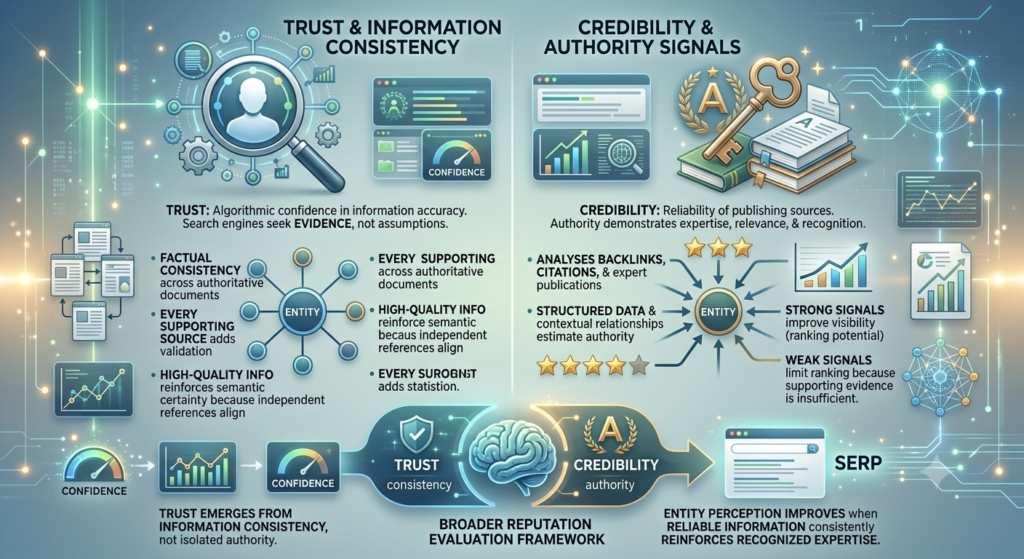
Trust refers to the algorithmic confidence that information accurately represents an entity. Credibility represents the reliability of the sources publishing that information. Search engines evaluate trust through evidence rather than assumptions, analysing factual consistency across authoritative documents. Every supporting source contributes additional validation for entity understanding. High-quality information reinforces semantic certainty because independent references align around the same facts. Trust therefore emerges from information consistency rather than isolated authority.
Authority signals expand credibility by demonstrating expertise, relevance, and recognition within a defined topic. Search engines analyse backlinks, citations, expert publications, structured data, and contextual relationships to estimate authority. Strong authority signals improve confidence that information deserves greater search visibility. Weak authority limits ranking potential because supporting evidence remains insufficient. Search algorithms combine trust and authority into broader reputation evaluation frameworks. Entity perception improves when reliable information consistently reinforces recognised expertise.
What Role Does Content Play in Reputation Management?
Content defines the information that search engines use to understand entities within semantic search systems. Every indexed article, page, guide, or resource contributes contextual evidence about expertise and topical relevance. Search engines analyse vocabulary, relationships between concepts, and factual consistency to classify content accurately. Comprehensive coverage strengthens topical authority because algorithms recognise complete information structures. Fragmented content weakens semantic understanding by limiting contextual depth. Reputation therefore depends on information quality as much as publication frequency.
Content also influences SERP evaluation by expanding the number of relevant search queries associated with an entity. Search engines identify semantic relationships that connect documents into topical clusters. Strong content networks improve entity understanding because each page reinforces related concepts. Internal semantic consistency increases contextual confidence during ranking evaluation. As search ecosystems evolve, information completeness becomes an increasingly important reputation signal.
Get deeper insight, explore:
Reputation management for business
How Does SERP Evaluation Shape Public Perception?
SERP evaluation refers to the process through which search engines organise and display information according to relevance, authority, and credibility. Users often form initial perceptions directly from search results before visiting individual pages. Titles, meta descriptions, review summaries, featured snippets, and knowledge panels create an immediate reputation overview. Search engines prioritise information that demonstrates stronger reputation signals through algorithmic analysis. Every visible result contributes to entity perception. SERPs therefore become the primary interface between digital information and public interpretation.
Search result diversity also influences reputation by presenting multiple perspectives from different authoritative sources. Algorithms balance relevance with informational quality to provide comprehensive search experiences. Consistent positive information across independent sources reinforces credibility through corroboration. Contradictory or outdated information introduces uncertainty into entity perception. Search evaluation therefore depends on the overall information ecosystem rather than a single ranking factor.
How Can Small Businesses Understand Reputation Signals More Effectively?
Understanding reputation signals begins with analysing how search engines organise information instead of focusing only on rankings. Reputation systems evaluate interconnected evidence across content, reviews, citations, and digital footprints. Each information source contributes semantic context that influences search visibility. A structured understanding of reputation requires recognising how algorithms connect these signals into entity profiles. Consistency remains the defining characteristic of reliable search evaluation. Reputation therefore reflects the quality of the complete information ecosystem.
A systematic understanding includes the following analytical steps:
- Evaluate indexed content by identifying how search engines classify pages according to topics and entity relationships.
- Compare reputation signals by analysing consistency between business information, review platforms, and authoritative references.
- Monitor content indexing through search visibility changes that indicate algorithmic reassessment of digital information.
- Analyse sentiment patterns by examining recurring language across reviews rather than focusing on isolated comments.
- Strengthen topical consistency by ensuring published information supports a coherent entity identity across the digital footprint.
These mechanisms demonstrate how search ecosystems transform information into measurable reputation signals. Understanding the system provides a clearer explanation of reputation than observing individual rankings alone.
Dive Deeper With Our Expert Guides:
How Businesses Can Improve Online Reputation and Gain More Customers
How Restaurants Can Manage Online Reviews and Improve Google Ratings
Online reputation management is the structured analysis of how digital information defines credibility, authority, and entity perception within search ecosystems. Search engines interpret reputation through indexed content, review signals, digital footprints, authority indicators, and semantic relationships rather than isolated webpages. Search visibility reflects the strength and consistency of these interconnected signals, while SERP evaluation determines how information is presented to users. Understanding these mechanisms explains how reputation develops as an evolving information network. A comprehensive view of reputation focuses on information quality, semantic consistency, and algorithmic interpretation rather than promotional activity alone.
Answers to Key Questions
What is reputation management for business?
Reputation management for business is the process of monitoring, understanding, and improving how a business is perceived across search engines, review platforms, and digital channels. It focuses on strengthening online credibility, search visibility, and trust through accurate, relevant information.
Why is online reputation important for small businesses?
Online reputation influences how customers evaluate a business before making contact or a purchase. Positive reputation signals, consistent business information, and credible reviews contribute to stronger trust and improved search visibility.
How do search engines evaluate a business’s reputation?
Search engines analyse reputation signals such as review sentiment, authoritative content, business citations, and content consistency. These signals help determine entity perception and influence rankings in search engine results pages.
Can negative search results affect business credibility?
Yes. Negative or outdated search results can shape public perception and reduce confidence in a business. Reputation management for business focuses on ensuring accurate, relevant, and trustworthy information is more visible in search results.