

Online review management refers to the structured process of monitoring, interpreting, and maintaining review-related information that influences digital reputation across search ecosystems. Reputation management is the practice of analysing and shaping how information about an entity is created, indexed, evaluated, and presented within search engines and online platforms.
Online reputation refers to the collective perception of a business, organisation, or public entity based on indexed content, review signals, user-generated information, and authoritative sources. Search engines continuously evaluate these signals to determine search visibility, entity perception, and trustworthiness. Reviews function as structured reputation signals because they provide searchable content, sentiment data, engagement metrics, and freshness indicators. As search ecosystems evolve, review information becomes increasingly interconnected with content indexing, SERP evaluation, and digital trust assessment. Understanding how review-related information contributes to reputation provides a clearer understanding of search performance without focusing on commercial services.
What is online review management within reputation management?
Online review management is the systematic organisation, evaluation, and interpretation of customer review information across digital platforms. Within search ecosystems, review management refers to maintaining accurate, discoverable, and contextually relevant review data that contributes to entity perception and search visibility.
Reviews represent structured content that search engines can crawl, index, and evaluate. Each review contributes textual relevance, sentiment indicators, topical associations, and engagement signals that strengthen an entity’s digital footprint. Search algorithms analyse both the content and metadata surrounding reviews to understand quality, consistency, and credibility. This analytical process helps establish relationships between review content and the entity being discussed. The result is a searchable reputation profile that influences how information appears across search engine results pages.
Review information also functions as a continuously updated source of reputation signals. Fresh content demonstrates ongoing user interaction, while historical review patterns provide context for long-term credibility. Search systems compare review consistency with other indexed information to determine entity reliability. This comparison strengthens semantic understanding across multiple information sources and improves overall content indexing accuracy.
How do online reviews influence search visibility?

Online reviews influence search visibility by supplying search engines with continuously updated reputation signals that support entity evaluation. Review content expands topical relevance while strengthening semantic associations between an organisation and specific subjects.
How review content supports content indexing
Review text introduces natural language that reflects genuine user vocabulary. Search engines analyse recurring terms, contextual phrases, and sentiment relationships to improve topical understanding. This process enriches semantic relevance without relying solely on website content. Indexed reviews therefore become an additional layer of searchable information connected to an entity.
How review signals affect SERP evaluation
Search systems evaluate review frequency, recency, consistency, and sentiment as measurable quality indicators. These signals contribute to overall SERP evaluation because they indicate active engagement and information freshness. Consistent review activity also strengthens confidence that an entity remains relevant within its category. The combined evaluation influences how prominently information appears across search results.
Why do search engines evaluate reputation signals?
Search engines evaluate reputation signals to determine the reliability, credibility, and relevance of indexed entities. Reputation signals provide measurable evidence that supports accurate information retrieval and trustworthy search results.
Algorithms process information from reviews, authoritative publications, structured data, citations, and user engagement. These interconnected signals create a broader understanding of entity perception across the web. Search systems compare consistency between independent sources to identify reliable information. Strong alignment across multiple sources improves confidence in content indexing and semantic relationships. This evaluation helps search engines distinguish authoritative information from incomplete or inconsistent content.
Reputation signals also contribute to knowledge graph development. Search engines associate verified information with identifiable entities through semantic relationships rather than isolated keywords. This entity-based evaluation improves contextual accuracy during SERP generation and enhances search visibility for relevant queries.
What defines digital trust in search ecosystems?
Digital trust is the measurable level of confidence established through consistent, verifiable, and authoritative online information. Within search ecosystems, digital trust refers to the alignment of reputation signals that support accurate entity perception.
Trust develops through consistency rather than isolated content. Search engines compare business information, reviews, citations, structured data, and authoritative references to identify matching patterns. When these sources reinforce one another, algorithms interpret the entity as reliable. This systematic verification strengthens semantic relationships and improves information confidence.
Digital trust also depends on information quality. Accurate language, factual consistency, topical relevance, and well-structured content all contribute to search evaluation. Search systems reward information that demonstrates expertise through comprehensive topical coverage rather than repetitive keyword usage. As a result, trust becomes an accumulated outcome of semantic consistency across the entire digital footprint.
How does sentiment analysis affect online reputation?
Sentiment analysis is the computational evaluation of language that identifies positive, neutral, and negative expressions within online content. Search ecosystems use sentiment analysis to understand overall reputation patterns rather than isolated opinions.
Algorithms examine recurring themes, contextual wording, and semantic relationships across review content. This process identifies whether discussions consistently reinforce credibility or reveal persistent concerns. Sentiment interpretation extends beyond individual adjectives by evaluating complete linguistic context. Search systems therefore understand the broader perception surrounding an entity instead of relying on isolated phrases.
Sentiment also contributes to entity perception over time. Long-term consistency creates stronger semantic associations than temporary fluctuations. Search engines analyse aggregated review information alongside other reputation signals to establish balanced evaluations. This comprehensive interpretation supports more accurate SERP evaluation and content relevance.
How is entity perception created online?
Entity perception is the structured understanding that search engines develop about a person, organisation, or business based on interconnected information sources. It represents the semantic identity associated with an entity across digital environments.
Entity perception develops through relationships between indexed pages, reviews, structured data, citations, and authoritative references. Search algorithms compare these sources to confirm identity, relevance, and topical expertise. Consistent information strengthens entity recognition because semantic relationships remain stable across multiple datasets. This consistency improves confidence in search interpretation and ranking systems.
Information quality directly influences entity perception. Clear definitions, accurate descriptions, and comprehensive topical coverage strengthen semantic associations within search ecosystems. Fragmented or contradictory information weakens contextual understanding because algorithms detect inconsistencies between indexed sources. Stable entity perception therefore depends on coherent information architecture rather than isolated optimisation techniques.
How do content indexing and review content work together?
Content indexing and review content operate together by expanding searchable information connected to a single entity. Search engines combine website content with user-generated information to develop broader semantic understanding.
Indexed reviews introduce naturally occurring language that complements structured website content. This additional vocabulary expands topical relevance and strengthens contextual relationships between keywords, concepts, and entities. Algorithms interpret these connections to improve content classification during indexing. The result is a richer semantic network that supports accurate search retrieval.
Review content also provides freshness signals. Continuous publication of new reviews demonstrates ongoing activity, allowing search engines to reassess entity perception using updated information. This regular evaluation contributes to dynamic content indexing without replacing authoritative informational content. Together, both sources create a comprehensive representation of digital reputation.
Within a broader reputation strategy, a contextual reference can naturally connect informational content with related topics.
What role do SERPs play in reputation management?
Search engine results pages function as the primary interface through which users interpret online reputation. SERPs organise indexed information into a structured presentation that reflects algorithmic evaluation rather than chronological publication.
SERPs combine reviews, webpages, knowledge panels, images, news content, and other indexed assets into a unified search experience. Search engines rank these elements according to relevance, authority, freshness, and reputation signals. This arrangement determines which information receives immediate visibility during search queries. Consequently, SERP evaluation directly shapes entity perception.
Search results also establish contextual relationships between different information sources. Reviews appearing alongside authoritative content reinforce semantic consistency, while conflicting information introduces ambiguity. Algorithms continuously reassess these relationships as new content becomes available, ensuring that search visibility reflects the current state of indexed information.
Which factors strengthen online credibility?
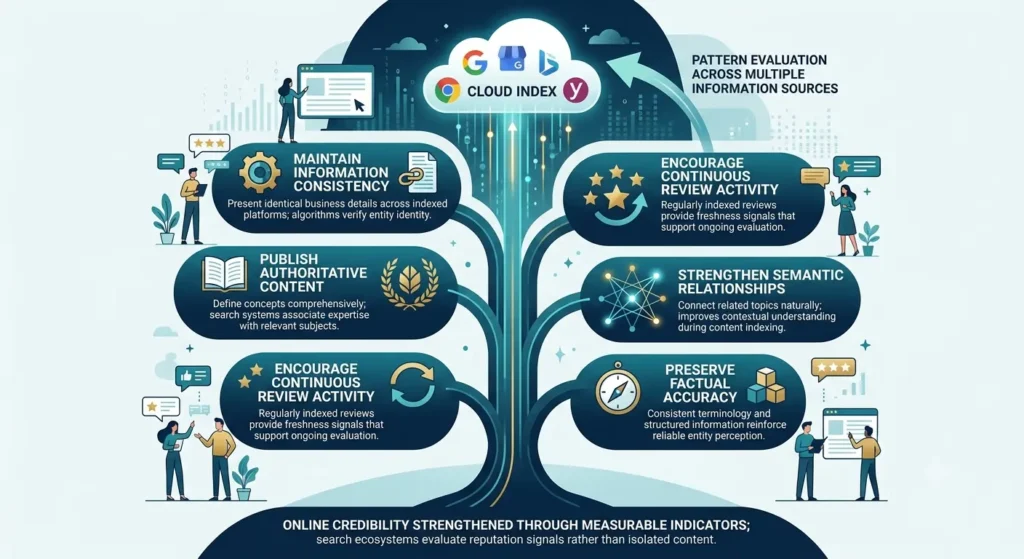
Online credibility is strengthened through measurable indicators that demonstrate consistency, authority, and information quality across digital environments. Search ecosystems evaluate credibility through interconnected reputation signals rather than isolated content.
- Maintain information consistency by presenting identical business details across indexed platforms, allowing algorithms to verify entity identity through matching data.
- Publish authoritative content by defining concepts comprehensively, enabling search systems to associate expertise with relevant subject areas.
- Encourage continuous review activity because regularly indexed reviews provide freshness signals that support ongoing reputation evaluation.
- Strengthen semantic relationships by connecting related topics naturally, improving contextual understanding during content indexing.
- Preserve factual accuracy through consistent terminology and structured information that reinforces reliable entity perception across search ecosystems.
Each factor contributes to a stronger semantic profile because search engines evaluate patterns across multiple information sources rather than isolated optimisation techniques.
Why is a digital footprint important for long-term reputation?
A digital footprint is the complete collection of indexed information associated with an entity across the internet. It includes websites, reviews, citations, media references, structured data, and user-generated content that collectively define online reputation.
Search engines continuously analyse this footprint to understand identity, authority, and relevance. Every indexed asset contributes additional semantic information that strengthens or weakens entity perception. Consistent digital footprints improve algorithmic confidence because information remains aligned across multiple sources. This alignment supports stronger search visibility and more accurate SERP evaluation.
Digital footprints also evolve through continuous indexing. New content, updated reviews, and refreshed information expand semantic relationships while maintaining historical context. Search ecosystems interpret these developments as part of an ongoing reputation profile rather than isolated events. Long-term credibility therefore depends on maintaining coherent information across the entire searchable environment.
Dive Deeper With Our Expert Guides:
How to Manage Google Reviews and Remove Negative Feedback Legally
Online review management represents an essential component of reputation management because reviews contribute measurable reputation signals that influence search visibility, entity perception, and digital trust. Search engines evaluate reviews alongside indexed content, authoritative references, structured data, and semantic relationships to determine how entities appear within search results.
Understanding reputation management from a search ecosystem perspective provides a clearer explanation of how content indexing, sentiment interpretation, SERP evaluation, and digital footprints interact. Rather than functioning as isolated ranking factors, these elements form an interconnected semantic network that defines online credibility, strengthens entity recognition, and shapes long-term digital reputation.
Answers to Key Questions
What is a review management service?
A review management service is the process of monitoring, organising, and responding to online reviews across digital platforms. It helps maintain accurate review information, supports online reputation, and strengthens trust signals that search engines evaluate.
Why is review management important for online reputation?
Review management helps ensure that customer feedback remains visible, organised, and up to date across online platforms. Consistent review activity and responses contribute to stronger reputation signals and improve overall brand perception in search results.
How do online reviews affect search engine rankings?
Online reviews provide fresh, user-generated content that search engines use as reputation and relevance signals. Review quality, recency, and consistency support local search visibility and influence how an entity is evaluated within search results.
How often should businesses monitor online reviews?
Businesses benefit from monitoring online reviews regularly to maintain accurate information and identify emerging reputation trends. Frequent monitoring also helps keep review data current, supporting search visibility and digital credibility.