

Reputation management for lawyers refers to the structured control of how legal professionals appear across search engines, review platforms, and digital information systems. It defines how credibility, trust, and authority are interpreted within search results.
Reputation management is the systematic process of shaping, monitoring, and influencing entity perception across search ecosystems, while online reputation refers to the aggregated digital signals, reviews, and indexed content that define how a lawyer or legal entity is evaluated in SERPs.
What is reputation management in search ecosystems for legal professionals?
Reputation management in search ecosystems for legal professionals is the process of shaping how legal entities are defined, indexed, and ranked across search engine results pages. It explains how search systems construct an evaluative profile of a lawyer based on distributed digital signals. This process operates through continuous content indexing, entity recognition, and trust calibration.
Search engines evaluate legal professionals as entities rather than isolated pages. This means every article, review, directory listing, and citation contributes to a unified reputation profile. The system consolidates these inputs into an entity-level understanding that determines search visibility and ranking position.
Reputation signals include structured data, backlinks, mentions, and review patterns. These signals define how authoritative a legal professional appears within a specific practice area. When these signals align consistently, search engines strengthen entity clarity and improve ranking stability.
The mechanism of reputation management operates through semantic association. Search engines connect topics such as legal expertise, client feedback, and professional mentions into a unified knowledge graph. This graph determines how often a lawyer appears in relevant queries and how prominently they are positioned.
Within this system, inconsistency reduces entity confidence. Conflicting information across platforms weakens trust evaluation and lowers search visibility. Consistency across indexed sources strengthens credibility signals and stabilises SERP positioning.
How do online reviews influence search visibility for lawyers?
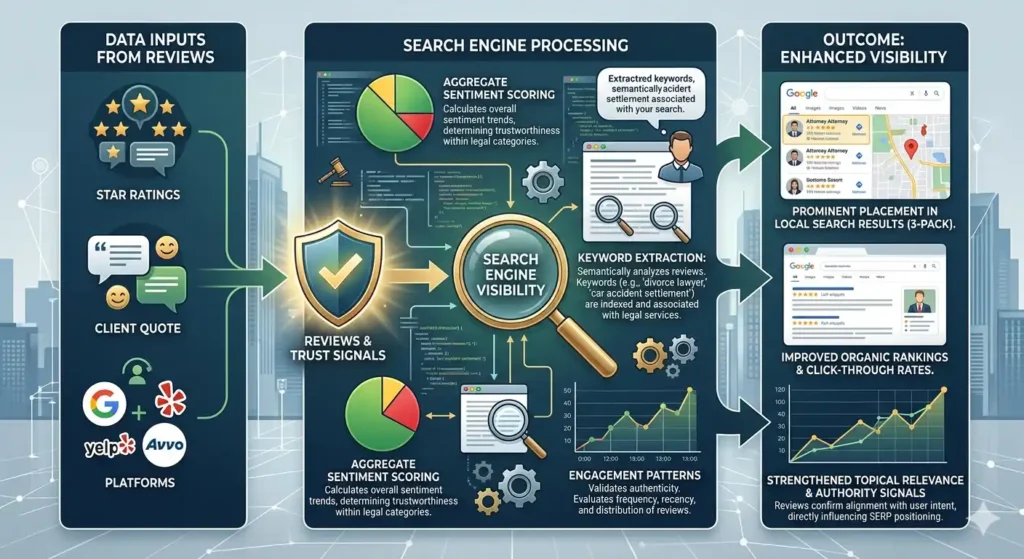
Online reviews influence search visibility for lawyers by functioning as direct trust signals within ranking algorithms and entity evaluation systems. Reviews are structured data inputs that contribute to sentiment scoring, relevance assessment, and credibility weighting in search results.
Search engines process reviews as part of entity reputation construction. Positive, consistent reviews reinforce authority signals, while negative or inconsistent patterns introduce trust ambiguity. These signals directly affect how prominently a legal professional appears in local and organic search results.
Review content is also semantically analysed. Keywords within reviews are indexed and associated with legal services, practice areas, and expertise categories. This association strengthens topical relevance, allowing search engines to map legal professionals to specific query clusters.
Key mechanisms through which reviews shape visibility
- Aggregate sentiment scoring evaluates consistency across platforms – Search systems calculate overall sentiment trends from review distributions, using them to determine perceived trustworthiness within legal categories.
- Keyword extraction strengthens topical relevance signals – Terms such as practice areas or legal outcomes embedded in reviews are indexed and mapped to search queries.
- Engagement patterns validate authenticity signals – Frequency, recency, and distribution of reviews contribute to authenticity evaluation within ranking systems.
Review ecosystems operate as external validation layers. They provide behavioural evidence that search engines use to confirm whether a legal entity aligns with user intent. This validation directly influences SERP positioning and visibility strength.
How do search engines evaluate entity reputation and trust signals?
Search engines evaluate entity reputation and trust signals by constructing a structured profile of authority, relevance, and credibility across indexed digital environments. This process is rooted in entity recognition systems that assign meaning to legal professionals as persistent digital identities.
Entity reputation is defined through aggregated signals from multiple sources, including citations, mentions, backlinks, and structured data. These signals are processed through knowledge graphs, which map relationships between legal entities, topics, and reputational indicators.
Trust signals operate as weighted variables in ranking systems. High-quality references from authoritative domains increase perceived credibility, while low-quality or inconsistent sources reduce trust stability. Search engines evaluate these patterns continuously to maintain ranking accuracy.
Entity evaluation also depends on contextual consistency. When a lawyer is referenced consistently across directories, articles, and legal listings, search systems strengthen identity confidence. This reduces ambiguity and improves SERP positioning for relevant legal queries.
Reputation signals are not static. They evolve through ongoing content indexing and re-evaluation cycles. Each new indexed page contributes to recalibrating how the entity is perceived within its topical domain.
The relationship between trust signals and search visibility is direct. Stronger trust profiles produce higher ranking stability, while fragmented signals create volatility in search performance.
What role does content indexing play in shaping a lawyer’s online image?
Content indexing plays a defining role in shaping a lawyer’s online image by determining which information is stored, retrieved, and ranked within search databases. Indexing establishes the foundation for how reputation data becomes visible to users and search systems.
Search engines crawl web content and assign it to indexed categories based on semantic relevance. For legal professionals, this includes practice areas, geographic relevance, and professional authority indicators. Indexed content becomes part of the entity’s searchable profile.
The indexing process evaluates structure, relevance, and contextual alignment. Pages with clear legal relevance are indexed more efficiently and associated more strongly with legal entity profiles. This strengthens search visibility across relevant queries.
Indexed content also contributes to reputation persistence. Once stored in search databases, content continues influencing entity perception over time. Even outdated or secondary references remain part of the evaluative structure unless reprocessed or devalued.
Anchor-based relevance also influences indexing strength. Internal linking structures guide search crawlers toward priority pages, reinforcing thematic authority. For example, structured legal content supported by online reputation analysis framework strengthens entity association within reputation systems.
Indexing does not merely store information; it structures perception. The way content is classified determines how search engines interpret authority, relevance, and trustworthiness. This directly affects how a legal professional is represented in SERPs.
How does sentiment analysis affect SERP evaluation of legal professionals?
Sentiment analysis affects SERP evaluation of legal professionals by interpreting the emotional and contextual tone of indexed content and converting it into structured reputation signals. This process enables search systems to assess whether references to a legal entity reflect positive, neutral, or negative perception.
Sentiment evaluation operates through natural language processing models that extract meaning from reviews, articles, and mentions. These models classify language patterns and assign them to sentiment categories, which are then integrated into entity reputation profiles.
Search engines use sentiment signals to refine ranking decisions. Positive sentiment strengthens credibility associations, while negative sentiment introduces risk signals that reduce perceived authority. Neutral sentiment contributes to baseline stability without significantly altering rankings.
Sentiment is also contextualised within topical relevance. A positive sentiment in a legal directory listing carries more weight than generic mentions in unrelated content. This contextual weighting ensures that sentiment analysis aligns with domain-specific evaluation.
The system continuously updates sentiment scores as new content is indexed. This creates a dynamic reputation model where perception evolves based on the latest available data.
Sentiment analysis therefore functions as a behavioural interpretation layer within SERP evaluation. It translates qualitative language into quantitative ranking inputs that influence how legal professionals are displayed in search results.
How is digital footprint constructed across platforms for lawyers?
Digital footprint for lawyers is constructed through the cumulative aggregation of all indexed content, mentions, and interactions associated with a legal entity across digital platforms. It defines the total searchable presence that search engines use to evaluate identity and authority.
Each platform contributes a segment of the digital footprint. Legal directories, news articles, review platforms, and professional listings all generate structured and unstructured data that becomes part of the entity profile. These inputs are merged into a unified representation within search systems.
The construction process relies on cross-platform entity matching. Search engines identify references to the same legal professional across different sources and consolidate them into a single identity cluster. This process strengthens entity coherence and improves search accuracy.
Digital footprint strength depends on consistency. Uniform naming, accurate professional details, and repeated authoritative references improve recognition accuracy. Inconsistent data fragments weaken entity consolidation and reduce search visibility.
Platform diversity also influences footprint complexity. A broad presence across multiple authoritative domains increases entity depth, while limited presence restricts indexing coverage and reduces SERP dominance.
Digital footprint is continuously updated through crawling and re-indexing cycles. Each new digital interaction modifies the entity’s perceived authority, relevance, and trustworthiness within search ecosystems.
How do authority signals determine credibility in legal search results?
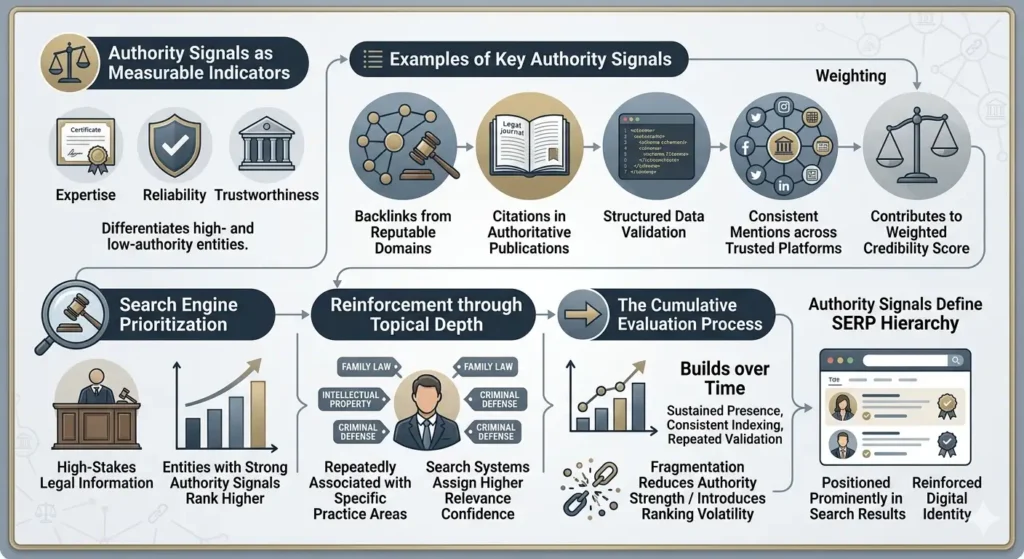
Authority signals determine credibility in legal search results by providing measurable indicators of expertise, reliability, and trustworthiness within search ranking systems. These signals form the basis of how search engines differentiate between high- and low-authority legal entities.
Authority signals include backlinks from reputable domains, citations in authoritative publications, structured data validation, and consistent mentions across trusted platforms. Each signal contributes to a weighted credibility score within search algorithms.
Search engines prioritise authority when evaluating legal content due to the high-stakes nature of legal information. Entities with strong authority signals are ranked higher because they demonstrate verified expertise and consistent digital validation.
Authority is also reinforced through topical depth. When a legal professional is repeatedly associated with specific practice areas across indexed content, search systems assign higher relevance confidence. This strengthens ranking stability for related queries.
The evaluation process is cumulative. Authority signals build over time through sustained presence, consistent indexing, and repeated validation across multiple digital sources. Fragmentation reduces authority strength and introduces ranking volatility.
Authority signals ultimately define SERP hierarchy. They determine which legal professionals are positioned prominently in search results and how strongly their digital identity is reinforced within the broader search ecosystem.
Reputation management for lawyers operates as a structured system of search-based entity evaluation, where online visibility is defined by indexed content, trust signals, and sentiment interpretation. It establishes how legal professionals are represented within SERPs through continuous data aggregation.
Online reputation is constructed through interconnected mechanisms including reviews, authority signals, digital footprint distribution, and content indexing. Each mechanism contributes to entity perception within search ecosystems, shaping how credibility is calculated and displayed.
Search engines evaluate legal professionals as unified entities rather than isolated sources, ensuring that reputation is defined by aggregated digital signals rather than single-point references.
Answers to Key Questions
What is reputation management for lawyers in search engines?
Reputation management for lawyers refers to how a legal professional’s online presence is shaped through search engine results, reviews, and indexed content. It influences search visibility by controlling how entity signals such as credibility, authority, and relevance are interpreted in SERPs.
How do online reviews affect a lawyer’s digital reputation?
Online reviews directly impact a lawyer’s digital reputation by contributing sentiment signals and trust indicators to search algorithms. Positive and consistent reviews strengthen credibility, while negative patterns can reduce perceived authority in legal search results.
Why is search visibility important for a lawyer’s online reputation?
Search visibility determines how prominently a lawyer appears in Google results for legal queries. Higher visibility reflects stronger entity reputation signals, including authority, content relevance, and trustworthiness within search ranking systems.
How does Google evaluate a lawyer’s credibility online?
Google evaluates a lawyer’s credibility through entity-based signals such as backlinks, mentions, reviews, and content consistency across platforms. These signals are processed to assess trust, expertise, and relevance within legal search categories.