

Reputation management strategies differ based on how legal professionals improve search visibility, strengthen entity credibility, and manage digital trust across search ecosystems. Online reputation control methods are evaluated through reputation signals, search ranking influence, sentiment distribution, and SERP composition rather than isolated reputation metrics.
A reputation management checklist provides a structured framework for evaluating the digital assets that shape an attorney’s online presence. Search engines analyse authoritative content, legal directories, review platforms, media references, and business information collectively to determine how legal professionals appear within branded search results. Understanding these interconnected factors allows lawyers to compare different reputation management approaches based on effectiveness, sustainability, and risk exposure instead of relying on individual tactics.
Reputation management for lawyers is a continuous process of assessing digital information, identifying weaknesses, and improving authoritative reputation signals. Each component within a structured checklist contributes differently to search visibility, entity perception, and long-term online credibility.
Which Reputation Signals Should Lawyers Evaluate First?
The most influential reputation signals are those that search engines consistently associate with professional credibility and digital authority. Evaluating these signals first provides a clearer understanding of how search ecosystems interpret an attorney’s online identity.
Professional websites establish foundational authority because they contain verified business information, legal expertise, practice areas, and structured data. Search engines use these elements to confirm entity relationships and evaluate topical relevance.
Legal directories contribute additional authority by providing consistent professional information across trusted third-party platforms. Accurate listings reinforce entity credibility and improve consistency between multiple search sources.
Review platforms, educational publications, media references, and business profiles expand reputation signals further. Search algorithms compare these assets collectively when determining search ranking influence and SERP composition.
Dive Deeper With Our Expert Guides:
Online Reputation Strategies Every Attorney Should Implement
How Does Content Enhancement Compare With Content Suppression?
Content enhancement and content suppression represent two different reputation management approaches that influence search visibility through separate mechanisms. Each method addresses reputation challenges from a different perspective.
Content Enhancement
Content enhancement is the process of increasing authoritative information across search ecosystems. It operates by publishing valuable legal resources, educational articles, professional biographies, and updated website content that strengthen positive reputation signals.
Search engines reward high-quality content because it improves topical authority and expands semantic relevance. As authoritative assets increase, stronger digital resources gradually influence search ranking and reduce the relative visibility of weaker content.
The primary advantage of content enhancement is sustainability. High-quality content continues supporting entity credibility while strengthening long-term search visibility through ongoing indexing and ranking improvements.
Content Suppression
Content suppression refers to reducing the prominence of unfavourable search results without removing indexed content. It operates by improving the visibility of stronger, more authoritative resources that compete for search rankings.
Search engines compare relevance, authority, freshness, and user engagement when determining rankings. Stronger positive assets gradually influence SERP composition by occupying more prominent search positions.
Content suppression provides broader scalability than direct removal because it focuses on improving overall search ecosystems rather than targeting individual webpages. The limitation is that underlying content remains indexed even when its visibility decreases.
Which Approach Produces Better Results: Organic or Reactive Reputation Management?
Organic reputation management builds authority before visibility issues emerge, while reactive reputation management addresses reputation concerns after negative search results appear. Each strategy influences search perception through different operational models.
Organic approaches strengthen reputation signals through continuous content development, directory optimisation, structured business information, and authoritative publications. Search engines interpret these activities as evidence of stable entity credibility and consistent digital authority.
Reactive reputation management analyses existing search results before implementing corrective measures. The process evaluates reputation weaknesses, identifies inconsistent signals, and improves digital assets affecting search visibility.
Organic strategies generally demonstrate stronger sustainability because they strengthen digital authority continuously. Reactive approaches provide greater focus on existing visibility challenges but depend upon accurate evaluation of current search conditions.
Which Checklist Components Have the Greatest Impact on Search Visibility?
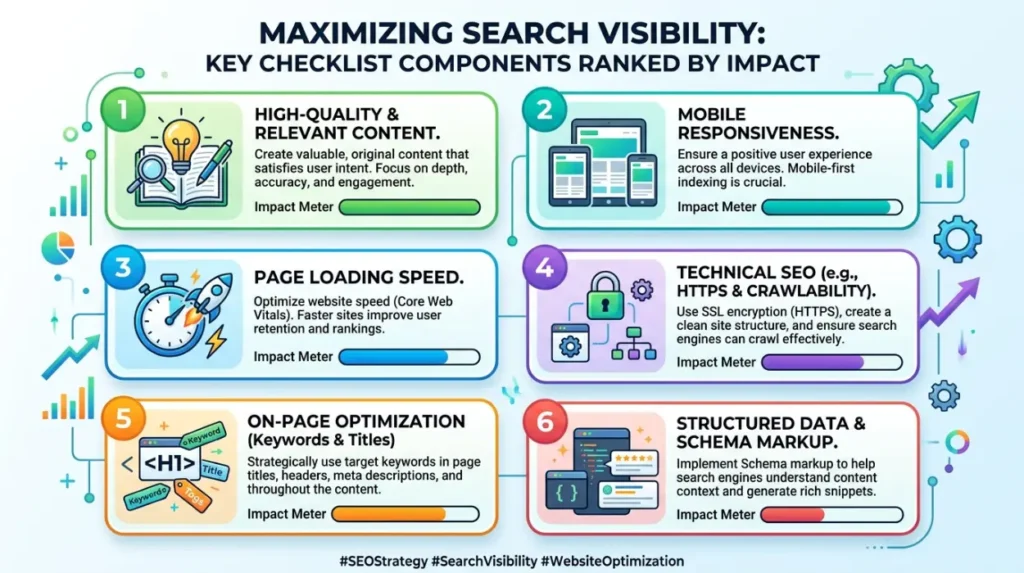
Different checklist components influence search visibility through separate reputation mechanisms. Their relative importance depends upon authority, consistency, semantic relevance, and search engine interpretation.
The most significant evaluation areas include:
- Review website authority by assessing structured legal content and technical quality.
- Verify legal directory consistency using identical professional information across trusted platforms.
- Evaluate review profiles to understand sentiment distribution and reputation signals.
- Measure media visibility by analysing authoritative references appearing within branded searches.
- Assess business information consistency to strengthen entity credibility across search ecosystems.
Each component contributes unique signals that search engines combine during SERP evaluation. Strong consistency across all checklist categories improves overall search perception more effectively than isolated optimisation efforts.
How Do Search Engines Compare Reputation Signals?
Search engines compare reputation signals by analysing consistency, authority, topical relevance, and contextual relationships between digital assets. Individual webpages rarely determine reputation independently because algorithms evaluate interconnected information.
Entity credibility develops through repeated confirmation across trusted sources. Business information, legal qualifications, educational publications, directory profiles, structured data, and authoritative references collectively reinforce professional identity.
Search ranking influence depends upon how these signals interact. High-authority content, verified profiles, quality reviews, semantic relevance, and positive user engagement strengthen search visibility by supporting reliable entity relationships.
Professionals evaluating structured reputation frameworks often gain additional perspective by examining expert reputation management for law firms, as it explains how coordinated reputation strategies influence search ecosystems beyond individual optimisation tactics.
How Does Review Management Compare With Authority Building?
Review management and authority building influence online reputation through different mechanisms within search ecosystems. Review management evaluates public feedback and sentiment distribution, while authority building strengthens entity credibility through trusted information sources.
Review Management
Review management is the process of monitoring, analysing, and maintaining review quality across recognised platforms. It operates by improving profile completeness, encouraging authentic feedback, and maintaining accurate business information associated with review platforms.
Search engines interpret reviews as one component of broader reputation signals rather than an isolated ranking factor. Review quality, consistency, recency, and platform authority collectively influence public perception and contribute to search ranking influence.
The primary advantage of review management is its direct effect on visible trust indicators. Its limitation is dependence on third-party platforms, where moderation policies and user-generated content remain outside direct editorial control.
Authority Building
Authority building is the process of expanding credible digital assets that reinforce professional expertise and entity perception. It operates through authoritative legal content, verified business profiles, industry publications, legal directories, and structured website information.
Search engines compare these authoritative assets against competing information to determine topical relevance and entity credibility. Consistent authority signals improve search visibility while strengthening long-term SERP composition.
Authority building provides stronger sustainability because newly indexed authoritative content continues supporting digital credibility long after publication. The limitation is that measurable improvements develop progressively as search engines evaluate new information.
Which Reputation Management Activities Deliver the Greatest Long-Term Sustainability?
Long-term sustainability is achieved by strengthening digital authority rather than relying exclusively on short-term corrective measures. Sustainable reputation management focuses on continuously improving the quality and consistency of information that search engines evaluate.
Content enhancement supports ongoing authority because each authoritative publication contributes additional semantic relevance and topical depth. Search engines continuously reassess this information, allowing strong digital assets to reinforce entity credibility over time.
Directory optimisation also contributes to sustainability by maintaining accurate professional information across trusted legal platforms. Consistent business details reduce conflicting reputation signals and improve algorithmic confidence in professional identity.
Review monitoring remains valuable because it supports balanced sentiment distribution while identifying emerging changes in public perception. Combined with authoritative content and consistent profiles, review management contributes to a stable digital reputation that adapts to evolving search ecosystems.
How Does Risk Exposure Differ Between Reputation Management Strategies?
Risk exposure varies according to the methods used to influence search visibility and reputation signals. Strategies that align with search engine quality principles generally create lower long-term risk than approaches designed to manipulate rankings artificially.
Content enhancement strengthens authoritative information through genuine expertise, making it compatible with long-term search evaluation systems. This reduces the likelihood of significant visibility fluctuations caused by algorithmic quality updates.
Content suppression also operates within accepted search ecosystem principles when achieved through stronger competing content rather than technical manipulation. Improved authoritative assets naturally influence SERP composition without altering indexed information directly.
Strategies relying upon inaccurate information, artificial engagement, or inconsistent digital identities weaken entity credibility and increase search uncertainty. Search engines compare information across trusted sources, making consistency an essential factor in reducing long-term reputation risk.
Which Reputation Management Checklist Provides the Most Balanced Evaluation?
A balanced reputation management checklist evaluates every reputation signal contributing to search visibility rather than concentrating on one digital platform. Comprehensive evaluation provides greater understanding of overall entity credibility and search perception.
A structured checklist typically examines website authority, review sentiment, legal directory consistency, business profile accuracy, media references, structured data, content indexing, and SERP composition together. Each component influences search ecosystems through different mechanisms, making collective evaluation more informative than isolated analysis.
Comparing these areas also highlights strengths and weaknesses within an attorney’s digital footprint. Search visibility improves most effectively when reputation signals reinforce one another across multiple authoritative sources instead of operating independently.
The checklist therefore functions as an analytical framework for understanding how search engines interpret legal professionals within increasingly complex digital ecosystems.
A reputation management checklist for lawyers provides a structured method for evaluating the reputation signals that influence search visibility, entity credibility, and public perception. Content enhancement, content suppression, review management, authority building, directory consistency, and digital footprint analysis each contribute different strengths, limitations, and long-term outcomes.
Search engines evaluate these interconnected signals collectively rather than independently. Understanding how individual strategies influence SERP composition, sentiment distribution, and search ranking influence enables more informed evaluation of reputation management approaches without relying on isolated optimisation methods.
Comparing reputation management strategies through a structured checklist supports clearer analysis of sustainability, scalability, effectiveness, and risk exposure. This analytical approach provides a stronger understanding of how online reputation develops within modern search ecosystems and why consistent authority remains central to long-term digital credibility.
What should a reputation management checklist for lawyers include?
A reputation management checklist for lawyers should include website optimisation, legal directory accuracy, client review monitoring, branded search analysis, content quality, and business profile consistency. These elements strengthen reputation signals and improve search visibility across search engines.
Why is a reputation management checklist important for lawyers?
A structured reputation management checklist helps lawyers evaluate the factors that influence online credibility and entity perception. Regular assessments support accurate business information, stronger trust signals, and improved search ranking influence.
How do search engines evaluate a lawyer’s online reputation?
Search engines evaluate online reputation by analysing reputation signals such as authoritative content, review quality, legal directory listings, business information consistency, and content indexing. These factors collectively influence SERP evaluation and search visibility.
What is the difference between content enhancement and content suppression?
Content enhancement focuses on publishing authoritative information that strengthens search visibility and entity credibility. Content suppression reduces the prominence of unfavourable search results by increasing the visibility of stronger, more relevant content rather than removing existing pages.
How does Clear My Name support reputation management for lawyers?
Clear My Name approaches reputation management for lawyers by evaluating search visibility, reputation signals, digital footprint quality, and entity credibility. The process focuses on maintaining accurate online information and improving long-term search perception across authoritative platforms.