
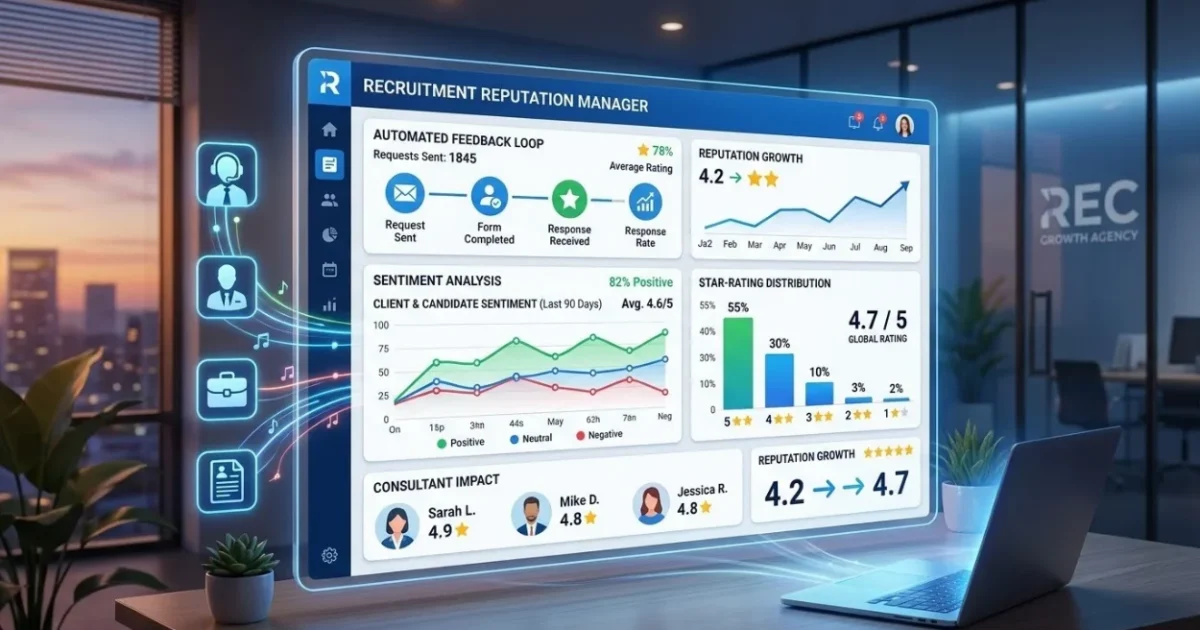
A review generation programme gives recruitment agencies a structured way to strengthen reputation signals, improve search visibility and increase control over how prospective clients and candidates assess the business.
The right programme combines review acquisition, reputation monitoring, response management and SERP control to create measurable improvements in trust and search perception.
What Does a Recruitment Agency Review Generation Programme Actually Include?
A professional review generation programme includes a controlled system for requesting genuine feedback, monitoring reputation signals, managing responses and identifying search visibility risks. Recruitment agencies operate in a trust-sensitive environment where candidates and employers assess credibility before initiating contact. Reviews therefore form part of the wider entity credibility surrounding an agency, rather than functioning as isolated ratings. A structured programme connects review activity with the agency’s wider digital reputation and search presence. This creates a clearer process for improving perception without relying on artificial review activity or unsupported claims.
The first component is review acquisition from genuine clients, candidates and other eligible stakeholders. The process establishes appropriate points in the recruitment journey where feedback requests can be issued consistently. Timing matters because a review request connected to a completed placement, successful hiring process or concluded consultancy engagement produces feedback based on an identifiable experience. This creates a reliable source of reputation signals while maintaining authenticity. Consistent acquisition also produces a more representative review profile over time.
A complete programme also includes reputation monitoring across the platforms that influence recruitment decisions. Google Business Profile reviews, recruitment-related directories, social platforms and other publicly visible sources can contribute to search perception. Monitoring identifies rating changes, recurring complaints, positive themes and content that gains search visibility. The agency can then distinguish between an isolated criticism and a recurring reputation issue. This improves decision-making because reputation activity becomes measurable rather than reactive.
Which Review Generation Process Delivers the Strongest Reputation Signals?
A structured review process delivers stronger reputation signals because it creates consistent feedback at defined stages of the recruitment lifecycle. The objective is not simply to increase the number of reviews but to build a credible pattern of genuine experiences around the agency. Search users interpret ratings, review frequency, recency and written sentiment together when evaluating a recruitment business. A controlled process therefore supports both immediate trust and long-term entity credibility. The programme becomes more valuable when every review request follows a documented and repeatable workflow.
An effective process can be organised around these actions:
- Identify completed recruitment interactions where a legitimate review request is appropriate
- Trigger feedback requests at defined stages after placements, consultancy engagements or completed hiring assignments
- Collect genuine responses through compliant review channels without manufacturing or manipulating feedback
- Monitor new reviews for sentiment, recurring themes, rating changes and reputation risks
- Analyse review patterns to identify service weaknesses affecting public perception
- Respond consistently to legitimate criticism while reinforcing factual and professional information
- Measure rating movement, review acquisition, sentiment and search visibility over time
This approach also reduces operational inconsistency. Without a defined process, review requests become dependent on individual consultants remembering when and how to ask for feedback. A programme removes that inconsistency by connecting reputation activity with operational events. The result is a more stable review profile that accurately reflects the agency’s ongoing performance. That stability strengthens trust because prospects encounter an active and coherent reputation rather than an outdated collection of reviews.
Recruitment agencies also benefit from analysing the language used within reviews. Repeated references to communication, candidate quality, responsiveness, hiring outcomes or consultancy expertise create identifiable reputation themes. Those themes contribute to how users understand the agency before they make contact. Reputation analysis therefore goes beyond calculating an average star rating. It identifies the specific signals that support or weaken search perception influence.
Dive Deeper With Our Expert Guides:
What Is Proactive Reputation Management and When Do Agencies Start It?
How Do Finance Recruiters Build a Personal Brand Candidates Trust?
How Does Review Generation Improve Search Visibility and SERP Control?
Review generation improves search visibility indirectly by strengthening the reputation signals associated with an agency and its business entity. Search engines evaluate numerous signals when determining which information appears for branded and local queries, while users also interpret visible ratings and review content when selecting a recruitment provider. A consistent stream of legitimate reviews gives the business a stronger and more current reputation footprint. This does not guarantee a particular ranking position, because rankings depend on multiple search-system factors. It does, however, create stronger supporting signals around the agency’s digital presence.
SERP control becomes especially important when negative or outdated content appears prominently for branded searches. A recruitment agency cannot control every third-party page that mentions its business, but it can strengthen credible assets that compete for attention in the search ecosystem. This includes authoritative business profiles, relevant website content, legitimate reviews and other trustworthy sources connected to the agency. Stronger assets increase the available positive and neutral signals surrounding the entity. This supports negative content suppression by improving the overall quality and breadth of the information users encounter.
The process can be strengthened through search visibility control for recruitment agencies, particularly when review activity forms part of a broader reputation strategy. Review generation alone does not remove negative content from search results. Instead, it contributes to an ecosystem of credible information that supports improved perception when users investigate the agency. This distinction is important because sustainable reputation management focuses on the complete search environment rather than attempting to manipulate one ranking signal.
The relationship between consultant performance and agency reputation also matters. Individual consultants frequently interact directly with candidates and employers, creating experiences that become associated with the wider recruitment brand. Understanding how consultant reviews affect agency reputation provides a stronger basis for evaluating the value of a review programme. This prevents agencies from treating reviews as disconnected testimonials and instead positions them as reputation signals within a broader entity structure.
Does Professional Reputation Management Reduce the Risk of Negative Reviews?
Professional reputation management reduces risk by identifying reputation threats early and establishing a defined response process before negative content becomes a wider search problem. A negative review is not automatically damaging, but an unresolved complaint that receives engagement and remains highly visible can influence public perception. Recruitment agencies face particular exposure because candidates and employers often use online research as part of supplier and employer evaluation. Delayed responses therefore leave the narrative largely controlled by the reviewer. A structured reputation process restores operational control.
Risk management starts with classification. Legitimate criticism requires a professional response and internal assessment, while content that breaches a platform’s rules requires a different process. Reviews containing harassment, personal information, fabricated claims or other policy violations can be assessed against the relevant platform’s rules. Where removal is justified, the correct reporting and escalation mechanism provides a defensible route. This is fundamentally different from attempting to remove genuine criticism simply because it is unfavourable.
The response process also protects the agency from inconsistent public communication. A defensive or emotional response can amplify a complaint and create additional reputational exposure. A controlled approach keeps responses factual, proportionate and aligned with the agency’s professional identity. It also allows recurring complaints to reach operational teams so that reputation management informs service improvement. This creates a feedback loop between public perception and business performance.
Is the Cost of Review Generation Justified for Recruitment Agencies?
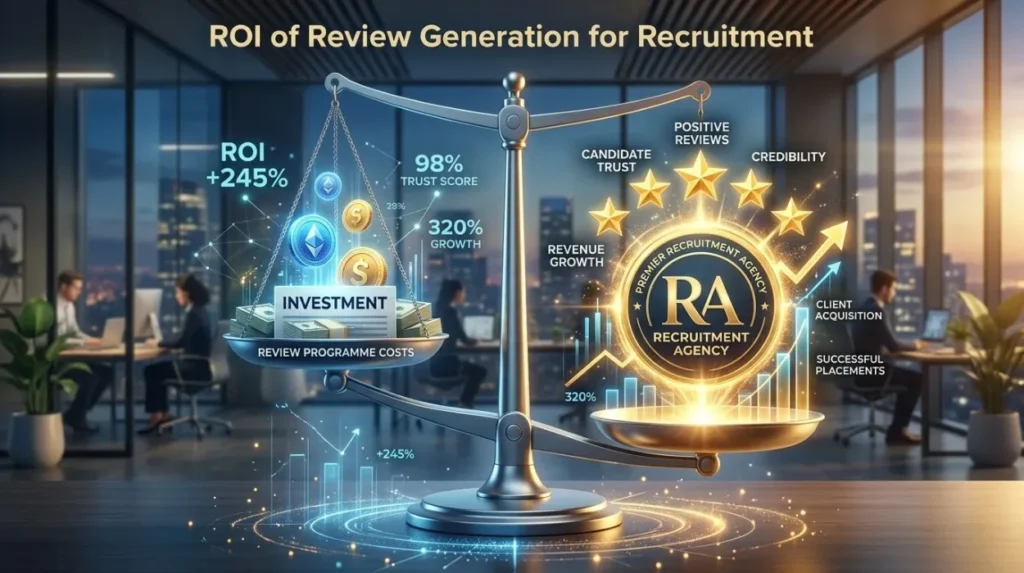
The cost is justified when review generation forms part of a measurable reputation system rather than operating as a standalone request for testimonials. Recruitment agencies compete for trust from two commercially important audiences: candidates and employers. For professionals becoming a recruitment consultant in the UK, building a credible reputation early can provide additional evidence of reliability and expertise. A stronger reputation reduces uncertainty during the selection process and gives prospects additional evidence when comparing agencies. The commercial value therefore extends beyond the review platform itself. It includes improved trust, stronger search perception and reduced reputational risk.
Cost assessment becomes clearer when agencies measure outcomes rather than review volume alone. A useful evaluation framework includes:
- Track review acquisition rates to measure whether the programme consistently generates genuine feedback
- Measure average rating movement to identify changes in overall reputation performance
- Monitor review recency to determine whether the agency maintains an active reputation profile
- Analyse sentiment themes to identify repeated strengths and service weaknesses
- Assess branded search results to identify changes in visible reputation content
- Compare enquiry behaviour before and after reputation improvements where reliable analytics are available
- Record policy-based removal outcomes to quantify the impact of legitimate content intervention
This measurement framework prevents agencies from judging success through vanity metrics. A business that gains reviews but continues to display unresolved negative content in prominent search positions has not achieved full reputation control. Likewise, a business with a strong rating but weak monitoring remains exposed to future reputation deterioration. Value comes from combining acquisition, analysis, response and search visibility management.
For agencies with a large consultant network, the economic value becomes more significant because reputation activity can otherwise become fragmented. A central programme creates consistent standards across consultants while preserving genuine individual experiences. It also allows management teams to identify patterns across offices, teams or service lines. This makes reputation data useful for operational decisions as well as marketing performance.
How Quickly Can a Recruitment Agency Expect Reputation Improvements?
Reputation improvements become visible at different speeds depending on the outcome being measured. New genuine reviews can appear as soon as customers complete the feedback process, while changes in average ratings depend on the agency’s existing review profile and the volume of new feedback. Search visibility changes follow a separate timeline because search engines continuously process content, relevance, authority and engagement signals. No credible reputation service can guarantee a specific ranking position within an arbitrary timeframe. A reliable programme instead establishes measurable milestones and monitors movement against them.
Early indicators include increased review activity, stronger review recency and improved response consistency. Medium-term indicators include changes in rating distribution, sentiment patterns and the prominence of credible agency information. Longer-term outcomes involve a more stable reputation profile and stronger control over the information encountered during branded searches. This staged approach gives agencies realistic visibility into performance. It also prevents short-term ranking fluctuations from being mistaken for permanent reputation outcomes.
Speed also depends on the starting condition. An agency with a strong operational record but an inactive review profile has a different challenge from an agency facing persistent negative content across multiple platforms. The first requires systematic reputation signal development, while the second requires signal development alongside risk assessment and negative content suppression. A professional programme adjusts the workflow to the actual search environment. This makes the strategy more reliable than applying the same review process to every recruitment agency.
Why Choose Clear My Name for Reputation Management for Recruiters?
Clear My Name provides a structured approach to professional reputation management for recruiters, connecting review activity with broader reputation monitoring, search perception influence and SERP control. The value of this approach lies in process clarity: reputation signals are identified, monitored and evaluated rather than treated as isolated marketing assets. Recruitment agencies gain a clearer view of what prospective candidates and employers encounter when researching the business. This supports more informed decisions about review acquisition, response management and negative content intervention.
A credible reputation management strategy also separates legitimate reputation development from artificial reputation manipulation. Genuine reviews provide evidence of real customer experiences, while compliant monitoring identifies content requiring professional attention. This distinction reduces platform-policy risk and protects the agency’s long-term credibility. The objective is not to manufacture a perfect reputation but to establish a more accurate, current and trustworthy digital representation of the business.
Clear My Name also fits the wider principle that reputation is an ongoing search ecosystem rather than a one-off campaign. Reviews continue to change, new content enters search results and public perception evolves with each visible interaction. Continuous monitoring therefore provides greater reliability than a short-term burst of review activity. It keeps the agency aware of reputation changes and provides a defined route for addressing emerging risks.
What Outcomes Can a Recruitment Agency Expect From a Structured Programme?
A structured programme delivers measurable improvements across visibility, trust and reputation control when review acquisition is combined with monitoring and search-focused management. The strongest outcome is not simply a higher star rating. It is a more coherent digital reputation in which genuine reviews, authoritative business information and professional responses reinforce the agency’s credibility. This improves the information environment prospective clients and candidates use when making decisions. It also reduces dependence on a single review or platform.
The core outcomes include:
- Strengthen reputation signals through consistent acquisition of genuine customer feedback
- Improve review recency by maintaining an active and representative feedback profile
- Stabilise public perception through consistent responses and reputation monitoring
- Reduce reputational risk by identifying policy violations and emerging negative themes early
- Increase SERP control by strengthening credible information surrounding the agency entity
- Support negative content suppression through a broader ecosystem of relevant, trustworthy content
- Measure reputation performance through rating, sentiment, visibility and engagement indicators
These outcomes create long-term value because they reinforce one another. Better review activity produces stronger reputation evidence, stronger evidence supports trust, and improved trust contributes to how users interpret search results. Monitoring then protects those gains by identifying emerging threats. The programme therefore functions as an integrated reputation system rather than a simple review collection exercise.
Is a Review Generation Programme the Right Reputation Strategy for Your Recruitment Agency?
A review generation programme is the right starting point when an agency needs stronger reputation signals, greater search visibility control and a consistent method for demonstrating genuine client and candidate experiences. It becomes even more valuable when integrated with professional monitoring and content management. Recruitment agencies operate in a market where credibility influences both candidate engagement and employer decisions. A controlled digital reputation therefore represents a business asset rather than a cosmetic marketing feature.
The decision should centre on process reliability, measurable outcomes and risk control. A provider must distinguish genuine review generation from manipulation, separate legitimate criticism from removable policy violations and evaluate the complete search environment surrounding the agency. The programme must also remain sustainable after initial improvements appear. These requirements make reputation management a continuing discipline rather than a one-time campaign.
Clear My Name positions reputation management around that disciplined approach, combining reputation signals, search perception influence and SERP control to give recruitment agencies greater control over their digital reputation. The result is a clearer and more defensible process for strengthening trust, managing negative visibility and maintaining credible search results. For agencies where online perception directly affects candidate and employer decisions, that level of control provides measurable long-term value.
What does a review generation programme include for recruitment agencies?
It includes genuine review requests, reputation monitoring, review response management and performance tracking. The process builds consistent reputation signals while improving visibility into how candidates and employers perceive the agency.
How can review generation improve a recruitment agency’s online reputation?
Consistent genuine reviews strengthen the agency’s reputation signals by providing current evidence of client and candidate experiences. Review monitoring and professional responses also help stabilise public perception and support stronger entity credibility.
How do recruitment agencies manage negative reviews?
Agencies can assess negative reviews for legitimacy, respond professionally to genuine criticism and report content that violates platform policies. Reputation management also monitors search visibility to identify negative content that requires further attention.
Does reputation management help recruitment agencies control search results?
Reputation management supports SERP control by strengthening credible business information, genuine reviews and authoritative content associated with the agency. This improves the overall search environment and supports negative content suppression where appropriate.
Is a review generation programme worth the cost for a recruitment agency?
A review generation programme provides long-term value when it combines review acquisition with reputation monitoring, sentiment analysis and search visibility management. Measuring rating trends, review recency, sentiment and branded search results helps agencies assess its effectiveness.