

Constituent complaints online affect re-election chances because publicly visible criticism becomes part of the information voters encounter when evaluating a political candidate.
Reputation management is the process of monitoring and understanding reputation signals, while online reputation refers to how searchable information shapes entity perception across digital ecosystems.
How do constituent complaints become online reputation signals?
Constituent complaints become online reputation signals when criticism is published, indexed, discussed, reviewed, or referenced across digital platforms. A complaint can exist on a social network, review platform, local publication, discussion forum, campaign-related website, or search result. Once indexed, the information becomes part of the candidate’s digital footprint and can appear in response to relevant searches. Search engines then evaluate the relationship between the candidate entity, the complaint, the source, and the user’s query. This process transforms individual criticism into searchable information that contributes to online reputation.
The significance of a complaint depends on its context and visibility rather than its existence alone. A complaint buried within a low-authority page has a different search impact from criticism published by a prominent news source or repeatedly referenced across authoritative websites. Search ranking dynamics determine which sources appear prominently when voters investigate a candidate. Content indexing therefore acts as an important bridge between public criticism and search perception. The resulting SERP composition influences which reputation signals receive attention during online research.
Why does online criticism influence voter perception?
Online criticism influences voter perception because search results provide a structured information environment through which people investigate candidates and public representatives. Voters encounter news reports, official statements, social discussions, reviews, interviews, professional profiles, and constituent commentary within the same digital ecosystem. These sources provide different levels of authority and different forms of evidence about the candidate entity. Search visibility determines the prominence of each source, while content quality and relevance influence how useful the information appears. Online reputation therefore develops through the combined presentation of multiple sources.
Perception is also influenced by information repetition. When the same complaint is referenced by multiple independent sources, search users encounter a stronger association between the complaint topic and the political entity. This does not mean that search engines determine whether a complaint is factually correct or politically significant. Instead, ranking systems organise available information according to relevance and other signals. Users then interpret the resulting information environment when forming their own judgements. Reputation analysis therefore examines both the content itself and its position within the wider search ecosystem.
How do search engines interpret constituent complaints?
Search engines interpret constituent complaints through relationships between entities, documents, topics, queries, and sources rather than through a single political reputation score. The candidate represents an identifiable entity, while complaints and related coverage provide contextual information connected to that entity. Search systems evaluate which documents best correspond to a particular query and determine their relative visibility within the SERP. Authority, relevance, freshness, content quality, and other ranking signals influence this process. The resulting rankings determine which reputation information becomes most accessible to search users.
Entity perception develops as information accumulates around the candidate. If a candidate is consistently associated with a particular policy complaint, service issue, or constituent concern across indexed sources, that subject becomes part of the entity’s searchable context. Other content can provide additional information that broadens or changes this context. Search visibility therefore reflects the competitive relationship between different sources rather than a fixed reputation classification. Understanding this mechanism helps explain why online complaints can remain relevant beyond their original publication.

What makes some constituent complaints more visible than others?
The visibility of constituent complaints depends on the characteristics of the content, publishing source, search query, and competitive SERP environment. Content published by an authoritative source has a different ranking profile from content appearing on a page with limited relevance or authority. Query alignment also matters because a complaint connected directly to the candidate’s name can compete differently from one associated with a broader policy topic. Freshness can influence the visibility of recently published material, while established pages can retain visibility through continuing relevance. These factors collectively determine how strongly a complaint participates in search perception.
Content indexing also affects discoverability. A complaint that is not indexed does not normally participate in standard organic search results, while indexed content becomes eligible for ranking against relevant queries. Search engines continuously process new and existing pages, meaning visibility can change as the information environment develops. New reporting can introduce additional references, while older pages can lose prominence as competing content appears. Reputation signals therefore need to be evaluated dynamically rather than through a single search observation.
How do reviews and sentiment affect political reputation?

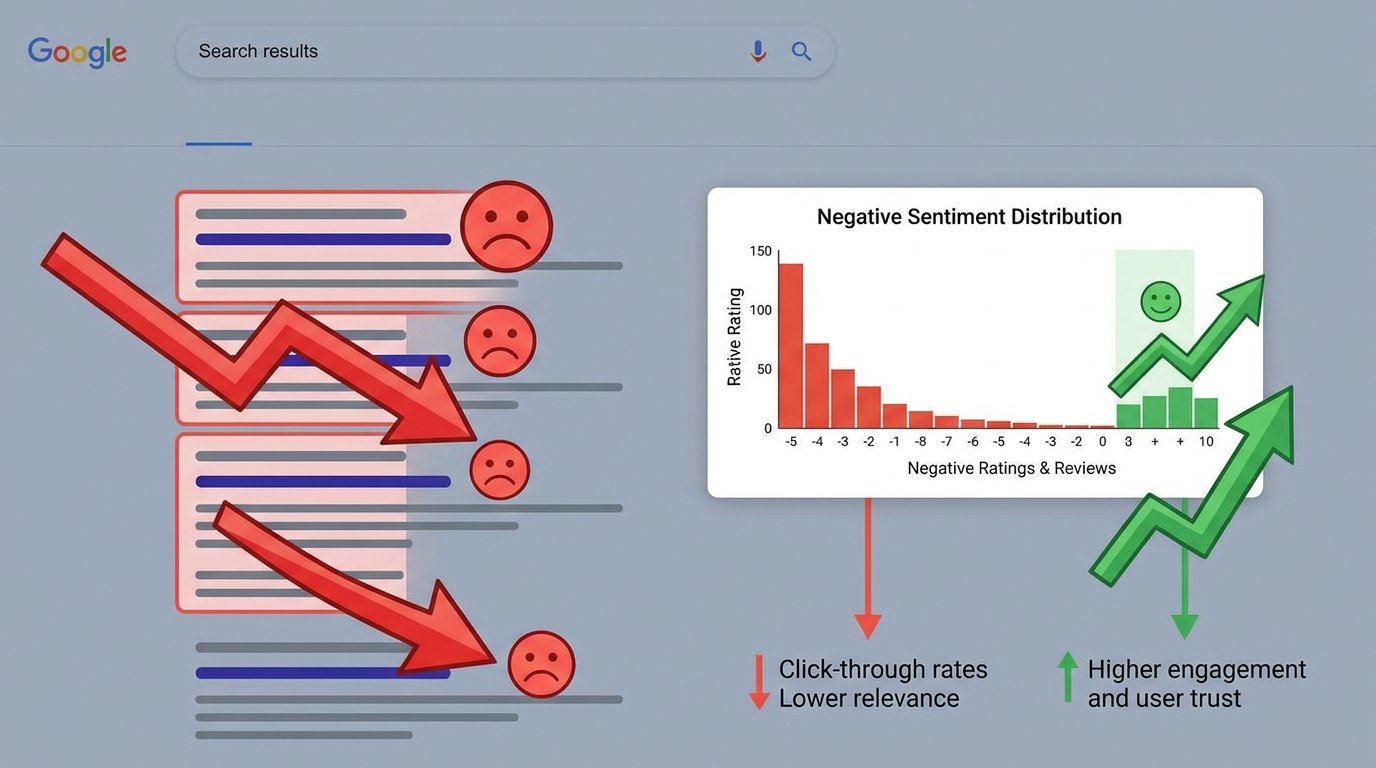
Reviews and sentiment provide user-generated reputation signals that contribute to the broader digital footprint surrounding a political entity. Review-style content can appear on platforms where users discuss public services, constituency experiences, local issues, or interactions with representatives. Sentiment analysis evaluates whether language expresses positive, negative, or neutral attitudes, but sentiment alone does not establish factual accuracy or political significance. The source, context, visibility, and recurring themes remain important parts of the evaluation. Search engines and users therefore encounter sentiment as one component of a larger information environment.
Sentiment distribution refers to the balance of positive, negative, and neutral themes within a defined body of user-generated content. A concentration of criticism around one recurring issue provides a different reputation signal from isolated complaints covering unrelated subjects. Repetition can strengthen the association between a topic and an entity in the searchable information environment. However, repetition does not automatically establish credibility. Reputation analysis therefore separates sentiment patterns from source authority and factual context.
How does social media change the spread of constituent complaints?
Social media accelerates the distribution of constituent complaints by allowing users to publish, discuss, quote, share, and reference information rapidly. A single post can generate additional commentary, links, screenshots, news coverage, and discussions that expand the digital footprint surrounding a candidate. Not every social post receives substantial organic search visibility, but highly referenced discussions can contribute to broader information discovery. Social platforms also create a direct environment where users interpret complaints before consulting other sources. This creates a relationship between social sentiment and search perception.
The structure of social content also creates secondary reputation signals. Journalists can reference public posts, community groups can discuss them, and other users can connect them with existing coverage. These interactions increase the number of documents and references associated with the underlying topic. Search systems then process those documents according to their individual characteristics. Reputation therefore develops through a network of information rather than through one social post alone.
Why does news coverage matter when constituents complain online?
News coverage matters because established publishers can provide highly visible and authoritative references to constituent concerns. A complaint that receives news coverage becomes part of a more formal information ecosystem and can rank for searches related to the candidate, constituency, policy area, or specific incident. The publisher’s authority, topical relevance, article structure, and continued references influence its search visibility. This can give the complaint greater prominence than the original user-generated post. News coverage therefore represents an important transition from isolated commentary to indexed third-party information.
The framing of news content also affects entity perception. A report can connect a complaint with wider themes such as public services, representation, policy decisions, or constituent satisfaction. Search users then encounter both the underlying issue and the broader context provided by the publisher. This distinction matters because search reputation is influenced by the information architecture surrounding a complaint. Authority and context therefore operate alongside sentiment when evaluating political reputation.
Dive Deeper With Our Expert Guides:
How a Single Viral Clip Can Redefine a Political Career
Why Local Councillors Face Different Reputation Risks Than MPs
How does a candidate’s digital footprint affect re-election perception?
A candidate’s digital footprint consists of the searchable information associated with their public identity across websites, social platforms, news publications, directories, profiles, official pages, and other digital sources. Constituent complaints become one component within this broader structure rather than an independent reputation system. The impact of criticism depends partly on what other authoritative information users encounter when researching the same entity. A well-developed digital footprint contains diverse sources that provide context about the candidate’s public activities and record. Search engines then organise these sources according to individual queries.
Digital footprint analysis therefore examines both information volume and information prominence. A candidate can have extensive online coverage while still having limited visibility for a particular complaint. Conversely, one highly authoritative page can dominate a specific search query despite a much larger body of unrelated content. This distinction demonstrates why reputation cannot be assessed through content quantity alone. Search visibility and SERP composition provide the necessary context.
What role do authority and trust signals play in political reputation?
Authority and trust signals influence how information is evaluated within search ecosystems by distinguishing stronger sources from less established sources. Authority refers to the recognised relevance and strength of a source within a particular topic, while trust relates to the perceived reliability and consistency of its information. Official government information, established journalism, professional publications, and reputable institutional sources can contribute different forms of authoritative context. User-generated commentary provides another perspective but requires separate evaluation of source and context. These signals collectively shape the information environment surrounding the political entity.
Trust also depends on consistency across independent sources. If official information, reputable reporting, constituency information, and other credible references provide compatible facts, users receive a clearer informational picture. Contradictory information creates additional uncertainty that users must resolve themselves. Search engines process these documents individually rather than issuing a universal credibility verdict on the candidate. Reputation analysis therefore evaluates source relationships and content consistency rather than assuming that one source represents the complete truth.
Can positive content counterbalance negative constituent complaints?
Positive and neutral content can provide additional context within the SERP, but its effect depends on relevance, authority, indexing, and search competition. Search engines do not simply average positive and negative pages to create a reputation score. Instead, each document competes for visibility according to its relationship with the user’s query. Authoritative information relevant to the same topic has greater potential to appear alongside or above competing material. This creates a more complete information environment for search users.
The distinction between content enhancement and suppression is important here. Content enhancement focuses on strengthening relevant information that contributes positively or neutrally to entity understanding. Suppression focuses on reducing the relative prominence of specific negative results through the competitive search environment. Neither mechanism establishes the factual validity of a complaint. Their purpose within reputation analysis is to understand and influence the composition and visibility of available information.

How does complaint visibility affect searches before an election?
Complaint visibility becomes particularly relevant when voters conduct candidate research through branded and issue-specific searches. A search containing a candidate’s name can produce news, official information, social profiles, constituent discussions, and historical coverage within one SERP. Issue-related searches can produce a different composition by prioritising content associated with a particular policy or constituency concern. This means the same complaint can have different visibility levels depending on the query. SERP evaluation therefore needs to consider the search terms through which voters encounter the candidate.
Search behaviour also creates a sequence of information discovery. A user can encounter a news report first, then examine social commentary, official statements, and additional sources to establish context. Each stage introduces new reputation signals that contribute to the user’s assessment. The candidate’s overall digital footprint therefore becomes part of the research process. Search perception is consequently shaped not only by individual pages but by the order and prominence of information across queries.
How can constituent complaints become reputation opportunities?
Constituent complaints can become reputation opportunities when they generate useful information about recurring public concerns and reveal gaps in communication or publicly available context. A complaint provides a data point about an issue associated with the candidate, while aggregated patterns provide broader insight into the topics appearing within the digital footprint. Analysing these patterns can identify areas where authoritative information is missing or difficult to discover. This shifts the focus from the existence of criticism to the information structure surrounding it. The resulting analysis can support more informed understanding of public-facing reputation.
A structured evaluation can involve four actions:
- Identify recurring complaint themes by grouping indexed criticism according to issue, source, query relevance, and publication context.
- Evaluate search visibility by measuring which complaints, news reports, reviews, and official pages appear for candidate-related searches.
- Compare authority signals by distinguishing established publishers, official sources, user-generated content, and low-authority references.
- Analyse information gaps by determining which relevant topics lack clear, authoritative, and accessible contextual information.
This framework does not treat criticism as something that automatically requires removal or suppression. Instead, it analyses what the information reveals about the entity’s searchable reputation. The approach also separates public criticism from inaccurate or inappropriate content. That distinction is essential for maintaining analytical accuracy within political reputation systems.
What is the relationship between online complaints and re-election chances?
Online complaints can affect re-election perception when their visibility, authority, repetition, and relevance make them prominent parts of the information voters encounter during candidate research. They do not independently determine electoral outcomes because voting decisions involve factors beyond search reputation. Their significance lies in how they contribute to the information environment surrounding a candidate. Search visibility determines whether users encounter the complaint, while entity perception determines how it relates to the candidate’s broader digital identity. Reputation signals therefore represent one information layer within the wider electoral decision environment.
The relationship becomes clearer when separating reputation from electoral causation. Search engines rank information, not candidates for office, and a prominent complaint does not constitute evidence that voters will respond in one specific way. However, visible information can become part of the evidence voters consider when researching public representatives. This makes search reputation relevant to understanding digital political perception without treating it as a deterministic electoral mechanism. The appropriate analytical focus remains information visibility, source authority, sentiment, and entity context.
How can the online reputation of a political candidate be analysed?
Political online reputation can be analysed by examining the candidate’s complete search environment across branded, issue-related, constituency, and reputation-focused queries. The analysis includes news coverage, constituent complaints, reviews, social references, official information, professional profiles, and other indexed sources. Each source is evaluated according to relevance, authority, sentiment, visibility, and relationship to the candidate entity. Comparing these factors reveals which reputation signals dominate particular searches. This produces a more accurate picture than relying on isolated comments or individual ranking positions.
A useful analysis also separates historical reputation signals from current information. Older criticism can remain indexed even after the underlying issue has changed, while new content can alter the SERP composition rapidly. Search engines continuously process changing information, so reputation analysis needs to account for content freshness and ranking competition. The candidate’s digital footprint therefore represents a dynamic information system. Monitoring its development provides insight into how online perception changes over time.
What should be understood about constituent complaints and political reputation?
Constituent complaints affect online political reputation primarily through their visibility and association with a candidate entity across search and digital information systems. Their influence depends on source authority, indexing, repetition, query relevance, sentiment, and the surrounding information environment. Search engines organise these signals into SERPs rather than assigning a simple reputation score. Users then interpret the resulting information when researching candidates and public representatives. Understanding this mechanism provides a more precise explanation of how online complaints participate in political reputation.
The central insight is that a complaint becomes more significant when it enters a wider network of searchable information. News coverage, social discussion, reviews, official statements, and independent references can strengthen or contextualise the original signal. This means political reputation is formed through relationships between content and entities rather than through isolated posts. For a deeper consideration of how criticism can be interpreted within a broader reputation framework, turning constituent complaints into reputation opportunities provides a relevant next-stage analysis.
How do constituent complaints online affect re-election chances?
Online constituent complaints can influence how voters perceive a political candidate when criticism becomes prominent in search results, news coverage, or social discussions. Search visibility, source authority, sentiment, and repetition determine how strongly these reputation signals contribute to online perception.
Why do online complaints affect a politician’s reputation?
Online complaints become part of a politician’s digital footprint when they are published, indexed, and connected with the candidate entity. Prominent complaints can influence search perception by appearing alongside news reports, reviews, official information, and other reputation signals.
Do negative reviews affect political reputation?
Negative reviews and constituent feedback contribute to sentiment distribution within a political candidate’s online reputation. Their impact depends on factors such as source credibility, search visibility, relevance, and whether similar concerns appear across multiple sources.
Can positive content improve a politician’s online reputation?
Accurate and authoritative content can provide additional context around a political candidate and influence the composition of relevant search results. Content enhancement works by increasing the visibility of useful information rather than automatically removing negative constituent complaints.
How can politicians manage constituent complaints online?
Political reputation management involves monitoring complaints, evaluating their source and visibility, analysing sentiment, and assessing how the information appears across search results. This process helps identify reputation signals and information gaps within the candidate’s broader digital footprint.