

Customer review trends define how search engines interpret credibility, trust, and entity reputation within digital environments. Reputation management is the process of monitoring, analysing, and structuring reputation signals that influence search visibility and public perception.
Online reputation refers to the collective interpretation of reviews, indexed content, sentiment signals, and engagement data across search ecosystems. Customer reviews function as measurable trust indicators that shape SERP evaluation, local search prominence, and entity understanding.
How do customer reviews influence search visibility?
Customer reviews influence search visibility by supplying structured trust signals that search engines index, analyse, and rank. Reviews contain sentiment data, topical relevance indicators, and behavioural engagement metrics that contribute to entity evaluation. Search engines interpret review frequency, recency, and linguistic consistency as indicators of active reputation maintenance. A review ecosystem with sustained activity demonstrates operational legitimacy within local and commercial search environments. Positive and negative sentiment patterns also affect click-through behaviour, which reinforces user engagement signals tied to ranking performance. Review content therefore functions as a semantic layer that supports search engine interpretation of credibility.
Review indexing also contributes to keyword association within search results. User-generated content frequently contains natural language phrases connected to products, locations, or services, which expands contextual relevance. Search engines analyse these references to understand topical relationships between entities and search intent. Consistent review terminology strengthens semantic associations within local search ecosystems. Review-rich entities therefore accumulate broader contextual coverage across indexed content. This process increases discoverability for informational and navigational queries linked to reputation perception.
What defines customer review authenticity within search ecosystems?
Customer review authenticity refers to the perceived legitimacy and reliability of review content within indexed search environments. Search engines evaluate authenticity through behavioural consistency, reviewer history, content variation, and engagement patterns. Repetitive phrasing, unnatural review timing, and duplicated language weaken credibility signals. Authenticity analysis therefore functions as a trust-filtering mechanism within ranking systems. Search ecosystems prioritise signals that demonstrate organic user participation and verifiable interaction histories. This evaluation framework protects search result integrity and reduces manipulation risks.
Algorithmic review validation also examines reviewer account activity across platforms. Accounts with diversified engagement histories contribute stronger credibility indicators than isolated review-only profiles. Search engines compare behavioural patterns to identify anomalies associated with coordinated reputation manipulation. Temporal analysis also identifies abnormal review spikes disconnected from normal engagement cycles. These assessments contribute to broader entity trust calculations within local search environments. Authentic review ecosystems therefore reinforce stable reputation signals over time.
Why does review recency affect reputation perception?
Review recency affects reputation perception because search ecosystems prioritise current behavioural data when evaluating entity reliability. Recent reviews demonstrate operational continuity, active engagement, and updated consumer sentiment. Search engines interpret outdated review profiles as incomplete indicators of present-day credibility. Recency therefore functions as a freshness signal within SERP evaluation systems. Entities with continuously updated feedback maintain stronger contextual relevance within local and transactional search categories. This relevance contributes to sustained visibility across search interfaces.
Read More:
How Review Signals Influence Google’s Local Results
What Makes Customers Trust Online Reviews
User perception also changes according to review timelines. Recent sentiment carries greater interpretive weight because it reflects contemporary operational standards and customer experience consistency. Search engines incorporate this behavioural tendency into ranking logic by emphasising temporal relevance. Continuous review generation therefore supports stable entity perception across indexed results. Fresh reviews additionally expand keyword diversity and topical depth within content indexing systems. This process reinforces semantic relevance for evolving search behaviour patterns.
How do search engines interpret review sentiment?
Search engines interpret review sentiment through natural language processing models that classify emotional polarity, contextual meaning, and topical associations. Sentiment analysis evaluates whether language patterns indicate satisfaction, dissatisfaction, or neutrality. Algorithms identify descriptive modifiers, recurring themes, and contextual relationships within review content. These signals contribute to entity reputation scoring and trust assessment mechanisms. Sentiment interpretation therefore extends beyond star ratings into linguistic evaluation. Search visibility increasingly depends on contextual sentiment accuracy rather than numerical averages alone.
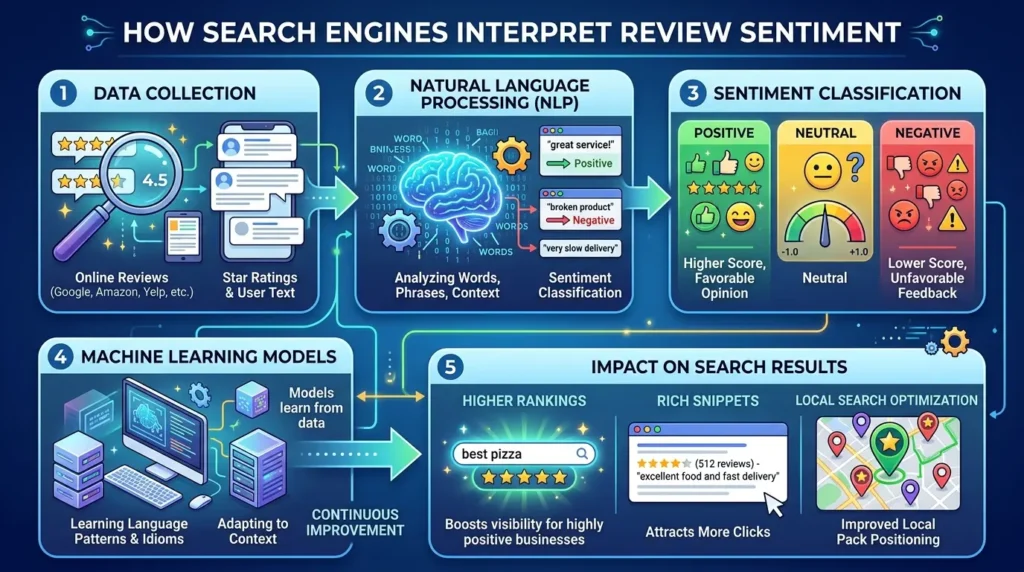
Sentiment analysis also contributes to entity association modelling. Search systems evaluate recurring references connected to reliability, responsiveness, quality, or trustworthiness. Repeated positive associations strengthen credibility signals within search ecosystems. Repeated negative associations weaken authority perception and reduce confidence indicators. This process affects both ranking potential and user interpretation within SERPs. Sentiment-rich review ecosystems therefore influence both algorithmic evaluation and behavioural engagement outcomes.
How does negative sentiment affect indexed reputation signals?
Negative sentiment affects indexed reputation signals by introducing contradictory trust indicators into search evaluation systems. Search engines analyse complaint frequency, issue repetition, and linguistic intensity when interpreting dissatisfaction patterns. Concentrated negative themes create semantic associations tied to operational inconsistency or reduced reliability. These associations alter entity perception across search interfaces. Negative review clusters also influence click behaviour, which contributes indirect engagement-based ranking signals. Reputation volatility therefore becomes measurable through indexed sentiment distribution.
Balanced review ecosystems, however, contribute interpretive realism within search environments. Completely uniform positivity can reduce perceived authenticity because search systems evaluate natural behavioural variation. Moderate negative sentiment combined with consistent resolution signals creates stronger credibility patterns than artificially uniform feedback. Search engines therefore prioritise contextual legitimacy over numerical perfection. This evaluation model reinforces trust calibration within local search ecosystems.
What role do star ratings play in SERP evaluation?
Star ratings function as compressed reputation indicators within search ecosystems. Search engines use aggregated ratings to summarise sentiment patterns and trust signals at scale. Numerical averages simplify user interpretation during rapid SERP evaluation processes. High ratings contribute to stronger engagement probability because users associate numerical consistency with operational credibility. Search systems therefore incorporate rating data into visibility calculations for local and commercial queries. Ratings act as shorthand indicators within reputation analysis frameworks.

However, star ratings alone do not define search performance. Search engines compare rating quantity, review recency, and sentiment diversity alongside numerical averages. A high rating supported by limited review volume carries weaker credibility than sustained ratings across large datasets. Search ecosystems therefore evaluate rating reliability through contextual support signals. This layered interpretation prevents superficial metrics from dominating ranking systems. Reputation analysis consequently depends on combined behavioural indicators rather than isolated numerical values.
How does review volume influence online credibility?
Review volume influences online credibility by increasing the statistical reliability of reputation signals. Large review datasets provide broader behavioural evidence regarding entity performance and public perception. Search engines interpret higher review counts as indicators of sustained engagement and operational visibility. Review volume therefore strengthens confidence in sentiment accuracy and reputation consistency. Sparse review ecosystems provide limited interpretive certainty within search environments. High-volume review profiles contribute stronger authority signals during ranking evaluation.
Review quantity also affects semantic depth within indexed content. Larger datasets generate broader topical associations, increased keyword diversity, and expanded contextual relevance. Search engines use this linguistic variation to refine entity understanding across search categories. Review ecosystems with extensive content coverage therefore strengthen semantic positioning within SERPs. Increased review volume also improves behavioural trust because users associate broader participation with legitimacy. This interaction reinforces both algorithmic and perceptual credibility indicators.
Why do review responses affect entity trust signals?
Review responses affect entity trust signals because they demonstrate active participation within reputation ecosystems. Search engines interpret consistent response behaviour as evidence of operational engagement and accountability. Responsive entities exhibit measurable interaction patterns that contribute to trust evaluation frameworks. This behaviour strengthens perceived legitimacy within local search environments. Review response activity therefore functions as a behavioural credibility signal within indexed reputation systems. Engagement visibility influences both algorithmic interpretation and public perception.
Search systems also analyse response consistency and linguistic structure. Generic or duplicated responses weaken authenticity indicators because they reduce contextual relevance. Detailed responses demonstrate active communication patterns tied to operational transparency. Search ecosystems prioritise behavioural signals that reflect sustained engagement rather than automated interaction. This process contributes to entity reliability modelling across indexed content environments. Reputation management therefore includes response quality as a measurable credibility component.
How do review responses influence perception in local search?
Review responses influence perception in local search by shaping visible interaction patterns within SERPs. Users interpret active communication as evidence of responsiveness and operational oversight. Search engines recognise this behavioural tendency and incorporate engagement metrics into local ranking calculations. Consistent responses therefore contribute to stronger trust calibration within geographically targeted searches. Local search ecosystems prioritise signals connected to accessibility, responsiveness, and operational continuity. Review response visibility directly supports these interpretive mechanisms.
Response content also contributes additional indexed language within search environments. Replies frequently contain contextual terminology associated with operational categories, locations, or customer concerns. Search engines index this content as supplementary semantic data connected to the entity profile. This process expands contextual relevance and strengthens topic association signals. Review response ecosystems therefore support both perception management and semantic indexing simultaneously.
How do mobile search behaviours change review importance?
Mobile search behaviours increase review importance because users conduct rapid trust evaluation directly within search interfaces. Mobile-first indexing environments prioritise concise credibility indicators that support immediate decision-making. Reviews, ratings, and sentiment summaries therefore become dominant evaluation elements within limited screen environments. Search engines optimise local SERPs around these behavioural patterns. Mobile users rely heavily on visible reputation signals during navigational and transactional searches. This behaviour increases the algorithmic importance of review ecosystems.
Location-based searches further intensify review relevance within mobile environments. Search engines connect proximity data with reputation indicators to prioritise credible local entities. Reviews therefore function as location-sensitive trust signals within geographically targeted ranking systems. Mobile behaviour patterns also increase the visibility of review snippets and sentiment summaries within SERP layouts. Search ecosystems adapt to this interaction model by elevating review-rich profiles. Reputation visibility consequently becomes closely connected to mobile search optimisation.
Why are review platforms central to digital footprint analysis?
Review platforms are central to digital footprint analysis because they contain persistent, indexable reputation data connected to identifiable entities. A digital footprint refers to the cumulative collection of indexed behavioural and informational signals associated with an entity online. Review ecosystems contribute large-scale sentiment, engagement, and trust indicators to this footprint. Search engines aggregate these signals when evaluating credibility and authority relationships. Review platforms therefore operate as structured repositories of public perception data. Their indexed content influences long-term entity interpretation within search ecosystems.
Digital footprints also develop through interconnected content relationships. Reviews link with maps, directories, social references, and local search profiles to create broader entity association networks. Search engines analyse these relationships to validate legitimacy and consistency across platforms. Inconsistent review signals weaken trust calibration because they disrupt entity coherence. Stable review ecosystems therefore strengthen unified digital identity interpretation. This process contributes directly to sustained search visibility and online credibility.
How do algorithms evaluate authority through reviews?
Algorithms evaluate authority through reviews by analysing consistency, engagement quality, sentiment reliability, and contextual relevance. Authority refers to the perceived credibility and informational reliability assigned to an entity within search ecosystems. Review systems contribute behavioural evidence supporting this evaluation process. Search engines interpret long-term engagement stability as a marker of operational legitimacy. Consistent positive sentiment combined with sustained participation strengthens authority signals within local search categories. Review ecosystems therefore influence broader entity trust modelling.
Authority evaluation also depends on contextual corroboration. Search engines compare reviews against other indexed signals such as citations, references, and content consistency. Alignment across multiple sources reinforces entity reliability within ranking systems. Contradictory or unstable review patterns weaken authority calculations because they reduce interpretive confidence. Algorithms therefore prioritise coherent reputation ecosystems that demonstrate stable behavioural evidence. Review-based authority consequently emerges through accumulated trust validation across indexed environments.
What is the relationship between customer reviews and reputation management?
Customer reviews form a foundational component of reputation management because they generate publicly indexed trust signals that influence perception and ranking systems. Reputation management is the process of monitoring, analysing, and structuring reputation-related information across search ecosystems. Reviews contribute measurable behavioural data that affects entity interpretation within SERPs. Search engines use this information to evaluate credibility, engagement quality, and trust consistency. Reputation management therefore includes the analysis of review sentiment, recency, responsiveness, and semantic relevance. These factors collectively shape online credibility within digital environments.
Review ecosystems also influence how entities are categorised and interpreted semantically. Search engines analyse review language to understand operational themes, service associations, and sentiment patterns connected to the entity profile. This analysis contributes to broader search visibility across informational, navigational, and local queries. Reputation management consequently extends beyond review collection into structured perception analysis. Understanding comparative reputation performance also supports deeper evaluation of entity trust indicators through Google Review Benchmarking: How Top-Rated Businesses Compare.
What are the biggest customer review trends affecting businesses in 2026?
Businesses are seeing major shifts toward AI-generated review summaries, video testimonials, and customer demand for faster responses to online reviews. Platforms like Google Reviews and Trustpilot also prioritize authentic, recent feedback, making reputation management more important than ever.
How do online reviews impact customer trust and buying decisions?
Customer reviews strongly influence purchasing decisions because consumers often check ratings and feedback before choosing a business. Positive reviews improve trust, while unresolved negative reviews can reduce credibility and lower conversion rates.
Why are businesses focusing more on review management strategies?
Businesses use review management strategies to monitor customer feedback, improve online reputation, and increase local SEO visibility. Consistently responding to reviews also helps companies build customer trust and improve customer experience.
How can businesses respond effectively to negative customer reviews?
Businesses should respond to negative reviews professionally, acknowledge the customer’s concerns, and offer a practical resolution when possible. Timely and respectful responses can reduce reputation damage and show potential customers that the business values feedback.
What role does AI play in customer review trends?
AI tools help businesses analyze customer sentiment, detect review patterns, and automate review monitoring across multiple platforms. Companies like Clear My Name also use advanced reputation management strategies to help businesses understand review trends and protect their online presence.