

Online reputation refers to the structured collection of signals, mentions, and behavioural data that define how an entity appears within search engine results pages and digital information systems.
Reputation management is the systematic organisation, interpretation, and influence of these signals across indexed content, SERPs, and entity-level data structures.
This topic explains how information is created, evaluated, and ranked within search ecosystems where visibility is determined by trust signals, content authority, and semantic associations.
What is online reputation and how is it defined within search ecosystems?
Online reputation is defined as the aggregated perception of an entity based on indexed digital content, structured data, and algorithmically interpreted engagement signals. It refers to how search systems construct an identity profile from distributed information across the web.
Search engines evaluate reputation by mapping content to entities and assigning meaning through semantic relationships. These systems analyse text, links, mentions, and contextual relevance to form an entity profile. The outcome is a dynamic representation that influences search visibility and ranking stability.
Reputation within search ecosystems does not exist as a single document or page. It exists as a network of interconnected signals distributed across SERPs, knowledge graphs, and indexed repositories. Each interaction between content and user behaviour contributes to this structured identity.
How do search engines construct reputation signals in SERPs?

Search engines construct reputation signals by processing structured and unstructured data that defines how entities are interpreted within search visibility frameworks. These signals determine ranking strength and credibility positioning in SERPs.
Entity recognition systems extract names, topics, and relationships from content to build a semantic map. This map connects documents across domains and assigns authority weight based on consistency and relevance. Content indexing ensures that each reference contributes to a broader reputation model.
SERP evaluation systems measure trust through link authority, topical alignment, and contextual reinforcement. These elements combine to produce a ranked interpretation of credibility across search results.
Core mechanisms that define reputation signals
- Analyse content authority distribution across indexed pages to determine credibility density within a topic cluster. This process evaluates how consistently an entity appears in high-quality contexts.
- Map entity relationships by connecting mentions across documents, reinforcing semantic proximity between topics and sources.
- Evaluate contextual relevance by measuring how closely content aligns with user queries and search intent structures.
- Aggregate link authority signals to determine how external references validate entity trustworthiness within search ecosystems.
- Stabilise ranking patterns by tracking repeated content reinforcement across multiple indexed sources.
Each mechanism contributes to SERP-level reputation construction by reinforcing how search engines interpret authority and relevance.
What role do engagement metrics play in reputation evaluation?
Engagement metrics define how users interact with content, and these interactions function as behavioural signals within reputation evaluation systems. They refer to measurable actions such as click patterns, dwell time, and content interaction depth.
Search engines interpret engagement as an indicator of content usefulness and relevance. High interaction density strengthens perceived authority, while weak engagement reduces ranking confidence. These signals contribute directly to SERP positioning and entity perception.
Engagement metrics also influence semantic validation. When users repeatedly interact with specific content types, search systems reinforce those associations within entity models. This process strengthens topical authority over time.
The evaluation of engagement does not operate in isolation. It integrates with indexing systems, link structures, and semantic mapping processes to produce a unified reputation profile.
How do reviews and sentiment shape entity perception online?
Reviews and sentiment shape entity perception by contributing structured opinion data that search systems interpret as trust indicators. This refers to textual and rating-based signals that influence how an entity is classified within search ecosystems.
Sentiment analysis systems evaluate linguistic tone, emotional framing, and contextual meaning. These systems convert unstructured opinions into structured reputation signals. The resulting data influences how entities appear in SERPs and knowledge-based panels.
Review aggregation also contributes to entity stability. Consistent sentiment patterns reinforce credibility, while conflicting signals create semantic ambiguity. Search engines resolve this by weighting authoritative sources more heavily.
Entity perception is continuously updated as new sentiment data enters indexing systems. This ensures that reputation reflects current behavioural and informational trends.
Why does digital footprint directly affect search visibility?
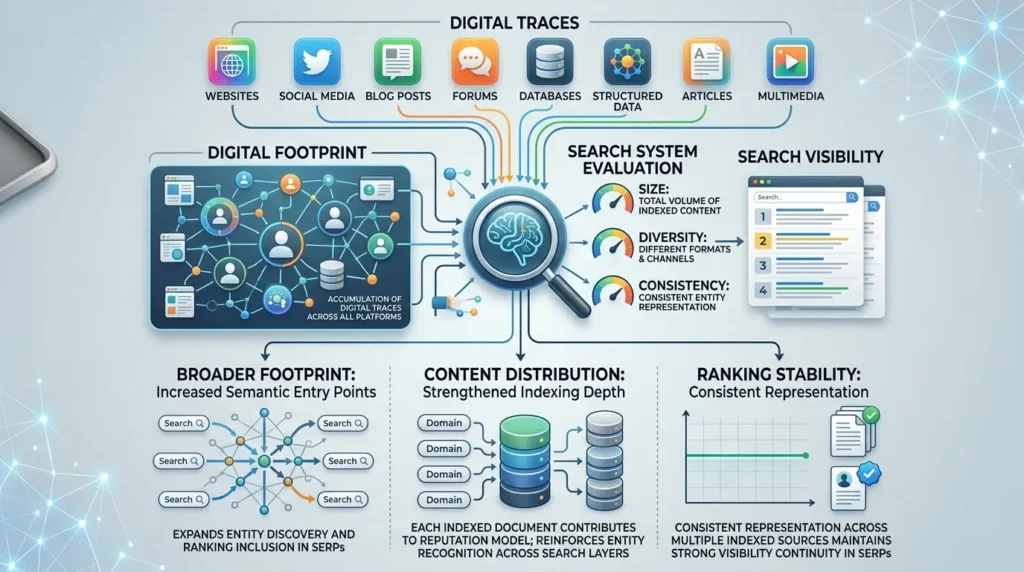
Digital footprint directly affects search visibility because it defines the total volume of indexed content associated with an entity. It refers to the accumulation of all digital traces across websites, platforms, and structured databases.
Search systems evaluate digital footprint size, diversity, and consistency to determine visibility strength. A broader footprint increases the number of semantic entry points into SERPs. This expands the likelihood of entity discovery and ranking inclusion.
Content distribution across multiple domains strengthens indexing depth. Each indexed document contributes to the overall reputation model, reinforcing entity recognition across search layers.
Digital footprint also affects ranking stability. Entities with consistent representation across multiple indexed sources maintain stronger visibility continuity within SERPs.
What are the most important online reputation statistics professionals analyse?
Online reputation statistics define measurable indicators used to evaluate visibility strength, trust formation, and semantic authority within search ecosystems. These metrics represent how reputation is quantified across indexed environments.
Search systems use statistical patterns to evaluate entity reliability, content performance, and engagement distribution. These patterns inform ranking models and influence SERP positioning.
Key reputation statistics and their analytical functions
- Measure search impression distribution across indexed pages to determine how frequently an entity appears in query results.
- Track click-through ratios to evaluate how often users select content associated with specific entities in SERPs.
- Evaluate dwell time metrics to analyse how long users engage with content after entry from search results.
- Analyse backlink authority scores to determine how external references reinforce credibility within semantic networks.
- Assess sentiment polarity distribution to identify dominant emotional patterns within review and mention datasets.
- Monitor indexed mention frequency across platforms to measure entity visibility density in search ecosystems.
- Compare ranking volatility levels to determine stability of search positioning across time-based indexing cycles.
- Evaluate content freshness signals to measure how recently indexed information influences reputation updates.
- Track entity association strength within knowledge graphs to assess semantic connectivity between topics.
- Measure engagement-to-impression ratio to evaluate content effectiveness in converting visibility into interaction.
- Analyse duplicate content impact on ranking dilution and reputation fragmentation within SERPs.
- Assess branded search volume patterns to measure direct search demand for specific entities.
- Evaluate cross-platform consistency scores to determine uniformity of entity representation across digital environments.
Each statistic contributes to a structured interpretation of how reputation is formed, maintained, and adjusted within search systems.
How does content indexing influence reputation stability over time?
Content indexing influences reputation stability by controlling how information is stored, retrieved, and updated within search systems. It refers to the process of adding web content to searchable databases that form the foundation of SERP generation.
Search engines continuously re-index content to reflect changes in relevance, authority, and semantic relationships. This process ensures that reputation models remain aligned with current information structures.
Indexed content contributes to long-term stability when it maintains consistent topical alignment and entity association. When indexing patterns fluctuate, reputation signals become fragmented, affecting SERP reliability.
Stability increases when content is reinforced through repeated indexing across authoritative sources. This creates a durable semantic footprint that supports consistent visibility.
What is Personal Reputation Audit and what should be checked first?
A Personal Reputation Audit is a structured evaluation process that identifies how an individual entity appears across search systems, indexed content, and SERP environments. It refers to the systematic mapping of digital footprint, sentiment distribution, and entity association signals.
The audit process examines how search engines construct identity profiles and how content contributes to perception formation. It evaluates visibility structure, ranking patterns, and semantic consistency across indexed platforms.
The first element to evaluate is search result composition for entity-related queries. This establishes a baseline understanding of what information defines the entity within SERPs. It reveals dominant narratives, content sources, and authority distribution patterns.
Get deeper insight explore:
Personal Reputation Audit: What Should You Check First?
Primary audit checkpoints
- Inspect SERP entity mapping to identify which content sources define primary search visibility.
- Evaluate indexed content distribution to measure how information is spread across domains and platforms.
- Analyse sentiment structure in reviews and mentions to determine perception direction within search ecosystems.
- Review backlink authority sources to identify credibility reinforcement patterns.
- Assess content recency signals to determine how updated information influences ranking stability.
This structured evaluation defines how reputation is constructed at the individual entity level within search systems.
Online reputation operates as a structured semantic system built from indexed content, behavioural signals, sentiment data, and entity relationships. Search engines construct this system by evaluating authority, relevance, engagement, and consistency across SERPs.
Reputation signals define how entities are interpreted, ranked, and stabilised within search ecosystems. Digital footprint size, indexing patterns, and engagement metrics collectively determine visibility strength. Sentiment and review structures further refine entity perception within algorithmic models.
Understanding these mechanisms reveals how reputation is formed as a continuously updated information structure rather than a static identity.
Answers to Key Questions
What is reputation management for individuals?
Reputation management for individuals refers to the process of monitoring, analysing, and influencing how a person appears in search engine results and digital platforms. It focuses on managing online reputation signals, SERP visibility, and entity perception across indexed content. This ensures search engines display a structured and accurate digital identity.
How does online reputation affect search engine results?
Online reputation directly influences how search engines rank and display information about an individual in SERPs. Algorithms evaluate content relevance, authority signals, and sentiment data to construct an entity profile. These factors determine visibility, credibility, and ranking position across search results.
What factors influence personal reputation in search engines?
Personal reputation is influenced by digital footprint size, content indexing patterns, and sentiment distribution across online mentions. Search engines also evaluate backlinks, engagement signals, and content freshness to build entity trust. These combined signals shape how an individual is represented in search ecosystems.
Why is sentiment analysis important in reputation management?
Sentiment analysis helps search systems interpret whether online mentions are positive, neutral, or negative. This evaluation contributes to entity perception and affects how reputation signals are weighted in SERP rankings. It ensures that emotional context within content is reflected in search visibility models.