

A personal reputation audit evaluates how an individual is represented across search engines, platforms, and indexed digital entities.
Online reputation control methods are evaluated through entity credibility, SERP composition, and sentiment distribution patterns.
Reputation management strategies differ based on search visibility structure, content indexing behaviour, and reputation signal density.
A personal reputation audit operates as a diagnostic layer within search ecosystems that maps how identity-based information is constructed and ranked.
Online reputation control methods are evaluated through the interaction between algorithmic indexing, authority signals, and cross-platform content alignment.
What elements define a personal reputation audit in search ecosystems?
A personal reputation audit defines a structured evaluation of how identity data is indexed, ranked, and interpreted across search systems. It operates by mapping entity-level representation, content associations, and trust signals into a measurable visibility profile. Search engines construct this profile through indexed mentions, structured data consistency, and contextual relevance of content clusters. Each element contributes to entity credibility, which determines how the individual appears in knowledge graphs and SERP layouts. The audit framework isolates these elements to measure visibility accuracy and reputational alignment.
Entity credibility forms the central mechanism in this process because it determines how search engines classify identity consistency. When identity markers remain uniform across platforms, algorithmic systems assign higher trust weight to the entity. In contrast, fragmented or conflicting data reduces interpretive clarity, weakening SERP stability. Content indexing patterns also influence this structure by determining which pages gain prominence in branded search queries. These mechanisms collectively define how reputation signals consolidate into a coherent search identity.
Comparative analysis between structured and unstructured audit components highlights distinct evaluation layers. Structured components include knowledge panel data, schema markup, and verified listings. Unstructured components include articles, mentions, and user-generated content distributed across external platforms. Structured components reinforce stability, while unstructured components introduce variability in sentiment distribution. Effective audits evaluate both layers simultaneously to determine overall reputation coherence.
How do SERP-based reputation signals differ from social reputation signals?
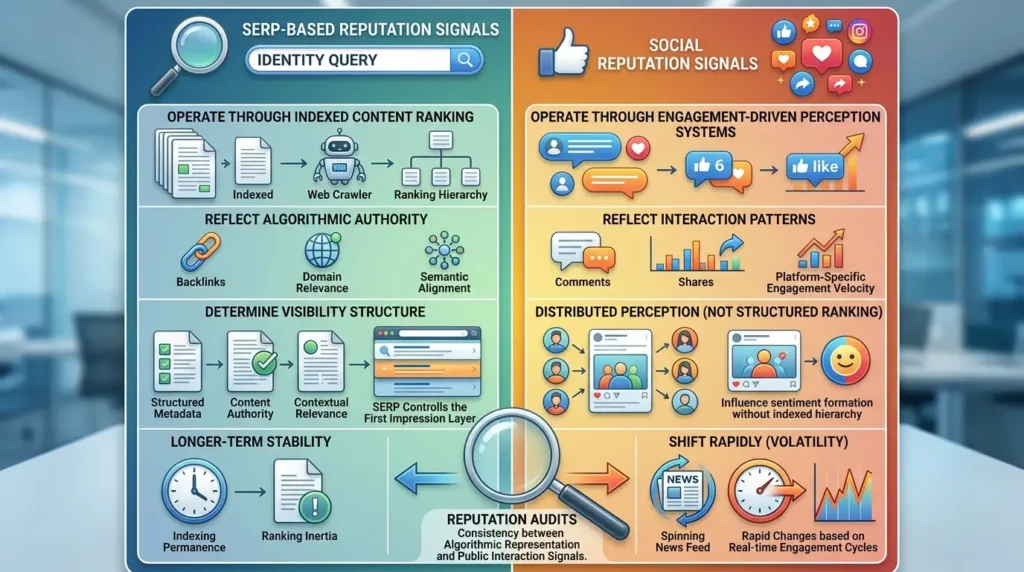
SERP-based reputation signals operate through indexed content ranking, while social reputation signals operate through engagement-driven perception systems. SERP signals reflect algorithmic authority based on backlinks, domain relevance, and semantic alignment. Social signals reflect interaction patterns such as comments, shares, and platform-specific engagement velocity. Both systems influence reputation, but they function through separate evaluative mechanisms within digital ecosystems.
Search-based signals determine visibility structure by controlling what appears in query results for identity-based searches. These signals include structured metadata, content authority, and contextual relevance within indexed documents. High-ranking SERP content establishes narrative dominance by controlling the first impression layer of reputation. Social signals, in contrast, operate through distributed perception rather than structured ranking systems. They influence sentiment formation but lack direct control over indexed hierarchy.
Comparing both systems reveals differences in durability and volatility. SERP-based signals maintain longer-term stability due to indexing permanence and ranking inertia. Social signals shift rapidly because they depend on real-time engagement cycles. This creates a layered reputation structure where search visibility stabilises identity framing, while social platforms continuously modify perception dynamics. Audits evaluate both layers to measure consistency between algorithmic representation and public interaction signals.
Which matters more: content suppression or content enhancement?
Content suppression operates by reducing visibility of negative or irrelevant indexed material, while content enhancement increases the prominence of positive or authoritative assets. Both approaches influence SERP composition, but they function through fundamentally different mechanisms of search influence. Suppression modifies ranking distribution, while enhancement modifies content density within indexed ecosystems.
Suppression techniques rely on ranking displacement strategies where higher-authority content overtakes lower-value pages in SERP positions. This mechanism depends on backlink strength, semantic optimisation, and content freshness signals. However, suppression does not eliminate indexed material; it reorganises visibility hierarchy. Enhancement strategies operate by increasing the number of authoritative pages associated with an entity, expanding positive signal coverage. This improves narrative dominance through content saturation rather than displacement.
Comparative evaluation shows that suppression provides immediate structural correction within SERPs, while enhancement builds long-term resilience. Suppression remains sensitive to algorithmic updates because ranking fluctuations can restore previously buried content. Enhancement stabilises reputation signals by expanding the density of positive associations across indexed sources. Effective audits measure both approaches to determine whether reputation correction requires restructuring visibility or expanding authoritative content ecosystems.
How do review-driven signals compare with knowledge panel entity signals?
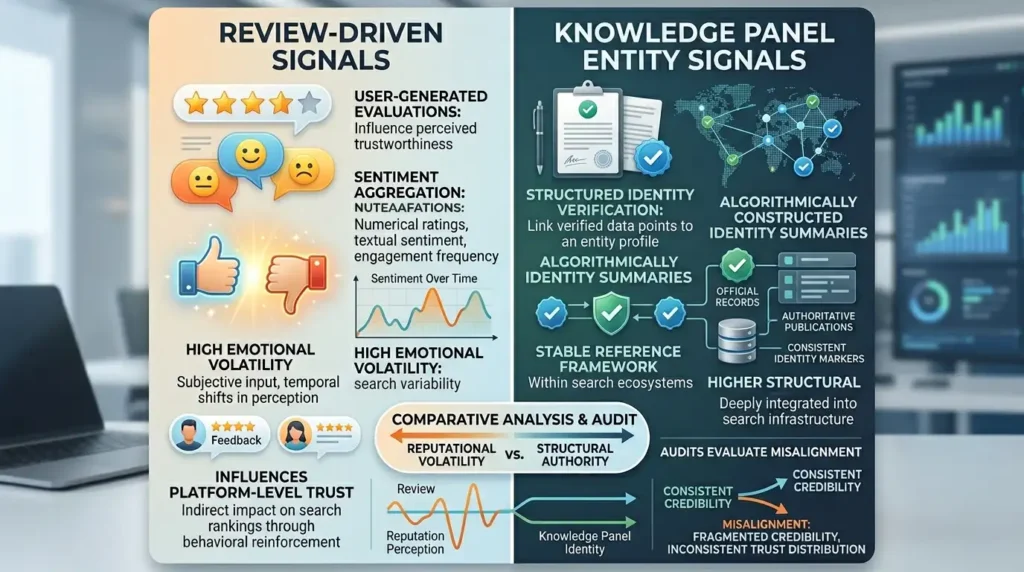
Review-driven signals operate through sentiment aggregation, while knowledge panel entity signals operate through structured identity verification. Reviews represent user-generated evaluations that influence perceived trustworthiness through sentiment distribution. Knowledge panels represent algorithmically constructed identity summaries that consolidate verified data points into a structured entity profile. Both systems influence reputation but differ in origin, stability, and interpretive weight.
Review systems generate reputation signals through numerical ratings, textual sentiment, and engagement frequency. These signals influence platform-level trust and indirectly affect search rankings through behavioural reinforcement. However, review systems remain highly variable due to subjective input and temporal shifts in perception. Knowledge panel systems operate through structured data validation, linking verified sources such as official records, authoritative publications, and consistent identity markers. This creates a stable reference framework within search ecosystems.
Comparative analysis shows that knowledge panel signals hold higher structural authority in SERP composition due to their integration into search infrastructure. Review signals hold higher emotional volatility due to direct user interaction. Audits evaluate both systems to determine whether reputation perception aligns with structured identity representation. Misalignment between these systems indicates fragmentation in entity credibility and inconsistent trust signal distribution.
What is the difference between short-term reactive audits and long-term structural audits?
Short-term reactive audits operate by addressing immediate reputation disruptions within search results, while long-term structural audits evaluate the underlying architecture of digital identity representation. Reactive audits focus on visibility correction, content displacement, and sentiment stabilisation across indexed platforms. Structural audits focus on entity consistency, semantic alignment, and long-term search ecosystem positioning.
Reactive audit mechanisms respond to specific visibility issues such as negative content dominance or SERP imbalance. These mechanisms analyse current ranking distribution and identify high-impact pages influencing perception. Structural audits analyse identity cohesion across multiple data sources, ensuring consistency between structured profiles, indexed content, and semantic associations. This creates a foundational layer of reputation stability that persists beyond short-term fluctuations.
Comparative evaluation highlights that reactive audits provide immediate SERP adjustments, while structural audits determine long-term resilience. Reactive systems operate within ranking cycles, making them sensitive to algorithmic shifts. Structural systems operate through entity alignment, reducing vulnerability to individual content changes. Effective reputation analysis integrates both layers to ensure immediate correction and sustained credibility across search environments.
How do sentiment distribution patterns influence entity credibility?
Sentiment distribution patterns influence entity credibility by determining the balance between positive, neutral, and negative content associated with a search entity. Search engines interpret sentiment distribution as a contextual signal that shapes trust evaluation and ranking stability. High concentrations of negative sentiment reduce perceived authority, while balanced or positive distributions reinforce credibility within indexed ecosystems.
Sentiment analysis systems classify content based on linguistic markers, contextual framing, and engagement reactions. These classifications contribute to aggregate reputation signals that influence how entities are positioned in SERPs. When sentiment distribution remains stable, search engines assign higher confidence scores to entity representation. When sentiment fluctuates significantly, credibility scores weaken due to inconsistent perception patterns.
Comparative evaluation shows that sentiment distribution interacts directly with content visibility. Positive sentiment increases ranking reinforcement for associated pages, while negative sentiment increases scrutiny within indexing systems. Neutral sentiment stabilises baseline perception without significantly altering ranking dynamics. Audits measure sentiment distribution across platforms to identify imbalance zones that affect overall entity credibility.
What framework evaluates personal reputation risk exposure across platforms?
A personal reputation risk framework evaluates exposure by analysing cross-platform visibility, content volatility, and entity consistency across indexed systems. It measures how fragmented or unified identity signals appear across search engines, social platforms, and third-party publications. Risk exposure increases when inconsistencies exist between structured data and unstructured content sources.
The framework operates through three analytical layers. The first layer measures SERP volatility by tracking ranking fluctuations across identity-based queries. The second layer evaluates sentiment dispersion across platforms to identify imbalance in perception signals. The third layer analyses entity consistency by comparing structured identity markers with external mentions. These layers collectively determine reputation stability across digital ecosystems.
Comparative analysis shows that high-risk profiles exhibit fragmented entity signals, unstable SERP composition, and inconsistent sentiment distribution. Low-risk profiles maintain uniform identity markers, stable search rankings, and balanced sentiment profiles. Risk frameworks evaluate these dimensions to quantify exposure levels and identify structural weaknesses in digital identity representation.
Personal reputation audits operate through structured evaluation of SERP composition, entity credibility, sentiment distribution, and cross-platform identity consistency.
Comparative analysis between methods shows that suppression and enhancement strategies function differently within search ecosystems, influencing both short-term visibility and long-term stability.
Risk evaluation frameworks consolidate these signals to measure exposure levels and determine reputation resilience across indexed environments.
For deeper insight explore:
Personal Reputation Management Services
Answers to Key Questions
What is included in a personal online reputation audit?
A personal online reputation audit reviews search engine results, sentiment distribution, and content visibility linked to a name. It identifies negative listings, ranking imbalances, and inconsistencies in digital identity across platforms.
How do search engines evaluate personal reputation signals?
Search engines evaluate personal reputation signals through backlinks, content authority, structured data, and contextual relevance. These signals help determine entity credibility and how prominently a person appears in search results.
What is the difference between reputation repair and reputation management?
Reputation repair focuses on reducing or suppressing negative content already ranking in search results. Reputation management is broader and includes long-term strategies like content enhancement, authority building, and SERP optimisation.
Why is entity credibility important in online reputation management?
Entity credibility determines how consistently a person is recognised across search systems and indexed data sources. Higher credibility improves trust signals, stabilises rankings, and reduces visibility of conflicting or negative content.