

Voters evaluate politicians through a network of online information sources that collectively shape public perception and search visibility. Search engines organise these sources into search results where authority, relevance, freshness, and credibility determine which information receives the greatest exposure.
Reputation management is the structured process of understanding how information influences public perception across digital ecosystems. Online reputation refers to the collection of indexed content, authority signals, sentiment indicators, and entity associations that search engines and users use to evaluate credibility.
What defines a politician’s online reputation?
A politician’s online reputation is the digital perception created through indexed information, authority signals, and search visibility across multiple online platforms. Search engines analyse thousands of content signals before presenting results to users, making reputation a measurable outcome of information quality rather than a single opinion. Every indexed webpage contributes to an entity’s digital footprint, creating associations between names, policies, achievements, controversies, and public statements. These associations become reputation signals that influence how search algorithms organise search results. As content continues to be indexed, updated, and referenced, entity perception evolves according to changes in authority and relevance rather than chronological publication alone.
Search ecosystems evaluate information through relationships between entities, sources, and user intent. Content published by authoritative domains carries stronger credibility signals because search engines interpret those domains as reliable knowledge sources. Consistent factual information strengthens entity recognition and reduces ambiguity across search results. Contradictory or poorly sourced information weakens information consistency and creates competing reputation signals. The resulting search landscape forms the basis upon which voters interpret political credibility.
Why do search engines influence political reputation?
Search engines influence political reputation because they organise information according to relevance, authority, trust, and user intent. Search engine results pages (SERPs) determine which sources appear first, giving greater visibility to content that demonstrates stronger ranking signals. Position within the SERP directly affects exposure because users primarily interact with the highest-ranking results. Ranking algorithms analyse hundreds of factors including content quality, source authority, semantic relationships, freshness, and structured data. These mechanisms create an information hierarchy that shapes initial public perception before individual sources are examined.
Entity-based search has transformed political research from keyword matching into contextual understanding. Search algorithms recognise politicians as entities connected to legislation, organisations, elections, policy positions, speeches, and media coverage. These relationships create knowledge structures that influence SERP evaluation. As additional authoritative content becomes indexed, search engines refine entity perception using semantic connections rather than isolated webpages. This process defines how political identities are represented across digital search ecosystems.
Which online sources do voters use to research politicians?
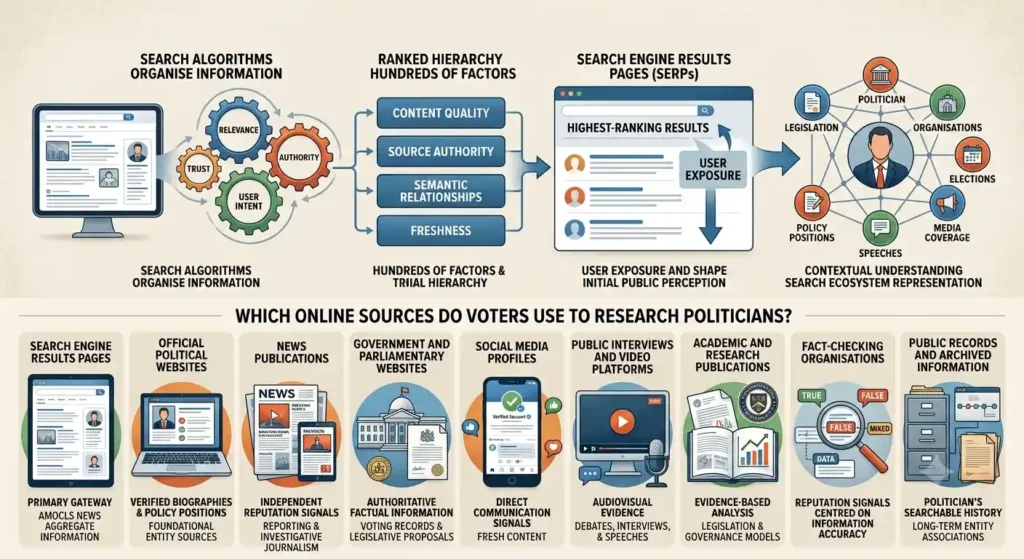
Voters use multiple information sources because each platform contributes different reputation signals that collectively define digital credibility. Every source provides unique information structures that search engines interpret differently during content indexing and ranking.
1. Search engine results pages
Search engine results pages represent the primary gateway for political research because they aggregate information from multiple authoritative sources. SERPs display news articles, official profiles, educational resources, multimedia content, and structured knowledge panels according to ranking algorithms. This arrangement establishes immediate search visibility and influences first impressions before deeper research begins. Search engines continuously update rankings as new content enters the index. Consequently, SERPs function as the central reputation evaluation environment.
2. Official political websites
Official websites define primary entity information because they publish verified biographies, policy positions, speeches, campaign priorities, and official announcements. Search engines interpret these websites as foundational entity sources due to ownership verification and content consistency. Structured information strengthens semantic understanding between the politician and related topics. Internal linking further reinforces topical authority through logical information architecture. Official websites therefore establish core reputation signals within search ecosystems.
3. News publications
News organisations contribute independent reputation signals through reporting, investigative journalism, interviews, editorial analysis, and election coverage. Search engines evaluate news domains according to authority, editorial standards, and publication quality. Articles frequently rank for politician-related searches because they demonstrate topical relevance and timely information. News coverage expands entity associations by linking politicians to legislation, debates, policy discussions, and public events. Continuous publication creates evolving search visibility across multiple political topics.
4. Government and parliamentary websites
Government databases provide authoritative factual information regarding parliamentary activity, voting records, committee memberships, legislative proposals, and official documentation. Search engines recognise these domains as highly trustworthy because they publish verified institutional records. Indexed government content strengthens factual entity relationships rather than opinion-based interpretation. These records improve information consistency across search ecosystems. Their authority makes them influential reputation references during political research.
5. Social media profiles
Verified social media profiles generate direct communication signals between politicians and the public. Posts, videos, public responses, and policy announcements create fresh content that search engines frequently index when relevant. Social platforms also produce engagement signals that influence broader digital discussions. Although engagement metrics do not directly determine search rankings, they contribute to wider content visibility and citation across the web. Social media therefore expands the digital footprint surrounding political entities.
6. Public interviews and video platforms
Video platforms host debates, interviews, speeches, and press conferences that provide audiovisual evidence of political communication. Search engines index video metadata, transcripts, titles, descriptions, and structured information to evaluate topical relevance. Multimedia content increases entity diversity across search results by offering alternative information formats. Video transcripts also strengthen semantic associations with policies, organisations, and political issues. This combination improves comprehensive search representation.
7. Academic and research publications
Universities, policy institutes, and research organisations publish evidence-based analysis that contributes authoritative contextual information. Search engines evaluate these publications using expertise, citation patterns, and institutional authority. Research documents often explain legislation, economic proposals, governance models, and constitutional matters linked to political figures. These publications strengthen informational depth within entity perception. Their credibility supports balanced SERP evaluation through fact-based content.
8. Fact-checking organisations
Fact-checking platforms analyse public statements using transparent evidence and documented verification methods. Search engines recognise these pages because they answer informational queries with structured evaluations supported by cited sources. Fact-check articles establish reputation signals centred on information accuracy rather than political opinion. Indexed verification content contributes to credibility assessments across search ecosystems. This information assists users in evaluating factual consistency.
9. Public records and archived information
Archived webpages, historical databases, public documents, and preserved digital records extend a politician’s searchable history. Search engines index archived content when it remains accessible and relevant to user queries. Historical records contribute long-term entity associations that remain part of the digital footprint. Older information continues influencing perception when authoritative sources reference or preserve it. Consequently, archived content forms a lasting component of online reputation.
How do search engines evaluate trust and authority across these sources?
Search engines evaluate trust through measurable reputation signals rather than subjective opinion. Authority originates from source reliability, editorial quality, citation relationships, structured information, and topical expertise. Algorithms compare multiple sources to identify factual consistency across the web. Consistent information strengthens entity confidence because semantic relationships remain stable across independent publications. Strong authority therefore improves search visibility through reliable information networks.
Content indexing determines how rapidly new information enters search ecosystems and becomes eligible for ranking. Crawlers discover pages, interpret structured elements, identify entity relationships, and evaluate topical relevance before storing information within searchable indexes. Ranking systems later determine visibility according to search intent and quality signals. Higher authority produces stronger indexing confidence and improved SERP positioning. This process explains why authoritative domains consistently appear prominently in political search results.
How does sentiment influence political reputation without determining rankings?
Sentiment refers to the positive, neutral, or negative interpretation expressed within indexed content. Search engines analyse language context and entity relationships to understand topical meaning, yet sentiment alone does not define rankings. Instead, algorithms prioritise relevance, authority, and informational value while recognising contextual relationships between entities and topics. This distinction separates emotional interpretation from ranking methodology. Reputation therefore depends upon information quality as well as public discussion.
Negative sentiment originating from highly authoritative sources receives substantial visibility because authority strengthens ranking potential. Positive sentiment published on weak domains contributes limited influence due to reduced search visibility. Neutral reporting frequently dominates search results because factual information satisfies informational search intent. Consequently, perception develops through exposure to visible content rather than emotional language alone. Search ecosystems reward informational relevance instead of subjective opinion.
How does a digital footprint shape long-term political perception?
A digital footprint refers to the complete collection of searchable information connected to an individual across online ecosystems. Every indexed article, speech, interview, public document, image, and video contributes to this cumulative information network. Search engines continuously reassess relationships between these assets through semantic analysis and entity recognition. As information accumulates, reputation signals become increasingly comprehensive and interconnected. Long-term perception therefore reflects the total indexed information landscape rather than isolated publications.
Digital permanence distinguishes political reputation from temporary public discussion. Archived material remains discoverable through search indexing, citations, and external references. Updated information expands existing entity profiles instead of replacing earlier content completely. Search ecosystems evaluate historical and current information together to establish comprehensive entity perception. This cumulative structure explains why political reputation develops progressively through continuous indexing and information relationships.
How can political reputation be evaluated across voter research platforms?
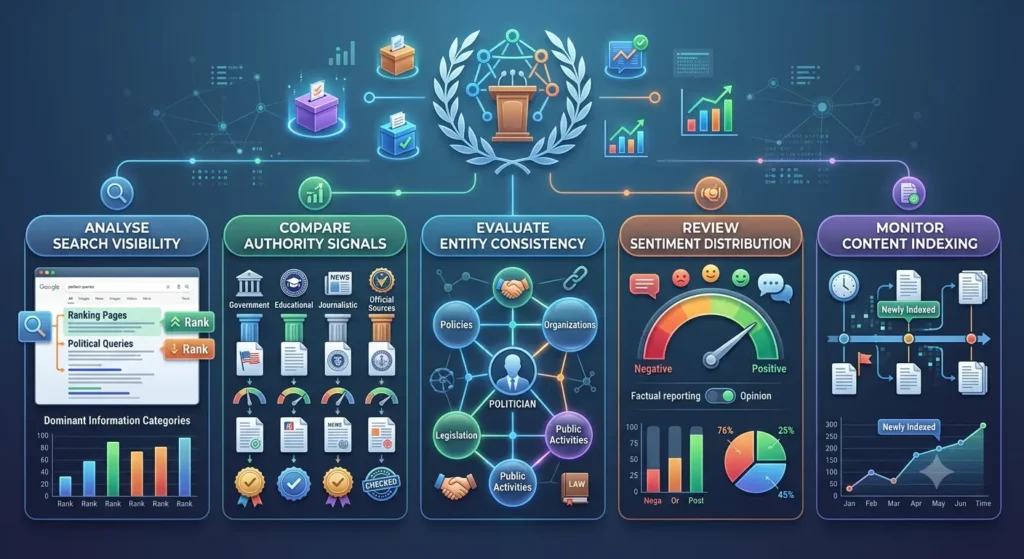
Political reputation can be evaluated through systematic analysis of visibility, authority, consistency, and entity perception across major research platforms. Effective evaluation focuses on measurable reputation signals instead of isolated search results. Comparing indexed information across authoritative sources reveals whether entity associations remain accurate, consistent, and well-supported. SERP evaluation identifies dominant narratives appearing for politically relevant search queries. These observations demonstrate how search ecosystems represent political credibility.
A structured evaluation process includes:
- Analyse search visibility by reviewing the highest-ranking pages for politically relevant search queries and identifying dominant information categories.
- Compare authority signals by examining whether government, educational, journalistic, and official sources consistently present factual information.
- Evaluate entity consistency by identifying recurring associations between the politician, policies, organisations, legislation, and public activities.
- Review sentiment distribution by distinguishing factual reporting from opinion while measuring overall information balance.
- Monitor content indexing by identifying newly indexed material that changes search visibility or entity perception over time.
These analytical steps provide a structured framework for understanding how search ecosystems organise political information without relying on individual opinions or isolated publications.
Dive Deeper With Our Expert Guides:
Why Digital Reputation Matters More Than Traditional Political Advertising
How Online Reputation Influences Modern Political Campaign Outcomes
Why is understanding voter research behaviour important for reputation analysis?
Understanding voter research behaviour explains how search intent determines information discovery across digital ecosystems. Users typically begin with broad informational queries before refining searches towards policies, voting history, interviews, or official documentation. Search engines interpret these evolving queries using semantic intent rather than exact keyword matching. Consequently, different information sources become visible according to changing research objectives. Search visibility therefore depends upon query relevance as well as source authority.
Information pathways reveal how entity perception develops through sequential content discovery. Users frequently transition from SERPs to official resources, news publications, government records, research documents, and multimedia platforms during a single research journey. Each interaction contributes additional reputation signals that reinforce or challenge existing perceptions. The cumulative evaluation process produces a comprehensive understanding of political credibility across digital environments.
Evaluating Your Political Reputation Across Key Voter Research Platforms represents the next stage of analysing these interconnected reputation signals.
Political reputation exists as an interconnected digital system shaped by search visibility, authority signals, content indexing, entity relationships, and information consistency. Search engines organise information according to relevance and credibility, creating structured environments where voters evaluate political identities through multiple authoritative sources. Official websites, news publications, government records, research documents, social platforms, videos, fact-checking resources, and archived information collectively contribute to entity perception within search ecosystems. Understanding these mechanisms provides a clearer explanation of how online reputation develops, evolves, and influences public interpretation through searchable information rather than isolated opinions.
Answers to Key Questions
What is reputation management for politicians?
Reputation management for politicians refers to monitoring and analysing how a political figure is represented across search engines, news websites, social media, and other online sources. It focuses on search visibility, credibility, and the consistency of publicly available information.
Why is online reputation important for politicians?
Online reputation influences how voters perceive a politician when researching their background, policies, and public record. Search results, authoritative content, and trusted sources all contribute to digital credibility and public trust.
Which online platforms have the biggest impact on a politician’s reputation?
Search engines, news websites, official government pages, social media profiles, video platforms, and fact-checking websites are key voter research platforms. Together, they shape search reputation and entity perception across the web.
How can politicians evaluate their online reputation?
Evaluating political reputation involves reviewing search engine results, analysing reputation signals, monitoring authoritative content, and checking the accuracy of indexed information. This process identifies how a politician is presented across key voter research platforms.