

Online reputation refers to the collective digital footprint, algorithmic sentiment, and verified trust signals that determine how an entity is perceived within search ecosystems. In modern political campaigns, this digital consensus directly shapes voter behavior because search engines serve as the primary truth-arbitrator for the electorate. When voters search for a candidate, the information infrastructure determines whether they encounter authoritative policy documentation or historical risk factors.
What is Online Reputation Within Search Ecosystems?
Online reputation is the algorithmic synthesis of an entity’s digital footprint, indexed content, and external authority signals across search engine results pages (SERPs). Within semantic search engines, an entity is not merely a string of text, but a distinct node within a knowledge graph connected to attributes, actions, and public sentiment. Search algorithms continuously evaluate these connections to establish a baseline of digital trust and credibility for the entity.
The mechanism of reputation formation relies heavily on entity perception. Search engines extract data from structured and unstructured web sources, analyzing the proximity of a candidate’s name to specific topical nodes, such as policy positions, historical controversies, or professional achievements. This process defines the entity’s topical authority. When information production aligns with high-trust sources, the search ecosystem establishes a stable, positive algorithmic profile for that entity.
This digital footprint directly dictates search visibility. If the index contains an abundance of unverified, critical, or emotionally volatile content, the SERP evaluation shifts, frequently surface-level risks rather than core policy messaging. Consequently, a candidate’s online reputation within search ecosystems functions as an automated validation system, either reinforcing or degrading public credibility before a voter ever accesses a campaign’s official website.
How Do Authority and Trust Signals Affect Candidate Visibility?
Authority and trust signals determine the ranking hierarchy of information within the SERP when users execute queries related to political candidates. Search engines utilize complex validation frameworks to assess the reliability of information, prioritizing content that exhibits high levels of historical accuracy, source accountability, and topical expertise. For political entities, these signals are heavily derived from mainstream journalistic domains, governmental archives, and verified legal records.
The search ecosystem interprets trust by evaluating the backlink profile and reference network of a given piece of content. When authoritative, non-partisan institutions link to a candidate’s policy platform, the algorithm registers a positive trust signal, which stabilizes the content’s ranking. Conversely, if a candidate’s digital footprint is predominantly referenced by low-quality, biased, or newly created domains, the algorithm applies a lower trust score, restricting the content’s overall search visibility.
This mechanism prevents unverified claims from dominating primary search results during critical campaign periods. However, if a candidate fails to proactively cultivate verified digital assets, the search engine lacks the necessary data points to build a robust trust profile. This lack of data creates an informational vacuum, allowing third-party analyses or legacy media critiques to dictate the primary entity perception within the search ecosystem.

How Do Search Engine Results Pages Shape Voter Perception?
Search engine results pages shape voter perception by controlling the sequence, format, and contextual framing of information presented during a search query. The architectural layout of a modern SERP includes diverse elements such as rich snippets, top stories, knowledge panels, and people-also-ask sections. Each component alters how an individual processes information, as users consistently attribute higher credibility to elements positioned at the top of the page.
The layout functions as an implicit cognitive filter for the electorate. When an individual searches for a candidate’s stance on economic reform, the algorithm selects and displays specific content snippets that it deems most relevant to the query. If the top stories carousel features headlines focused exclusively on campaign finance investigations, the search ecosystem effectively prioritizes risk factors over structural policy, fundamentally altering the user’s cognitive evaluation of that candidate.
Furthermore, the entity perception generated by a knowledge panel solidifies public consensus. A knowledge panel synthesizes biographical facts, official social profiles, and associated political entities into a single, authoritative sidebar. When this panel displays accurate, structured data, it reinforces digital credibility; when it associates the candidate with controversial entities or historical failures, the search engine structurally embeds those associations into the public profile of the candidate.
How Do Content Ranking Dynamics Influence Political Narratives?
Content ranking dynamics influence political narratives by determining which viewpoints gain maximum digital distribution and permanence during an election cycle. Search algorithms evaluate content based on semantic relevance, information density, and user engagement metrics to determine its placement in the organic results. A political narrative is therefore highly dependent on the velocity and technical optimization of the content networks supporting it.
The primary mechanism driving this influence is the freshness algorithm, which prioritizes real-time updates and breaking news for queries with high search volume fluctuations. During a debate or major policy announcement, search engines adjust their evaluation criteria to favor high-velocity media outlets. This dynamic alters the SERP landscape within minutes, meaning the initial interpretation of an event by digital journalists can dominate search visibility during the exact window when voter interest peaks.
Over the long term, however, ranking dynamics shift back to historical authority and semantic completeness. If a campaign fails to produce deeply structured, comprehensive resources regarding its legislative record, third-party political blogs and opposition networks optimize for those semantic gaps. By building comprehensive content networks that answer long-tail voter queries, opposition entities can permanently occupy valuable SERP real estate, neutralizing the campaign’s intended narrative.
How Do Review Signals and Sentiment Interpretation Impact Digital Trust?
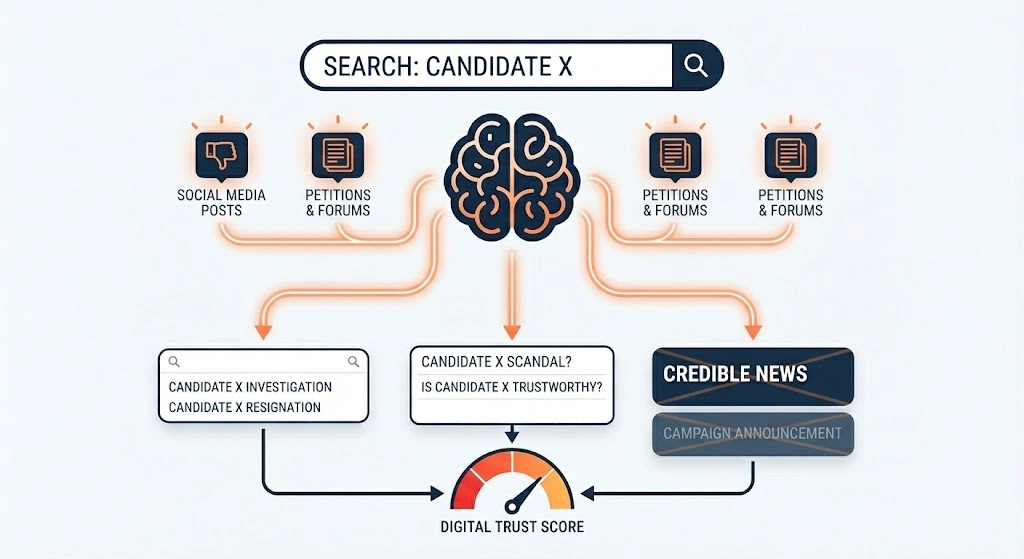
Review signals and sentiment interpretation impact digital trust by providing search algorithms with crowdsourced data regarding an entity’s real-world accountability and public approval. While individual political candidates rarely accumulate standard commercial reviews, the search ecosystem evaluates sentiment by analyzing public forums, social media commentary, and digital petition platforms. Natural language processing (NLP) models scan these sources to decode the underlying emotional polarity associated with an entity.
This algorithmic sentiment analysis directly shapes how search engines categorize entity risk. When an NLP model detects a high concentration of negative semantic terms—such as “investigation,” “misconduct,” or “resignation”—in close structural proximity to a candidate’s name, it updates the entity’s risk profile. This shift in sentiment classification can trigger changes in autocomplete suggestions and the generation of “People Also Ask” boxes, surfacing critical queries to undecided voters.
Additionally, structured review signals on adjacent digital assets, such as a candidate’s published literature or official community offices, feed into the broader trust evaluation. Consistent negative sentiment across these touchpoints signals to the algorithm that the entity experiences systemic trust deficits. This algorithmic deduction can suppress the organic visibility of official campaign announcements, as the search ecosystem prioritizes domains that maintain higher net credibility scores.
How Can Political Entities Manage Algorithmic Reputation Signals?
Political entities manage algorithmic reputation signals by engineering a resilient, highly authoritative digital architecture that satisfies semantic search requirements. This process involves the strategic deployment of structured data, the proactive elimination of informational gaps, and the continuous monitoring of entity associations. To control search perception, an entity must feed the algorithm unambiguous, verifiable data points that validate its core expertise and public utility.
The execution requires specific actions directed at content indexing and SERP evaluation:
- Deploy schema markup across all owned web properties to explicitly define the candidate’s relationships, official roles, and policy documents for search crawlers.
- Publish comprehensive, exhaustively researched policy whitepapers that establish undeniable topical authority on critical legislative issues.
- Audit autocomplete queries and automated search suggestions weekly to identify emerging sentiment shifts or unverified risk associations.
- Diversify the entity’s digital footprint by securing placements on high-authority, neutral educational or governmental domains that resist rapid sentiment degradation.
- Optimise digital assets for long-tail informational queries to ensure that voter searches regarding complex controversies resolve to authoritative, fact-based resources.
By executing these structural adjustments, an entity transitions from a reactive posture to a proactive state of search perception control. The search ecosystem relies on the availability of structured, verifiable facts to render a precise entity profile. When a campaign consistently supplies these high-trust data points, it insulates the primary SERP from volatile sentiment shifts, ensuring that voter queries yield a balanced, accurate depiction of the candidate’s platform.
The intersection of search engine mechanics and political communication establishes online reputation as a critical determinant of campaign outcomes. Search ecosystems operate on complex algorithmic evaluations of entity perception, data-driven trust signals, and structural content ranking dynamics. When a candidate’s digital footprint lacks authoritative, structured data, the algorithm populates the SERP with third-party narratives and volatile public sentiment, often elevating risk factors over policy initiatives. Consequently, understanding and managing these algorithmic signals is essential for maintaining informational control and ensuring an accurate public perception within modern digital environments. For organizations seeking to systematically evaluate these digital dynamics across complex institutional structures, measuring the impact of online reputation on campaign performance remains the foundational methodology for quantifying digital trust and search engine visibility.
Frequently Asked Questions
How does a political candidate’s digital footprint affect voter perception?
A political candidate’s digital footprint directly shapes voter perception by determining the volume of authoritative versus critical content indexed within search engines. Search engine results pages (SERPs) act as a primary information filter, meaning that unverified claims or legacy media critiques can dominate search visibility if a candidate lacks robust, optimized digital assets. Proactive entity perception management ensures that voters encounter structured, verified policy data rather than volatile public sentiment.
What methods are used for measuring the impact of online reputation on campaign performance?
Measuring the impact of online reputation on campaign performance involves tracking search visibility, entity risk profiles, and natural language processing (NLP) sentiment metrics across primary search ecosystems. Analysts evaluate changes in autocomplete suggestions, “People Also Ask” query variations, and the prominence of a candidate’s knowledge panel to quantify digital trust. Professional frameworks like those utilized in business reputation management analyze these data points to assess how algorithmically generated sentiment correlates with voter trust and public credibility.
How do search engine algorithms interpret trust and credibility during an election?
Search engine algorithms interpret trust and credibility by evaluating the authority signals, backlink profiles, and topical expertise of domains publishing content about a candidate. High-trust signals are derived from stable reference networks, such as mainstream journalistic outlets, official governmental archives, and verified legal records. If a candidate’s digital presence relies on low-quality or newly created domains, the search ecosystem restricts overall organic visibility to protect users from unverified information.
Why do autocomplete suggestions and “People Also Ask” boxes change during a political campaign?
Autocomplete suggestions and “People Also Ask” boxes change dynamically due to freshness algorithms that respond to rapid shifts in search volume and online sentiment. When an NLP model detects a high density of negative semantic terms or real-time controversy surrounding an entity, it updates the search ecosystem’s risk profile for that individual. This algorithmic deduction surfaces long-tail queries and critical risk vectors directly to undecided voters executing informational searches.
Can business reputation management strategies be applied to political campaigns?
Business reputation management strategies are highly effective when applied to political campaigns because both rely on engineering a resilient, authoritative digital architecture to control search perception. By deploying structured schema markup, optimizing content networks for semantic search, and systematically eliminating informational gaps, entities can feed search crawlers unambiguous data points. This systematic approach stabilizes the entity’s profile within the knowledge graph, shielding the primary SERP from sudden, damaging sentiment degradation.