

Reputation management strategies differ based on how they influence search visibility, reputation signals and entity credibility within search ecosystems. Online reputation control methods are evaluated through their effectiveness in shaping SERP composition, strengthening digital trust and maintaining sustainable search ranking influence over time.
Small law firms face different reputation challenges from larger legal organisations because they often possess fewer digital assets and a narrower online footprint. Search engines evaluate legal professionals by analysing authority signals, indexed content, review sentiment and topical relevance rather than organisational size alone. Reputation strategies therefore focus on strengthening the quality, consistency and credibility of searchable information. Different methods achieve this objective through distinct mechanisms, producing different outcomes for visibility, trust and long-term reputation stability. Understanding these differences enables informed evaluation of reputation management approaches rather than assumptions based on visibility alone.
What Makes an Affordable Reputation Strategy Effective for Small Law Firms?
An affordable reputation strategy is one that delivers measurable improvements in search visibility and entity credibility through efficient use of available digital resources. Effectiveness depends on how successfully the strategy strengthens reputation signals while maintaining consistency across search ecosystems. Cost alone does not determine value because search engines evaluate information quality, authority and relevance rather than financial investment. Reputation management therefore focuses on improving digital evidence that supports professional credibility. Sustainable strategies prioritise lasting improvements instead of temporary visibility gains.
Search engines interpret authoritative legal information as stronger evidence than repetitive promotional material. A strategy centred on accurate profiles, topical legal content and trusted citations contributes to clearer entity perception across indexed sources. These improvements strengthen digital trust because algorithms identify consistency between professional information and external references. Lower-cost strategies often achieve sustainable outcomes when they improve information quality rather than increasing publication volume. Effectiveness is therefore measured by stronger reputation signals rather than the quantity of digital assets.
How Do Content Enhancement and Content Suppression Compare?
Content enhancement and content suppression represent two distinct reputation management approaches that influence search ecosystems through different mechanisms. Content enhancement operates by increasing the visibility of authoritative and relevant information, whereas content suppression focuses on reducing the prominence of unfavourable yet lawful content through ranking competition. Both approaches influence SERP composition, although they rely upon separate search ranking mechanisms. Their suitability depends on the nature of existing search results and the objectives of reputation management. Comparing these methods requires evaluation of their long-term sustainability and impact on entity credibility.
Content enhancement strengthens reputation by expanding the volume of trustworthy information available for search engine indexing. High-quality legal articles, professional biographies and authoritative directory profiles provide additional evidence supporting expertise and topical relevance. Search engines interpret this growing body of information as broader confirmation of professional credibility. This approach strengthens search visibility gradually because authority develops through cumulative digital evidence.
Content suppression influences SERP composition by encouraging stronger authoritative content to outrank less favourable results. Rather than removing indexed information, this method changes the relative visibility of competing content within search results. Search engines continue evaluating all indexed pages while adjusting rankings according to relevance, authority and user value. Content suppression therefore operates through competitive ranking influence instead of deletion mechanisms. Its effectiveness depends upon the authority and quality of replacement content rather than technical removal.
Dive Deeper With Our Expert Guides:
Building Authority and Credibility Through Personal Branding
Crisis Reputation Management Strategies for Law Firms
How Do Search Engines Interpret These Two Approaches?
Search engines evaluate both approaches according to the quality and authority of available information rather than the strategy itself. Algorithms analyse topical relevance, user value and trust indicators before determining ranking positions. Enhanced authoritative content provides stronger evidence supporting expertise, while competitive ranking changes alter the overall composition of visible search results. Entity credibility improves when authoritative information consistently receives greater visibility across relevant searches. Both approaches therefore influence perception through different ranking mechanisms.
How Does Organic Reputation Management Compare with Reactive Reputation Management?
Organic reputation management is a proactive approach that strengthens digital credibility before reputation concerns emerge. Reactive reputation management addresses existing visibility issues after unfavourable content or negative reputation signals become established within search ecosystems. Both approaches influence reputation formation, although their timing, objectives and operational mechanisms differ significantly. Organic strategies build authority progressively, whereas reactive strategies evaluate and respond to existing search visibility challenges. Their effectiveness depends on the condition of the existing digital footprint.
Organic reputation management develops through consistent publication of authoritative legal content, profile optimisation and accurate digital information. Search engines accumulate this evidence over time, strengthening entity credibility through continuous evaluation. Trust indicators become increasingly stable because algorithms observe sustained topical relevance and information consistency. This gradual process establishes a resilient reputation capable of supporting long-term search visibility. Organic methods therefore prioritise prevention through structured digital development.
Reactive reputation management analyses existing SERP composition before implementing corrective measures. Reputation signals receive evaluation to identify inconsistencies, visibility imbalance or negative sentiment distribution affecting entity perception. Strategies then focus on improving authoritative content, strengthening credibility signals and restoring balanced search representation. Reactive approaches often require broader analysis because search engines continue interpreting historical information alongside new content. Their success depends on correcting underlying reputation weaknesses rather than isolated visibility issues.
Which Reputation Signals Carry Greater Search Ranking Influence?
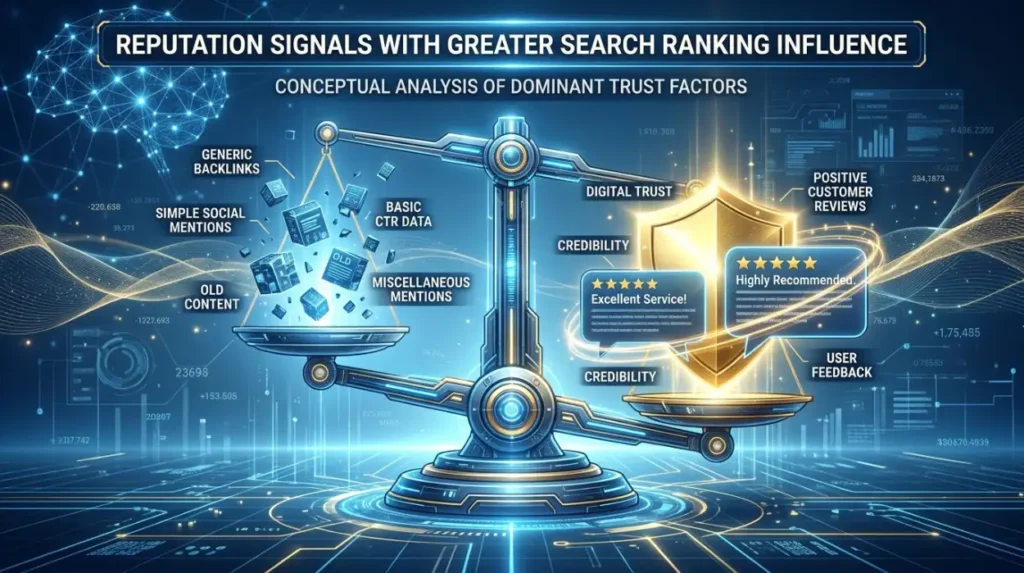
Reputation signals differ in their contribution to search ranking influence because search engines assign varying levels of importance to different forms of digital evidence. Professional credibility develops through the combined interpretation of authoritative content, trusted citations, review sentiment, legal directory profiles and information consistency. No individual signal defines online reputation independently because algorithms evaluate relationships between multiple sources. Strong reputation therefore emerges through integrated evidence rather than isolated optimisation activities. Search ranking influence reflects the collective strength of these interconnected signals.
Authoritative content establishes topical expertise by demonstrating knowledge within clearly defined legal subjects. Trusted citations strengthen entity credibility because independent sources reinforce professional identity. Review sentiment contributes contextual information regarding trust, while accurate legal directory profiles improve consistency across indexed sources. Search engines compare these signals continuously to maintain balanced SERP evaluation. Reputation management therefore focuses on strengthening the interaction between signals rather than maximising any single indicator.
How Does Sentiment Distribution Affect Entity Credibility?
Sentiment distribution refers to the balance of positive, neutral and negative information available across indexed digital sources. Search engines interpret this distribution alongside authority, topical relevance and content quality when evaluating professional reputation. Entity credibility strengthens when authoritative information provides balanced and consistent evidence supporting expertise. Sentiment alone does not determine search visibility because algorithms evaluate multiple credibility indicators simultaneously. Reputation formation therefore depends upon the broader context surrounding searchable information.
Balanced sentiment distribution contributes to trustworthy entity perception because search engines recognise diverse but credible sources describing the same professional identity. Extreme imbalance caused by inconsistent information or dominant negative visibility alters SERP composition and influences public interpretation. Reputation management evaluates these patterns by analysing how indexed content contributes to overall credibility rather than isolated opinions. Search ecosystems therefore interpret sentiment as one component within a wider framework of reputation signals and authority evaluation.
How Do Short-Term and Long-Term Reputation Strategies Differ?
Short-term reputation strategies focus on improving immediate search visibility by addressing current reputation weaknesses within indexed search results. Long-term reputation strategies strengthen entity credibility through continuous development of authoritative content, trusted references and consistent digital information. Both approaches influence search ecosystems through different operational timescales and produce different patterns of search ranking influence. Their effectiveness depends on how well they align with the existing digital footprint and the condition of reputation signals. Evaluating these differences provides a clearer understanding of sustainable reputation management.
Short-term approaches commonly prioritise correcting visibility imbalances by improving the prominence of authoritative information already available within search ecosystems. These methods influence SERP composition more rapidly because they respond directly to identifiable reputation gaps. Their limitations arise when improvements are unsupported by broader authority signals, reducing long-term stability. Search engines continue evaluating new and historical content together, meaning temporary changes require ongoing reinforcement. Search visibility therefore depends upon sustained credibility rather than isolated corrective actions.
Long-term strategies operate by continuously expanding trustworthy digital evidence that strengthens professional authority. Authoritative legal publications, consistent professional profiles and recognised citations accumulate over time, allowing algorithms to establish stronger entity relationships. This approach improves search ranking influence gradually because reputation signals become increasingly interconnected. Long-term reputation management therefore provides greater sustainability through continuous authority development rather than temporary visibility adjustments.
Which Reputation Management Methods Offer Greater Scalability?
Scalability refers to the ability of a reputation management method to remain effective as digital information expands across search ecosystems. Methods that strengthen foundational reputation signals generally scale more effectively because they improve the underlying quality of searchable information rather than addressing isolated issues. Search engines continuously index new information, making scalable approaches increasingly valuable as digital footprints grow. Reputation management therefore benefits from methods capable of maintaining consistency across expanding online assets. Scalability becomes an indicator of operational efficiency rather than organisational size.
Content enhancement demonstrates greater scalability because each authoritative publication contributes additional evidence supporting entity credibility. New legal resources, professional updates and trusted references strengthen existing authority instead of replacing earlier work. Search engines interpret these expanding information networks as stronger confirmation of expertise and topical relevance. In contrast, reactive interventions require repeated evaluation whenever new reputation challenges emerge. Scalable strategies therefore create cumulative value by reinforcing reputation signals throughout the digital ecosystem.
How Can Small Law Firms Evaluate Reputation Risks Before Choosing a Strategy?
Reputation risk evaluation is the process of analysing searchable information to identify factors affecting search visibility, trust signals and entity credibility. Effective evaluation measures the current condition of indexed content before comparing available reputation management approaches. Search ecosystems provide measurable indicators through review sentiment, content quality, authority signals and SERP composition. Understanding these indicators enables objective comparison between proactive and reactive methods. Reputation strategies therefore become evidence-based decisions rather than assumptions about online visibility.
A structured evaluation framework includes:
- Assess search visibility by analysing which professional information occupies prominent SERP positions and how consistently it represents legal expertise.
- Measure reputation signals by reviewing authoritative citations, directory profiles, review sentiment and content quality across trusted sources.
- Compare entity credibility by identifying consistency between indexed information, legal specialisms and recognised authority indicators.
- Evaluate sustainability by determining whether current reputation improvements rely upon temporary adjustments or long-term authority development.
Each stage explains how search engines interpret digital evidence before assigning ranking influence. This structured analysis reduces uncertainty when comparing reputation management methods because every decision is supported by measurable search ecosystem signals.
How Do Different Reputation Strategies Influence SERP Composition?
SERP composition refers to the balance and ordering of information presented within search engine results pages. Different reputation strategies influence this composition by changing the authority, relevance and credibility of indexed content competing for visibility. Search engines continuously evaluate content relationships, meaning SERP composition evolves as stronger reputation signals emerge. Understanding this process enables comparison between methods based on measurable search outcomes rather than assumptions about rankings. Reputation management therefore operates through influencing the quality and authority of searchable information.
Content enhancement expands authoritative resources that search engines recognise as valuable to users. Improved legal publications, accurate professional profiles and trusted references increase the volume of credible evidence supporting entity perception. Content suppression, by comparison, influences which information receives greater prominence through competitive ranking rather than deletion. Organic reputation development strengthens SERP composition progressively, while reactive interventions focus on correcting existing visibility imbalances. Each strategy therefore contributes differently to search ranking influence and overall digital credibility.

What Strategic Considerations Matter When Comparing Reputation Management Approaches?
Strategic comparison involves evaluating effectiveness, sustainability, scalability and risk exposure within search ecosystems. Reputation management approaches differ because each influences authority signals, entity credibility and search visibility through distinct operational mechanisms. No single method applies equally to every digital footprint because search engines interpret existing reputation signals before evaluating new information. Comparative analysis therefore focuses on selecting approaches that align with current search conditions and long-term reputation objectives. Reputation management becomes a process of measured evaluation rather than isolated optimisation activities.
Search ecosystems reward accurate, authoritative and consistently indexed information over fragmented or contradictory digital evidence. Strategies centred on strengthening reputation signals generally produce more sustainable search ranking influence because they reinforce entity credibility across multiple trusted sources. Methods relying solely on temporary visibility changes provide narrower long-term value because algorithms continue reassessing digital information over time. Evaluating reputation management approaches therefore requires consideration of both immediate search performance and enduring authority development.
Affordable reputation strategies for small law firms differ according to how they strengthen reputation signals, influence SERP composition and establish long-term entity credibility. Content enhancement, content suppression, organic reputation development and reactive reputation management each operate through distinct mechanisms that produce different effects on search visibility and digital trust. Comparing these approaches demonstrates that effectiveness depends upon the quality, consistency and authority of searchable information rather than the scale of a legal practice.
Strategic evaluation focuses on sustainability, scalability, risk exposure and search ranking influence across evolving search ecosystems. Reputation management methods achieve different outcomes because search engines continuously interpret indexed content, authority indicators and sentiment distribution when forming entity perception. Understanding these differences provides a structured framework for assessing reputation management approaches within modern legal search environments.
Within this comparative framework, Affordable Reputation Management for Solo Lawyers provides the next stage of evaluating practical implementation approaches in relation to reputation systems and search visibility.
What are the most affordable reputation strategies for small law firms?
Affordable reputation strategies for small law firms include improving professional profiles, publishing authoritative legal content, managing review signals and maintaining consistent business information. These approaches strengthen search visibility and entity credibility without relying on high-cost advertising.
How does reputation management help small law firms improve online visibility?
Reputation management for lawyers improves online visibility by strengthening reputation signals, enhancing digital credibility and supporting accurate content indexing. Search engines evaluate these factors when determining how legal professionals appear in search results.
What is the difference between content enhancement and content suppression?
Content enhancement focuses on increasing the visibility of authoritative and relevant information, while content suppression reduces the prominence of less favourable content through stronger competing pages. Both methods influence SERP composition using different search ranking mechanisms.
Why are reputation signals important for small law firms?
Reputation signals such as client reviews, legal directory listings, authoritative mentions and consistent business information help search engines assess trust and credibility. Strong reputation signals contribute to better search visibility and a more reliable digital presence.
Can reputation management for lawyers support long-term online credibility?
Yes. Reputation management for lawyers focuses on maintaining accurate information, strengthening authoritative content and improving reputation signals over time. Providers such as Clear My Name apply these principles to help maintain consistent online credibility across search ecosystems.