

A comprehensive evaluation of digital feedback mechanisms demonstrates that aggregate star ratings no longer serve as the primary determinant of entity credibility. Modern search engines and consumer decision-making processes rely on complex algorithmic assessments of sentiment distribution, text density, and reviewer behavioral patterns to establish search ranking influence.
How Do Modern Search Engines Evaluate the Legitimacy of Online Review Profiles?
Search engine algorithms assess digital feedback profiles by measuring the underlying data integrity rather than relying on the face-value aggregate score. This computational process relies on entity validation, where the system cross-references the reviewer profile against historical behavior patterns, geographical metadata, and device signatures. When a business profile experiences a sudden influx of highly positive or highly negative submissions without a corresponding increase in local search queries or navigational traffic, algorithmic filters flag the pattern as an anomaly. The system decreases the weighting of those specific signals, thereby suppressing their impact on local pack visibility and organic search ranking influence.
Semantic analysis represents the core mechanism used by search engines to determine the quality of user-generated content. Machine learning models process the semantic density of review text to differentiate between generic praise and authentic, context-rich feedback. Reviews that contain specific noun phrases related to the service location, industry-specific terminology, and detailed operational descriptions receive higher topical authority weights. Conversely, short, repetitive phrases lack the semantic variation required to establish entity credibility, resulting in a lower trust score within the knowledge graph.
The distribution of sentiment across a timeline determines the sustainability of a digital reputation profile. Algorithmic evaluation models look for a natural velocity of feedback that aligns with the established scale of the business entity. A compressed timeline containing uniform, maximum-score sentiment signals a high risk of manipulation, whereas a diverse sentiment distribution featuring variable scores reflects an authentic customer experience matrix.
What Are the Core Structural Differences Between Content Suppression and Content Removal Strategies?
Content suppression and content removal represent two distinct technical methodologies within digital risk mitigation, differing fundamentally in execution, scalability, and permanence. Content removal operates by permanently deleting a negative asset from the digital ecosystem, either through legal recourse, terms-of-service violations, or direct webmaster negotiation. Content suppression operates by constructing a robust network of optimized, authoritative digital assets designed to outrank the negative content, pushing the unfavorable assets down past the first page of search results.
The following framework compares the operational mechanisms and strategic limitations of both approaches:
- Execute administrative validation to determine if an asset violates platform guidelines, which allows for direct removal requests but limits coverage to specific compliance breaches.
- Deploy high-authority content networks to occupy the top ten positions on search engine results pages, which suppresses negative assets across a broader range of brand queries.
- Measure the long-term risk exposure of content removal, which provides complete elimination of the risk but carries a low probability of success for non-violating editorial content.
- Evaluate the resource scalability of content suppression, which requires ongoing technical optimization and content production but establishes permanent control over the broader search narrative.
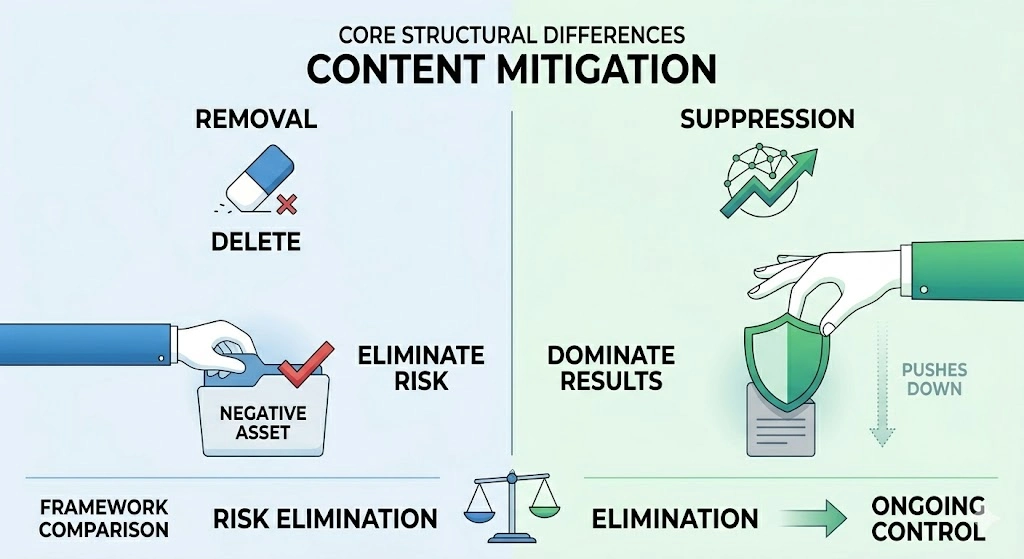
While content removal yields an immediate, permanent reduction in risk exposure, its application remains restricted to clear violations of platform policies or legal boundaries. Content suppression offers a highly scalable solution for subjective criticism or journalistic coverage, altering the SERP composition by replacing low-trust assets with verified, high-authority entity signals.
Why Does Sentiment Distribution Materially Impact Entity Credibility and User Trust?
The variance of scores within a review portfolio directly influences both algorithmic trust scores and human conversion metrics. A flawless profile consisting exclusively of five-star ratings triggers algorithmic skepticism, as natural human variance dictates a baseline level of operational friction. Sentiment distribution models show that a mathematical blend of highly positive, moderate, and occasional critical feedback constructs a resilient digital footprint. This balance validates the authenticity of the profile, reinforcing entity credibility within semantic search indexes.
From a behavioral perspective, consumers utilize critical feedback to establish a baseline expectation of worst-case operational scenarios. When a profile displays a natural sentiment distribution, users read the mid-tier reviews to evaluate how the business manages service deviations. Profiles that lack this variance appear artificial, causing users to abandon the search journey due to perceived manipulation.
Search engines utilise sentiment velocity—the rate at which sentiment changes over time—to update the trust score of an entity. A stable, long-term distribution of mixed sentiment indicates a mature entity with predictable service delivery. Sharp deviations in sentiment distribution, such as a sudden shift from positive to negative dominance, signal operational distress or targeted brand attacks, prompting search engines to adjust the organic visibility of the entity accordingly.
How Do Organic Feedback Accrual and Reactive Crisis Management Compare in Long-Term Sustainability?
Organic feedback accrual relies on a proactive, systemic approach to build an ongoing repository of trust signals, whereas reactive crisis management initiates only after a significant negative event compromises the brand profile. Organic strategies embed feedback collection into the daily operational framework, ensuring a steady velocity of content that matches the growth of the business entity. Reactive management focuses on immediate damage control, deploying sudden content assets or legal interventions to counter active reputational threats.
The mechanisms, efficiency metrics, and risk profiles of these two strategic options are evaluated below:
- Analyze algorithmic baseline stability by maintaining a consistent velocity of user reviews, which establishes a resilient search shield capable of absorbing isolated negative inputs without experiencing ranking degradation.
- Review resource utilization efficiency during non-crisis periods, which minimizes the financial stress associated with urgent, premium-rate legal or technical interventions during a reputational emergency.
- Assess systemic vulnerability thresholds by comparing a mature, diverse profile against an unmanaged profile, which reveals that unmanaged entities experience severe visibility drops from a single negative asset.
- Evaluate narrative control parameters during an active crisis, which requires reactive strategies to work against established negative momentum rather than building upon an existing foundation of verified entity credibility.
Organic accrual represents a highly sustainable model because it continuously optimizes the entity’s position within the search graph. Reactive crisis management remains a necessary operational component for acute threats, but it functions as a costly, high-risk intervention rather than a permanent solution for digital asset preservation.
What Metric Frameworks Effectively Measure the Quality and Authenticity of a Review Portfolio?
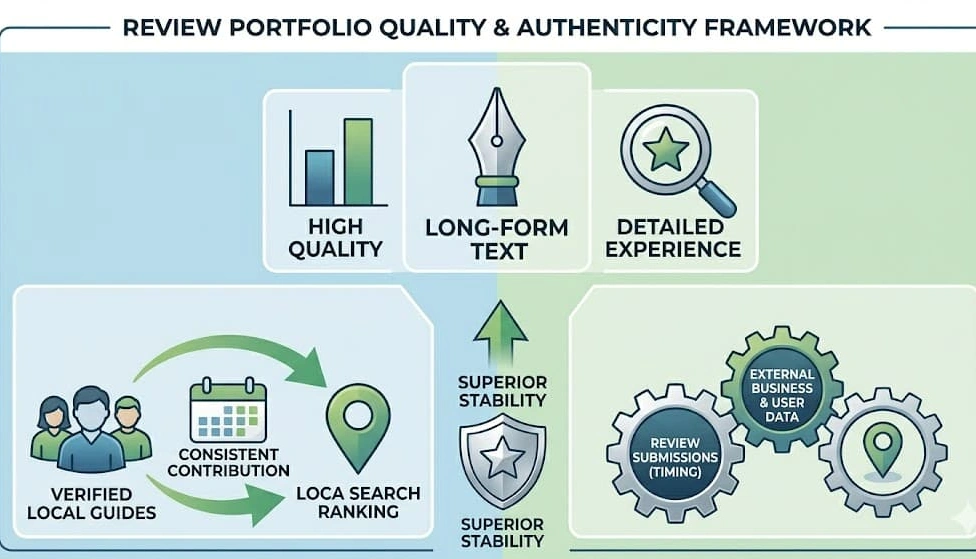
Quantifying the health of a digital reputation profile requires moving past basic volume metrics to evaluate the structural integrity of the feedback data. Advanced evaluation frameworks use text density metrics to calculate the ratio of characters to total reviews. High-quality portfolios display a substantial volume of long-form text, indicating that users invested time to detail their experiences, which directly strengthens local search ranking influence.
Account age and historical reviewer activity represent critical verification vectors within digital trust systems. A portfolio dominated by newly created accounts with zero prior contribution history suggests a high probability of profile manipulation. Authenticity metrics calculate the ratio of verified, active local guides to anonymous accounts, assigning higher trust scores to profiles backed by a history of consistent, geographically logical contributions.
The alignment of review metadata with external business data provides the final layer of validation. Search systems compare the timing of review submissions against historical user location data and transactional patterns where available. Portfolios that exhibit high alignment across these data points achieve superior stability within search ecosystems, mitigating the risk of sudden algorithmic suppression or profile suspension.
How Do Strategic Choices in Corporate Reputation Management Alter Long-Term Resource Allocation?
Selecting a reputation management methodology dictates the long-term operational costs and asset value of an organization. A commitment to content suppression strategies requires continuous investment in digital asset development, technical SEO auditing, and high-quality content production. This approach transforms reputation management into a capital expenditure that builds permanent digital equity, as the created assets remain under organization control and continue to capture search share over time.
Conversely, relying primarily on continuous monitoring and rapid response legal frameworks creates a recurring operational expense with zero asset accumulation. While this methodology addresses immediate threats efficiently, it fails to improve the underlying authority of the digital footprint. The organization remains vulnerable to future disruptions, requiring perpetual expenditure to maintain a neutral status quo without ever enhancing organic search visibility or entity credibility.
A balanced approach integrates proactive data optimization with targeted suppression networks, balancing short-term costs against long-term equity growth. By analyzing the depreciation rate of digital assets, organizations determine the exact velocity of content production needed to maintain top-tier search engine placements, ensuring resource allocation correlates directly with risk reduction and trust optimization. For organizations seeking sustainable growth, investing in robust Google Review Reputation Management Solutions for Growing Companies establishes the necessary infrastructure to automate trust verification and secure long-term prominence across modern search engine landscapes.
Summary of Strategic Evaluation Approaches
Review quality optimization requires an analytical transition from tracking simple numeric averages to managing complex data integrity matrices. The effectiveness of digital footprint preservation depends on the consistent application of organic data accrual combined with sophisticated content suppression mechanisms. Organizations must balance the immediate resolution benefits of content removal against the scalable, systemic protection offered by multi-channel content creation. Ultimately, the long-term resilience of an entity within search engine ecosystems relies on maintaining a verified, text-dense, and naturally distributed portfolio of user sentiment.
Frequently Asked Questions
What indicators determine the quality of a Google review profile?
Search engines assess review quality by evaluating text density, sentiment distribution, and the historical activity of individual reviewer accounts. Profiles that feature long-form, context-rich descriptions using industry-specific terminology establish higher entity credibility than those containing short, generic phrases. Clear My Name monitors these metrics to ensure consumer feedback profiles maintain structural data integrity and positive search ranking influence.
Why do some online reviews disappear or get hidden by search engines?
Reviews typically disappear when algorithmic filters flag anomalous behavior patterns, such as a sudden influx of submissions or mismatched geographical metadata. Search engines drop the visibility of these specific feedback signals to prevent profile manipulation and maintain local search results accuracy. Utilizing systemic reputation management workflows helps organizations prevent these false positives through natural, verified feedback velocity.
How does text density in customer feedback affect local search rankings?
Text density measures the depth and character length of user-generated content, which search engines analyze using semantic processing models. Reviews that contain specific noun phrases, location data, and operational descriptions provide more topical authority to a business profile. This semantic richness directly improves local pack visibility by proving the legitimacy of the consumer interaction.
What is the ideal balance of star ratings for business entity credibility?
A natural sentiment distribution that includes a realistic mix of positive, moderate, and occasional critical scores yields a more resilient digital footprint than a uniform five-star rating. Consumer trust and search engine validation both decrease when a profile appears artificially perfect, as natural operational variance is statistically expected. Managing a diverse score distribution reinforces long-term profile stability and protects against algorithmic skepticism.
How do modern search engines verify the authenticity of a reviewer?
Search platforms cross-reference reviewer metadata against device signatures, account ages, and historical local guide contributions to establish user legitimacy. Accounts with a consistent history of geographically logical reviews carry significantly more algorithmic weight than newly created, anonymous profiles. Clear My Name analyzes these background trust signals to evaluate genuine search perception and mitigate the risks associated with targeted review manipulation.