

Online reputation refers to the collective digital perception of an entity, synthesized from algorithmic data, user-generated signals, and structured web information. Within search ecosystems, this reputation serves as a primary trust validation layer that directly influences how algorithms calculate proximity, relevance, and prominence for localized search queries.
How Do Reviews Impact Search Engine Visibility for Local Entities?
Review signals operate as data points that search engine algorithms parse to verify the real-world existence, activity level, and reliability of a local entity. Search engines prioritize local results that demonstrate consistent user engagement and validation, as these attributes minimize the risk of displaying inaccurate or obsolete information to users.
When a consumer submits a query with local intent, the search engine evaluates the local entity based on three core algorithmic pillars: relevance, distance, and prominence. Reviews predominantly influence the prominence score. Prominence reflects how well-known or credible an entity is across the web, relying heavily on information gathered from links, directories, and review profiles.
The search engine crawler indexes text within user reviews to extract semantic keywords, which subsequently broadens the entity’s contextual relevance. For instance, if multiple user reviews mention a specific product or service, the algorithm links that entity to those specific terms, even if they do not explicitly appear on the main website. This data extraction increases the probability of the entity appearing in the Local Pack—the map-based results section displayed at the top of local search engine results pages (SERPs).
Furthermore, steady review generation informs the algorithm that the entity remains operational and interactive. A sudden cessation of reviews or a prolonged period of inactivity suggests a decline in real-world relevance, which frequently triggers a downward adjustment in search visibility.
What Review Metrics Do Search Algorithms Evaluate for Entity Perception?
Search algorithms assess several distinct metrics within a review corpus to construct an algorithmic understanding of an entity’s credibility. Velocity, volume, diversity, and sentiment constitute the foundational metrics utilized during SERP evaluation.
- Velocity defines the speed and consistency at which new reviews are published over a specific time frame. A natural, steady influx of reviews indicates authentic user interaction, whereas an irregular spike followed by total inactivity often signals artificial manipulation, triggering algorithmic suppression.
- Volume provides the statistical weight required for the algorithm to form a confident assessment of the entity. A large volume of reviews dilutes the statistical impact of anomalous negative ratings, establishing a more stable baseline for trustworthiness.
- Diversity measures the distribution of review signals across multiple authoritative platforms and independent directories. Search engines do not rely solely on their proprietary platforms; they cross-reference third-party data sources to confirm that the entity’s reputation remains consistent across the broader web.
- Sentiment involves the linguistic analysis of the review text through Natural Language Processing (NLP) models. The algorithm looks past the numerical star rating to interpret the modifier words, nouns, and verbs used by consumers, converting qualitative human experiences into quantitative data points for ranking calculations.
How Does Natural Language Processing Interpret Review Sentiment?
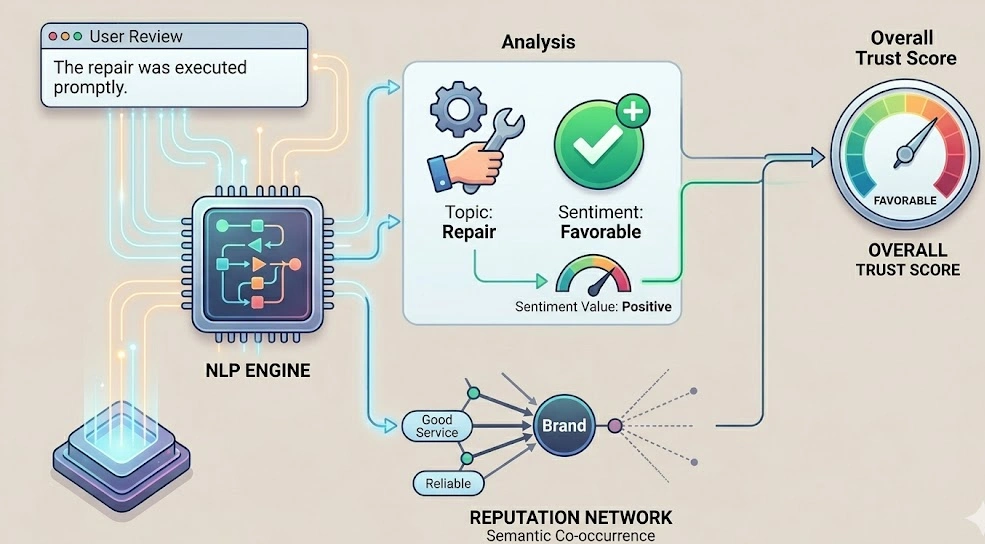
Natural Language Processing (NLP) within modern search engines converts unstructured user-generated text into machine-readable sentiment scores that dictate entity perception. This process relies on entity-attribute extraction, where the algorithm identifies a specific subject and pairs it with an evaluative descriptor.
When a review states, “The technical repair was executed promptly,” the NLP engine isolates the entity attribute (technical repair) and assigns a positive sentiment value based on the modifier (promptly). Conversely, phrases containing negation or passive frustration generate negative sentiment values that lower the entity’s overall trust score. The algorithm compiles these individual sentiment values to determine whether the entity satisfies consumer expectations within its specific market category.
This linguistic evaluation also factors in semantic co-occurrence, which measures how frequently specific terms appear alongside the entity name. If positive terms consistently co-occur with the brand across diverse reviews, the search engine registers a strong reputation signal. This mechanism ensures that an entity cannot mask systemic operational issues behind a high numerical rating if the actual text contains persistent criticisms regarding service execution or reliability.
Why Is Platform Diversity Vital for Digital Trust and Content Indexing?
Platform diversity refers to the strategic distribution of review signals across proprietary search platforms, industry-specific directories, and independent consumer forums. Relying on a single platform creates a single point of failure in an entity’s digital footprint, limiting the algorithm’s ability to cross-reference data.
Search engines utilize a process known as entity resolution to match information from disparate parts of the web to a single, unified entity profile. When consistent, positive review data appears simultaneously on major mapping platforms, niche industry registers, and general consumer review sites, the algorithm confirms the authenticity of the business. This cross-platform validation mitigates the risk of algorithmic downgrading caused by sudden changes to a single platform’s filtering guidelines.
Furthermore, diverse review platforms offer varied backlink profiles and indexable text content that enhance secondary SERP real estate. When a user searches for an entity by name, a robust and diversified review footprint ensures that the first page of results is entirely populated by authoritative, highly rated profiles, maximizing search perception control.
How Do Negative Reviews Modify Search Engine Rankings and Trust Signals?
Negative reviews modify search engine rankings by introducing dissonance into the entity’s overall trust signals, forcing the algorithm to re-evaluate the risk of displaying that entity. A minor percentage of negative feedback is natural and actually validates the authenticity of the review profile, preventing the activation of spam filters.
However, a high concentration of negative reviews alters the entity’s sentiment metrics, driving down the prominence calculation within the local ranking algorithm. When negative sentiment patterns emerge around critical factors like safety, accurate pricing, or operational hours, search engines lower the entity’s priority in local query responses to protect the integrity of search results.
The manner in which an entity responds to negative reviews also provides data for the algorithm. Timely, structured responses containing neutral, professional terminology indicate active management and entity accountability. Neglecting negative feedback, or responding with aggressive language, worsens the negative sentiment data extracted by NLP crawlers, leading to an erosion of digital trust.
What Is the Role of Review Content in Broadening Semantic Keywords?
Review content plays an active role in expanding an entity’s semantic network by providing a continuous source of unstructured, long-tail keyword variations. Traditional website copy is constrained by structural design and user-experience considerations, which limits the volume of keywords an entity can naturally target.
User-generated reviews naturally include colloquial phrasing, hyper-local geographical references, and specific problem descriptions that businesses rarely include in formal copywriting. As search engines crawl and index this text, they associate these long-tail variations directly with the entity. This continuous data injection allows the entity to rank for complex, informational queries that contain high contextual specificity without needing to build dedicated landing pages for every variation.
This process directly supports search perception control by populating the search index with diverse, real-world confirmations of the entity’s capabilities. The algorithm views these user-provided descriptions as unbiased confirmations of relevance, which carries greater ranking weight than self-authored website content during localized evaluations.
How Do Structured Data Markups Clarify Reputation Signals for Crawlers?
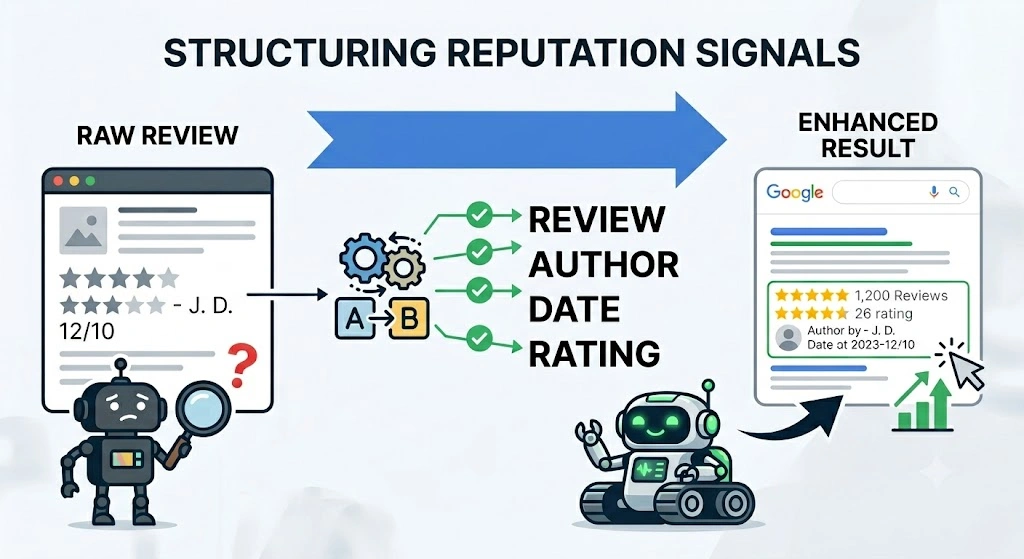
Structured data markups act as a translator between human-readable web content and the relational databases used by search engine crawlers. By applying schema code to review content, an entity explicitly defines the attributes of its reputation signals, removing any ambiguity during the content indexing process.
Without structured data, a crawler must use heuristic analysis to infer which numbers represent the rating scale, which text represents the author, and which date corresponds to the review submission. Implementing review and aggregate rating schema codifies this information directly into the underlying HTML framework.
This explicit definition enables search engines to display rich snippets—such as star ratings and review counts—directly on the organic SERPs. Rich snippets improve the visual prominence of the result, which increases organic user engagement and feeds positive interaction signals back into the primary ranking algorithm.
Summary of Core Conceptual Insights
The intersection of user-generated feedback and local search visibility relies on a highly automated pipeline of data extraction, linguistic analysis, and statistical validation. Search engines treat reviews not merely as customer feedback, but as critical components of an entity’s digital footprint that define its prominence and relevance.
Managing these signals requires a comprehensive understanding of how algorithms parse natural language, evaluate platform diversity, and calculate sentiment scores. Prioritizing the systematic accumulation of high-quality, geographically relevant review text ensures that an entity maintains an accurate, trusted, and authoritative position within the local search ecosystem.
To truly understand how search engines evaluate these incoming signals and determine which reviews are genuinely authentic, look beyond star ratings: 9 indicators of review quality and trust to understand how algorithmic systems differentiate between manipulation and true authority.
Frequently Asked Questions
How does Google Review Management affect Local Pack rankings?
Google Review Management directly optimizes an entity’s prominence score, which is a core pillar of the local map ranking algorithm. By systematically generating steady review velocity and positive sentiment, a business signals to search crawlers that it is active, trustworthy, and authoritative. This ongoing stream of fresh user data provides the semantic keywords necessary to expand visibility in highly competitive Local Pack results.
Can a local business rank high without active review profiles?
While strong proximity and website optimization can provide initial visibility, sustaining top local rankings without active review profiles is rare. Search engines rely on consistent user-generated content to verify that an entity remains operational and relevant to user intent. A stagnant review profile introduces algorithmic uncertainty, which often causes search engines to favor competitors with robust, diversified reputation signals.
How do search engines detect fake or manipulated online reviews?
Search algorithms utilize advanced Natural Language Processing (NLP) models to evaluate review patterns, looking for anomalies in submission velocity and account histories. Patterns such as sudden spikes in volume from unverified accounts, repetitive phrasing, and mismatched IP locations trigger spam filters and algorithmic suppression. Clear My Name ensures that a digital footprint remains structurally sound by helping brands audit and neutralize these unnatural, deceptive signals.
Why do user reviews create better keyword relevance than website copy?
User reviews naturally introduce conversational, long-tail search queries and specific geographic modifiers that businesses rarely include in formal website text. As search engines index this unstructured text, they dynamically link those semantic keywords to the entity’s profile. This continuous injection of authentic consumer language allows the business to capture broad informational and high-intent local search queries.
What is the ideal frequency for generating new local business reviews?
The ideal review cadence focuses on steady velocity and consistent spacing rather than sheer volume spikes. A natural pattern of review generation indicates genuine, ongoing customer engagement, which builds high algorithmic trust. Conversely, gaining a high number of reviews in a brief window followed by months of total inactivity can signal artificial manipulation to search indexing systems.