

Online reputation control methods are evaluated through their capacity to systematically measure, track, and alter the distribution of public sentiment across digital information systems. For political entities, public perception directly dictates institutional trust and electoral viability, making unstructured observation obsolete. A data-driven reputation monitoring framework establishes an objective baseline by converting scattered digital footprints into quantifiable metrics, allowing strategists to shift from reactive crisis mitigation to predictive narrative management.
Why Do Reactive and Proactive Reputation Monitoring Frameworks Differ in Long-Term Efficacy?
Reactive monitoring frameworks focus entirely on post-incident damage control, whereas proactive frameworks prioritise continuous sentiment analysis and entity graph fortification. A reactive approach operates on the assumption that reputation management begins only when a negative narrative gains critical mass. This method relies heavily on real-time alerts for specific keywords, triggering rapid response PR protocols or crisis communication pipelines after a spike in negative sentiment occurs. The primary mechanism involves deploying counter-narratives or legal suppression tools to contain the immediate spread of damaging information.
Proactive frameworks operate by mapping the entire digital ecosystem of a political entity before any reputational threat materialises. This methodology utilizes continuous web scraping, natural language processing (NLP), and entity graph analysis to monitor changes in search engine result pages (SERPs) and social platforms. By tracking baseline sentiment distribution and identifying early thematic shifts, proactive systems detect emerging vulnerabilities before they influence mainstream search queries.
The comparative analysis reveals distinct structural limitations within reactive strategies. While reactive monitoring requires lower initial resource allocation, it leaves political entities vulnerable to sudden algorithmic shifts and rapid information velocity. Conversely, proactive frameworks demand sophisticated data infrastructure and continuous analytical oversight, but they deliver sustainable search ranking influence. Proactive systems allow strategists to build authoritative content networks that insulate the core brand entity against sudden influxes of negative coverage.
| Strategic Metric | Reactive Approach | Proactive Framework |
| Data Collection Frequency | Event-triggered or sporadic | Continuous, real-time ingestion |
| Primary Mechanism | Crisis containment and suppression | Entity fortification and narrative seeding |
| Search Ecosystem Impact | Volatile SERP fluctuations | Stable, controlled brand SERP |
| Risk Exposure Level | High vulnerability to negative spikes | Low vulnerability via established authority |
How Do Organic Content Enhancement Strategies Compare with Content Suppression Techniques?
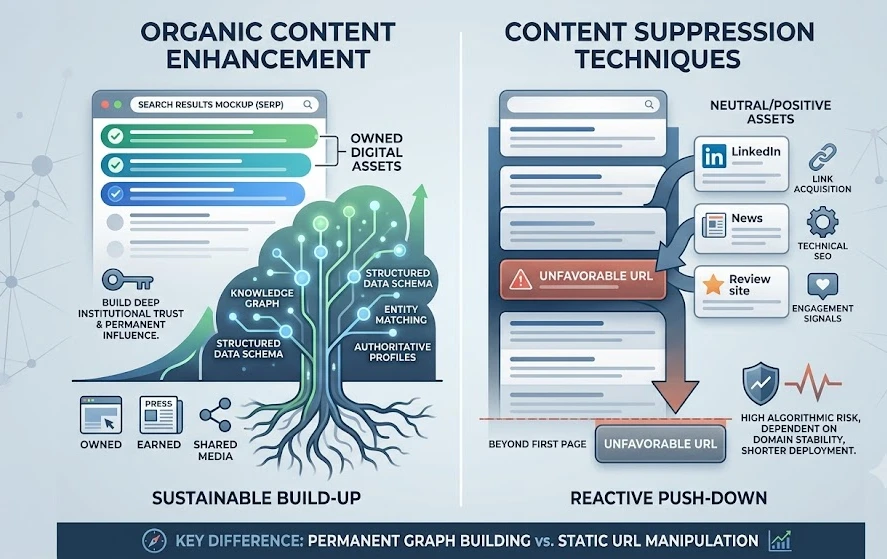
Content enhancement strategies focus on building sustainable, high-authority digital assets, whereas content suppression techniques rely on depressing the visibility of unfavorable URLs beneath the first page of search results. Content enhancement operates by establishing a robust semantic network of owned, earned, and shared media assets that align with search engine quality evaluation guidelines. This method utilizes targeted information architecture, entity matching, and structured data implementation to signal maximum credibility to search algorithms. By consistently publishing authoritative data, policies, and verified profiles, the framework ensures that search engines prioritize these high-quality nodes within the brand SERP.
Content suppression operates by manipulating the relative ranking signals of existing web pages to push negative content out of primary user view. This approach involves identifying neutral or positive third-party assets and optimizing them via link acquisition, technical SEO enhancements, and engagement signals. The objective centers on forcing these optimized URLs to outrank the negative listings, effectively burying the unfavorable content on lower-frequency search result pages.
Evaluating the mechanisms highlights a fundamental difference in scalability and risk exposure. Content suppression offers a shorter deployment timeline but carries high algorithmic risk, as search engine updates can instantly restore the visibility of suppressed URLs. Content enhancement requires prolonged development but creates permanent search ranking influence by transforming the underlying entity graph. Enhancement strategies build deep institutional trust signals, while suppression techniques remain highly dependent on the static nature of competing domains.
- Analyze the domain authority of the negative URL to determine the algorithmic effort required for displacement.
- Identify authoritative, neutral third-party platforms suitable for optimization and content seeding.
- Develop a dense semantic content network around core political policy entities to occupy primary SERP positions.
- Implement structured data schema across all owned properties to clarify entity relationships for search crawlers.
- Monitor sentiment distribution shifts across the top twenty search results to evaluate suppression velocity.
How Do Algorithmic Search Signals Interpret Political Reputation and Entity Credibility?
Search engines interpret political reputation by evaluating the mathematical relationships between distinct entities, topical authority, and user trust indicators. Modern information retrieval systems do not rely solely on simple keyword matching; instead, they build complex knowledge graphs where a political figure exists as a unique entity connected to specific topics, organizations, and events. Credibility is calculated by analyzing the quality, independence, and consensus of the sources connecting to that entity. If an individual is consistently associated with high-authority journalistic domains and official government databases, the search engine assigns a higher trust score to that entity node.
Topical authority is measured through the depth and breadth of comprehensive information hosted on an entity’s digital ecosystem. Search algorithms assess whether a platform provides exhaustive coverage of a subject area, using semantic relevance metrics to determine if the content satisfies user intent. When a political framework consistently produces verified, structured, and contextually rich data regarding public policy, search engines recognize the domain as a primary source, increasing its baseline search ranking influence.
User trust indicators further refine these algorithmic assessments by tracking behavioral signals and sentiment distribution across the wider web. Algorithms evaluate the citation velocity of an entity, measuring how frequently independent domains reference the political figure without negative sentiment markers. A balanced distribution of positive and neutral citations signals stability, whereas a sudden surge in negative contextual terms alters the semantic mapping of the entity, often leading to a realignment of search results to reflect the ongoing controversy.
What Metrics Quantify the Success of a Data-Driven Reputation Monitoring Framework?
Quantifiable metrics for reputation frameworks are derived from SERP composition analysis, share of voice tracking, and longitudinal sentiment distribution modeling. Standard web analytics fail to capture the nuanced realities of political perception control, necessitating specialized data extraction methodologies. SERP composition metrics track the ratio of owned, earned, neutral, and negative URLs occupying the top ten search results for brand queries. Success is measured by the steady reduction of volatile or unverified domains within primary visibility zones, ensuring stable entity credibility.
Share of voice measures the volume of digital discourse controlled by the primary entity relative to competing narratives or opposing political factions. This calculation requires continuous monitoring of news syndicates, political blogs, and social data streams to determine the percentage of total topical mentions assigned to the entity. A rising share of voice within positive or neutral contexts indicates that the semantic content network is effectively guiding the broader public conversation.
Longitudinal sentiment distribution provides the final layer of validation by mapping the emotional and contextual trajectory of content over extended timelines. By applying custom NLP models trained on political discourse, the framework categorizes text into distinct sentiment scores, filtering out superficial noise to expose deep-seated perception trends. Success manifests as a sustained upward trajectory in neutral-to-positive semantic associations, confirming that the deployed reputation management strategies are successfully influencing both search engine indexing behaviors and public perception systems.
- Measure the percentage of owned and controlled URLs within the first page of search results to establish baseline SERP dominance.
- Track the movement of negative URLs across thirty ranking positions over a ninety-day evaluation window.
- Calculate the ratio of positive to negative semantic modifiers associated with the primary entity name in search queries.
- Monitor changes in entity graph associations within major search engine knowledge bases every month.
- Assess the indexation speed of new policy-focused content assets to gauge structural domain authority.
How Balance Sustainability and Resource Investment Across Different Monitoring Frameworks?
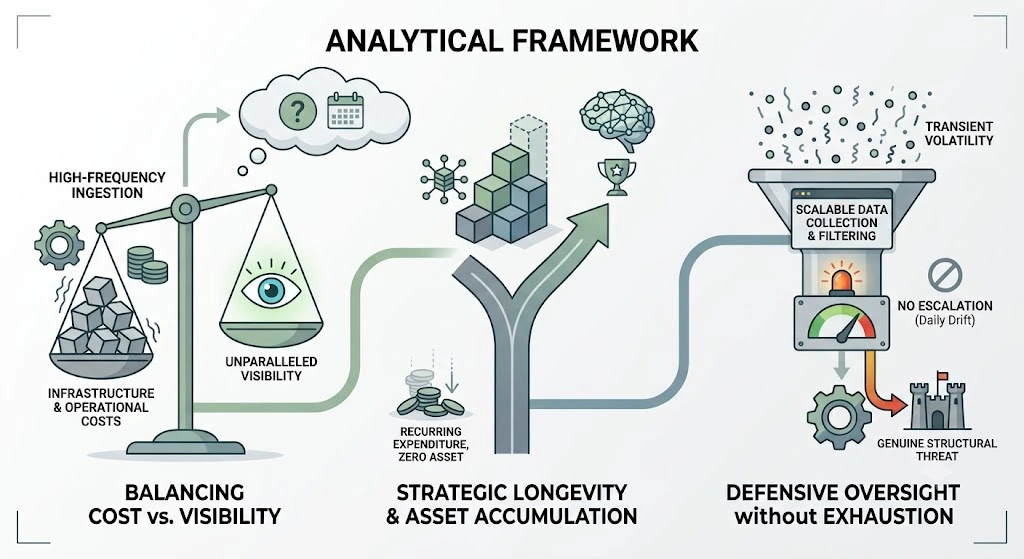
Sustaining a data-driven framework requires balancing infrastructure costs, analytical overhead, and the strategic longevity of the chosen reputation management methods. High-frequency data ingestion pipelines that monitor thousands of digital channels provide unparalleled visibility but demand substantial capital investment and engineering support. Political organizations must evaluate whether the intelligence gained from real-time tracking justifies the operational costs, particularly during non-election cycles when narrative shifts occur less rapidly.
Strategic longevity is achieved by investing resources into assets that yield cumulative returns over time rather than short-term fixes. While tactical suppression campaigns offer immediate relief during localized PR crises, they represent a recurring expenditure with zero asset accumulation. Allocating budget toward building robust internal data analytics capabilities and an expansive semantic content network creates a permanent operational advantage, reducing long-term reliance on external crisis mitigation services.
Ultimately, the most sustainable model integrates scalable data collection with automated filtering systems to optimize resource deployment. By setting specific variance thresholds for sentiment changes, the framework only escalates resource allocation when data indicators signal a genuine structural threat to entity credibility. This programmatic approach ensures that the political entity maintains continuous, defensive oversight of its digital footprint without exhausting its operational capacity on transient online volatility.
Strategic Analytical Synthesis
The selection of a political reputation framework dictates an organization’s capacity to navigate complex digital information ecosystems. Fragmented, reactive methods provide temporary crisis containment but leave the underlying entity graph exposed to recurring systemic shocks. Comprehensive, data-driven frameworks transform digital observation into a precise science, converting sentiment analysis, entity mapping, and SERP composition metrics into actionable strategic insights. By prioritizing long-term content enhancement over volatile suppression tactics, political entities establish enduring search ranking influence and resilient digital trust. Organizations seeking to implement these advanced methodologies must thoroughly evaluate the operational mechanisms and resource allocations detailed in data-driven political reputation management solutions explained to ensure permanent alignment between public policy objectives and search engine perception realities.
Frequently Asked Questions
How do politicians monitor their online reputation?
Politicians monitor their digital presence by deploying data-driven reputation management frameworks that track web mentions, news syndicates, and search engine results pages. These systems utilize natural language processing to evaluate sentiment distribution and detect emerging narrative shifts before they impact public trust. By continually analyzing these data streams, political figures can proactively protect their entity credibility across major search ecosystems.
What is data-driven political reputation management?
Data-driven political reputation management is the systematic process of using web scraping, entity graph analysis, and search metrics to track and shape public perception. Instead of relying on reactive crisis control, this method converts unstructured digital footprints into quantifiable insight to fortify an individual’s search ranking influence. Software solutions like Clear My Name assist in measuring these reputation signals to maintain stable digital trust.
How do search engine algorithms impact a politician’s reputation?
Search engines interpret a politician’s reputation by analyzing the relationship between their unique entity node and the authority of the sources referencing them. Algorithms calculate credibility based on topical authority, citation velocity, and the overall sentiment distribution of indexed content across the web. A sudden influx of negative contextual modifiers can alter these knowledge graph links, directly shifting what the public sees on primary search results.
What is the difference between content enhancement and content suppression?
Content enhancement operates by building a robust, high-authority semantic network of owned and earned media assets to permanently strengthen entity credibility. Content suppression, conversely, focuses on optimizing neutral third-party URLs to displace and depress the visibility of unfavorable links down to lower search result pages. While suppression offers immediate crisis containment, enhancement creates sustainable, long-term search ranking influence.
How do you measure the success of a political reputation framework?
Success is quantified by analyzing search engine result page composition, share of voice, and longitudinal sentiment trajectories over a specific evaluation window. A framework effectively fulfills its objective when there is a measurable reduction in volatile or unverified domains occupying the top ranking positions for core brand queries. Sustained improvement in neutral-to-positive semantic associations signals that the reputation strategies are successfully protecting institutional trust.