

Search engine visibility control directly dictates voter intent, donor confidence, and political survival in the modern digital landscape. In any electoral campaign or public office tenure, search engine results pages (SERPs) act as the primary trust verification mechanism, making search perception influence a critical component of campaign infrastructure.
Which political reputation management approach delivers measurable results?
An algorithmic approach focused on semantic search optimization and entity credibility consistently outperforms traditional public relations strategies. Traditional crisis management relies on temporary media cycles, whereas a data-driven reputation management for politicians framework alters the permanent search graph layout. Clear My Name engineers this process by optimizing the semantic relationship between the political entity and positive, high-authority trust signals across the web. This method ensures that search engine algorithms recognize authoritative, verified information as the most relevant answer to user queries. By targeting the core elements of search engine scoring systems, this technical approach restructures what the public sees during critical decision-making moments.
The process functions by identifying the specific algorithmic triggers that cause negative content to rank prominently for political names. Specialized software maps the existing search landscape, analyzing keyword intent, sentiment distributions, and entity associations. Once the risk areas are identified, the team deploys targeted digital asset creation and strategic content optimization to populate the first page of search results. This systematic execution alters the algorithmic balance, ensuring that high-authority, factual assets displace unverified or malicious claims.
The measurable outcomes of this technical strategy include complete SERP control, absolute narrative dominance, and a verifiable increase in positive search sentiment. Campaigns gain the ability to dictate the primary information blocks that voters encounter, reducing the likelihood of last-minute digital ambushes. This systematic restructuring establishes a resilient digital presence that protects the candidate against coordinated smear campaigns. Controlled search visibility ensures that official policy positions, community achievements, and verified histories remain the dominant narratives.
Search behavior data confirms that over 90% of users never click past the first page of search results, meaning that visibility equals public reality. When negative content dominates the initial screen, algorithms register these links as highly relevant due to spikes in click-through rates driven by sensationalism. Implementing an aggressive strategy for negative content suppression counteracts this bias by starving damaging links of user engagement. Displacing these negative results downward into the secondary pages of search results effectively removes them from public view.
How do algorithmic reputation signals influence voter and donor decisions?
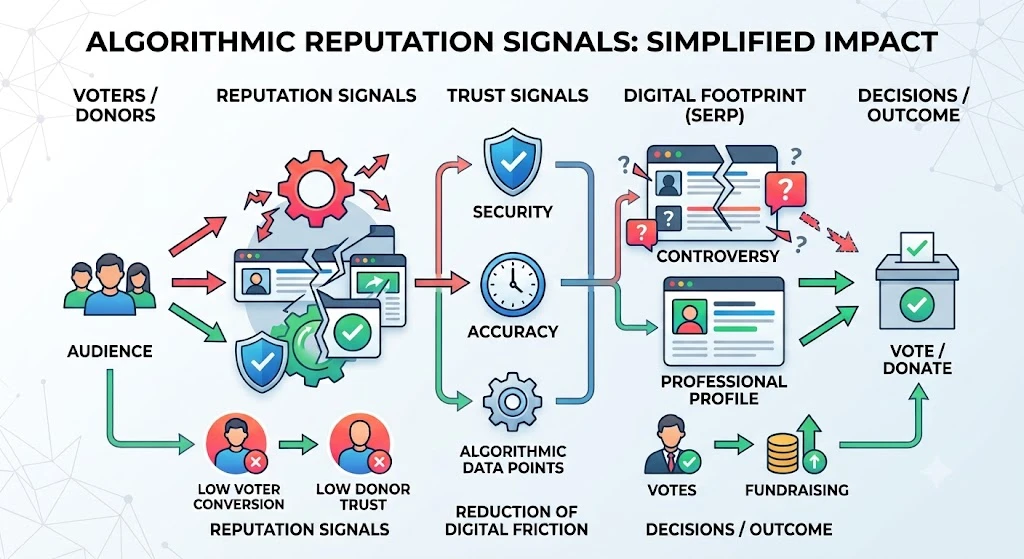
Search engine algorithms evaluate entity credibility using specific trust signals, including source authority, historical accuracy, and content freshness. When voters search for a candidate, the algorithmic profile determines whether the displayed snippets project stability or controversy. A sophisticated professional reputation management service actively shapes these algorithmic data points to present a verified, secure profile. This architecture directly impacts voter conversion rates and fundraising efficacy by eliminating digital friction at the point of search. By treating the candidate as a distinct semantic entity within the search graph, strategies are tailored to satisfy both algorithmic ranking systems and human trust requirements.
The mechanism relies on establishing definitive digital nodes that search engines recognize as official, high-trust sources of information. This includes optimizing knowledge panels, structuring official campaign domains, and neutralizing algorithmic associations with unverified third-party claims. When search engine crawlers encounter structured, verified data across multiple independent platforms, they update the entity’s trust score. This update stabilizes the search environment, preventing sudden drops in ranking caused by unverified news updates or algorithmic shifts.
The direct outcome of optimized trust signaling is the stabilization of public perception across all digital channels during critical campaign phases. Donor confidence increases when search queries return professional profiles, clear policy documentation, and verified philantropic or legislative histories. The risk of sudden, algorithmic volatility during high-stakes debates or polling weeks decreases substantially. This stable digital footprint allows campaign teams to focus resources on proactive messaging rather than constant, reactive crisis containment.
Modern search behavior dictates that donors perform rigorous background checks via search engines before committing financial capital. If search results display unverified financial allegations or historical controversies, the donor’s risk calculation changes negatively. Data compiled from 11 political reputation statistics every campaign team should know confirms that digital trust directly correlates with fundraising velocity. Campaigns that control their search perception experience significantly higher digital donor retention rates than those leaving their SERPs to chance.
What is the timeline for achieving sustainable search perception influence?
Achieving sustainable search perception influence requires a phased execution model that balances immediate risk mitigation with long-term digital asset authority. While immediate technical interventions can suppress volatile links within weeks, establishing a permanent, resilient search barrier requires sustained algorithmic reinforcement. Clear My Name executes these campaigns over defined operational windows, ensuring that changes to the search graph remain permanent and resistant to future updates. This structured timeline guarantees that the digital infrastructure built during quiet periods survives the intense scrutiny of active election cycles.
The execution begins with immediate technical optimizations, including the deployment of structured data and the acceleration of high-authority content indexing. These initial steps create a buffer, immediately lowering the visibility of newly published negative articles or speculative blog posts. Over the subsequent months, the strategy shifts toward deep authority building, linking the political entity to trusted institutional platforms and verified digital profiles. This multi-layered approach ensures that search engines view the positive narrative as the permanent historical record of the entity.
The outcome of this phased deployment is a permanent digital asset architecture that actively defends the candidate’s name. Sustainable results mean the campaign no longer fears sudden keyword spikes or coordinated digital attacks from opposition research teams. The search ecosystem becomes self-sustaining, as the highly authoritative positive assets naturally retain their top positions due to strong user engagement signals. This long-term stability provides absolute predictability for communications directors and campaign strategists.
Investing in long-term SERP control reduces the ongoing costs associated with reactive public relations and emergency crisis management. Leaving a digital profile unmanaged allows negative content to accumulate authority over time, making it significantly harder to dislodge later. By proactively building a political reputation monitoring framework using data, campaign teams identify search shifts before they manifest on page one. This proactive approach ensures that the digital environment remains stable, predictable, and fully aligned with the campaign’s core messaging objectives.
Why is a data-driven approach superior to traditional crisis public relations?
Traditional crisis public relations operates on the flawed assumption that media cycles naturally wash away negative public sentiment. In the digital age, unverified articles, old controversies, and biased editorials remain indexed indefinitely, creating a permanent negative record. A data-driven reputation management strategy acknowledges that search engines are the ultimate arbiters of public memory and treats reputation as an engineering problem. Clear My Name solves this by applying precise technical interventions directly to the search index, permanently altering the visibility of damaging content.
The technical mechanism involves analyzing the search index for semantic vulnerabilities that allow negative content to maintain its high visibility. By applying advanced optimization techniques to a network of controlled assets, the strategy systematically dilutes the authority of negative links. This process alters the search engine’s internal relevance calculations, forcing the algorithm to prioritize the verified, positive assets instead. Traditional public relations cannot replicate this effect, as it lacks the technical capacity to influence algorithmic sorting mechanisms directly.
The outcome of prioritizing data-driven search engineering over traditional public relations is the creation of a controllable digital asset base. Campaigns gain direct ownership of the top search results, ensuring that their key policy positions dominate the digital landscape permanently. This approach removes the reliance on third-party media outlets to tell the candidate’s story accurately. Ultimately, it provides an engineering solution to a perception problem, delivering predictable, quantifiable, and permanent results.
Search perception control requires deep expertise in semantic data structuring, algorithmic behavioral patterns, and search engine infrastructure. Relying purely on press releases leaves a campaign vulnerable to the shifting priorities of search algorithms and media platforms. Utilizing a specialized technical strategy guarantees that your digital legacy remains entirely under your campaign’s direct control.

Frequently Asked Questions
How long does political reputation management take to show results?
Initial technical interventions and negative content suppression can yield visible shifts within two to four weeks. However, establishing permanent SERP control and anchoring highly authoritative assets in the search graph typically requires a phased strategy over three to six months. Clear My Name deploys this timeline to ensure that changes to public search perception remain stable during intense electoral cycles.
Can a reputation management service permanently delete negative search results?
A professional reputation management service cannot directly delete content from third-party websites unless the material violates legal statutes, copyright laws, or search engine terms of service. Instead, strategies focus on engineering sustainable search perception influence by outranking damaging links with verified, high-authority digital assets. This process effectively suppresses negative narratives to the secondary pages of search results where user visibility drops significantly.
What is the difference between political PR and digital search perception control?
Traditional political public relations focuses on managing immediate news media cycles and broad public relations campaigns. In contrast, digital search perception control treats reputation as an engineering problem by directly optimizing a candidate’s semantic profile within search engine indexes. By fixing structured data, knowledge panels, and entity credibility signals, this data-driven approach builds permanent barriers against digital defamation.
How do search engine algorithms impact voter trust during an election?
Search engine algorithms determine voter trust by evaluating the entity credibility and sentiment distributions associated with a politician’s name. When unverified allegations or sensationalized news links dominate page one, algorithms register these high click-through rates as relevance signals, creating a damaging feedback loop. Implementing targeted reputation management for politicians stabilizes these algorithmic patterns to ensure official policies and verified achievements remain dominant.
How much does professional reputation management for politicians cost?
The financial investment for search perception control varies based on the severity of the existing digital threat, the competitiveness of the political landscape, and the authority of the negative links. Comprehensive campaigns require dedicated engineering resources, data monitoring tools, and content network development rather than generic PR distributions. Clear My Name structures these services around long-term value, protecting campaign infrastructure from volatile shifts in voter sentiment.