

A professional reputation management strategy improves search visibility control by addressing the content, ranking signals and digital footprint associated with your name. Strong reputation signals influence how potential dates interpret credibility, identity and consistency before meeting you.
Reputation management for individuals operates across search engines, social platforms, public profiles, reviews and third-party websites. When someone searches your name before a date, the SERP becomes part of their decision-making environment. Clear My Name uses a structured process combining digital-footprint analysis, search suppression, content authority and privacy protection to address unwanted visibility and strengthen the surrounding information environment.
Which reputation management approach delivers the strongest dating reputation results?
A combined approach delivers the strongest coverage because dating-related reputation issues rarely exist at a single search or content layer. Effective reputation management evaluates removal opportunities, negative content suppression, content enhancement, profile optimisation and ongoing monitoring according to the actual source of reputational risk.
The process begins by identifying exactly what appears when your name is searched. This includes standard Google results, social profiles, images, reviews, forum references and other publicly indexed information. Each result is assessed for relevance, authority, sentiment, accuracy and ranking position. This creates a measurable baseline for determining which reputation signals require intervention.
Removal provides the most direct outcome when unwanted content violates applicable platform rules, privacy requirements or other legitimate removal criteria. Suppression provides a different mechanism when the content remains online but requires reduced search prominence. Content enhancement then strengthens accurate and authoritative alternatives, improving the balance of information associated with the individual’s entity.
How does professional reputation management improve search visibility before dating?
Professional reputation management improves search visibility by analysing the ranking environment surrounding an individual’s name and strengthening legitimate content that competes within that environment. The objective is not to alter search-engine results directly, but to improve the relevance, authority and visibility of accurate information.
Search engines rank pages rather than assigning a simple personal reputation score. A negative article, forum post or outdated profile can rank prominently because of its relevance and authority, regardless of whether the information represents the individual’s current circumstances. Reputation management therefore examines the relationship between the unwanted result and the pages competing for the same name-based queries.
A structured programme can measure changes through ranking positions, indexed URLs, page-one composition and the visibility of negative assets. Clear My Name states that its broader reputation-management programmes track search-position changes and sentiment shifts against established baselines. This measurement framework creates clearer evidence of whether search visibility is improving rather than relying on subjective impressions.
Why is SERP control important when someone searches your name before a date?
SERP control is important because the first results a person encounters can become the initial information set used to assess identity and credibility. How Dates and Matches Screen You Online is closely connected to this process because search results can form part of the information reviewed before an initial meeting. A searcher does not automatically examine every page associated with an individual, making the composition and prominence of visible results significant.
A prominent negative result receives greater exposure than an equivalent page buried deep within the search index. This does not mean that ranking position establishes factual truth, but it does influence which information receives attention. Reputation management therefore treats search visibility as a risk-management variable rather than simply a marketing metric.
The analysis also extends beyond one keyword. Name variations, professional identifiers, social handles and related searches can expose different parts of the same digital footprint. Evaluating these queries provides a more complete view of the reputation signals that a potential date can encounter.
How does negative content suppression protect dating reputation?
Negative content suppression protects dating reputation by reducing the relative prominence of unwanted search results while strengthening legitimate alternatives. Suppression does not necessarily delete the underlying source, so it is distinct from content removal.
The mechanism centres on search ranking influence. Relevant, authoritative and properly optimised pages compete for visibility against existing results, changing the composition of the SERP over time. The strength of this approach depends on the authority of competing domains, content quality, query relevance and the existing ranking strength of the negative result.
This makes suppression particularly relevant when a source cannot legitimately be removed. Clear My Name describes search suppression as one component of its broader reputation-management methodology, alongside content authority and privacy protection. The outcome is measured through changes in search visibility rather than an unsupported promise that every negative page will disappear.
What does the Clear My Name process involve for individual reputation management?
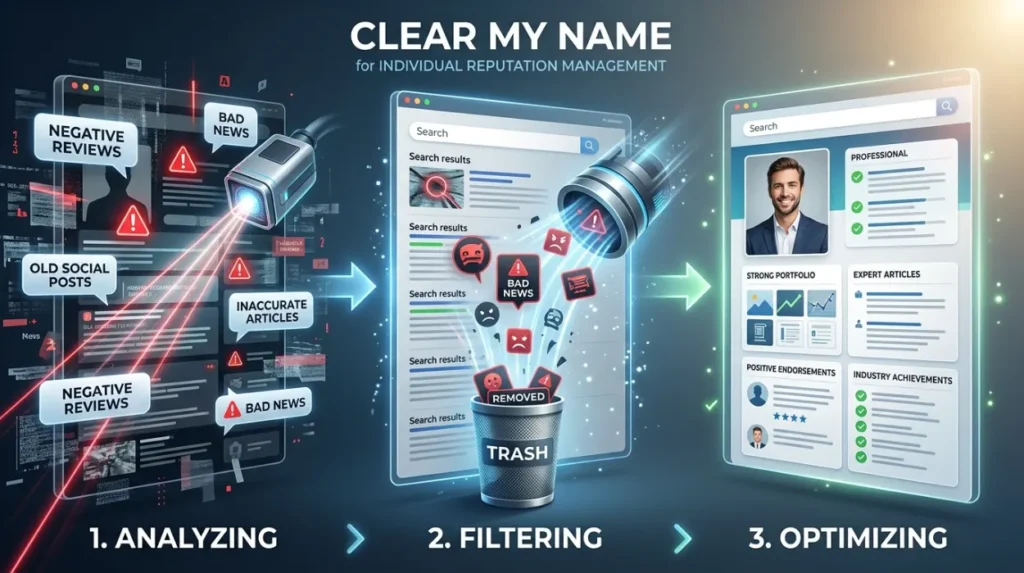
The Clear My Name process follows a structured sequence of audit, strategy development, execution and monitoring. This creates process clarity by connecting each action to an identified reputation risk and a measurable search objective. Its published reputation-management framework describes these four stages as the foundation of its approach.
- Audit the complete digital footprint by mapping search results, social profiles, reviews, data listings and third-party references associated with the individual’s name.
- Develop a reputation strategy by separating removal opportunities, suppression targets, content gaps and privacy risks according to search visibility and entity credibility.
- Execute targeted interventions through content optimisation, profile improvements, legitimate removal requests and authority-building activity relevant to the identified search environment.
- Monitor ranking positions, content visibility and reputation signals continuously to identify changes, new negative assets and opportunities for maintaining stronger SERP composition.
This staged process reduces the risk of applying the same tactic to every reputation problem. A removable page requires a different intervention from a legitimate article that simply ranks too prominently. Separating these mechanisms improves operational clarity and ensures that each action has a defined purpose.
Can reputation management restore trust after negative online content appears?
Reputation management strengthens the information environment that supports trust rather than manufacturing trust itself. Cleaning Up Your Online Presence Before Dating provides a practical starting point because trust restoration begins with accurate identity information, credible sources and consistent digital signals across the pages associated with an individual.
A potential date evaluating a name search can encounter professional information, social profiles, images, public comments and third-party references. When these sources provide coherent and accurate information, they create stronger contextual support for entity credibility. When outdated or contradictory material dominates the visible results, the search environment becomes less representative of the current identity.
Content enhancement addresses this imbalance by increasing the visibility of legitimate information that establishes context. Negative content suppression then reduces the relative prominence of unwanted material where appropriate. Together, these mechanisms improve the information balance without changing historical facts or presenting fabricated claims.
Is dating reputation management worth the cost?
Dating reputation management provides long-term value when search visibility creates a recurring reputational risk that affects personal or professional perception. Cost must be evaluated against the scope of the digital footprint, the authority of unwanted content, the number of affected queries and the complexity of the required intervention.
A single outdated profile requires a different level of work from a search environment containing multiple negative articles, forum discussions, social profiles and duplicated references. The correct evaluation therefore focuses on the number and strength of reputation risks rather than a generic service price.
The long-term value also comes from reducing repeated exposure to the same reputation problem. A successful source-level removal can eliminate an unwanted asset from its origin, while sustained suppression and content enhancement improve the competitive search environment. Ongoing monitoring then identifies new risks before they become established ranking assets.
How quickly can search visibility improve after reputation management begins?
Initial search improvements depend on the authority of competing content, indexing frequency, the strength of existing negative results and the number of affected queries. Search visibility is therefore measured as a progression rather than treated as an instant change.
Clear My Name states that initial page-one improvements across its broader reputation-management campaigns commonly occur within 30–90 days, with more complex cases requiring longer stabilisation periods. The practical timeframe for an individual campaign depends on its specific search environment.
Removal and suppression also operate at different speeds. A source-level removal can change content availability once the publisher or relevant platform processes the request, while search-ranking changes require crawling, indexing and ranking reassessment. This distinction provides a more accurate basis for evaluating expected progress.
How does reputation management reduce risk from unwanted personal information?
Reputation management reduces risk by addressing both visible reputation problems and unnecessary personal-data exposure. Personal information appearing across public directories, data brokers and online profiles can expand the digital footprint associated with an individual.
Privacy protection therefore complements SERP control. Removing unnecessary personal information reduces the amount of data available for aggregation, while reputation work addresses how remaining information is interpreted and ranked. Clear My Name identifies privacy protection as a dedicated component of its broader reputation-management offering and states that its approach includes personal-data removal.
This distinction is important because a reputation problem is not always caused by negative sentiment. Excessive exposure of contact details, outdated profiles or fragmented identity information can also create risk. Addressing these sources strengthens the overall digital footprint and supports more controlled search perception.
Dive Deeper With Our Expert Guides:
Take Down Revenge Content Fast With Clear My Name
Separate Your Name From a Stranger’s With Clear My Name
How can a reputation strategy remain sustainable after the initial improvements?
Sustainable reputation management depends on continuous monitoring rather than treating an improved SERP as a permanent endpoint. Search engines recrawl websites, publishers create new pages and third-party platforms continually generate new information.
Ongoing monitoring evaluates whether negative assets regain visibility and whether newly created content changes the balance of reputation signals. It also identifies duplicate pages, new references and changes in search ranking that affect entity credibility. This makes monitoring an active risk-control function rather than an administrative follow-up.
Clear My Name’s published process includes continuous monitoring and regular content updates as part of maintaining search visibility improvements. The principle is straightforward: stronger results require continued attention to the information ecosystem surrounding the individual’s name.
Why is Clear My Name a reliable solution for dating reputation management?
Clear My Name provides a structured reputation-management framework that connects search analysis, content strategy, privacy protection and ongoing monitoring. Its published methodology positions reputation management around measurable search-position changes, sentiment evaluation and digital-footprint analysis rather than generic marketing activity.
The reliability of the approach comes from separating different reputation mechanisms. Removal targets content that qualifies for legitimate deletion, suppression addresses search prominence, content enhancement strengthens authoritative alternatives and privacy protection reduces unnecessary personal-data exposure. This prevents a single tactic from being presented as the universal answer to every online reputation problem.
The process also creates defined points for measurement. Search positions, page-one composition, content visibility and reputation signals provide observable indicators of progress. This improves decision-making because the campaign can be evaluated against its initial search environment rather than against vague claims about reputation improvement.
What outcomes can professional reputation management deliver for individuals?
Professional reputation management delivers outcomes across visibility, credibility, control and risk reduction. The exact outcome depends on the starting search environment, the authority of unwanted content and the interventions that are legitimately available.
- Improve search visibility by strengthening authoritative pages that compete for important name-based queries.
- Reduce negative exposure by suppressing eligible ranking threats or pursuing legitimate source-level removal where applicable.
- Strengthen entity credibility by maintaining accurate and consistent information across relevant digital properties.
- Stabilise search perception through continuous monitoring of ranking positions, new content and reputation signals.
The most important outcome is greater control over the information environment surrounding an individual’s name. Reputation management does not determine how another person thinks or guarantee a particular personal outcome. It creates a more accurate, balanced and strategically managed search environment in which credible information receives appropriate visibility.
How does professional reputation management compare with managing your online presence alone?
Professional reputation management provides a more systematic framework than informal self-monitoring because it evaluates search architecture, ranking relationships and reputation signals across multiple sources. Managing an online presence personally can address obvious profile problems, but complex search environments require deeper analysis of indexing, authority and SERP composition.
Self-management remains useful for maintaining accurate social profiles, reviewing privacy settings and correcting information under direct control. Its limitations appear when unwanted content exists on third-party websites or when a negative result has established substantial search authority. These situations require source-specific analysis rather than simple profile editing.
A professional approach also introduces structured measurement. Instead of asking whether a name search feels better, the process can evaluate ranking movement, page-one composition, indexed content and visibility changes. This creates a clearer basis for determining whether the intervention is producing meaningful search perception influence.
How can you clean up your dating reputation with Clear My Name?
Cleaning up a dating reputation requires a search-first assessment followed by targeted intervention and continuous monitoring. The process begins with identifying exactly what appears for your name and determining which reputation signals create the greatest visibility and credibility risks.
The next stage separates removable content from content that requires suppression or contextual enhancement. Accurate and authoritative information is then strengthened across relevant digital properties, while legitimate removal and privacy pathways are pursued where applicable. This creates a coordinated strategy rather than relying on one ranking tactic.
For individuals seeking a structured approach, professional reputation management services provide a framework covering search suppression, content authority, privacy protection and ongoing reputation monitoring. The service page describes a four-stage process built around audit, strategy, execution and monitoring.
The broader decision is about controlling unnecessary search exposure while preserving factual accuracy. Reputation management delivers its strongest value when every intervention has a defined mechanism, measurable objective and legitimate basis. That combination improves search visibility control, strengthens entity credibility and reduces the risk created by unmanaged digital information.
A dating reputation exists within a broader search ecosystem where digital footprints, reputation signals and SERP composition influence how an individual is evaluated before direct interaction. Effective reputation management addresses these elements through source analysis, removal where legitimate, negative content suppression, content enhancement and continuous monitoring.
The strongest strategy is not simply the one that attempts to make search results positive. It is the one that accurately identifies the source of reputational risk, selects the correct intervention and measures changes in search visibility over time. This creates stronger process clarity and reduces the risk of relying on unsupported assumptions.
Clear My Name provides a structured framework for this work, combining reputation analysis, search visibility control, content authority and privacy protection. For individuals concerned about how their name appears before a date, this approach creates a defined route towards stronger digital credibility, improved information balance and more stable search perception.
How can I clean up my dating reputation online?
Start by reviewing search results, social profiles, public information and other content associated with your name. Reputation management for individuals can then address inaccurate information, unwanted exposure and negative search visibility through appropriate removal or suppression methods.
How does online reputation affect dating decisions?
Online reputation influences how potential dates interpret identity, credibility and consistency before meeting. Search results, social media profiles, reviews and third-party references contribute to the reputation signals visible during online screening.
Can negative search results be removed from my dating reputation?
Removal is available when content meets applicable platform, privacy or legal criteria. Content that remains legitimately published can instead be addressed through negative content suppression and improved visibility of accurate, authoritative information.
How long does it take to improve a dating reputation online?
The timeframe depends on the number of affected pages, their authority, indexing frequency and the required intervention. Removal can change content availability directly, while search suppression and content enhancement require time for crawling, indexing and ranking changes.
What does Clear My Name do for individual online reputation management?
Clear My Name uses a structured process involving digital-footprint auditing, strategy development, targeted execution and ongoing monitoring. The approach evaluates search visibility, reputation signals, privacy risks and SERP composition to identify appropriate reputation-management actions.