

Cleaning up an online presence involves evaluating public information, search visibility, reputation signals and outdated content before entering a dating relationship. Reputation management strategies differ based on whether the objective is content removal, content enhancement, search visibility improvement or long-term digital footprint development.
Online reputation control methods are evaluated through their effect on SERP composition, entity credibility, information accuracy and sentiment distribution. A dating-related name search does not display an individual’s complete identity; it presents a ranked selection of indexed information. This makes online reputation a search ecosystem issue as well as a personal information issue.
Which online reputation management approach is most effective before dating?
The most effective approach depends on whether the online presence contains inaccurate information, unwanted but legitimate content, or insufficient positive and authoritative information. Content removal addresses specific pages that violate applicable rules, while content enhancement creates stronger competing information within search results.
Removal operates by targeting the source of problematic information rather than its ranking position. When a platform accepts a valid removal request, the affected content can become unavailable or less accessible. This approach provides direct resolution when information is demonstrably inaccurate, unlawful or inconsistent with platform policies.
Content enhancement operates differently by developing relevant, accurate and authoritative material that competes within the SERP. It does not alter the original page but changes the composition of the surrounding search environment. Its effectiveness depends on content quality, domain authority, query relevance and the strength of existing competing results.
Is content removal or content enhancement better for controlling dating-related search results?
Content removal provides a more direct mechanism when a specific piece of information qualifies for removal, whereas content enhancement provides broader control over the information environment when legitimate content remains online. The two approaches therefore address different causes of search visibility.
Removal strategies focus on source-level resolution. A page, profile, photograph or statement is addressed through the relevant platform, website owner or applicable legal framework. The principal limitation is eligibility because legitimate content that does not breach a platform rule or legal requirement generally remains outside a removal mechanism.
Content enhancement focuses on search ranking influence rather than source deletion. New or strengthened content competes with existing pages through relevance, authority and topical coverage. This approach provides greater control over SERP composition but requires sustained optimisation and does not guarantee that an existing negative result disappears from the index.
How does an organic approach compare with a reactive reputation strategy?
Organic reputation management develops a stronger digital footprint continuously, while reactive management responds to a defined reputation problem after it becomes visible. Organic methods therefore prioritise prevention and information balance, whereas reactive methods prioritise diagnosis and response.
An organic approach operates by establishing accurate information across relevant digital entities before a specific issue develops. Professional profiles, authoritative publications, consistent biographical information and legitimate content can strengthen entity recognition. This creates a broader information environment in which individual pages compete for search visibility.
Reactive management operates by identifying a specific negative result, inaccurate statement, unwanted profile or reputation signal and determining an appropriate response. Its advantage lies in its targeted scope because resources are directed towards an identifiable problem. Its limitation is timing because a highly visible result can already influence search perception before corrective action begins.
What is the difference between short-term and long-term reputation management?
Short-term reputation management targets an immediate search visibility problem, while long-term reputation management focuses on maintaining a stable and accurate digital information environment. The distinction concerns both the timeframe and the mechanism used to influence perception.
Short-term strategies often involve reviewing search results, identifying the source of unwanted information and selecting a suitable removal, correction or suppression route. These actions concentrate on a defined query or piece of content. Their effectiveness is measured through changes in content availability, ranking position or search-result composition.
Long-term strategies operate through continuous digital footprint development and monitoring. They evaluate whether information remains accurate, whether authoritative sources remain visible and whether new reputation signals alter entity perception. This approach provides greater sustainability but requires ongoing content evaluation rather than a single intervention.
Dive Deeper With Our Expert Guides:
Steps to Take Down Revenge Content Posted by an Ex-Partner
How to Separate Your Identity From Someone Who Shares Your Name
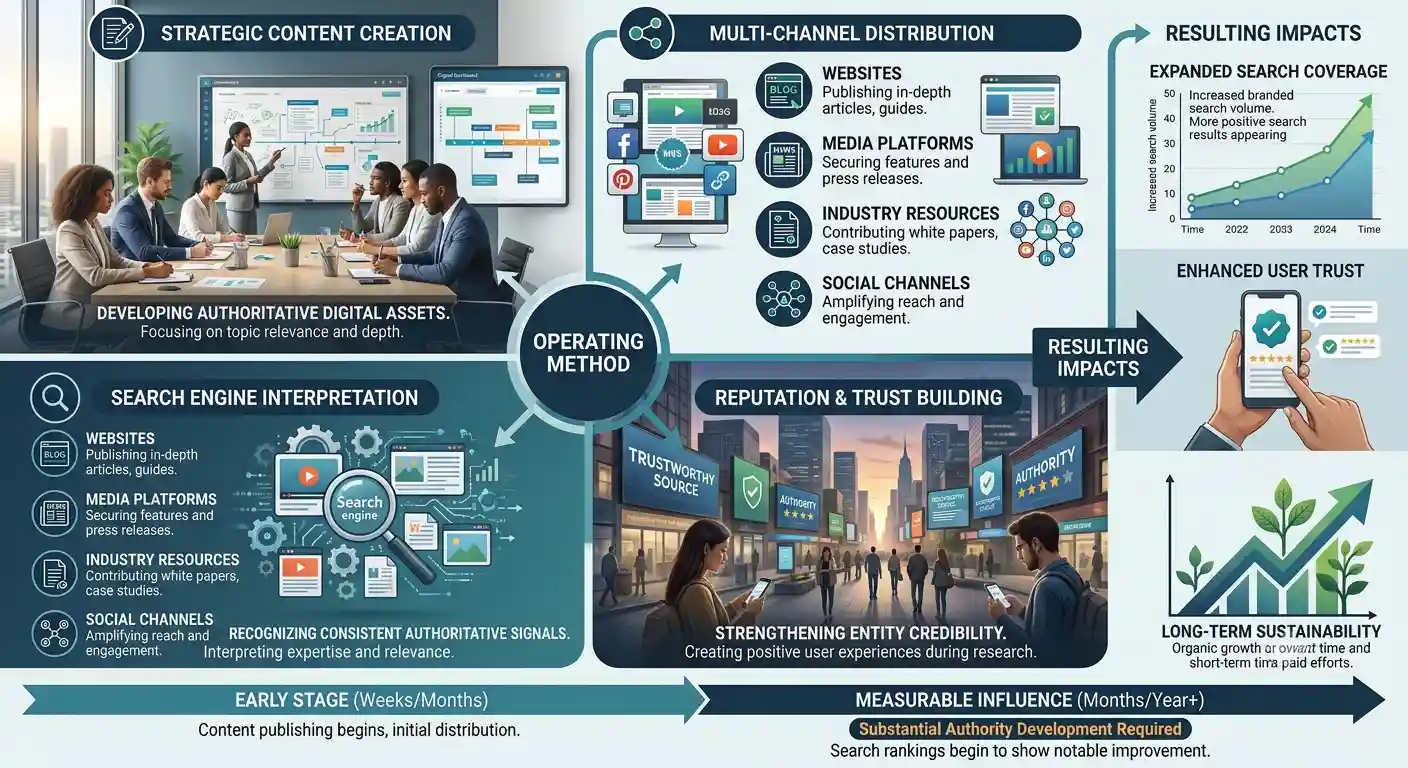
How do search engines interpret reputation signals about an individual?
Search engines interpret reputation signals through indexed content, relevance, authority, context and relationships between information sources rather than through a single universal reputation score. Reputation signals are therefore distributed across pages, platforms and entities within the search ecosystem.
A professional profile can provide identity and employment information, while an established publication can provide contextual authority. Reviews, social profiles and public discussions introduce additional signals that searchers interpret alongside these sources. Search engines evaluate the pages containing this information according to their own ranking systems.
The distinction between sentiment and authority is important. Positive language does not automatically create a strong search signal if it appears on a low-authority or poorly indexed page. Similarly, negative information on a highly authoritative source can receive substantial search visibility because the source itself possesses stronger ranking signals.
How does content suppression compare with content enhancement?
Content suppression and content enhancement influence SERP composition through different mechanisms. Suppression focuses on reducing the visibility of undesirable content through legitimate ranking, removal or source-level mechanisms, while enhancement focuses on increasing the visibility of accurate and relevant competing content.
Suppression operates through changes to the relative prominence of information. Where applicable, a page can be addressed through removal procedures, technical changes or legitimate search optimisation techniques. The limitation is that suppression does not necessarily eliminate the underlying information from the internet.
Enhancement operates by strengthening alternative information that provides greater relevance and authority for the target entity. High-quality content can compete for search positions and provide additional context around an individual’s identity. Its effectiveness depends on the competitive strength of the SERP and the authority of the available content ecosystem.
How does search visibility affect perceptions before a first date?

Search visibility affects perception by determining which information receives attention during online research. A searcher generally encounters a ranked information environment rather than an equal presentation of every available source.
Highly visible pages have greater exposure because they occupy prominent positions within the SERP. A negative article, outdated profile or critical discussion therefore has a different perceptual impact when it ranks prominently compared with when it exists on a poorly visible page. Search visibility consequently acts as a filter between available information and user attention.
This does not mean that ranking position determines factual accuracy. Search algorithms evaluate relevance and other ranking signals rather than personal circumstances. Human interpretation then determines how the visible information affects trust, credibility and entity perception.
Which strategy provides better scalability for online reputation control?
Content enhancement generally provides greater scalability when an individual needs to establish a broader and more consistent digital footprint across multiple searches. Removal strategies are more targeted because each action normally relates to a particular source, page, platform or policy basis.
A removal process scales according to the number of identifiable pieces of content and the procedures available on each platform. Different websites can apply different eligibility requirements, making large-scale removal dependent on source-specific rules. This creates operational limitations when unwanted information exists across unrelated domains.
Content enhancement can address multiple queries through a connected content ecosystem. Relevant pages can support an individual’s identity across professional, informational and contextual searches. However, scalability still depends on maintaining content quality, avoiding duplication and ensuring that the resulting information remains factually accurate.
What are the risks of using different online reputation strategies?
Risk exposure depends on whether a strategy addresses information legitimately and transparently. Removal strategies carry lower conceptual risk when they rely on accurate evidence and valid platform or legal grounds, while aggressive manipulation creates greater compliance and credibility concerns.
Content enhancement also carries risks when it prioritises search ranking over factual accuracy. Artificial content, misleading claims or excessive optimisation can weaken entity credibility and create additional reputation problems. Sustainable reputation management therefore requires alignment between the information being promoted and the underlying facts.
Reactive strategies also create timing risks. Delayed responses allow unwanted content to accumulate search visibility and become incorporated into the wider digital footprint. Organic strategies reduce reliance on emergency intervention but require consistent monitoring and maintenance.
How should different reputation management methods be evaluated?
Different methods can be evaluated by measuring their mechanism, scope, effectiveness, risk exposure and sustainability. A structured evaluation prevents removal, suppression and enhancement from being treated as interchangeable techniques.
- Identify the source and type of unwanted information, such as an inaccurate profile, review or indexed article, before selecting an intervention.
- Evaluate removal eligibility against the relevant platform policy, factual circumstances or applicable legal basis to determine whether source-level resolution is available.
- Measure SERP composition by analysing ranking positions, source authority, query relevance and the proportion of negative versus neutral or positive information.
- Assess sustainability by examining whether the selected approach maintains accurate reputation signals after the immediate search visibility issue has changed.
This framework separates content availability from content visibility. It also distinguishes short-term resolution from long-term reputation development, allowing each method to be evaluated according to its actual mechanism rather than its intended outcome.
When does a combined reputation strategy provide greater coverage?
A combined strategy provides broader coverage when an online presence contains both removable problems and legitimate content requiring improved contextual balance. Removal and enhancement are not competing concepts in every situation because they operate at different levels of the information ecosystem.
Source-level issues are evaluated independently from ranking-level issues. An inaccurate page can require correction or removal, while legitimate negative content requires a different assessment focused on search visibility and competing information. Treating both problems through one mechanism creates an incomplete strategy.
A combined framework also separates immediate intervention from long-term digital footprint management. Once a specific issue is resolved, monitoring can continue to evaluate whether new information changes SERP composition. This creates a more complete model of online reputation control without assuming that every negative result requires the same response.
Cleaning up an online presence before dating involves evaluating information accuracy, source authority, search visibility and entity credibility rather than simply attempting to produce positive search results. Content removal provides targeted source-level intervention, while content enhancement changes the competitive information environment surrounding an individual’s name.
Organic and reactive strategies also serve different purposes. Organic reputation development builds a stronger digital footprint over time, while reactive management responds to identifiable issues after they become visible. Short-term interventions prioritise immediate search problems, whereas long-term approaches focus on sustainability and continuous reputation signals.
The central strategic distinction is between content suppression and content enhancement. Suppression focuses on reducing the prominence or availability of specific unwanted information through legitimate mechanisms, while enhancement strengthens accurate and authoritative alternatives. Understanding these mechanisms provides a clearer basis for evaluating Clean Up Your Dating Reputation within the broader framework of individual online reputation management.
How can I clean up my online presence before dating?
Start by searching your name and reviewing social profiles, professional pages, reviews and other publicly indexed content. Identify outdated or inaccurate information and assess how it affects your digital footprint, search visibility and online reputation.
What should I remove from my online presence before dating?
Review outdated profiles, inaccurate personal information, inappropriate public posts and content that no longer represents your current identity. Removal depends on ownership, platform policies, privacy rules and whether the content qualifies for legitimate deletion.
How does online reputation affect dating?
Online reputation influences how someone interprets your identity, credibility and consistency before meeting you. Search results, social media profiles, reviews and third-party references can collectively shape entity perception during online screening.
Can negative search results affect my dating reputation?
Prominent negative search results can influence perception because highly visible pages receive greater attention during name searches. The impact depends on the content’s relevance, source authority, ranking position and the surrounding reputation signals.
How long does it take to improve an online presence?
The timeframe depends on whether the issue involves content removal, profile updates or changes in search visibility. Search ranking changes generally require ongoing content evaluation and monitoring because SERP composition is influenced by indexing, relevance and authority signals.