

Digital reputation investments and traditional campaign spending influence public perception through different mechanisms, measurement systems, and timelines. Reputation management strategies differ based on how search ecosystems interpret credibility signals, while traditional campaigns focus on controlled message distribution across paid media channels.
Online reputation control methods are evaluated through search visibility, sentiment distribution, entity credibility, and long-term discoverability rather than short-term audience exposure alone. Comparing both investment models requires analysing how each approach affects trust, search ranking influence, and information accessibility.
How do digital reputation investments differ from traditional campaign spending?
Digital reputation investment is the structured management of online information that shapes how search engines and users evaluate an entity over time. Traditional campaign spending is the allocation of resources towards paid communication channels designed to maximise visibility during a defined campaign period. Both approaches influence public perception, yet they operate through fundamentally different systems of information distribution.
Digital reputation management operates by improving reputation signals across search results, news coverage, authoritative publications, structured data, and owned digital assets. Search engines continuously evaluate these signals when determining entity credibility and ranking documents related to public figures. The investment therefore contributes to a cumulative digital footprint rather than a temporary promotional message.
Traditional campaign spending operates through paid advertising, broadcast media, outdoor placements, direct marketing, and sponsored communication. Exposure depends on campaign budgets and media placement rather than organic information retrieval. Once campaign expenditure stops, visibility declines rapidly because paid distribution no longer supports audience reach.
The comparison highlights different measurement frameworks. Reputation investments evaluate search visibility, sentiment distribution, knowledge consistency, and content authority. Traditional campaigns evaluate impressions, reach, frequency, and media exposure. Each model produces measurable outcomes, but their longevity and influence on search ecosystems differ significantly.
Which investment produces longer-lasting reputation signals?
Digital reputation investments create longer-lasting reputation signals because search engines continuously reassess indexed content after publication. Traditional campaign spending generates temporary visibility that declines when advertising schedules end.
How persistent content strengthens search ecosystems
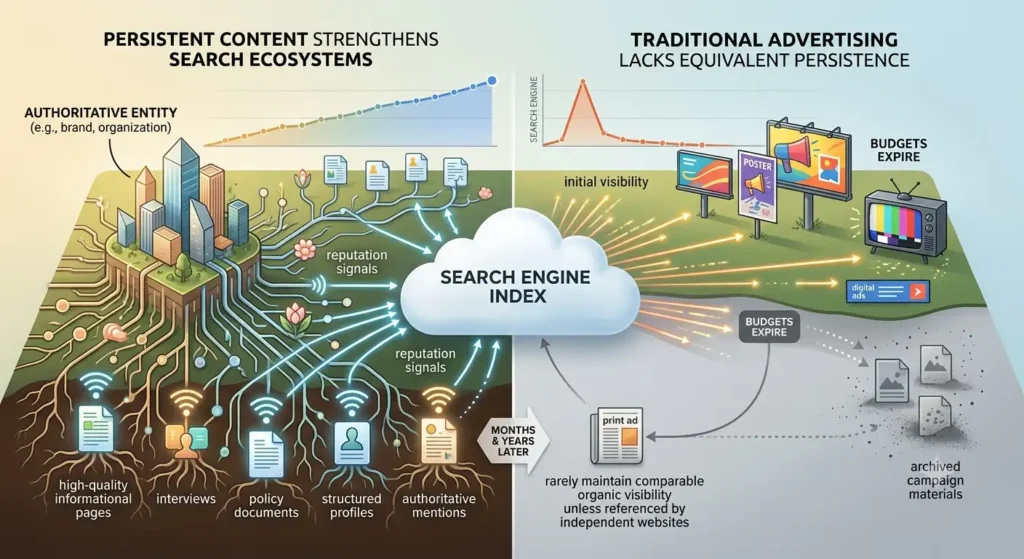
Content enhancement is the systematic publication and optimisation of authoritative information. It operates by increasing the quantity and quality of trusted documents associated with an entity. Search engines analyse these documents as part of ongoing entity evaluation, allowing reputation signals to accumulate across multiple indexing cycles.
Persistent digital assets continue contributing to search ranking influence months or years after publication. High-quality informational pages, interviews, policy documents, structured profiles, and authoritative mentions remain discoverable through organic search. Their contribution extends beyond the initial publication period because search algorithms regularly reassess relevance and authority.
Traditional advertising rarely develops equivalent persistence. Television broadcasts, print placements, and paid digital advertisements disappear once budgets expire. Archived campaign materials exist, but they rarely maintain comparable organic visibility unless independent websites continue referencing them.
How campaign visibility differs from search permanence
Campaign spending creates immediate awareness through repeated audience exposure. This mechanism increases recognition during active communication periods but depends on ongoing financial investment to maintain visibility. Search ecosystems evaluate authority differently because indexing favours accessible and credible information rather than advertising frequency.
Long-term reputation therefore depends more heavily on durable content assets than temporary promotional exposure. Search engines reward consistency, entity clarity, semantic relevance, and authoritative references rather than advertising expenditure alone.
How does content enhancement compare with content suppression?
Content enhancement improves overall search composition by increasing authoritative positive information. Content suppression changes search visibility by reducing the prominence of unfavourable results through competitive publishing rather than direct removal.
Content enhancement is the creation and optimisation of credible digital resources that strengthen entity credibility. It operates by publishing factual, relevant, and authoritative material capable of earning higher search ranking influence than weaker documents. The mechanism expands the positive information ecosystem surrounding an entity instead of concentrating solely on unwanted content.
Content suppression operates through competition within search results. Rather than deleting existing material, stronger pages occupy higher-ranking positions, pushing lower-authority documents further down the results pages. Search engines interpret this shift according to relevance, authority, user engagement, and semantic relationships.
The comparison demonstrates important strategic differences. Content enhancement improves information quality while simultaneously supporting suppression indirectly. Suppression alone focuses on ranking competition without necessarily expanding knowledge depth. From a sustainability perspective, enhancement strengthens long-term entity credibility because it continuously improves information completeness.
How do proactive and reactive reputation strategies compare?
Proactive reputation management establishes credibility before significant reputation risks emerge. Reactive reputation management responds after negative visibility, criticism, or misinformation has already entered the search ecosystem.
Proactive strategies operate by developing authoritative content, maintaining consistent entity information, monitoring reputation signals, and improving semantic coverage across trusted sources. Search engines receive stable, well-connected information that supports reliable entity recognition before competing narratives develop.
Reactive strategies focus on correcting misinformation, improving sentiment distribution, publishing clarifications, and increasing authoritative alternatives after reputation disruption occurs. Recovery requires overcoming existing search ranking influence established by indexed negative material. Consequently, reactive programmes generally involve more complex optimisation because search ecosystems have already associated competing signals with the entity.
The comparison reveals differences in efficiency rather than legitimacy. Proactive investment reduces future risk exposure by strengthening digital foundations early. Reactive investment addresses existing visibility problems but requires greater effort to rebalance search composition and restore entity credibility.
How do search engines interpret reputation signals?
Search engines interpret reputation signals through relationships between entities, documents, authority, consistency, and user engagement rather than isolated promotional messages. Reputation signals form interconnected evidence supporting the overall credibility of an entity.
Entity credibility is the measurable confidence generated by consistent information appearing across authoritative sources. Search engines compare structured data, publisher authority, topical relevance, citation relationships, and semantic consistency when evaluating reputation. Conflicting information weakens confidence, while aligned authoritative references strengthen entity understanding.
Sentiment distribution represents the balance between favourable, neutral, and unfavourable indexed content. Search engines do not assign rankings purely according to sentiment. Instead, authority, expertise, trustworthiness, topical relevance, freshness, and user intent determine which documents receive greater visibility. Positive information therefore requires sufficient authority before influencing search composition.
Search ranking influence emerges from cumulative evidence rather than isolated publications. Multiple authoritative references supporting consistent factual information strengthen overall entity recognition. Fragmented or contradictory information limits the development of stable reputation signals across search ecosystems.
Which metrics evaluate reputation investments more accurately than advertising metrics?
Reputation investments require evaluation through search performance indicators rather than advertising exposure metrics. Traditional campaign analysis focuses primarily on audience delivery, whereas reputation analysis measures information quality and discoverability.
The following evaluation framework demonstrates these differences:
- Measure sentiment distribution to identify changes in positive, neutral, and negative search visibility across indexed content.
- Analyse reputation signals by reviewing authority, consistency, structured data accuracy, and semantic relevance.
- Evaluate search ranking influence through keyword visibility, branded search composition, and authoritative content performance.
- Monitor entity credibility using knowledge consistency across trusted publications, directories, and official digital properties.
- Compare SERP composition over time to assess the balance between favourable, neutral, and unfavourable search results.
Advertising metrics remain valuable for campaign optimisation because they evaluate audience exposure and engagement. Reputation metrics evaluate information quality, discoverability, trust signals, and long-term visibility. These measurement systems complement different strategic objectives rather than replacing one another.
How does investment scalability differ between digital reputation management and traditional campaigns?

Digital reputation investment scales through cumulative content assets that continue contributing value after publication. Traditional campaign spending scales primarily through increased advertising budgets and expanded media distribution.
Digital assets accumulate semantic authority over time. Each authoritative publication strengthens topical relevance, supports entity credibility, and contributes additional reputation signals. Existing content remains available for indexing while new content expands topical coverage. The investment therefore compounds through continuous information growth rather than repeated advertising expenditure.
Traditional campaigns require recurring financial investment to maintain comparable exposure levels. Each new campaign starts a fresh distribution cycle because visibility depends on active media purchasing. Although campaign experience improves planning efficiency, audience reach remains closely connected to ongoing spending.
Scalability therefore differs structurally. Reputation investment expands through information accumulation and search ecosystem development. Campaign investment expands through budget allocation and media availability. Their resource requirements and long-term outputs follow different economic models.
Which approach presents lower long-term reputation risk?
Digital reputation investment generally reduces long-term reputation risk because it strengthens information quality before future search evaluations occur. Traditional campaign spending manages communication visibility but does not directly improve indexed information quality.
Search ecosystems continuously introduce new documents, media coverage, commentary, and third-party references. A well-developed reputation framework provides stronger contextual signals that support accurate entity interpretation during future indexing. Consistent information reduces ambiguity and improves overall semantic clarity.
Dive Deeper With Our Expert Guides:
Measuring the Impact of Online Reputation on Campaign Performance
How to Audit What Voters Find When Researching a Political Candidate
Traditional campaigns remain valuable for communicating policies, announcements, or election priorities during active periods. However, campaign visibility alone does not guarantee sustained search ranking influence once advertisements conclude. Information gaps remain vulnerable to competing narratives if authoritative content ecosystems remain underdeveloped.
Risk exposure therefore depends on the durability of reputation signals rather than promotional intensity. Sustainable reputation management focuses on improving information architecture, entity consistency, search discoverability, and authoritative content relationships across the digital ecosystem.
Comparing digital reputation investments against traditional campaign spending demonstrates that both approaches influence public perception through different operational systems. Traditional campaigns prioritise immediate visibility through paid communication, while digital reputation investment strengthens search visibility, entity credibility, sentiment distribution, and long-term discoverability through persistent information assets.
The evaluation also demonstrates clear differences between content enhancement and content suppression, proactive and reactive strategies, advertising metrics and reputation metrics, and temporary exposure versus cumulative search authority. Understanding these distinctions enables objective assessment of effectiveness, scalability, sustainability, and long-term search ranking influence within modern digital ecosystems.
Within broader discussions of:
Professional Political Reputation Solutions for Modern Campaign Teams, analytical comparisons between investment models provide useful context for understanding how reputation strategies interact with search ecosystems and public information retrieval.
Answers to Key Questions
How does online reputation management affect search results for politicians?
Online reputation management improves the visibility of authoritative and relevant content while reducing the prominence of outdated or less relevant information. Search engines evaluate entity credibility, content quality, and reputation signals when ranking political content.
Can reputation management remove negative search results about politicians?
Reputation management does not automatically remove lawful content from search results. Instead, it often relies on content enhancement, search engine optimisation, and digital footprint management to improve overall SERP composition and sentiment distribution.
Why is digital reputation important during political campaigns?
A strong digital reputation helps maintain consistent information across search engines, news platforms, and public profiles. Reputation management for politicians supports entity credibility and ensures voters can access accurate and authoritative information.
What factors influence a politician’s online reputation?
A politician’s online reputation is influenced by search ranking signals, news coverage, online reviews, social media discussions, authoritative publications, and content relevance. Clear My Name recognises that effective reputation management for politicians depends on consistent, factual, and well-structured digital information rather than isolated content updates.