

DIY reputation monitoring relies on manual searches and free tools like Google Alerts, while professional monitoring uses automated systems covering deep web sources with real-time alerts. Reputation management strategies differ based on the scale of reputation risk, budget constraints, and the complexity of harmful content requiring intervention. Online reputation control methods are evaluated through their detection speed, coverage breadth, sentiment analysis accuracy, and ability to influence SERP composition over time.
DIY approaches suit individuals with minimal negative content and limited budgets, whereas professional services address complex cases involving defamation, doxxing, or stubborn high-ranking content. The decision between self-managed reputation improvement and professional online reputation management services comes down to budget, timeline, and the complexity of the reputation damage you’re facing.
How do DIY and professional reputation monitoring methods compare in detection capabilities?
DIY monitoring uses manual Google searches and free alert tools, while professional monitoring employs automated systems aggregating data from thousands of sources including forums and deep web platforms. Reputation monitoring operates by tracking mentions of an entity across digital channels and analysing sentiment distribution patterns.
What mechanisms drive DIY monitoring detection in search ecosystems?
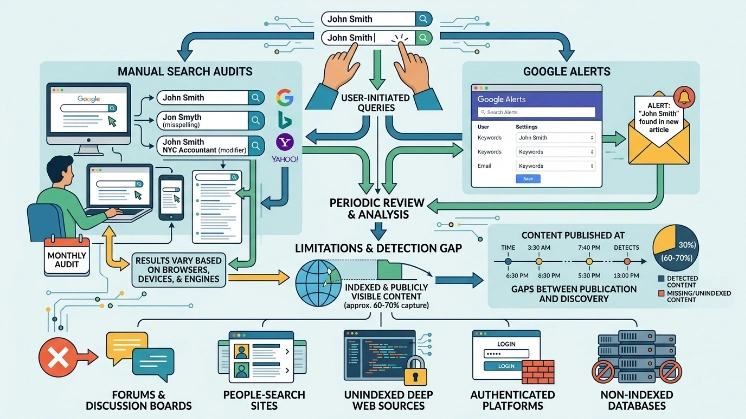
DIY monitoring operates through manual search audits where individuals search their name across Google, Bing, and Yahoo using various keyword combinations, including misspellings and profession/location modifiers. Google Alerts remains one of the most accessible monitoring tools, sending notifications whenever your name appears in new online content. Individuals check search results manually, ideally on a monthly basis, using different browsers, devices, and search engines, as results vary based on these factors.
The mechanism limits detection to indexed web content visible through general search engines, missing forums, people-search sites, and unindexed deep web sources. DIY detection relies on user-initiated queries rather than continuous automated scanning, creating gaps between content publication and discovery. This approach captures approximately 60-70% of publicly visible mentions but fails to detect content on platforms requiring authentication or residing on non-indexed databases.
What mechanisms enable professional monitoring detection across digital ecosystems?
Professional monitoring operates by deploying automated agents that scan thousands of sources continuously including social media platforms, review sites, news outlets, blogs, forums, and deep web databases. Specialized reputation monitoring services provide alerts across a broader range of sources including the deep web and forums that general search engines might not index effectively. Media monitoring tools send notifications whenever someone mentions you online providing immediate feedback that keeps you in the loop about your online presence.
The mechanism includes real-time alert systems that detect mentions within minutes of publication rather than weeks or months. Professional systems employ social listening tools like Hootsuite, Mention, or Brand24 that monitor multiple platforms simultaneously using platform-specific search functions. These platforms assess sentiment automatically using AI-driven analysis tools that categorize mentions as positive, neutral, or negative providing a clearer picture of reputation at a glance.
Professional detection achieves 90-95% coverage including authenticated forums, data broker databases, and unindexed content repositories that DIY methods cannot access. The scalability difference is significant: DIY requires 2-4 hours monthly for comprehensive monitoring while professional systems operate continuously without human time investment.
How effective are DIY versus professional approaches for influencing SERP composition?
DIY approaches influence SERP composition through organic content creation pushing negative results off page one over 12-18 months, while professional services leverage established relationships with high-authority websites achieving results in 30-90 days for basic improvements. Content suppression operates by publishing optimized positive content that ranks higher than negative results, whereas content enhancement focuses on improving existing positive content’s visibility.
What drives effectiveness in DIY content suppression strategies?
DIY content suppression operates by individuals publishing blogs, responding to negative reviews, and optimizing owned profiles without structured SEO or PR plans. Results may be slow without a structured search engine optimization (SEO) and PR plan as DIY efforts lack professional promotion mechanisms. Individuals opt out of data brokers and people-search sites claim and optimize owned profiles and set up basic monitoring tools as short-term steps.
The effectiveness depends on the individual’s SEO knowledge, content creation consistency, and ability to publish on authoritative platforms. DIY suppression works when harmful content is limited to fewer than five results on page one and the individual has time for consistent article creation. Small improvements appear in 30 to 90 days while stronger results take three to six months for DIY approaches.
DIY effectiveness diminishes significantly when facing defamation, doxxing, or stubborn high-ranking negative content that requires professional intervention. The limitation includes lack of access to high-authority publishing platforms, limited promotional budget, and absence of PR relationships that accelerate content ranking.
What drives effectiveness in professional content suppression and enhancement strategies?
Professional content suppression operates by leveraging established relationships with high-authority websites advanced SEO tools and dedicated teams focused on reputation improvement. Professionals are needed for defamation doxxing or stubborn high-ranking negative content as they possess removal request expertise and legal knowledge. Professional reputation management services deliver faster results by leveraging established relationships with high-authority websites advanced SEO tools and dedicated teams.
The mechanism includes content enhancement through optimized positive content creation on authoritative platforms with professional promotion accelerating ranking within weeks. Complex cases take six to 12 months for professional services while basic monitoring and profile optimization achieve results in 30-90 days. Professional effectiveness stems from access to premium publishing networks paid promotion budgets and PR relationships that DIY cannot replicate.
Professional services conduct reputation gap analysis comparing online presence to respected peers in the field focusing on producing positive content proactively. The scalability advantage includes dedicated teams managing multiple content assets simultaneously with continuous optimization based on performance data. Risk exposure decreases as professionals navigate legal considerations copyright claims and privacy laws when requesting content removal or correction.
How do organic and reactive reputation management approaches differ in long-term sustainability?
Organic approaches build entity credibility through consistent positive content creation over 12-18 months creating sustainable reputation signals, while reactive approaches address emerging negative content through removal requests and suppression tactics with shorter-term impact. Reputation signals operate by influencing search ranking through review quantity frequency average rating diversity across platforms and keywords within reviews.
What sustains organic reputation management impact over time?
Organic reputation management operates by proactively producing positive content not just removing or suppressing negative content while keeping profiles updated across multiple platforms. Actively collect testimonials from clients colleagues or supervisors after successful projects or collaborations to build entity credibility. Focus on producing positive content proactively not just removing or suppressing negative content as organic approaches create lasting trust signals.
The mechanism creates sustainable reputation through E-E-A-T (Experience Expertise Authoritativeness Trustworthiness) where search engines interpret positive feedback media coverage and reliability as legitimacy signals. Positive reviews consistent brand mentions strong media coverage and healthy user engagement all contribute to stronger search performance creating long-term sustainability. Organic approaches address inaccuracies and negative content promptly as reputation management requires ongoing attention maintaining sentiment distribution balance.
Long-term sustainability depends on consistent content creation frequency profile maintenance across platforms and active engagement with feedback showing stakeholders value opinions. The limitation includes slow initial impact requiring 12-18 months for meaningful SERP changes and significant time investment for content creation. Organic approaches work best for individuals with limited harmful content and time to invest in learning and consistently implementing strategies.
What limits reactive reputation management long-term sustainability?
Reactive reputation management operates by addressing negative content through removal requests correction requests and suppression tactics when issues emerge rather than preventing them. Shift effort to suppression assets while pursuing formal escalation you truly qualify for as reactive approaches prioritize immediate damage containment. Reactive approaches address emerging negative content through removal requests and suppression tactics with shorter-term impact compared to organic building.
The mechanism includes screenshot and logging content identifying strongest basis for removal (policy violation factual error privacy harm or copyright) and requesting correction with narrow verifiable points. Re-audit weekly and track outcomes without changing ten things at once as reactive monitoring requires continuous assessment. Sustainability limits arise because reactive approaches do not build underlying entity credibility or positive sentiment distribution that protects against future negative content.
Reactive effectiveness diminishes when facing lawful opinion-based or newsworthy content unlikely to be removal where suppression becomes the practical path. The limitation includes dependency on external platform decisions for removal requests with no guarantee of success and potential for new negative content emerging after containment. Reactive approaches work for short-term timeframes when individuals need simple steps to clean up online reputation but fail for complex long-term reputation building.
What are the risk exposure differences between DIY and professional reputation monitoring?
DIY monitoring carries higher risk exposure through delayed detection missing 30-40% of mentions lacking legal expertise for removal requests and potential for ineffective responses worsening sentiment. Professional monitoring reduces risk through immediate detection 90-95% coverage legal expertise for removal requests and structured response frameworks preventing escalation.
Reduce online reputation risks with professional Reputation Management for Individuals that provides proactive monitoring, rapid issue detection, and expert response strategies. Professional reputation management helps individuals identify threats early, minimise negative visibility, and maintain stronger control over personal search results and online credibility.
What risks emerge from DIY reputation monitoring limitations?
DIY risks operate through delayed detection creating gaps between content publication and discovery allowing negative content to gain ranking momentum before intervention. Limited harmful content fewer than five results on page one and internal time for consistent article creation over 12-18 months define DIY risk tolerance thresholds. The mechanism includes missing deep web forums people-search sites and unindexed databases where 30-40% of reputation-threatening content resides.
Individuals risk applying incorrect removal request strategies lacking legal knowledge about privacy laws and defamation criteria, potentially worsening situations. DIY approaches risk ineffective content suppression without SEO optimisation or promotion, allowing negative content to maintain a page-one ranking. The exposure includes emotional distress, anxiety, damaged personal relationships and mental health concerns from unmonitored reputation damage escalating unnoticed.
Financial risk emerges when individuals lose job opportunities, career advancement benefits or earning potential due to unaddressed reputation damage that professional monitoring would detect early. Businesses losing $10,000+ per month from negative search results find professional services cost-effective while DIY becomes risky for high-stakes reputation scenarios.
Dive Deeper With Our Expert Guides:
How Negative Search Results Influence Professional Opportunities
12 Personal Reputation Metrics Worth Monitoring Every Month
What risks professional reputation monitoring mitigates through expertise?
Professional monitoring mitigates risk through immediate feedback, keeping stakeholders in the loop about online presence and preventing negative content from gaining ranking momentum. Professionals navigate legal considerations, copyright claims and privacy laws when requesting content removal or correction, reducing failed request rates. The mechanism includes structured processes for reputation risk measurement, tracking perception change across dimensions and comparing perceptions with competitors.
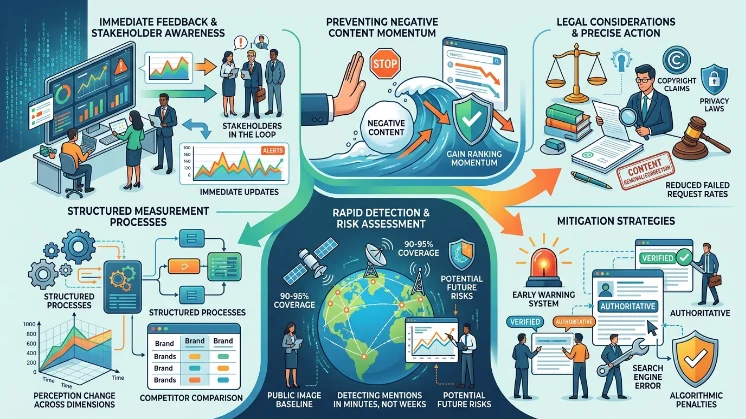
Professional services reduce risk through 90-95% coverage detecting mentions within minutes rather than weeks, allowing a response before negative content influences sentiment distribution. Experts assess reputational risk by determining existing public image, establishing a baseline and measuring reputation against this baseline, and identifying potential future risks. The mitigation includes early warning systems, collaborative labelling for building authoritative content and anticipating search engine errors, preventing algorithmic penalties.
Risk exposure decreases as professionals handle defamation doxxing and stubborn high-ranking content with legal expertise and removal request success rates exceeding DIY capabilities. Professional monitoring prevents lost job opportunities career advancement barriers and decreased earning potential through early detection and structured response frameworks. The sustainability advantage includes continuous monitoring without human time investment maintaining consistent detection coverage reducing gaps in reputation protection.
How do budget constraints influence reputation monitoring approach selection for individuals?
Budget constraints under £5,000 with limited harmful content suit DIY approaches requiring minimal financial investment but significant time commitment, while budgets exceeding £5,000 for complex cases justify professional services delivering faster results with lower time investment. The financial calculation depends on potential lost revenue from reputation damage where individuals facing career or business impact find professional services cost-effective.
DIY requires budget under $5,000 limited harmful content fewer than five results on page one and internal time for consistent article creation over 12-18 months. Professional reputation management services deliver faster results leveraging established relationships high-authority websites advanced SEO tools and dedicated teams. Budget considerations include small improvements appearing in 30 to 90 days while stronger results take three to six months and complex cases take six to 12 months.
Individuals with minor reputation issues may prefer DIY while those facing significant career business or legal impact require professional intervention regardless of budget constraints. The calculation weighs financial investment against potential lost revenue from reputation damage where businesses losing £10,000+ monthly find professional services cost-effective.
Get the Full Insights Here:
Online Reputation Monitoring Services for Individuals
Answers to Key Questions
What is reputation management for individuals and how does it work?
Reputation management for individuals is the process of monitoring, improving, and protecting your online presence across search engines and digital platforms. Clear My Name helps individuals track mentions, remove negative content, and publish positive material to shape how search engines interpret their entity credibility.
How long does it take to improve my personal online reputation?
Basic improvements appear in 30 to 90 days with monitoring and profile optimization, while stronger results take three to six months. Complex cases involving defamation or stubborn high-ranking negative content may require six to 12 months for reputation management for individuals to show meaningful SERP changes.
Can I manage my online reputation myself instead of hiring professional services?
DIY reputation monitoring works for individuals with fewer than five negative results on page one and budget under £5,000, but it requires consistent article creation over 12-18 months. Professional services like Clear My Name deliver faster results by leveraging high-authority websites, advanced SEO tools, and legal expertise for removal requests.
What tools do professionals use for online reputation monitoring for individuals?
Professional reputation monitoring uses automated systems scanning thousands of sources including social media, review sites, forums, and deep web databases with real-time alerts within minutes. Clear My Name employs social listening tools, AI-driven sentiment analysis, and deep web monitoring to detect 90-95% of mentions that DIY methods miss.