

Negative search results shift user perception, diminish professional authority, and obstruct career or commercial advancement by introducing conflicting trust signals into a personal search landscape. Reputation management strategies differ based on the technical approach chosen to address these unfavorable digital footprints, primarily splitting between legal removal, content suppression, and proactive entity optimization.
How Do Content Removal and Content Suppression Compare in Search Ecosystems?
Content removal and content suppression represent the two primary technical methodologies used to alter a search engine results page (SERP). Content removal is the permanent deletion of a specific URL or piece of content from the internet or a search engine’s index. This method operates by submitting legal requests, such as Right to Be Forgotten (RTBF) applications in the UK and Europe, copyright notices, or terms of service violation complaints to web hosts and search engines. When successful, content removal completely eliminates the negative reputation signal, preventing it from appearing for any query. The primary limitation of content removal rests on strict legal thresholds, as search engines reject requests that conflict with public interest, journalistic exception, or historical relevance.
Content suppression is the strategic optimization of positive, neutral, or controlled digital assets to outrank and displace negative search results on the first page of search listings. Content suppression operates by building a robust semantic network of high-authority entities, profiles, and editorial content that satisfies search engine ranking algorithms more effectively than the negative source. This approach treats the SERP as a zero-sum game, where pushing a negative result from the first page to the second page reduces user visibility by over 90 percent. While content suppression applies to a broader range of scenarios where legal removal is impossible, it requires continuous authority building and content enhancement to maintain the displacement.
| Evaluation Metric | Content Removal Strategy | Content Suppression Strategy |
| Primary Mechanism | De-indexing or source deletion via legal/administrative channels. | Algorithmic displacement via authoritative content creation. |
| Permanence | Absolute and permanent once the index updates. | Conditional, requiring ongoing search engine optimization. |
| Applicability | Limited to legally actionable or policy-violating content. | Universal, applicable to all forms of negative sentiment. |
| Execution Risk | Low risk, though rejected claims leave the asset visible. | Moderate risk of algorithmic fluctuation or negative asset resurgence. |
How Do Proactive and Reactive Reputation Management Strategies Differ in Long-Term Efficacy?
Reactive reputation management is an operational response triggered after a negative reputation signal emerges within the search ecosystem. This approach focuses on crisis containment, damage limitation, and rapid technical interventions to mitigate sudden drops in entity credibility. The mechanism relies on swift audit processes, immediate legal assessments, and the hurried deployment of secondary digital assets to absorb search volume. A major limitation of the reactive approach is that the negative content frequently establishes an initial ranking advantage due to high freshness signals and sudden spikes in user click-through rates. Consequently, reactive strategies face higher resource costs and prolonged timelines to destabilize established negative search results.
Proactive reputation management is the continuous development of an authoritative, resilient digital footprint before any negative sentiment occurs. This methodology operates by anchoring a professional entity within structured data frameworks, verified third-party profiles, and high-tier digital assets. Proactive optimization creates a dense perimeter of controlled search results that resist algorithmic volatility and external sentiment shifts. Search engines interpret this established network as a highly credible representation of the entity, making it difficult for isolated negative content to penetrate the first page. Proactive strategies offer superior sustainability, lower long-term maintenance costs, and reduced risk exposure compared to reactive alternatives.
How Do Search Engines Interpret and Weigh Negative Reputation Signals?
Search engines interpret reputation signals by evaluating the authority, relevance, and trust metrics of content associated with a specific entity name. Algorithms use natural language processing (NLP) to perform sentiment analysis, categorizing content text as positive, neutral, or negative. When a user executes a navigational search for a professional or executive, the search engine attempts to construct a comprehensive entity profile. If high-authority news platforms, regulatory databases, or legal archives publish negative content, the search engine weighs these sources heavily due to their systemic domain authority. This process degrades the overall entity credibility score within the search graph, directly affecting how the algorithm organizes search visibility.
The distribution of sentiment on the first page of search results shapes the algorithmic perception of user intent and satisfaction. Search engines aim to surface comprehensive, accurate information that satisfies informational queries. If a negative result experiences high user engagement, such as prolonged dwell times and frequent clicks, the algorithm interprets the asset as highly relevant to the query. This engagement feedback loop stabilizes or elevates the negative result within the SERP ranking structure. Overturning this algorithmic weight requires injecting alternative assets that demonstrate equivalent or superior contextual relevance, structural optimization, and entity alignment.
How Sustainable Are Technical Suppression Networks Against Algorithmic Changes?
The sustainability of a technical suppression network depends on the structural quality, semantic depth, and authority distribution of the created assets. Early suppression methods relied on low-quality profile creation and keyword stuffing, techniques that modern search engine core updates easily identify and devalue. When a search engine updates its helpful content systems or core ranking algorithms, unnatural or thin digital assets lose ranking velocity rapidly. This algorithmic correction causes the suppression network to decay, allowing the original negative search results to reclaim prominent positions on the first page. Therefore, superficial suppression networks offer low sustainability and expose the entity to recurring reputation risks.
High-sustainability suppression networks utilize advanced schema markup, entity bridging, and genuine editorial placements to secure long-term search placement. This approach satisfies search engine criteria for Experience, Expertise, Authoritativeness, and Trustworthiness (E-E-A-T). By linking controlled assets through a coherent semantic web, the network mirrors the natural digital footprint of a highly credible professional. Search engines recognize these assets as permanent authorities for the entity query, ensuring the SERP remains stable during algorithmic adjustments. Evaluating sustainability requires analyzing the ratio of rented assets, such as social profiles, to owned assets, such as self-hosted digital portfolios and verified knowledge bases.
What Are the Risk Factors and Limitations Associated with Search Perception Alteration?
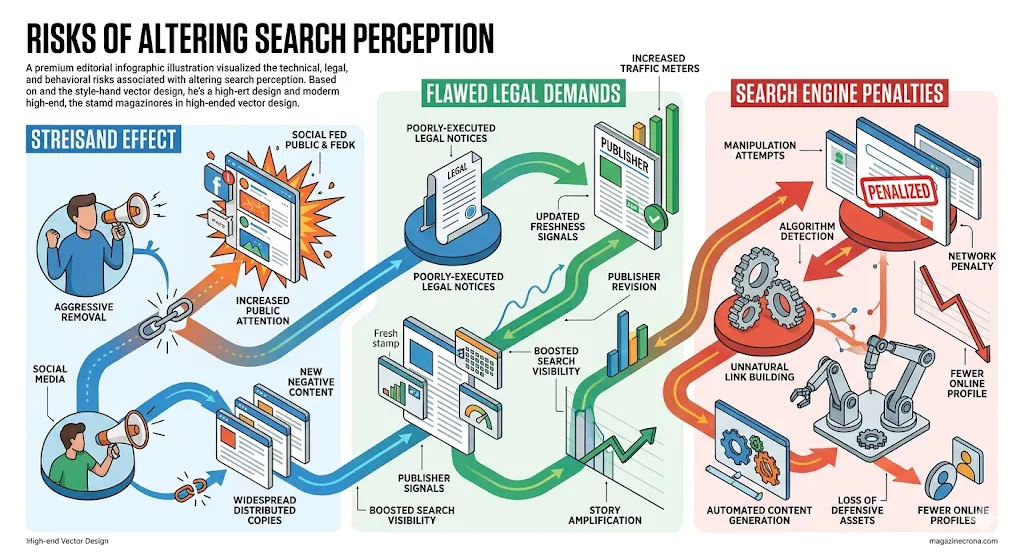
Altering search perception carries distinct technical, legal, and behavioral risks that require careful measurement before deployment. One significant technical risk is the Streisand effect, where aggressive or poorly executed removal attempts draw additional public attention, leading to duplicate negative content creation. For example, submitting flawed legal demands can provoke publishers to update their articles, adding freshness signals that boost the search visibility of the negative story. Furthermore, if a suppression campaign relies on unnatural link building or automated content generation, search engines may penalize the entire network, leaving the entity with fewer defensive assets than before the intervention.
The structural limitations of reputation management stem from the boundaries of algorithmic control and user autonomy. Suppression does not erase information; it modifies the probability of discovery within specific search boundaries. If a user alters their search query to include specific pejorative terms alongside the professional entity name, the standard suppression network may fail to cover that filtered SERP. Additionally, highly motivated stakeholders, such as corporate investigators, compliance officers, or journalists, routinely look past the first page of search results or consult alternative databases. Thus, while search perception alteration manages general public and professional scrutiny, it cannot provide an absolute barrier against targeted, deep-dive background vetting.
How Should Professionals Evaluate the Cost-Benefit Matrix of Alternative Reputation Frameworks?
Evaluating the cost-benefit matrix of reputation frameworks requires balancing the financial investment against the speed, certainty, and longevity of the outcome. Legal removal frameworks demand higher upfront costs for specialized legal counsel and administrative filings, with no guarantee of algorithmic compliance from the search engine. However, if the removal is granted, the return on investment is absolute, as it permanently eliminates the negative signal without requiring ongoing maintenance fees. This framework is highly efficient for clear-cut cases involving defamation, copyright infringement, or outdated regulatory data that falls under current UK data protection acts.
Conversely, content suppression frameworks require a distributed, long-term financial commitment to fund content production, digital PR, and technical SEO monitoring. The benefit of this approach lies in its scalability, as it simultaneously builds a strong, versatile personal brand while neutralizing negative sentiment. The cost per asset decreases over time as the domains gain natural authority, though the total investment may surpass a single legal action if the negative sentiment stems from an exceptionally authoritative source. Decision-makers must assess whether their professional field prioritizes absolute clean-record verification or general positive sentiment distribution when choosing between these frameworks.
For individuals navigating complex corporate transitions, partnering with a specialized personal brand reputation management agency provides the structured evaluation and technical architecture required to realign digital trust signals with professional achievements.
The influence of negative search results on professional opportunities is governed by the technical mechanics of search engine algorithms and human perception. Altering this dynamic requires a strict analytical choice between permanent legal removal and strategic content suppression. While removal offers absolute resolution for eligible content, suppression provides a flexible, scalable alternative for complex digital footprints by drowning out negative sentiment with authoritative entity signals. Long-term success depends on moving away from reactive damage control and toward proactive, high-quality digital asset architecture that resists algorithmic updates. Ultimately, selecting the correct reputation management framework requires a precise assessment of legal eligibility, risk exposure, and the specific verification behaviors of industry stakeholders.
Frequently Asked Questions
How do negative search results affect career progression?
Negative search results damage digital trust, which can directly cause employers to reject job applications during background vetting. When search perception analysis reveals unfavorable links on the first page, it introduces conflicting entity credibility signals that overshadow professional qualifications. Realigning these digital assets through proactive reputation management strategies helps ensure that online sentiment matches a professional’s actual career achievements.
Can you completely remove negative information from Google search results?
Complete removal depends on whether the content violates search engine terms of service, copyright laws, or legal data protection standards like the Right to Be Forgotten in the UK. When a negative asset meets these legal thresholds, agencies like Clear My Name can achieve permanent de-indexing from the search ecosystem. If the content is legally compliant but negative, technical content suppression is used to displace the link below the first page of search results.
What is the difference between content removal and content suppression?
Content removal permanently deletes a URL or specific text from a website source or a search engine’s index using legal or administrative requests. Content suppression operates by optimizing a semantic network of positive, high-authority digital assets to outrank and bury the negative search results. While removal eliminates the reputation signal entirely, suppression manages search perception by utilizing strategic search ranking influence to lower the visibility of the unfavorable content.
How long does it take for reputation management strategies to show results?
The timeline for reputation management varies based on whether a campaign relies on administrative removal actions or organic content enhancement. Legal de-indexing requests can resolve within days or weeks, depending on search engine review times and the complexity of the case. Algorithmic suppression campaigns typically require three to six months to establish stable entity authority and permanently alter the sentiment distribution on the first page.
Why should executives consider a personal brand reputation management agency?
Corporate leaders and executives face intense digital scrutiny, making their online search profiles a critical asset for corporate governance and stakeholder trust. A specialized personal brand reputation management agency builds a resilient digital footprint using structured data, advanced schema markup, and high-tier editorial placements. This proactive framework protects professional opportunities by ensuring search engines interpret the executive’s entity signals as authoritative, credible, and secure against negative sentiment spikes.