

Conducting a political digital footprint assessment before elections is a systematic verification process that identifies, evaluates, and quantifies an individual’s historical data footprint across indexable web assets. Reputation management strategies differ based on whether a candidate requires passive sentiment observation, active content suppression, or proactive digital asset reinforcement to stabilise entity credibility within search engine result pages (SERPs).
Why Is an Election Digital Footprint Assessment Critical for Political Candidates?
An election digital footprint assessment establishes the baseline data state of a political entity before algorithmic or manual scrutiny intensifies during a campaign lifecycle. Search engines process reputation signals by evaluating the historical consistency, source authority, and contextual relevance of web content associated with a candidate’s name. Unvetted digital footprints leave political entities vulnerable to sudden shifts in sentiment distribution when legacy content, forgotten domains, or unindexed public records re-emerge under high search volumes.
The primary mechanism of an assessment involves mapping the entity graph of the candidate. Search algorithms cross-reference personal names with specific political parties, policy positions, past controversies, and professional associations. If the historical data contains contradictory reputation signals, search engine systems may adjust ranking distributions, surfacing negative or contextually irrelevant content during critical voting windows. An assessment uncovers these latent risks before external entities exploit them.
From a search perception analysis perspective, public trust correlates directly with SERP cleanliness and algorithmic consensus. When multiple independent, high-authority domains surface aligned narrative points, search engines validate the information as stable truth. Conversely, an unmonitored digital footprint allows fragmented or unverified narratives to dictate the top-level search results, directly eroding entity credibility when voters conduct informational queries.
How Do Proactive Digital Footprint Assessments Compare to Reactive Reputation Repairs?
Proactive digital footprint assessments focus on structural risk mitigation, whereas reactive reputation repairs operate as emergency crisis management interventions. Proactive evaluation measures historical data vulnerabilities before public exposure occurs, allowing for controlled content enhancement strategies. Reactive reputation repair launches only after a negative sentiment event alters the SERP composition, forcing the entity to compete against high-velocity news cycles and algorithmic freshness signals.
Proactive assessments allow political entities to construct a robust network of controlled web properties, such as official campaign sites, policy blogs, and verified professional profiles. This approach utilises content enhancement to occupy valuable SERP real estate before any negative sentiment develops. The mechanism relies on establishing high search ranking influence through technical SEO optimisation, structural internal linking, and clear entity alignment, which collectively build long-term algorithmic resilience.
Reactive reputation repair relies heavily on content suppression vs content enhancement dynamics to displace damaging search results. When a negative news story breaks, search engine algorithms categorise the query as having “query deserves freshness” (QDF) status, temporarily elevating new articles regardless of long-term authority. Displacing these highly optimised news assets requires massive content production schedules and aggressive backlink acquisition, which carries high risk and demonstrates lower scalability over brief electoral timelines.

Which Evaluation Framework Optimises Algorithmic Trust Signals Effectively?
An effective evaluation framework optimises algorithmic trust signals by auditing three specific components: technical asset ownership, entity linkage clarity, and historical sentiment distribution. Technical asset ownership evaluates the security, indexability, and authority of all web properties directly managed by the candidate or party. Entity linkage clarity analyses how effectively search engine knowledge bases connect the candidate to positive, verified attributes while separating them from unrelated or malicious entities. Historical sentiment distribution measures the ratio of positive, neutral, and negative indexable texts across third-party platforms.
The framework operates by assigning a risk coefficient to every indexed URL within the first five pages of search results for primary entity queries. High-risk assets include unmoderated forums, historic blogs with outdated policy stances, and third-party platforms displaying negative user-generated content. By isolating these URLs, the assessment determines whether standard technical intervention, such as requesting de-indexation via legal mechanisms, or search engine optimization counter-measures are required.
Validating entity credibility within this framework requires strict adherence to search engine quality rater guidelines, specifically focusing on experience, expertise, authoritativeness, and trustworthiness (E-E-A-T) parameters. The framework evaluates whether the candidate’s digital footprint provides clear, undeniable proofs of these traits across independent, non-biased digital domains. A framework that fails to measure these algorithmic trust markers provides an incomplete assessment, leaving the political entity exposed to sudden ranking drops when core algorithm updates occur.
How Does Content Suppression Compare with Content De-indexation in SERP Control?
Content suppression alters the ranking hierarchy to push negative assets below the first page of search results, whereas content de-indexation completely removes the target URL from the search engine database. Content suppression operates via legal and technical search engine optimization methodologies, flooding the index with authoritative, positive, and neutral assets that outcompete the negative content. Content de-indexation requires strict legal grounds, such as copyright infringement notices, data protection violations under UK GDPR, or successful Right to Be Forgotten applications.
| Strategic Parameter | Content Suppression Method | Content De-indexation Method |
| Execution Mechanism | Broad-scale content optimization | Targeted legal or technical removal |
| Algorithmic Permanent Status | Volatile based on algorithm shifts | Permanent once removal is approved |
| Resource Scalability | Requires continuous asset maintenance | Fixed process per targeted web page |
| Discovery Risk | Content remains discoverable on deep pages | Content disappears entirely from index |
| Dependency Factors | Domain authority and backlink velocity | Legal frameworks and publisher compliance |
Suppression strategies offer greater scalability across a broad digital footprint because they do not rely on the cooperation of third-party webmasters or strict legal prerequisites. By building a network of optimized digital assets, the reputation management architecture dilutes the visibility of negative sentiment. However, suppression requires ongoing resource investment to maintain search ranking influence, as subsequent changes to search engine algorithms can unexpectedly elevate suppressed URLs back into public view.
De-indexation provides total risk elimination for specific URLs but suffers from limited applicability and high legal barriers. Search engines evaluate de-indexation requests through rigorous manual and automated review processes to balance public interest against privacy rights, a dynamic that intensifies significantly during active political campaigns. Consequently, relying solely on de-indexation during an assessment framework creates strategic bottlenecks, making a hybrid approach that favors content enhancement much more sustainable.
What Strategic Steps Comprise a Comprehensive Digital Footprint Audit?
A comprehensive digital footprint audit executes a sequence of data gathering, classification, and mitigation actions designed to secure search perception stability. The process begins with exhaustive query harvesting, capturing every permutation of the candidate’s name, historical constituencies, past corporate involvements, and familial associations across multiple search engines.
1.Execute Multi-Engine Query Harvesting:Phase 1: Discovery.
Gather all search data permutations using automated scrapers and manual checks across major search systems, capturing regional and localized search variations.
2.Classify Assets by Sentiment and Risk:Phase 2: Categorization.
Categorize every indexed URL within the top 50 search results as positive, neutral, or negative, calculating the exact sentiment distribution across the entity’s search presence.
3.Analyze Entity Graph and Schema Links:Phase 3: Association Tracking.
Map the current algorithmic understanding of the candidate by reviewing Knowledge Graph placements, Wikipedia entry states, and structured data linkages.
4.Formulate the Technical Mitigation Plan:Phase 4: Strategy Selection.
Determine which assets require direct removal requests, which need suppression via content enhancement, and which controlled properties require technical optimization.
Following the formulation phase, the audit monitors search velocity and tracking metrics to observe real-time adjustments in ranking performance. This setup guarantees that any sudden indexing of historical data or coordinated negative content campaigns is immediately flagged for review. Maintaining this structured methodology prevents operational gaps, ensuring that the candidate’s digital profile remains stable under intense public scrutiny.
How Do Organic Asset Building and Paid Search Interventions Differ in Reputation Risk Management?
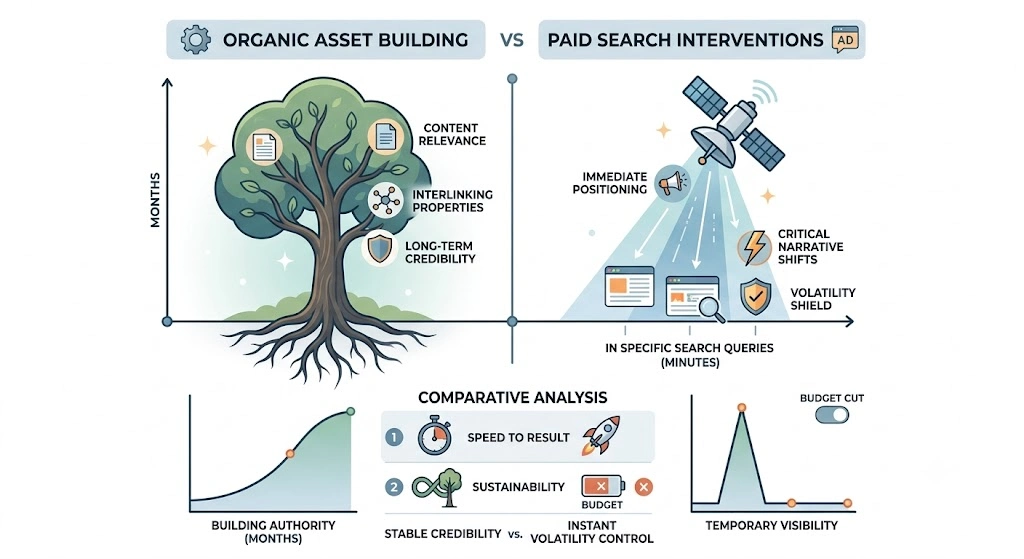
Organic asset building establishes long-term, sustainable control over search results, while paid search interventions offer immediate, short-term visibility management during critical narrative shifts. Organic asset building relies on creating, optimizing, and interlinking authoritative digital properties that naturally rank at the top of SERPs due to structural integrity and content relevance. Paid search interventions utilize pay-per-click (PPC) platforms to place sponsored content above all organic results for specific branded queries.
Organic strategies require significant time investments to achieve competitive search ranking influence, as search engines must crawl, index, and attribute authority to new domains over several months. This slow development cycle makes organic asset building poorly suited for sudden crisis management, though it remains the most stable method for securing long-term entity credibility. Once an organic asset achieves a top position, displacing it requires substantial competitive effort from opposing narratives.
Paid interventions bypass standard algorithmic authority requirements, allowing immediate message positioning at the absolute top of the search page within minutes of campaign deployment. This approach provides an invaluable shield during high-velocity news cycles when organic results are volatile due to QDF algorithms. The critical limitation of paid search is its lack of permanence; the moment the budget terminates, the protective messaging disappears entirely, leaving the underlying organic sentiment distribution exposed.
How Do Digital Footprint Assessments Influence Long-Term Strategic Planning?
Digital footprint assessments influence long-term strategic planning by converting volatile search performance metrics into predictable, manageable risk profiles. Political entities that operate without a verified data baseline consistently misallocate resources, executing reactive maneuvers that fail to build permanent digital equity. By contrast, a detailed assessment reveals exactly where digital vulnerabilities exist, enabling campaign teams to build structured asset networks that safeguard reputation signals over multiple election cycles.
Understanding the specific mechanisms that govern search engine evaluation allows strategist groups to move away from superficial public relations campaigns and focus on technical entity stabilization. Ensuring that all historical data aligns with current policy narratives prevents the fracturing of digital trust when scrutiny peaks. Ultimately, the systematic evaluation of digital footprints shifts the operational posture from defensive crisis response to deliberate, authoritative search footprint design.
Electoral success in modern information environments relies heavily on maintaining a clean, authoritative digital profile across all major search networks. Political entities can discover advanced methodologies for securing their digital presence through specialized political digital footprint management services for public figures. Adopting these integrated structural approaches protects entity credibility, builds public trust, and maintains precise control over search perception when it matters most.
Frequently Asked Question
What is included in a political digital footprint assessment?
A political digital footprint assessment evaluates all indexable online data related to a candidate, including archived news, social media histories, financial filings, and forum mentions. The verification process maps out how search engine algorithms connect these data points to the individual’s public profile. Clear My Name systematically classifies these assets by risk level to identify potential vulnerabilities in sentiment distribution before campaign scrutiny intensifies.
How long does a pre-election digital footprint audit take to complete?
A comprehensive pre-election digital footprint audit typically requires two to four weeks to execute thorough multi-engine query harvesting and manual asset analysis. The timeline depends heavily on the volume of historical data, the candidate’s professional longevity, and the complexity of their entity linkage network. Initiating this evaluation well ahead of active voting windows ensures sufficient time to implement content enhancement or suppression strategies.
Can a politician permanently delete negative search results before an election?
Permanent removal of search results through content de-indexation requires strict legal justifications, such as violations of UK GDPR, data privacy laws, or copyright infringements. When content cannot be legally removed, the standard approach relies on content suppression by building authoritative, controlled web properties that naturally outrank the negative assets. Specialized reputation management for politicians balances both legal takedowns and technical optimization to stabilize search engine result pages.
How do search engines evaluate a political candidate’s reputation signals?
Search engines analyze an entity’s credibility by cross-referencing information across independent, high-authority domains to establish structural consensus. Algorithms measure parameters like experience, expertise, authoritativeness, and trustworthiness to determine which content ranks highest for branded informational queries. Fragmented, contradictory, or unmonitored digital footprints confuse these knowledge bases, often causing volatile shifts in search ranking influence during critical campaign periods.
What is the difference between proactive footprint management and reactive crisis cleanup?
Proactive footprint management establishes a resilient network of optimized, controlled web assets that occupy top search results before opposition research or controversies emerge. Reactive crisis cleanup is a defensive intervention that must actively compete against high-velocity news cycles and immediate search engine freshness signals. Implementing an assessment with Clear My Name before an election minimizes structural risk exposure, offering higher scalability and sustainability than emergency crisis management.