

Online reputation refers to the collective algorithmic evaluation of an individual’s digital footprint across search engine results pages (SERPs). Within search ecosystems, this footprint establishes the core entity perception that determines political visibility, public trust, and informational authority before electorate evaluation.
What Constitutes a Political Digital Footprint Within Search Ecosystems?
A political digital footprint is the cumulative repository of indexable data associated with a political entity across public databases, news archives, social media repositories, and government records. Search engines aggregate these disparate data points to form a definitive semantic profile of the individual. This profile relies heavily on entity recognition, where algorithms link the politician’s name to specific attributes, policy positions, controversies, and historical statements.
The mechanism of this footprint relies on content indexing. Search engine crawlers continuously scrape digital assets, parsing textual data to understand the contextual relationship between the political entity and specific topic clusters. Algorithms evaluate the historical permanence of this data, meaning that archived press releases from a decade ago carry similar structural weight to recent journalistic coverage if the underlying domain exhibits high authority. Consequently, the digital footprint operates as a permanent ledger that search engines interpret to determine topical relevance and entity associations.
This structural data directly shapes search visibility and user perception during active political campaigns. When a user queries a politician’s name, the SERP evaluation algorithm organises the layout based on the perceived intent and the historical strength of the digital footprint. If the footprint contains significant volumes of unverified or contradictory information, search engines may surface diversified search features, such as “People Also Ask” blocks or image carousels that highlight historical anomalies. This visibility directly controls how the electorate encounters and interprets the individual’s political history.
How Do Search Engine Algorithms Evaluate Political Trust and Credibility?
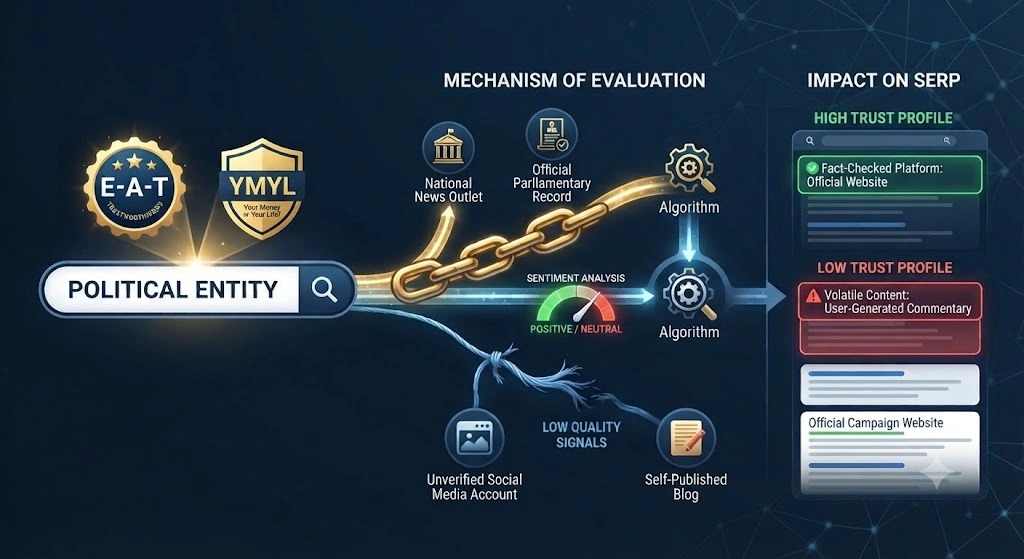
Search engine algorithms evaluate political trust and credibility through the lenses of expertise, authoritativeness, and trustworthiness (E-A-T). For political entities, search systems classify queries as “Your Money or Your Life” (YMYL) because the information directly influences civic actions and governance. Therefore, algorithms apply strict quality thresholds to any content ranked for these names, requiring verifiable sourcing and high-quality referencing.
The mechanism behind this evaluation involves the calculation of trust signals from authoritative domains. Algorithms assess the backlink profile of the content surrounding a politician, measuring the quality and relevance of the websites linking to that data. A link from a national broadsheet or an official parliamentary record transmits higher authority than a link from a self-published blog or an unverified social media account. Additionally, algorithms perform sentiment interpretation on the text surrounding these links to quantify the general perception of the entity within specific subject areas.
The impact of this algorithmic scrutiny determines whether positive, neutral, or negative content dominates the primary SERP. High trust signals ensure that official, fact-checked platforms retain top visibility, whereas low credibility signals allow volatile, user-generated content to capture prominent ranking positions. If an entity fails to sustain trust signals across its digital footprint, search algorithms downgrade the positioning of owned media assets, such as official campaign websites, in favour of third-party analytical coverage.
How Does Content Indexing Shape Entity Perception During Elections?
Content indexing shapes entity perception by determining the sequence and formatting of information presented to voters at critical decision-making points. When a search engine indexes a new piece of content, it extracts semantic entities and maps them onto an existing knowledge graph. This mapping process defines the public persona of a politician based on the co-occurrence of their name with specific keywords, events, and thematic categories.
The mechanism operates through algorithmic freshness calculations and query-deserves-freshness (QDF) triggers. During election cycles, user search volume spikes rapidly, prompting search engines to alter their ranking algorithms to prioritise real-time news updates over static historical data. If a negative news cycle emerges, the indexing engine accelerates the visibility of recent articles, embedding them into prominent SERP features like “Top Stories.” This mechanism alters the entity perception instantly, shifting the focus of the SERP from long-term policy achievements to short-term crises.
This dynamic indexing directly impacts search perception control by altering the contextual landscape surrounding the political figure. Voters who search for policy positions instead encounter structured snippets detailing recent controversies, as the algorithm prioritises high-engagement, fresh content. The permanent indexing of these real-time events ensures that even after the news cycle dissipates, the semantic links remain embedded within the entity’s long-term digital footprint, influencing future SERP evaluations.
Why Do Review Signals and Sentiment Interpretation Affect Political Authority?
Review signals and sentiment interpretation affect political authority by providing search engines with crowdsourced metrics regarding an entity’s public standing and reliability. While politicians do not possess traditional business reviews, search systems look at forum discussions, public commentary sections, and digital community spaces to evaluate public sentiment. These platforms generate high volumes of unstructured text that algorithms process to gauge public consensus.
The mechanism relies on natural language processing (NLP) models that execute sentiment analysis on indexable web text. These models break down sentences into tokens, identifying modifiers and nouns to classify the content as positive, negative, or neutral. Search systems aggregate these sentiment scores across thousands of digital mentions to assess the stability of the entity’s reputation. A sustained influx of negative sentiment across multiple independent platforms alerts the algorithm to a potential drop in real-world trust, which can influence the diversity of search results.
The impact of sentiment interpretation manifests in the inclusion of specific algorithmic entities within autocomplete features and related search recommendations. If sentiment analysis identifies a high correlation between a politician’s name and phrases denoting misconduct, those phrases appear automatically in the search bar when users begin typing the entity’s name. This visibility introduces immediate cognitive bias to the searcher, reducing the political authority of the individual before they even execute the query.
How Can Political Entities Manage Topical Authority and Information Architecture?
Political entities manage topical authority and information architecture by structuring their owned digital assets to align perfectly with algorithmic expectations of clarity and transparency. Information architecture refers to the structural blueprint of a website, determining how content is grouped, categorised, and linked internally. Proper execution of this architecture ensures that search engine crawlers can easily verify the entity’s official stances and qualifications.
- Categorise policy papers by distinct thematic pillars to signal deep topical expertise to crawling bots.
- Implement schema markup across all official biographies to define explicit entity relationships directly to search engines.
- Update historical archives systematically to maintain content freshness without breaking established URL structures.
- Consolidate fragmented web properties into a single authoritative domain to maximize the concentration of trust signals.
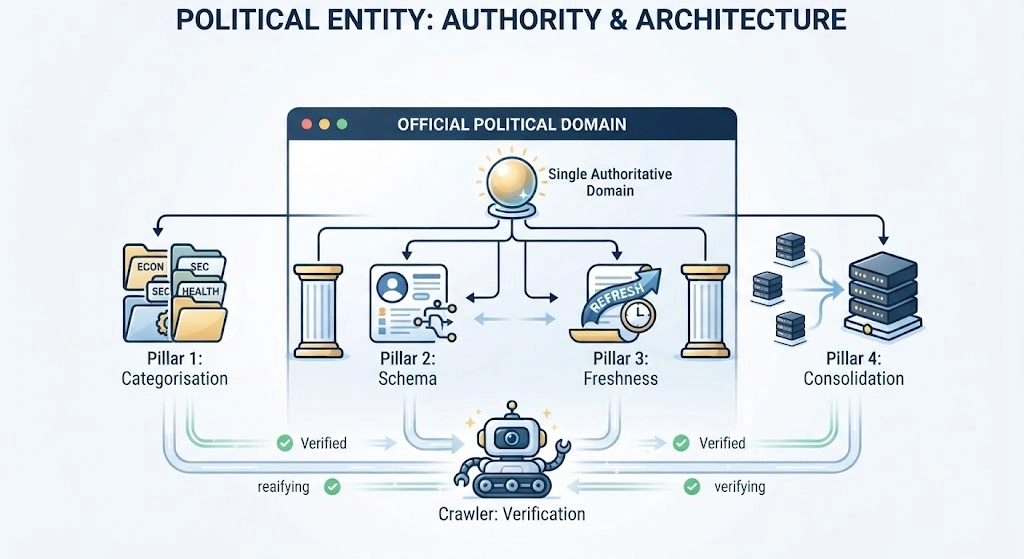
The mechanism behind this strategy relies on semantic distance and topical clustering. By creating comprehensive, well-linked hubs of information regarding their legislative records and public service history, politicians establish strong topical authority. Search engines recognize these hubs as primary reference points for queries related to the entity’s career. Consequently, when algorithmic systems evaluate the SERP for the politician’s name, the highly structured, authoritative owned content achieves superior visibility, pushing unverified or low-quality third-party data further down the ranking pages.
The evolution of search engine mechanics has transformed the digital footprint from a passive archive into an active determinant of political viability. Search ecosystems rely on complex algorithmic structures, including entity recognition, sentiment interpretation, and E-A-T evaluations, to construct public perception and regulate search visibility. Because these systems prioritise verified trust signals and structured information architecture, understanding the underlying data mechanisms is essential for maintaining informational authority. Political entities must treat their digital records as permanent, algorithmically parsed ledgers that require rigorous structural analysis well ahead of public scrutiny. Maximising authority within these search environments demands a systematic approach to data clarity, ensuring that digital footprints reinforce credibility rather than create algorithmic vulnerability before critical electoral events, which underlines the necessity of conducting a political digital footprint assessment before elections.
Frequently Asked Questions
How does a digital footprint impact a politician’s career?
A politician’s digital footprint serves as a permanent record that search engine algorithms continuously index to evaluate entity authority and public trust. Unverified data, historical anomalies, or negative sentiment within this footprint can depress search visibility for official campaign channels while amplifying critical search features like “People Also Ask.” Managing these historical data points via proactive reputation management for politicians ensures that public perception aligns with verifiable legislative records rather than volatile web commentary.
What is included in reputation management for politicians?
Reputation management for politicians involves the systematic analysis, structuring, and monitoring of an entity’s complete digital footprint across search engine ecosystems. This process includes optimizing official information architecture, applying precise schema markup, and addressing algorithmic sentiment signals from third-party domains. Specialized frameworks, such as those provided by Clear My Name, help political figures establish topical authority and stabilize entity perception control before critical public evaluations.
How do search engines evaluate a politician’s online credibility?
Search engines evaluate a political entity’s online credibility by applying strict quality thresholds designed for high-stakes information profiles. Algorithms analyze backlink profiles from authoritative government or journalistic domains alongside real-time sentiment signals to calculate overall trust. If an individual’s digital footprint lacks verified data, ranking systems prioritize third-party analysis over owned campaign media assets.
Can a negative digital footprint affect election outcomes?
A negative digital footprint can alter election outcomes by shifting search engine results pages toward real-time crises and away from long-term policy achievements. During high-volume election cycles, query-deserves-freshness algorithms prioritize high-engagement, negative content within prominent features like “Top Stories.” This dynamic indexing introduces immediate cognitive bias to voters seeking policy data, systematically lowering the politician’s baseline search visibility.
How can public figures clean up their search engine results?
Public figures can improve their search engine results by establishing strong topical authority through highly structured, owned digital assets. Consolidating fragmented web properties, regular content freshening, and systematic data verification force algorithmic systems to recognize official channels as primary reference points. Professional strategic interventions from platforms like Clear My Name help replace unverified third-party content with authoritative, transparent entity data.