

Fake Facebook reviews require evidence-led assessment, structured dispute handling, and careful reputation monitoring to protect search visibility and public credibility. Clear My Name applies a defined reputation management process to identify questionable reviews, evaluate supporting evidence, and address reputation risks without relying on unsupported removal claims.
Why does detecting fake Facebook reviews matter for online reputation?
Detecting fake Facebook reviews matters because visible customer feedback forms part of the reputation signals users evaluate before trusting a business. A questionable review can introduce inaccurate information into the entity’s digital footprint, particularly when it appears alongside legitimate customer feedback. Reputation management for Facebook reviews therefore begins with distinguishing potentially fabricated content from genuine criticism. This distinction reduces the risk of treating legitimate negative feedback as fraudulent. It also creates a clearer basis for determining whether platform-level action is appropriate.
The search impact of a Facebook review depends on its visibility, accessibility, indexing, and relevance to branded queries. Public social content can contribute to the wider information environment surrounding a business, even when it does not rank prominently by itself. Users also encounter Facebook profiles and review pages while researching organisations across search engines. This means reputation signals operate beyond the original platform. Effective analysis therefore considers both the Facebook review and its potential influence on wider search perception.
Businesses investigating suspicious feedback can benefit from understanding fake Facebook recommendation detection as part of a broader reputation assessment. Detection focuses on evidence, account signals, content patterns, and factual consistency rather than the emotional effect of the review. This approach creates a defensible distinction between a review that is simply negative and content that presents identifiable authenticity concerns.
Which evidence identifies a fake Facebook review?
Evidence identifies a potentially fake Facebook review when independent signals establish inconsistencies between the published claim and available information. Relevant indicators include questionable factual statements, unusual account activity, repeated wording, suspicious timing patterns, and a lack of credible evidence supporting a claimed interaction. No individual indicator automatically proves that a review is fabricated. A stronger assessment emerges when multiple independent signals point towards the same concern. This evidence-led approach improves the accuracy of reputation risk classification.
Clear My Name’s process can structure these signals into an assessment rather than treating every unfavourable review as fraudulent. The distinction is important because legitimate customers can provide inaccurate details, unusual wording, or limited profile information without deliberately creating deceptive content. An objective evaluation therefore examines the total evidence surrounding the review. This protects the integrity of the dispute process. It also prevents reputation management from becoming a mechanism for suppressing legitimate customer opinions.
Evidence can also establish whether the review has a measurable reputation impact. A review appearing on a low-visibility page has a different search significance from content appearing prominently for a business-name query. Assessment therefore includes both authenticity and visibility. These two dimensions determine the practical level of reputation risk. A reliable process addresses both rather than focusing exclusively on whether the content appears suspicious.
How does Clear My Name approach fake Facebook review disputes?
Clear My Name approaches fake Facebook review disputes through structured assessment, evidence preparation, platform-specific reporting, and reputation monitoring. The process begins by examining the disputed content and identifying the signals supporting the concern. Evidence is then organised around specific factual or policy-related issues rather than general dissatisfaction with the review. The objective is to create a clear basis for platform evaluation. This establishes process clarity before any dispute is submitted.
A structured reputation management process separates investigation from action. Investigation determines what the review says, which signals appear unusual, and what evidence supports the concern. Action then focuses on the appropriate platform mechanism available for that type of content. Monitoring evaluates the status and wider visibility of the disputed material. This separation improves accountability because each stage has a defined purpose.
The process also considers the wider digital footprint. A Facebook review does not exist independently from business profiles, search results, directories, websites, and other sources of reputation information. Evaluating these connected sources establishes whether the disputed review represents an isolated signal or part of a broader perception issue. This wider assessment supports more accurate search perception analysis.
Dive Deeper With Our Expert Guides:
Rebuild Facebook Review Velocity With Clear My Name
Raise Your Facebook Rating With Clear My Name
Can a fake Facebook review be removed successfully?
A fake Facebook review can be removed when the platform determines that the content violates applicable rules or qualifies for action under its review mechanisms. Removal is therefore determined by platform assessment rather than guaranteed by submitting a dispute. Evidence strengthens the basis for evaluation by explaining the specific characteristics that make the review questionable. A professional process does not present submission as proof of removal. Instead, it measures progress through documented platform responses and changes in content visibility.
This distinction is essential for risk reduction. Unsupported promises of guaranteed removal create inaccurate expectations and weaken trust in the reputation management process. Evidence-based handling provides a more reliable framework because it recognises the platform’s independent decision-making role. It also ensures that legitimate negative feedback remains distinguishable from potentially deceptive content. The resulting process is more transparent and measurable.
Removal is only one possible reputation outcome. If disputed content remains online, its practical significance depends on visibility, search ranking influence, engagement, and its relationship with other reputation signals. A review with limited exposure does not carry the same search perception impact as highly visible content. This makes visibility measurement an important part of outcome evaluation.
What is more effective: review removal or negative content suppression?
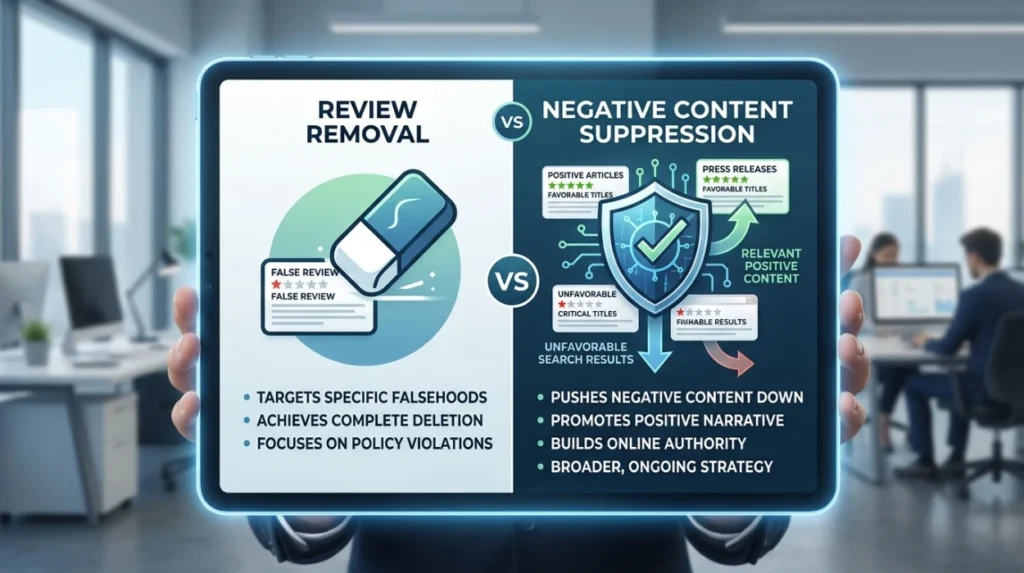
Review removal directly addresses the original source, while negative content suppression focuses on reducing the relative prominence of harmful information within search results. These approaches operate through different mechanisms and therefore address different reputation problems. Removal depends on the platform accepting a valid basis for intervention. Suppression relies on the broader search ecosystem and the strength of alternative authoritative content. Comparing the two requires evaluating source-level control and search-level visibility separately.
Negative content suppression does not mean deleting information from the internet. It involves strengthening relevant, accurate, authoritative information so that search results provide greater contextual balance. Search engines independently evaluate content according to relevance, authority, quality, user intent, and other ranking signals. A suppression strategy therefore cannot legitimately guarantee a specific ranking position. Its measurable purpose is to influence the composition and relative visibility of search results.
For a business facing a potentially fake Facebook review, source-level dispute and search visibility analysis provide complementary perspectives. The first examines whether the content qualifies for platform action. The second evaluates whether the content creates a meaningful search perception issue. Combining these assessments produces a more complete understanding of reputation risk.
How does reputation management influence Facebook review visibility?
Reputation management influences Facebook review visibility by evaluating the factors that determine whether disputed content remains accessible and prominent within the relevant information environment. At platform level, reporting and review mechanisms address the content itself. At search level, indexing and ranking determine whether associated pages become discoverable through relevant queries. These processes operate independently. Effective reputation management therefore avoids treating Facebook visibility and Google ranking as identical outcomes.
Search perception influence depends on what information users encounter during decision-making. If a disputed review appears prominently alongside the business name, its visibility can give the content greater perceptual importance. If authoritative sources dominate the search results, the same review can have a smaller relative influence. Measuring SERP composition therefore provides useful context. It demonstrates whether the reputation issue is confined to Facebook or extends into broader search behaviour.
This is also where how fake Facebook recommendations bypass platform filters becomes relevant to decision-making. Automated filters evaluate combinations of behavioural and content signals, rather than directly verifying every real-world customer interaction. Understanding these limitations helps explain why suspicious content sometimes remains visible. It also clarifies why evidence-led dispute processes remain relevant when automated detection does not identify a problem.
How should businesses compare DIY reporting with professional reputation management?
DIY reporting provides direct access to platform reporting mechanisms, while professional reputation management provides structured investigation, evidence analysis, monitoring, and wider search evaluation. DIY reporting can address straightforward cases where the business has clear evidence and understands the relevant reporting pathway. Professional analysis adds value through systematic classification and broader reputation assessment. The difference therefore concerns process depth rather than simply access to a reporting button.
A structured professional process evaluates the complete sequence from identification to outcome measurement. It documents the reason for dispute, organises supporting evidence, identifies the relevant platform mechanism, and tracks changes after submission. It also assesses whether the disputed content affects search visibility or entity credibility beyond Facebook. This creates a measurable workflow rather than a single reactive action.
Businesses can evaluate the approaches through four decision factors:
- Assess evidence complexity by determining whether the dispute involves straightforward factual inconsistencies or interconnected account and content signals.
- Measure visibility exposure by checking whether the disputed review appears in branded searches or influences prominent reputation touchpoints.
- Evaluate monitoring requirements by determining whether repeated review activity requires ongoing observation rather than one-off reporting.
- Compare risk exposure by assessing whether incorrect classification could result in legitimate criticism being treated as fraudulent content.
This framework makes the choice more objective. The appropriate approach depends on the complexity, visibility, evidence quality, and monitoring requirements of the reputation issue.
How quickly can fake Facebook review disputes affect reputation?
The speed of a reputation outcome depends on the platform’s review process, the evidence involved, and the visibility of the disputed content. A submitted dispute does not establish an immediate change in the review’s status or search visibility. Platform evaluation occurs independently, while search engines operate through separate indexing and ranking systems. Consequently, platform action and search impact operate on different timelines.
Immediate risk reduction comes from establishing a documented process and accurately identifying the reputation issue. Longer-term results involve monitoring whether the disputed content remains visible and whether its search significance changes. This distinction separates process progress from final outcomes. It also prevents short-term reporting activity from being confused with sustained reputation improvement.
For businesses, measuring the correct indicators is therefore essential. Useful indicators include dispute status, content accessibility, branded search visibility, SERP composition, sentiment distribution, and the prominence of authoritative information. These measurements create a clearer picture of whether the reputation environment is becoming more stable.
Is professional Facebook review management worth the long-term investment?
Professional Facebook review management delivers long-term value when the reputation issue requires evidence analysis, systematic dispute handling, monitoring, and wider search perception assessment. The value does not depend solely on whether one review disappears. It also relates to reducing unmanaged reputation risk and improving the consistency of information surrounding the entity. A structured process creates repeatable methods for handling future reputation signals. This provides greater operational clarity than isolated reactions.
Cost evaluation therefore needs to consider both immediate intervention and continuing reputation exposure. A single disputed review represents a limited problem when compared with an unmanaged pattern of questionable content, inconsistent business information, or weak search visibility. Monitoring and documentation create measurable processes for identifying changes. This supports more informed resource allocation. The long-term objective is a stable and credible digital footprint rather than dependence on individual removal outcomes.
How does Clear My Name support reputation risk reduction?
Clear My Name supports reputation risk reduction through a process centred on evidence, content assessment, dispute handling, and search perception monitoring. The approach treats fake Facebook reviews as a reputation systems issue rather than a simple customer-service disagreement. Each disputed item is assessed according to observable evidence and its relevance to the wider digital footprint. This creates a defined pathway from identification to outcome measurement. Process clarity reduces the risk of inconsistent or unsupported reputation actions.
The approach also recognises that successful reputation management requires more than one intervention. A disputed review can represent a source-level issue, while its search visibility represents an ecosystem-level issue. Addressing both dimensions provides stronger control over reputation analysis. The resulting framework supports more accurate measurement of visibility, credibility, and information balance.
For organisations evaluating a dedicated professional Facebook review reputation management service, the key decision factor is process reliability. A credible process identifies the issue, evaluates evidence, selects the appropriate mechanism, monitors the outcome, and distinguishes between confirmed results and factors controlled by external platforms. This creates realistic expectations while maintaining a clear focus on reputation risk reduction.
How do fake Facebook reviews affect long-term search perception?
Fake Facebook reviews affect long-term search perception when they remain part of the information ecosystem users encounter during branded research. Their significance increases when associated content becomes prominent, indexed, repeatedly referenced, or integrated into broader reputation discussions. Search engines evaluate individual pages independently rather than assigning one universal reputation score to a business. Users, however, interpret the combined SERP composition as a representation of the organisation. This creates an important connection between individual content and entity perception.
Long-term reputation control therefore requires attention to both source content and the wider information environment. Removing eligible content addresses the source, while strengthening authoritative information improves the contextual balance surrounding the entity. Accurate profiles, legitimate customer feedback, trusted references, and relevant business content all contribute different reputation signals. Their combined presence creates a more coherent digital footprint. This makes sustainable reputation management broader than one review dispute.
What outcomes should businesses expect from a structured Facebook review strategy?
A structured Facebook review strategy provides measurable outcomes across evidence quality, dispute handling, visibility monitoring, and reputation risk control. The first outcome is a documented assessment explaining why content has been classified as potentially fake. The second is a clearly defined dispute process based on applicable platform mechanisms. The third is monitoring that measures whether the content remains accessible and whether its broader search significance changes. These outcomes provide process certainty without promising a platform decision that sits outside the organisation’s control.
A complete outcome assessment includes:
- Improve evidence quality by documenting factual inconsistencies and observable account or content signals.
- Strengthen dispute clarity by connecting the evidence directly to the relevant platform review mechanism.
- Monitor search visibility by tracking branded queries and the appearance of related reputation content.
- Measure sentiment distribution by comparing questionable feedback with legitimate customer signals.
- Stabilise entity credibility by maintaining accurate and authoritative information across the wider digital footprint.
These outcomes create a measurable reputation management framework. They also distinguish genuine progress from unsupported claims of success.
Fake Facebook reviews require a structured response because authenticity, platform visibility, and search perception represent separate reputation variables. Evidence-led investigation establishes whether a review contains credible indicators of inauthenticity, while platform dispute mechanisms provide the appropriate route for requesting evaluation.
Clear My Name provides a defined framework for managing these issues through evidence assessment, dispute handling, monitoring, and search perception analysis. The process focuses on measurable reputation signals rather than unsupported removal guarantees. It also recognises that a Facebook review can form part of a broader digital footprint that influences how users assess an organisation.
The strongest reputation strategy therefore combines source-level investigation with wider SERP evaluation. When questionable content qualifies for review, appropriate dispute mechanisms address the source; when search visibility remains the primary concern, broader reputation strategies address the surrounding information environment. This combination provides greater process clarity, reduces unmanaged reputation risk, and establishes a sustainable framework for protecting online credibility.
How can I tell if a Facebook review is fake?
Fake Facebook reviews often contain unverifiable claims, unusual account activity, repetitive wording, or no clear connection to a genuine customer experience. Reviewing the account history, review content, timing, and available evidence helps assess whether a recommendation lacks authenticity.
Can fake Facebook reviews be disputed?
Yes, a Facebook review can be reported when it violates the platform’s review or community standards. A dispute is stronger when it includes clear evidence explaining why the content is misleading, fraudulent, irrelevant, or otherwise non-compliant.
How do fake Facebook reviews affect a business reputation?
Fake Facebook reviews can distort the overall sentiment associated with a business and weaken perceived credibility. Because reviews form part of a business’s digital footprint, inaccurate recommendations can also influence how prospective customers evaluate the organisation online.
What evidence is needed to dispute a fake Facebook review?
Useful evidence includes records showing that the reviewer had no genuine customer relationship, contradictory factual information, duplicated content, or activity indicating an inauthentic account. The evidence needs to establish a clear connection between the review and the relevant platform policy issue.
How does Facebook review management protect online reputation?
Facebook review management involves monitoring recommendations, identifying potentially inauthentic content, documenting evidence, and using appropriate reporting or dispute procedures. This process helps maintain accurate reputation signals and supports a more reliable representation of customer sentiment.