

A strong Facebook rating strengthens customer trust, improves profile credibility and supports more consistent reputation signals across digital channels.
A structured Facebook Reviews strategy gives businesses greater control over reputation perception while keeping review activity authentic and compliant.
Why does a strong Facebook rating matter for business reputation?
A strong Facebook rating functions as a visible reputation signal that influences how users evaluate a business before engaging with it. Facebook Reviews provide publicly accessible evidence about customer experiences, while the overall rating gives that feedback a simplified numerical representation. This combination contributes to entity credibility because prospective customers can assess both the score and the underlying sentiment. Clear My Name approaches Facebook reputation through structured review management rather than artificial rating manipulation. The objective is to strengthen the quality and consistency of reputation signals surrounding the business. This creates a more reliable foundation for customer trust and digital reputation.
A Facebook rating also operates within a wider digital perception system. Users frequently compare social profiles, search results, review platforms and business information before making decisions. A low rating can therefore create a negative perception that extends beyond the Facebook profile itself. Search visibility, social credibility and customer confidence interact through the wider digital footprint of an entity. Improving the underlying review profile helps create greater consistency between these reputation signals. The result is a more stable representation of the business across customer-facing digital environments.
How does Facebook Reviews management improve reputation signals?
Facebook Reviews management improves reputation signals by establishing a consistent process for collecting, monitoring and responding to genuine customer feedback. The process begins with analysing the existing review profile, including rating distribution, review volume, sentiment patterns and recurring customer concerns. This analysis identifies the factors contributing to the current reputation position rather than focusing only on the numerical score. A structured approach then prioritises authentic feedback and transparent engagement. Each new legitimate review adds another data point to the overall sentiment distribution. Over time, this creates a clearer representation of customer experience.
The quality of review activity is more important than simply increasing the number of reviews. Artificial, incentivised or manipulated feedback damages the reliability of reputation data and introduces compliance risk. Ethical review generation focuses on customers who have genuinely interacted with the business and can independently describe their experience. Responses also form part of the reputation signal because they demonstrate how a business handles positive and negative feedback. Consistent responses help establish a visible pattern of accountability and professionalism. This makes the review profile more informative for users evaluating the business.
Dive Deeper With Our Expert Guides:
Remove a ‘Not Recommended’ Google Snippet With Clear My Name
Turn Facebook Recommendations Into Sales With Clear My Name
Which Facebook rating improvement approach delivers the most reliable results?
A sustainable approach combines authentic review generation, review monitoring and reputation analysis rather than relying on isolated rating increases. Directly attempting to alter a rating without improving the underlying review profile does not address the factors shaping customer perception. A structured strategy instead examines how positive, neutral and negative feedback are distributed across the profile. It then creates a repeatable process for generating legitimate customer feedback. This approach improves the evidence supporting the business’s reputation rather than simply changing its presentation. Reliability therefore comes from process consistency rather than short-term numerical movement.
Three elements provide the strongest foundation for a measurable reputation improvement process:
- Analyse the existing review distribution to identify rating patterns, sentiment concentration and recurring issues.
- Generate authentic customer feedback through transparent requests that allow customers to provide independent opinions.
- Monitor incoming reviews and responses to measure changes in sentiment distribution, rating movement and customer perception.
This framework creates measurable checkpoints without treating the Facebook rating as an isolated metric. The rating becomes one indicator within a wider reputation system that includes review sentiment, response quality and customer feedback patterns. This distinction is important because a numerical score alone does not explain why users perceive an entity positively or negatively. Reputation analysis therefore connects quantitative rating data with qualitative feedback. That combined view supports more accurate decision-making.
Can a Facebook rating be improved without violating platform rules?
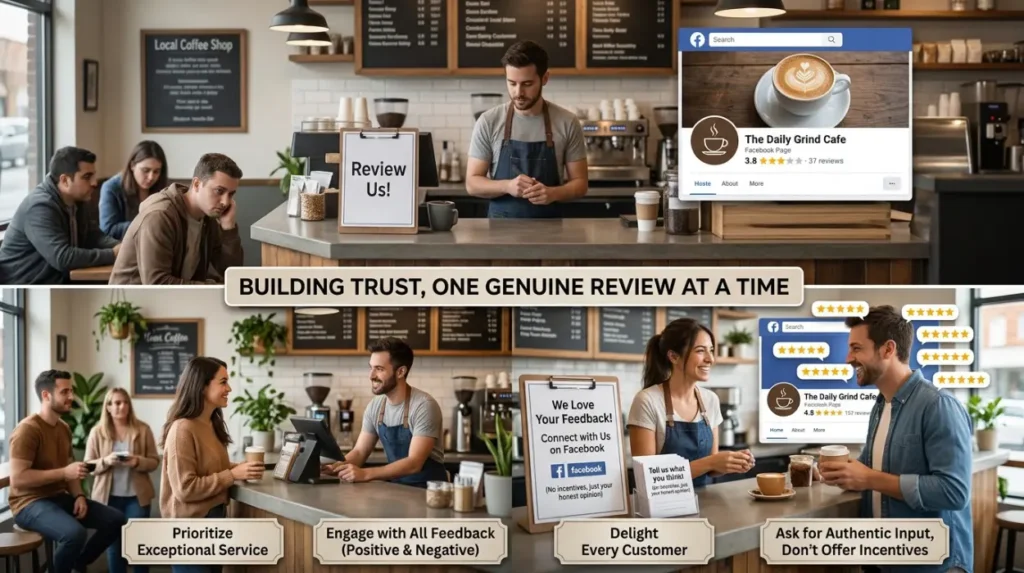
A Facebook rating can be improved through genuine customer feedback and transparent review practices rather than manipulated activity. Ethical review generation means requesting honest feedback without controlling the outcome or manufacturing customer experiences. Businesses also need to distinguish between encouraging feedback and attempting to influence the content or sentiment of that feedback. The safest operational model treats every customer as an independent source of opinion. This protects the credibility of the review profile while reducing the risk associated with artificial reputation signals. Compliance therefore becomes part of reputation management rather than a separate consideration.
The distinction between legitimate review activity and manipulation is central to sustainable reputation improvement. Genuine feedback reflects actual customer interactions and therefore contributes meaningful information to the entity’s public reputation. Fabricated or coordinated feedback creates an inaccurate sentiment distribution and weakens the reliability of the profile. A professional process focuses on improving the volume and consistency of authentic feedback while respecting platform requirements. This approach also produces more useful information for prospective customers. The result is a reputation profile based on evidence rather than artificial presentation.
Businesses seeking further evaluation can review ethical Facebook rating improvement strategies to understand how compliant feedback generation compares with higher-risk reputation tactics.
How does Clear My Name approach Facebook reputation improvement?
Clear My Name positions Facebook Reviews within a structured reputation management process that connects review activity with wider digital trust signals. The process begins with reputation assessment rather than immediately attempting to increase the rating. Existing reviews are evaluated for sentiment, recurring themes, rating distribution and response patterns. This establishes a baseline against which future changes can be measured. The strategy then focuses on strengthening legitimate positive signals through authentic customer engagement. The emphasis remains on process clarity, reputation stability and measurable improvement.
A structured process also creates better visibility into reputation performance. Instead of evaluating success through a single rating figure, businesses can assess changes in review volume, sentiment distribution, response consistency and overall perception. These measurements provide a more complete picture of whether reputation signals are becoming stronger. They also help identify recurring negative themes that require operational attention rather than purely reputational treatment. This connection between customer experience and digital reputation improves the sustainability of the process. Reputation management therefore becomes an ongoing measurement system rather than a one-time rating exercise.
What results can businesses expect from professional Facebook Reviews management?
Professional Facebook Reviews management focuses on measurable reputation outcomes rather than unsupported promises of a specific rating. The first outcome is improved visibility of authentic positive customer experiences within the business profile. The second is greater consistency in how the entity is represented through review sentiment and response activity. The third is improved control over the process used to monitor and strengthen reputation signals. These outcomes contribute to clearer customer perception without relying on artificial review activity. The measurement framework also provides evidence of progress over time.
The relationship between reputation signals and customer behaviour makes process quality particularly important. A customer evaluating a business encounters a combination of rating, review content, responses and other digital information. A coherent review profile reduces uncertainty by presenting consistent evidence about customer experiences. A stronger sentiment distribution also gives positive experiences greater representation within the available review data. These factors support trust without requiring exaggerated claims about rankings or conversions. The practical outcome is a more credible digital reputation.
For businesses assessing a wider reputation strategy, how Facebook ratings influence advertising performance provides useful context for understanding the relationship between social proof and customer perception.
Is improving a Facebook rating a long-term reputation strategy?
Long-term reputation improvement requires continuous review monitoring rather than a one-off attempt to increase the numerical rating. Customer feedback changes as new interactions occur, meaning reputation signals remain dynamic. A sustainable process therefore tracks new reviews, sentiment patterns and recurring concerns after an initial improvement has been achieved. Regular analysis also prevents a previously strong rating from becoming disconnected from current customer experience. This makes reputation monitoring an ongoing operational discipline. Consistency is the key factor that stabilises reputation over time.
The long-term value also comes from reducing the gap between actual customer experience and public perception. If recurring complaints appear in reviews, addressing the underlying issue strengthens future reputation signals more effectively than simply generating additional positive feedback. If customers consistently report positive experiences, a structured review process helps those experiences become visible within the public profile. This creates a feedback loop between customer experience, review activity and reputation perception. The business therefore gains a more accurate and sustainable digital representation. Reputation management becomes both analytical and operational.
How does the cost of reputation management compare with its long-term value?
The value of reputation management is measured through the quality, consistency and resilience of reputation signals rather than through the number of reviews alone. A structured process reduces the operational burden of manually monitoring feedback while creating a consistent framework for responding to reputation changes. It also identifies patterns that remain hidden when businesses evaluate reviews individually. This creates a clearer basis for deciding where reputation-related resources provide the greatest value. Cost evaluation therefore needs to consider both immediate management requirements and long-term reputation stability. A repeatable process provides greater strategic value than isolated corrective activity.
Long-term value also depends on risk reduction. Manipulated reviews, misleading feedback practices and inconsistent responses create reputational and platform-related risks that can undermine previous progress. An evidence-driven approach limits those risks by keeping review activity authentic and measurable. It also establishes documentation and monitoring processes that support clearer decision-making. This makes the reputation strategy more predictable and easier to evaluate. Sustainable reputation improvement ultimately depends on maintaining credible signals over time.
Which reputation management solution is appropriate for improving Facebook Reviews?
A suitable solution combines platform-compliant review practices, reputation monitoring, sentiment analysis and structured customer feedback processes. The approach needs to address both the numerical rating and the information behind that rating. A service that focuses exclusively on generating reviews misses the importance of sentiment, recurring complaints and response quality. Conversely, a process focused only on negative feedback does not strengthen the positive evidence within the profile. Effective management connects these components into one measurable system. This provides stronger control over reputation perception without relying on artificial manipulation.
Clear My Name provides a structured approach centred on these reputation principles. The process connects Facebook Reviews with wider digital reputation signals, helping businesses evaluate their public perception through measurable indicators. At the point where a business requires implementation rather than general analysis, a professional Facebook Reviews management service provides the appropriate service-level pathway. The emphasis remains on authentic feedback, process clarity and long-term reputation stability. This creates a stronger basis for managing customer perception across the Facebook profile.
How can businesses maintain a stronger Facebook reputation after improvement?
Maintaining a stronger reputation requires continuous monitoring, authentic feedback generation and consistent responses to customer reviews. Businesses need to treat reputation as an evolving digital asset rather than a fixed numerical score. Regular review analysis identifies changes in sentiment distribution before they become larger reputation problems. Consistent customer feedback also keeps the profile representative of current experiences. Response quality reinforces the perception of accountability and professionalism. Together, these activities create a stable reputation management cycle.
The strongest long-term model therefore follows a continuous sequence: assess the profile, analyse reputation signals, collect authentic feedback, respond consistently and measure changes. This sequence creates process clarity and provides measurable checkpoints for evaluating performance. It also reduces dependence on short-term interventions that fail to address the underlying reputation system. By connecting Facebook Reviews with broader digital trust signals, businesses gain a more complete view of public perception. This approach supports sustainable reputation improvement while maintaining the integrity of customer feedback.
Why is a structured Facebook rating strategy the reliable choice?
A strong Facebook reputation depends on credible evidence, consistent customer feedback and transparent reputation management practices. Improving the rating is not simply a numerical exercise because the underlying reviews, sentiment distribution and response patterns shape customer perception. A structured process strengthens these reputation signals while reducing the risks associated with artificial or misleading activity. It also provides measurable checkpoints for evaluating visibility, trust and reputation stability. The result is a more reliable digital representation of the business.
Clear My Name applies this principle through a process focused on assessment, authentic feedback, monitoring and measurable reputation improvement. The approach connects Facebook Reviews with broader digital trust and search perception rather than treating the rating as an isolated metric. Businesses gain clearer process control, stronger reputation signals and a sustainable framework for managing customer perception. The emphasis remains on evidence, compliance and consistency. That combination provides the strongest foundation for a credible and resilient Facebook reputation.
How can I raise my Facebook rating legitimately?
A Facebook rating can be improved legitimately by encouraging genuine customers to leave honest reviews based on their actual experiences. Consistent review monitoring and professional responses also strengthen the overall reputation profile.
Can a business improve its Facebook rating without buying reviews?
Yes, businesses can improve their Facebook rating through authentic customer feedback rather than purchased or fabricated reviews. Genuine reviews create more reliable reputation signals and reduce the risks associated with artificial review activity.
How do Facebook Reviews affect customer trust?
Facebook Reviews provide visible social proof that helps customers evaluate a business before making a decision. Rating level, review sentiment, review recency and business responses collectively influence perceived credibility.
How long does it take to improve a Facebook rating?
The timeframe depends on the existing rating, total review volume and rate of genuine customer feedback. Sustainable improvement comes from consistently collecting authentic reviews rather than attempting to produce rapid artificial changes.
What does Facebook Reviews management include?
Facebook Reviews management typically includes monitoring reviews, analysing sentiment, encouraging authentic customer feedback and responding to public feedback consistently. The process also evaluates rating trends and reputation signals to support long-term reputation stability.