
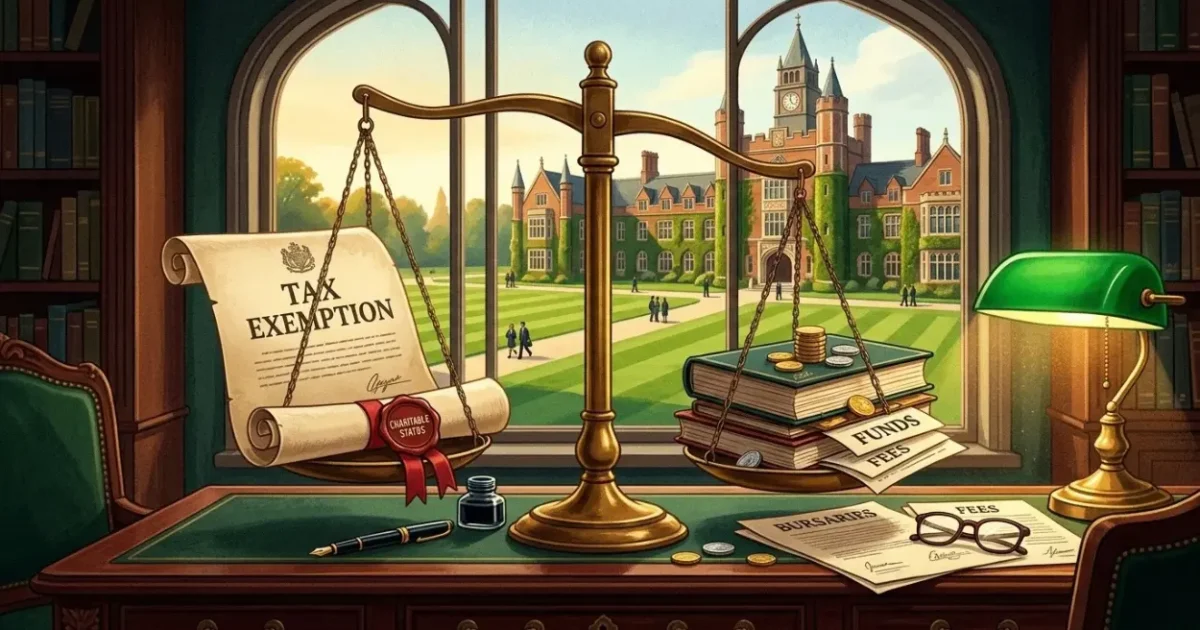
Private schools in the UK can pay tax, but their tax liabilities depend on their legal structure, charitable status, income and activities. Charitable status does not automatically make every income stream or transaction tax-free.
Reputation management is the process of understanding and influencing how an organisation is perceived through public information, reviews and search results. For private schools, online reputation refers to the way parents, pupils, staff, journalists and the wider public interpret information about fees, charitable status, governance and tax responsibilities. These perceptions form through published documents, news coverage, official records and discussions that appear in search engines. When a school’s tax status becomes a subject of public debate, the accuracy and visibility of information influence how people interpret its institutional credibility. Understanding charitable status therefore requires examining both the tax framework and the way related information becomes visible online.
Do private schools in the UK pay tax?
Yes, private schools can pay tax, although the amount and type depend on their legal and financial arrangements. A school operated as a company, charitable trust or other organisation has tax responsibilities determined by the relevant legislation and its activities. Charitable schools can receive tax advantages on qualifying income, but those advantages do not remove every tax obligation. Employment taxes, VAT, business-related income and other liabilities require separate consideration. The term private school describes a type of educational institution rather than a single tax classification.
Tax status also differs from public perception. A school may operate as an independent educational provider while meeting the legal requirements for charitable recognition. Search results that treat all private schools as identical can obscure distinctions between charitable trusts, commercial operators and schools with different governance structures. These distinctions matter when readers evaluate claims about tax payments, public benefit and financial accountability. Accurate interpretation begins with the school’s legal identity and the specific tax rules that apply.
What is the difference between private, independent and charitable schools?
A private school is generally understood as a school funded primarily through fees or private sources rather than maintained by a local authority. In the UK, independent school is a commonly used formal term for schools operating outside the state-maintained system. Charitable status is a separate legal concept that concerns an organisation’s purposes, public benefit and compliance with charity law. An independent school can be charitable, but the terms are not interchangeable. Understanding these definitions prevents the mistaken assumption that charging fees automatically excludes an organisation from charitable status.
This distinction also affects how online information is interpreted. A page describing an independent school does not establish whether the school is a registered charity, exempt charity or non-charitable organisation. Readers need to identify the organisation’s legal structure and consult relevant official records before drawing conclusions. Search engines can display pages that use similar terminology while describing different legal arrangements. Entity identification—the process of determining which organisation a source refers to—is therefore essential to accurate reputation analysis.
What does charitable status mean for a private school?
Charitable status means that an organisation operates for legally recognised charitable purposes and satisfies the applicable requirements, including public benefit. For schools in England and Wales, education is a recognised charitable purpose, but the organisation must also meet the relevant legal tests. Scotland and Northern Ireland have distinct charity-law frameworks and regulators. A school’s charitable status is not determined solely by its educational mission, fee structure or public statements. Its governing documents, activities and regulatory position are relevant to the assessment.
Charitable status can affect taxation because qualifying charitable income and activities receive specific treatment under tax legislation. However, a charity does not become exempt from all taxes merely by being recognised as charitable. Tax relief depends on the type of tax, the source and use of income, and whether the relevant conditions are met. This is why broad online statements such as “charities do not pay tax” can misrepresent the actual rules. The correct interpretation separates legal recognition from the tax treatment of individual transactions.
How is a school’s charitable status verified?
A school’s status can be investigated through official charity registers, regulatory records and its published governing information. In England and Wales, the Charity Commission maintains a register of charities, although some educational charities fall within different regulatory arrangements. Scotland uses the Office of the Scottish Charity Regulator, while Northern Ireland uses the Charity Commission for Northern Ireland. Some schools operate through trusts or foundations whose legal names differ from the school’s trading name. Matching the correct legal entity is therefore important when checking registration or governance information.
The verification process also helps distinguish factual evidence from commentary. A register entry can establish relevant registration details, but it does not automatically prove that every tax treatment claimed by the school is correct. Tax questions require reference to the relevant legislation and guidance from HM Revenue & Customs. News reports and opinion pieces provide context, but their claims need to be checked against primary information. A source-based approach improves both factual accuracy and the reliability of the school’s digital footprint.
Do private schools pay VAT on school fees?
Yes, since 1 January 2025, education and vocational training provided for a charge by private schools in the UK have generally been subject to VAT at the standard rate of 20%, including relevant boarding services.
This change applies independently of whether a school has charitable status. A charitable school therefore does not avoid VAT on chargeable education simply because it operates for charitable purposes. The rules also contain specific treatment for particular supplies, so the precise liability depends on what the school provides and how the transaction is structured.
This change has become an important part of public discussion about independent education. Search queries about private school tax frequently combine practical questions about fees with broader questions about fairness, charitable status and public benefit. Search engines respond to these different needs by displaying official guidance, news coverage, school announcements and commentary. When one type of source dominates the results, readers can develop an incomplete understanding of the legal position. Accurate content explains the change, its effective date and the distinction between VAT and other tax obligations.
Does charitable status exempt school fees from VAT?
No, charitable status does not automatically exempt private school fees from VAT under the rules introduced in 2025. HM Revenue & Customs states that chargeable education and vocational training provided by private schools are subject to the standard rate, with specific rules covering related services and exceptions.
This demonstrates why the legal status of an organisation and the tax treatment of its supplies must be evaluated separately. Confusing these categories can produce inaccurate claims that spread through news reports, social posts and search snippets.
For reputation analysis, this distinction matters because a tax policy change can be interpreted as evidence about an institution’s finances or values, even when the policy applies across a defined category of schools. A school’s public explanations, published fee information and accurate references to official guidance help readers understand the relevant facts. Search visibility alone does not establish whether a statement is correct. Readers need to compare the statement with authoritative information and identify the precise tax issue being discussed.
Dive Deeper With Our Expert Guides:
Northamptonshire School Term Dates 2026/27: Full Calendar
Milton Keynes School Reviews: Where Parents Research Schools Online
Do charitable private schools still receive business rates relief?
In England, private schools that are charities have not been eligible for charitable business rates relief from 1 April 2025. The change was enacted through the Non-Domestic Rating (Multipliers and Private Schools) Act 2025 and applies to qualifying private school properties in England. This rule concerns business rates on property, not the separate question of whether a school retains charitable status. It also does not establish an identical rule for every part of the UK, because business rates and related arrangements differ across the devolved nations.
The distinction is important when interpreting headlines about private schools losing tax advantages. A report about the removal of charitable business rates relief does not mean that every charitable benefit has ended or that a school has automatically lost its registration. It describes a specific change to the treatment of business property in England. Accurate reporting names the tax, jurisdiction and effective date rather than treating “tax relief” as a single universal category. This precision helps readers evaluate the information and prevents an individual policy change from being mistaken for a complete change in legal status.
How do tax policy changes affect school reputation?
Tax policy changes affect school reputation when audiences connect financial obligations with wider questions about fairness, access and public benefit. Parents may focus on fee increases, while journalists and campaigners examine the policy’s effects on school finances and educational provision. These responses create different types of content, including factual explanations, opinion pieces, news analysis and public comments. Search engines evaluate these pages according to relevance and other ranking systems, not by making a single definitive judgement about the school’s moral or financial position. As a result, the visible search landscape can contain conflicting interpretations of the same policy.
A school’s digital footprint includes its official website, financial information, regulator records, news coverage, review profiles and public discussion. Each source contributes a different type of information to entity perception—the way people understand an organisation through the information associated with it. A school’s own explanation establishes its stated position, while legislation and official guidance provide evidence about the applicable rules. Independent reporting supplies additional context, but its claims still require evaluation. Readers develop a more reliable view when these sources are considered together rather than treating one prominent result as a complete account.
How do search engines interpret trust and credibility about private schools?
Search engines use automated systems to discover, index and rank content according to its relevance and other quality signals. Content indexing refers to the process through which a search engine stores and organises information it discovers on accessible pages. Ranking then determines which indexed pages appear for a particular query, subject to the search engine’s systems and policies. A result’s position does not prove that its claims are legally correct, and a high-ranking page is not automatically an authoritative source for every question. Readers therefore need to distinguish search visibility from factual reliability.
Trust and authority are assessed through multiple signals rather than one universal reputation score. Relevant factors include the content’s usefulness, its connection to the query, the reputation of the source and the quality of the information presented. For tax questions, legislation, government guidance and regulatory records provide stronger primary evidence than unsupported social media claims. Search results can still display opinion and commentary because these formats answer different user needs. A careful SERP evaluation examines what each result establishes, which claims it supports and what information remains unverified.
How do reviews and sentiment influence entity perception?
Reviews and public comments contribute to entity perception by revealing how individuals describe their experiences or interpret an organisation’s actions. Sentiment analysis refers to the automated or human assessment of whether text expresses positive, negative or neutral attitudes. It helps categorise language, but it does not independently establish whether an allegation is true. A negative comment about fees, for example, may express dissatisfaction without providing evidence of a legal or financial breach. Readers need to distinguish sentiment from verifiable facts when assessing a school’s reputation.
Review content can also influence what prospective parents notice when researching a school. However, reviews are only one part of the information environment and do not necessarily carry the same weight as official regulatory records or detailed reporting. Search engines may display reviews, news articles, school pages and other sources together for a branded query. The combination of these results shapes the information people encounter before contacting a school or making an enrolment decision. Understanding the context, date, source and evidence behind each item produces a more balanced assessment.
How can readers evaluate claims about private school tax fairly?
Readers can evaluate tax-related claims more accurately by identifying the specific tax, checking the relevant jurisdiction and verifying the statement against an authoritative source. This process separates the underlying legal position from political interpretation and public opinion. It also helps establish whether a claim refers to current rules, an earlier policy or a proposed change. Tax terminology is particularly important because VAT, business rates, corporation tax and charitable tax relief concern different obligations. Treating them as interchangeable leads to inaccurate conclusions about a school’s finances or charitable status.
A useful assessment compares the claim with the original source and checks whether the source supports the wording being used. Readers need to establish whether a statement describes a legal requirement, a reported financial effect or an opinion about the fairness of a policy. Dates also matter because a statement that was accurate before a legislative change can become outdated. Where a claim concerns a particular school, the school’s legal identity and applicable arrangements need to be confirmed. These checks improve factual understanding and reduce the likelihood of repeating unsupported claims.
For readers examining the reputational consequences of a dispute, how private schools manage reputation during charitable status disputes is a related topic that connects legal clarification with public interpretation. Such disputes demonstrate how the same information can be interpreted differently by parents, staff, journalists and policymakers. Understanding those differences requires examining the original evidence, the language used to describe it and the context in which it appears. This approach keeps analysis focused on information quality rather than assuming that positive or negative sentiment proves an organisation’s conduct.
What are the key facts about private school tax and charitable status?
Private school tax obligations depend on the organisation’s legal structure, the nature of its income and the tax rules applicable to each activity. Charitable status can provide particular tax advantages, but it does not create a blanket exemption from every tax. Since January 2025, chargeable education and vocational training supplied by private schools in the UK have generally been subject to 20% VAT, while charitable business rates relief for private schools was removed in England from April 2025. These changes need to be considered separately from the question of whether an organisation continues to qualify as a charity. How Do Private Schools Manage Reputation During Charitable Status Disputes? Private schools can protect their reputation during charitable status disputes by communicating transparently, clarifying their tax obligations and governance decisions, and addressing public concerns with accurate information.
Online reputation is shaped by how accurate information, commentary and public sentiment appear together in search results. Search visibility influences which sources people encounter, while entity perception reflects how they interpret the organisation through those sources. Reviews, rankings and sentiment provide context, but none independently establishes legal compliance or charitable eligibility. A sound assessment relies on current official guidance, relevant regulatory records and careful interpretation of the evidence. Understanding both the tax framework and the search ecosystem gives readers a clearer, more balanced view of private schools’ financial responsibilities.
Do private schools pay tax in the UK?
Private schools in the UK may pay taxes such as Corporation Tax, business rates and VAT, depending on their legal structure and activities. Since January 2025, private school fees have generally been subject to 20% VAT, subject to specific rules and exemptions.
Are private schools charities in the UK?
Some private schools operate as registered charities, while others are run as commercial businesses. Charitable status depends on meeting legal requirements, including providing public benefit rather than operating solely for private gain.
What tax benefits do charitable private schools receive?
Registered charitable schools may qualify for tax relief on eligible income and certain activities, provided they meet the relevant conditions. However, charitable status does not exempt a school from every tax or remove its obligation to comply with tax legislation.
Do charitable private schools have to pay VAT on school fees?
Yes, charitable status does not generally exempt private schools from VAT on education fees. Since 1 January 2025, most private school education and boarding fees have been subject to 20% VAT under UK rules.
How can I check whether a private school is a registered charity?
In England and Wales, you can search the Charity Commission’s online register using the school’s name or charity number. Checking the register can help you verify its registration status, trustees and published financial information.