

Online reputation refers to the collective perception of an entity, such as a public figure or political organisation, as determined by the structure, prominence, and sentiment of data indexed across digital platforms. In the context of modern search ecosystems, this reputation is not merely a reflection of public opinion but a product of algorithmic evaluation, where search engines retrieve, rank, and present information based on specific trust and authority signals.
How Do Search Engines Process and Rank Political Entity Data?
Search engines process political entity data through a systematic pipeline of crawling, indexing, and ranking that relies heavily on entity recognition and semantic relationships. Within this ecosystem, a political figure is categorised as a distinct entity with defined attributes, connections, and historical data points. Algorithms analyse text across news sites, government registries, and public forums to map how these attributes relate to broader societal topics, policy decisions, and public sentiment.
Information retrieval systems evaluate the relevance of content by calculating the proximity of keywords to the specific entity name within digital documents. When a user executes a query, the search engine does not simply match strings of text; it evaluates the entire knowledge graph surrounding that entity to determine which sources offer the most authoritative context. This process establishes the baseline visibility for any political figure online.
Ranking dynamics depend on the continuous assessment of content freshness, source diversity, and historical domain authority. Search engines apply stricter quality thresholds to queries involving civic information, public finance, and elections because these topics directly influence public welfare. Consequently, the algorithms prioritise documents originating from platforms that demonstrate long-term compliance with rigorous informational standards, thereby controlling which narratives achieve primary positioning on the search engine results pages (SERPs).
Why Do Search Engine Results Pages Dictate Public Perception?
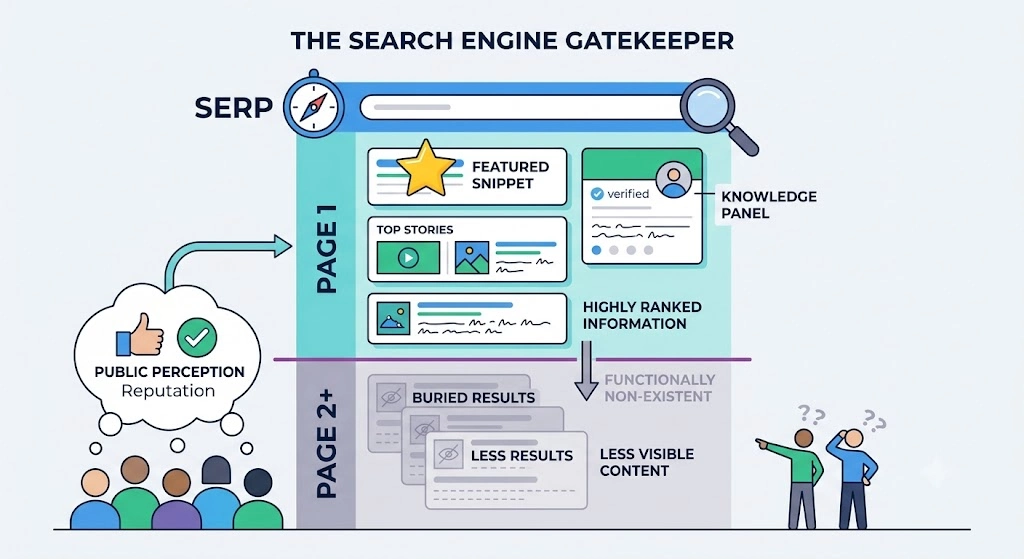
Search engine results pages dictate public perception because they control the hierarchy of information exposure, effectively determining which aspects of an entity’s digital footprint are visible to the public. The top positions on a SERP capture the vast majority of user interactions, creating a cognitive bias where highly ranked information is automatically perceived as more credible and accurate. Information buried beyond the first page of results is functionally non-existent to the average user, regardless of its factual accuracy.
The formatting of search results—including featured snippets, knowledge panels, and top stories carousels—further consolidates this narrative control. Knowledge panels synthesize data points into a single, authoritative sidebar that users accept as verified fact, while top stories prioritize real-time news coverage that can rapidly shift public sentiment. This structural curation means that the search engine acts as an information gatekeeper, shaping the framework through which a political figure is understood.
Furthermore, the sentiment of the dominant search listings defines the baseline reputation of the entity. If the first page of results contains primarily investigative reports, legal disputes, or critical commentary, the search engine cements a negative entity perception that resists easy modification. Conversely, a SERP dominated by policy achievements and official documentation fosters public trust, proving that the structural ordering of data directly governs reputation outcomes.
What Authority and Trust Signals Influence Political Search Visibility?
Authority and trust signals influence political search visibility by serving as the primary metrics that algorithms use to verify the reliability of information. Search engines measure the digital authority of a source through its backlink profile, evaluating the quantity, quality, and topical relevance of inbound links from external domains. A political narrative published by an established national news outlet carries immense algorithmic weight because the underlying domain possesses a verified history of editorial oversight and trust.
Trust is also calculated through the concept of digital expertise and trustworthiness, where algorithms assess the credentials of the content creator and the publishing platform. For political entities, this means that content authored by recognized policy experts, legal professionals, or accredited journalists ranks consistently higher than unverified user-generated content. The system cross-references author names and publishing histories across the web to validate identity and expertise before granting high search visibility.
Additionally, technical signals contribute to the overall trust score of a platform hosting political data. Factors such as secure protocols, structured data implementation, and mobile optimization signal to search engines that a website is maintained to professional standards. When these technical components align with high-quality, original reporting, the algorithm rewards the content with stable ranking positions, shielding it from sudden algorithmic volatility.
How Do Review Signals and Sentiment Interpretation Affect Reputation?
Review signals and sentiment interpretation affect reputation by introducing qualitative user data into the algorithmic evaluation of an entity. Although traditional product reviews do not apply directly to public figures, search engines monitor public sentiment across discussion forums, social media channels, and independent commentary platforms. Natural language processing (NLP) algorithms parse these textual data points to classify the underlying sentiment as positive, neutral, or negative.
This sentiment classification influences how search engines associate specific attributes with a political entity. A sustained influx of negative sentiment across multiple independent digital platforms signals a shift in public trust, which can cause the search engine to alter the composition of the SERP. For instance, algorithmic systems may elevate critical editorial content or forums discussing a controversy if the volume of negative sentiment crosses a specific computational threshold.
Moreover, the persistent association of an entity with negative sentiment terms alters autocomplete suggestions and related searches. When users begin typing a politician’s name, the search engine predicts queries based on search volume trends and prevailing sentiment associations. This mechanism introduces critical narratives to users before they even execute a full search, demonstrating how sentiment processing actively steers the direction of public inquiry.
How Does a Digital Footprint Accumulate Algorithmic Risk Over Time?
A digital footprint accumulates algorithmic risk over time through the permanent preservation of contradictory, unverified, or highly critical historical data within search engine indexes. As a political figure operates in the public sphere, every press release, media interview, legislative vote, and public controversy generates digital documentation. If this historical content remains unmanaged, older narratives can resurface during critical periods, disrupting current perception goals.
Algorithmic risk increases when historical data conflicts with current messaging, as search engines favor consistency and thematic alignment when evaluating entity profiles. If an entity’s digital footprint contains a large volume of fragmented or conflicting information across different domains, the algorithm struggle to determine the primary context of the entity. This ambiguity lowers the overall trust score of the entity, leaving the SERP vulnerable to manipulation by external critical sources.
To mitigate these systemic vulnerabilities, organisations systematically measure narrative control online by performing structured evaluations of how search systems process their data. Engaging in regular political search visibility audits: measuring narrative control online allows entities to identify historical data gaps, detect emerging sentiment shifts, and understand the technical vulnerabilities within their digital footprint before these factors negatively impact search prominence.

Summary of Search Narrative Mechanics
Search engines operate as active architects of political reputation by using complex algorithmic frameworks to crawl, categorise, and rank information. Entity perception is not static; it is constantly reconstructed by algorithms that weigh domain authority, source trustworthiness, and user sentiment. Because top search results capture primary user attention and establish immediate credibility, the structural configuration of a SERP directly governs how public figures are perceived by the electorate. Managing a digital footprint within this ecosystem requires a precise understanding of these systemic mechanisms to ensure that authority signals and sentiment trends align to reflect an accurate, stable reputation.
Frequently Asked Questions
How do search engines evaluate political candidate reputations?
Search engines assess candidate reputations by analyzing data from trusted news outlets, government records, and verified digital entities within their knowledge graphs. Algorithms look for consistency, high domain authority, and reliable backlinks to determine the credibility of the information displayed on results pages. For specialized public figures, utilizing a dedicated target service name like reputation management for politicians helps monitor and align these algorithmic trust signals over time.
What is a political search visibility audit?
A political search visibility audit is a systematic evaluation of how search engines index, rank, and present information related to a public official or campaign. This analysis measures narrative control online by identifying negative sentiment shifts, outdated press coverage, and technical vulnerabilities within the entity’s digital footprint. Political figures use these audits to understand which search queries pose the highest reputation risks during active cycles.
Can a politician change their Google knowledge panel information?
Politicians can influence their Google knowledge panel information by claiming the profile and verifying their identity as the official entity representative. Once verified, they can suggest edits to factual errors, dates, or official links directly through the search interface. However, the final display depends on search engines cross-referencing the changes with authoritative, third-party web sources to ensure accuracy.
How does negative online sentiment impact a politician’s search visibility?
Sustained negative online sentiment shifts search visibility by triggering natural language processing algorithms to associate an entity with critical terminology. When high volumes of negative content appear across forums and news sites, search engines may elevate these sources in the rankings and update autocomplete suggestions to reflect the controversy. This algorithmic shift can obscure positive achievements and permanently alter public perception on primary results pages.
How do search algorithms counter political misinformation online?
Search engines counter misinformation by enforcing stricter quality thresholds and tracking expert signals for queries involving civic or historical information. Algorithms prioritize content from established journalistic institutions, legal bodies, and accredited educational domains that demonstrate factual compliance. Additionally, search systems actively downrank unverified user-generated content or platforms that show patterns of manipulative link building and false reporting.