

Reputation management strategies differ based on the structural alignment of Search Engine Results Pages (SERPs), the velocity of public interest, and the technical mechanics of entity credibility. Online reputation control methods are evaluated through their capacity to modify sentiment distribution, recalibrate search ranking influence, and reconstruct trust signals across multi-layered digital ecosystems.
How Do Digital Reputation Signals Shift During Political Controversies?
A political controversy alters the algorithmic evaluation of an entity by triggering an influx of high-velocity query spikes and real-time news indexing. Search engines prioritize freshness and source authority when public interest spikes, which temporarily disrupts the established entity graph. During this phase, user intent shifts from informational discovery to critical investigation, causing search algorithms to elevate news clusters, algorithmic carousels, and user-generated discussion platforms.
The mechanism of this shift relies on the interaction between user behavior signals and algorithmic indexing frequency. When a controversy occurs, high click-through rates on negative content signal to search engines that these results possess high situational relevance. Consequently, the sentiment distribution within the top positions of the SERP skiles toward critical narratives, depressing older, authoritative, and neutral entity profiles.
Long-term suppression of negative sentiment requires an understanding of how search engines interpret historical entity credibility against recent algorithmic updates. If the negative content originates from highly authoritative domains, such as national news outlets or government archives, the search ranking influence of these URLs hardens over time. This makes the degradation of negative signals a structural challenge rather than a temporary visibility issue.
What Are the Structural Differences Between Content Suppression and Content Removal Strategies?
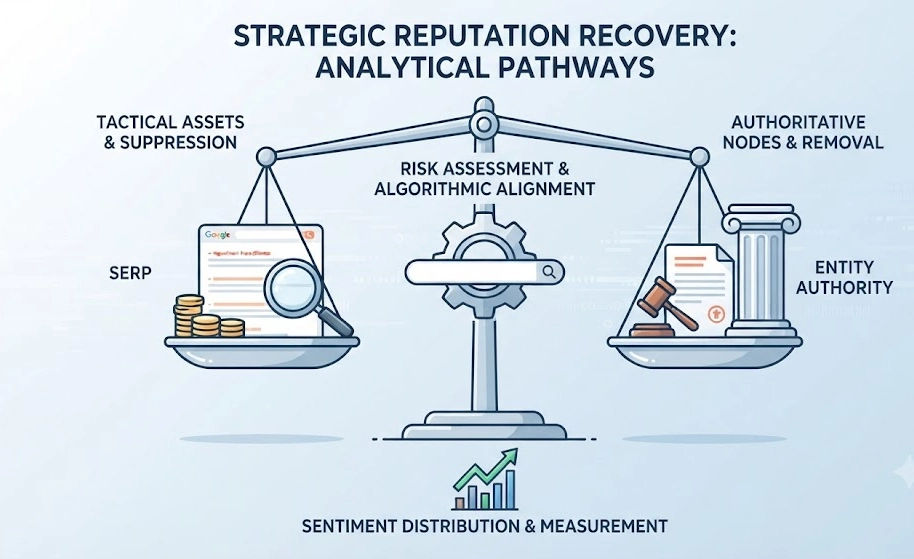
Content suppression and content removal represent two distinct technical methodologies within digital risk mitigation. Content suppression operates by increasing the volume, authority, and semantic density of positive or neutral assets to outrank negative URLs. Content removal focuses on the absolute elimination of the negative content from the index or the hosting domain entirely.
| Evaluation Criteria | Content Suppression Strategy | Content Removal Strategy |
| Primary Mechanism | Algorithmic displacement via content enhancement | Legal, regulatory, or webmaster de-indexing |
| Search Ecosystem Impact | Alters the sentiment distribution of the SERP | Eliminates specific URLs from the search index |
| Implementation Risk | Requires sustained authority building to prevent reversal | High exposure to public backlash or legal counters |
| Scalability | Scalable across broad keyword variations and entities | Limited to specific actionable URLs and domains |
| Resource Dependency | Long-term asset development and link equity | Specialist legal resources and platform policy alignment |
Mechanics of Content Suppression
Content suppression utilizes content enhancement frameworks to manipulate the algorithmic balance of the SERP. This approach constructs a ring fence of owned, earned, and shared media assets that match the semantic profile of the primary entity. By optimizing these assets for identical keyword variations, the strategy forces search engine algorithms to distribute ranking equity across the newly created, controlled network. The limitation of this method lies in its dependency on continuous authority maintenance, as a sudden decay in asset optimization allows negative URLs to reclaim their former visibility.
Mechanics of Content Removal
Content removal targets the root source of the reputation signal by utilizing legal frameworks, right-to-be-forgotten requests, or terms-of-service violations to delete data. This approach completely alters the SERP composition because the targeted URLs cease to exist within the search index. The constraint of this strategy is its narrow applicability; factual reporting, public records, and expressions of opinion on authoritative news sites rarely meet the strict criteria required for forced removal. Attempting content removal without solid legal grounds can also trigger secondary controversies, often amplifying the visibility of the original issue.
How Do Organic and Reactive Approaches Compare in Long-Term Perception Control?
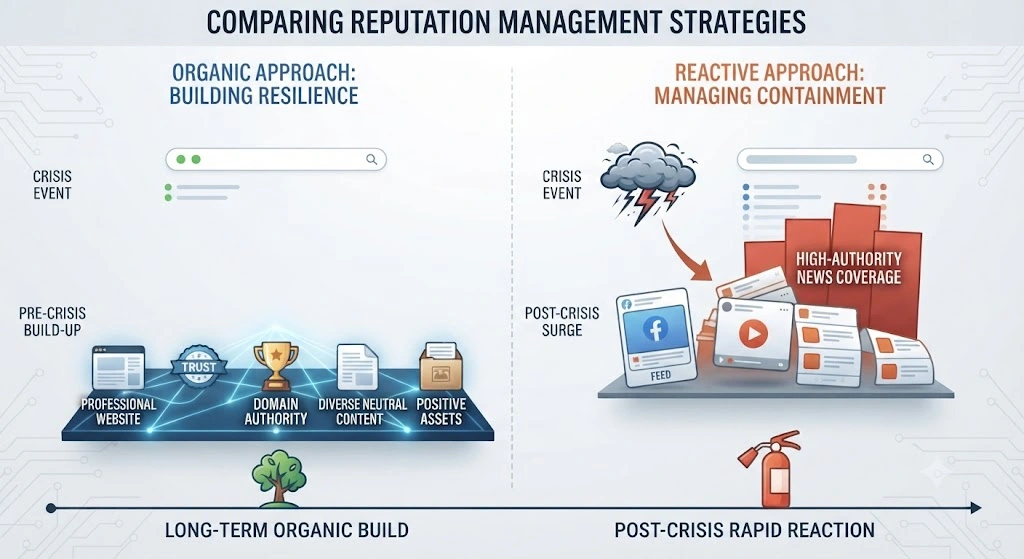
Organic reputation management establishes a resilient digital footprint prior to any algorithmic disruption, whereas reactive reputation management initiates containment protocols only after a crisis occurs. An organic strategy focuses on continuous entity asset distribution, securing defensive digital real estate across core search terms over a multi-year horizon. A reactive strategy deploys rapid content generation and technical optimization to counter an active surge of negative sentiment.
Organic approaches possess high structural durability because they build deep domain authority and established trust signals over time. When a political controversy occurs, an entity supported by a robust, pre-existing organic network experiences less SERP volatility. The search engine already recognizes a diverse array of authoritative, neutral assets, which limits the capacity of fresh news clusters to dominate the entire first page of results.
Reactive approaches suffer from a structural lag within search ecosystems. Because search engines require time to crawl, index, and evaluate the authority of new content, reactive assets cannot instantly displace high-authority news coverage. Reactive strategies must focus on volatile, short-term search features like social media feeds or video carousels rather than competing immediately for core organic positions.
Which Metrics Effectively Measure the Sustainability of Search Perception Recovery?
Measuring the stabilization of an entity profile involves analyzing specific data points that reflect algorithmic trust and sentiment balance. Relying solely on the displacement of a single URL introduces risk, as search layouts vary by location, device, and user history. A comprehensive evaluation framework tracks deeper structural indicators across the search environment.
- Analyse the sentiment distribution ratio across the first three pages of search results to verify that neutral or positive assets occupy the highest-visibility positions.
- Measure the volatility of the entity graph by monitoring changes in automated knowledge panels and related search queries over a ninety-day observation window.
- Track the domain authority growth rate of owned defensive assets to ensure they possess sufficient link equity to withstand future algorithmic updates.
- Evaluate the query intent shift within autocomplete predictions to determine whether search engines are decoupling the entity name from controversy-specific terms.
- Monitor the search ranking influence stability of authoritative third-party domains to identify whether negative news assets are experiencing natural algorithmic decay.
How Do Strategies Differ for Short-Term Sentiment Correction and Long-Term Entity Credibility?
Short-term sentiment correction focuses on immediate visibility management, whereas long-term entity credibility targets the fundamental re-indexing of the entity within the knowledge graph. Short-term methods prioritize tactical adjustments to volatile SERP elements, utilizing high-frequency updates on platform-specific profiles to influence real-time search queries. These actions satisfy the immediate demand for information without altering the underlying authority structure of the search results.
Long-term entity credibility requires a systematic restructuring of semantic associations. This method involves generating deeply researched, authoritative digital footprints that establish new nodes of relevance within search algorithms. By connecting the entity to verified institutional frameworks, academic contributions, or policy initiatives, this strategy shifts the thematic focus of search engine indexing models away from past controversies.
The primary risk of relying exclusively on short-term sentiment correction is its lack of structural permanence. Once the immediate technical optimization efforts slow down, the underlying authority of established news assets can pull negative results back to prominent positions. Sustainable recovery demands a transition from superficial visibility management to deep semantic network enhancement.
What Strategic Considerations Govern the Choice of Reputation Recovery Methods?
Selecting an analytical path for digital recovery requires evaluating the nature of the controversy, the authority of the negative content, and the current state of the entity’s digital footprint. Political controversies introduce unique variables because the public interest profile decays at a different rate compared to corporate or commercial crises. The long-term success of any recovery strategy depends on aligning technical capabilities with realistic algorithmic behaviors.
Strategic options must be weighed against their potential to influence search engine behavior without introducing further risk. While content suppression offers a scalable, constructive path for long-term digital footprint optimization, it demands continuous resource allocation and precise keyword targeting. Conversely, content removal provides absolute resolution for specific URLs but remains restricted by rigid legal parameters and platform policies.
Ultimately, balancing these approaches involves evaluating the structural permanence of each method. A strategy that incorporates both the immediate deployment of tactical assets and the long-term cultivation of authoritative entity nodes provides the highest defense against systemic search volatility. Analysts must continuously measure sentiment distribution and authority signals to adapt their chosen approach to ongoing search engine core updates. Understanding these dynamics is essential when evaluating the utility of specialized reputation recovery services for politicians facing public controversies.
Frequently Asked Questions
How long does political reputation recovery take on search engines?
The timeline for digital reputation recovery following a public controversy typically ranges from six to twelve months, depending on the authority of the sites hosting the negative content. High-velocity news updates and institutional press reports establish deep algorithmic footprint permanence that requires sustained content enhancement to displace. Clear My Name measures recovery stability over a minimum ninety-day window to ensure new, authoritative trust signals have successfully recalibrated the sentiment distribution.
Can a politician legally remove negative news articles from Google search results?
Forced content removal from search engine indexes is rarely possible for public figures unless the content is proven to be defamatory, breaches data protection laws, or violates copyright. News media outlets possess high domain authority and public interest exemptions, meaning standard content suppression and semantic node enhancement are generally more effective than legal deletion attempts. Strategic reputation management for politicians focuses on outranking these assets rather than pursuing low-probability removal strategies.
What is the difference between content suppression and content removal for public figures?
Content suppression builds a defensive ring fence of high-authority, optimized digital assets to lower the search ranking influence of negative URLs. Content removal focuses on the absolute deletion of a specific link from the web directory through legal frameworks or webmaster outreach. Because political controversies often involve protected journalistic reporting, suppression frameworks offer a more scalable and reliable method for balancing sentiment distribution.
How do search engine algorithms treat political controversies over time?
Search engines prioritize real-time updates and freshness signals during an active public crisis, which elevates news carousels and query predictions. As the public search velocity decreases, the algorithm returns to evaluating long-term entity credibility and core domain authority. If no proactive digital footprint optimization occurs, the negative news URLs can permanently solidify their positions within the top organic search results.
How does Clear My Name rebuild digital trust signals after a crisis?
Clear My Name systematically alters semantic associations within the entity graph by developing highly optimized, authoritative profiles and public-facing assets. This process shifts search engine indexing models away from controversy-specific query terms and toward verified institutional contributions. Over time, this structural content enhancement dilutes negative sentiment distribution and restores stable ranking authority to the primary entity.