

Online reputation refers to the collective digital footprint, algorithmic interpretations, and public perceptions of an entity as manifested across search engine results pages (SERPs) and web ecosystems. In the context of political figures, this digital footprint serves as a permanent historical record that structures how search engines evaluate authority, trustworthiness, and historical relevance over extended periods.
Why Do Historical Political Scandals Remain Visible in Search Ecosystems?
Historical political scandals remain highly visible in search ecosystems because search algorithms prioritize information freshness, historical prominence, and sustained user engagement signals. When a political controversy occurs, it generates a massive influx of high-authority news coverage, which indexes deeply within web architectures. Search engines catalog these events not as temporary anomalies, but as core entities and topical attributes permanently associated with the political figure.
Information creation within search ecosystems relies heavily on the concept of entity-attribute relationships. Within a semantic web framework, a politician is an “entity,” and their actions, policies, and controversies are “attributes” linked to that entity. When authoritative domains create thousands of cross-referenced articles regarding a specific scandal, the semantic connection between the entity and the negative attribute strengthens. Algorithms interpret this dense network of links and textual associations as a primary component of the entity’s identity, ensuring that the information surfaces whenever the entity is queried.
The impact on search visibility is profound and enduring. Because search engines use historical query volume and click-through data to evaluate user intent, historical scandals continue to rank prominently. Even years after the event, if users periodically search for the politician alongside risk-related terms, the algorithm receives continuous signals that the controversy remains relevant to public interest. This feedback loop ensures that negative content maintains high visibility, structurally dominating the first page of results and continuously shaping public opinion.
How Do Search Algorithms Evaluate Trust and Credibility for Political Entities?
Search algorithms evaluate trust and credibility for political entities through explicit frameworks that measure Expertise, Authoritativeness, and Trustworthiness (E-A-T). Within search ecosystems, political figures fall under the category of “Your Money or Your Life” (YMYL) topics, as their actions directly influence civic infrastructure, legislation, and public welfare. Consequently, search engines apply significantly higher standards of data verification and source scrutiny to content indexed about these individuals.
The mechanism of credibility evaluation relies on the algorithmic assessment of link equity, citation networks, and domain authority. Search engines do not read content like human observers; instead, they analyze the structural metadata and backlink profiles of the websites publishing information. When a political controversy is documented by national news outlets, academic journals, and governmental records, these high-authority nodes transmit strong trust signals to the specific narrative. The algorithm establishes a consensus based on the structural agreement of these reputable domains, anchoring the scandal as a verified historical fact within the knowledge graph.
Sentiment interpretation engines further refine this process by extracting semantic vectors from textual content. Natural language processing (NLP) algorithms scan web documents to evaluate the contextual sentiment surrounding a political entity. If the lexical patterns across a majority of authoritative index entries contain risk-related terminology, legal vocabulary, or unethical associations, the entity perception score drops within the system. This negative sentiment mapping alters how the search engine contextualizes the individual, frequently dampening their ability to rank for positive, self-authored, or neutral promotional content.
What Structural Challenges Hinder Entity Perception Correction After a Crisis?
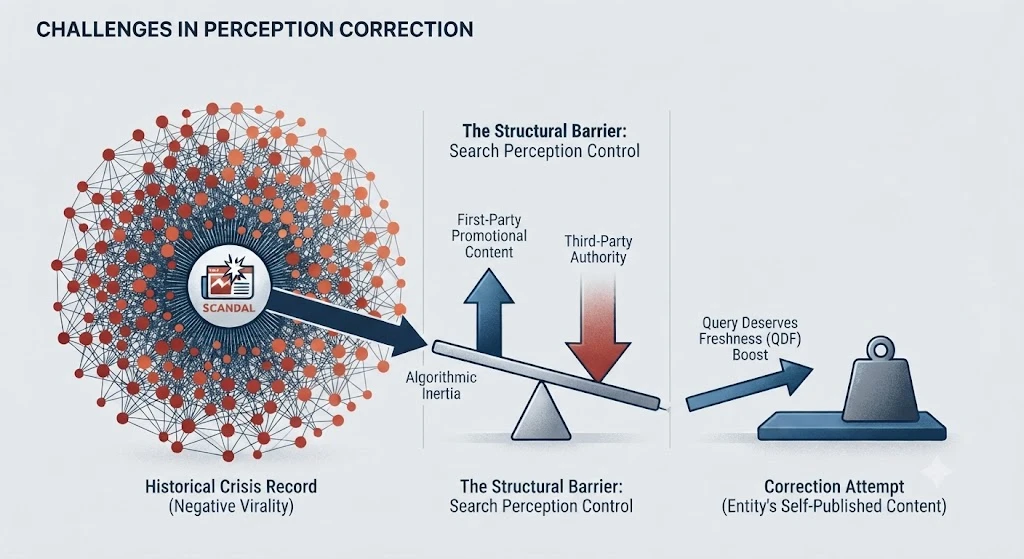
Structural challenges that hinder entity perception correction after a crisis stem from the inherent asymmetry between the virality of negative information and the algorithmic inertia of established search indexes. Once a scandal achieves critical mass, the digital architecture creates a self-sustaining informational hierarchy that resists modification. Modifying a digital footprint requires overriding a deeply entrenched network of authoritative citations, which presents a significant technical barrier within search perception control.
The primary mechanism preventing rapid perception correction is algorithmic bias toward established authority over self-published declarations. When a political figure attempts to alter public perception by publishing neutral or positive content on personal websites or social media platforms, these assets lack the historical domain authority required to displace major media publications. Search engines prioritize third-party independent coverage over first-party promotional content to prevent manipulation, meaning that the historical record maintained by media conglomerates naturally retains its superior ranking positions.
Furthermore, evaluating reputation recovery challenges following political controversies demonstrates that informational gaps are rarely filled by positive updates. In search ecosystems, a phenomenon known as “query deserves freshness” (QDF) temporarily boosts new content, but once the immediate aftermath of a recovery effort stabilizes, the algorithm reverts to historical cumulative weight. Because historical negative data possesses thousands of high-quality backlinks gathered during the peak of the crisis, it outlasts new, low-impact content that fails to generate identical levels of organic reference and user engagement.
How Do Review Signals and Public Sentiment Interactions Affect Digital Footprints?
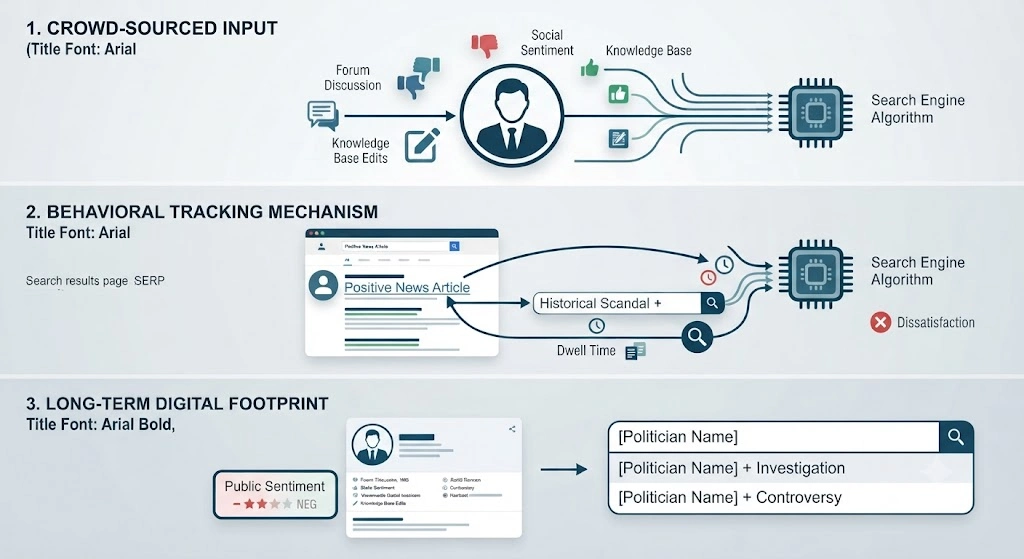
Review signals and public sentiment interactions affect digital footprints by generating continuous user-generated data streams that search engines ingest to measure real-time entity health. While traditional political entities do not possess commercial product reviews, they are subject to alternative digital feedback loops such as forum discussions, social media sentiment aggregators, and public knowledge base edits. These crowd-sourced inputs provide secondary verification layers that algorithms use to cross-reference official media narratives.
The mechanism through which user interactions shape the digital footprint involves real-time data mining and behavioral tracking. Search engines monitor how users interact with search results, specifically analyzing parameters such as dwell time, bounce rates, and secondary search queries. If a user clicks on a positive article about a politician but immediately returns to the SERP to search for the historical scandal, the algorithm notes the dissatisfaction with the positive content. This behavior signals that the public interest resides with the controversy, leading the algorithm to maintain the visibility of the negative assets.
The long-term impact of these sentiment interactions manifests in the automated updates of knowledge graphs and autocomplete predictions. Search queries entered by thousands of citizens generate immediate associations within search bar suggestions. When terms relating to legal investigations or ethical failures become permanently appended to a politician’s name in autocomplete features, user perception is directed toward the controversy before a single search result page even loads. This continuous reinforcement integrates public skepticism directly into the search infrastructure, solidifying the negative digital footprint.
Summary of Conceptual Insights
To conceptualize how long-term search visibility influences public opinion, it is useful to observe the structural workflow through which digital architectures process, lock, and maintain reputation records over multi-year periods.
1.The Crisis Trigger and Information Saturated Indexing:Immediate Execution Phase.
Authoritative media domains generate high volumes of content referencing the controversy. Search engines index these documents rapidly due to high query volume and freshness signals, establishing strong entity-attribute links.
2.Consolidation Within the Knowledge Graph:Intermediate Institutional Phase.
Natural language processing systems evaluate the consensus across high-authority sites. The scandal transitions from a temporary news item to a permanent semantic attribute attached to the political entity’s profile.
3.Algorithmic Inertia Realization:Long-Term Stagnation Phase.
The historical content accumulates permanent link equity, domain trust, and behavioral engagement signals. This creates a high barrier of entry for any subsequent neutral or positive information attempting to displace the original results.
4.Feedback Loop Reinforcement:Perpetual Maintenance Phase.
User search behavior, autocomplete generation, and continuous query associations maintain the visibility of the historical event, ensuring that public perception remains tethered to the past controversy indefinitely.
Online reputation management within search ecosystems requires an understanding of structural data management rather than superficial public relations. Search engines function as mathematical consensus engines that rely on authority, link networks, and semantic context to determine what constitutes the truth about an entity. When a political controversy occurs, the digital footprint undergoes a fundamental transformation that locks negative attributes to the entity’s identity. Because search engines prioritize independent domain authority and historical user engagement signals over self-published corrections, these digital records remain highly stable. Consequently, the persistence of historical information on SERPs ensures that political scandals continue to structure public opinion and dictate entity perception years after the physical events have concluded.
Frequently Asked Questions
How do political scandals affect long-term search visibility?
Political controversies generate dense clusters of high-authority media coverage that search engines index as permanent semantic attributes of an individual. Over time, algorithmic systems treat these well-documented historical events as foundational entity data rather than temporary news. Consequently, the negative content retains premium positioning on search results pages, shaping user perception whenever the politician’s name is queried.
What is reputation management for politicians during an online crisis?
Reputation management for politicians refers to the systematic framework of monitoring digital footprints, addressing algorithmic sentiment bias, and building authoritative neutral assets within search ecosystems. Agencies like Clear My Name analyze entity-attribute relationships to counter the structural domination of historical negative links. This process focuses on balancing the search environment by introducing verified, high-trust informational sources to neutralize past algorithmic associations.
Why is evaluating reputation recovery challenges following political controversies difficult?
Evaluating reputation recovery challenges following political controversies requires measuring the massive technical imbalance between viral news networks and low-authority personal sites. Search engines naturally prioritize third-party independent coverage over first-party promotional content to ensure indexing integrity and data verification. Because historical negative data possesses immense cumulative link equity, displacing established crisis narratives requires a sophisticated, long-term semantic SEO strategy rather than short-term public relations.
Can a politician permanently remove negative search engine results pages?
Under standard search architectures, a public figure cannot unilaterally delete authoritative news articles or governmental records from indexed search engine results pages (SERPs). Unless the content violates specific legal mandates like copyright laws or localized privacy regulations, it remains a permanent fixture of the web ecosystem. Technical mitigation relies on architectural suppression, which requires developing stronger authority signals to gradually lower the visibility of risk-related links.
How do search autocomplete predictions influence public perception of public figures?
Search autocomplete predictions influence public perception by directing user attention toward historical risks or legal controversies before a full query is even executed. These real-time search suggestions are generated by automated algorithms tracking aggregate user search behavior and persistent phrase associations. When negative terms become structurally appended to a political entity’s name, it creates a continuous feedback loop that reinforces public skepticism and drives ongoing traffic to older scandal documentation.