

Negative comments and reviews on social media platforms are addressed through structured reputation management practices that evaluate content accuracy, sentiment, visibility, and search perception. Reputation management is the process of monitoring, interpreting, and influencing how information about an entity is created, indexed, and understood across digital ecosystems.
Online reputation refers to the collective perception formed by user-generated content, platform interactions, search engine indexing, and reputation signals that shape credibility over time. Negative comments and reviews become part of a digital footprint and contribute to how search engines and users evaluate trust, authority, and relevance.
What are negative comments and reviews on social media platforms?
Negative comments and reviews are publicly accessible pieces of user-generated content that express dissatisfaction, criticism, or adverse opinions about an entity. Within search ecosystems, they function as reputation signals that contribute to entity perception and influence online credibility. Every published comment, review, reply, or discussion adds contextual information that search engines associate with a brand, organisation, or individual. Content indexing allows these interactions to become discoverable both within social media platforms and through search engine results pages (SERPs). The visibility of this information affects how audiences interpret trust before engaging with an entity.
Negative content differs from harmful or false content because it often represents authentic user feedback rather than misinformation. Search engines evaluate this information according to relevance, freshness, authority, and engagement rather than emotional tone alone. Platform algorithms also analyse interaction patterns, including replies, reactions, and reporting activity, to determine content prominence. These processes define how negative comments remain visible or lose prominence over time. As a result, reputation develops through information quality rather than isolated opinions.
Why do negative comments and reviews influence online reputation?
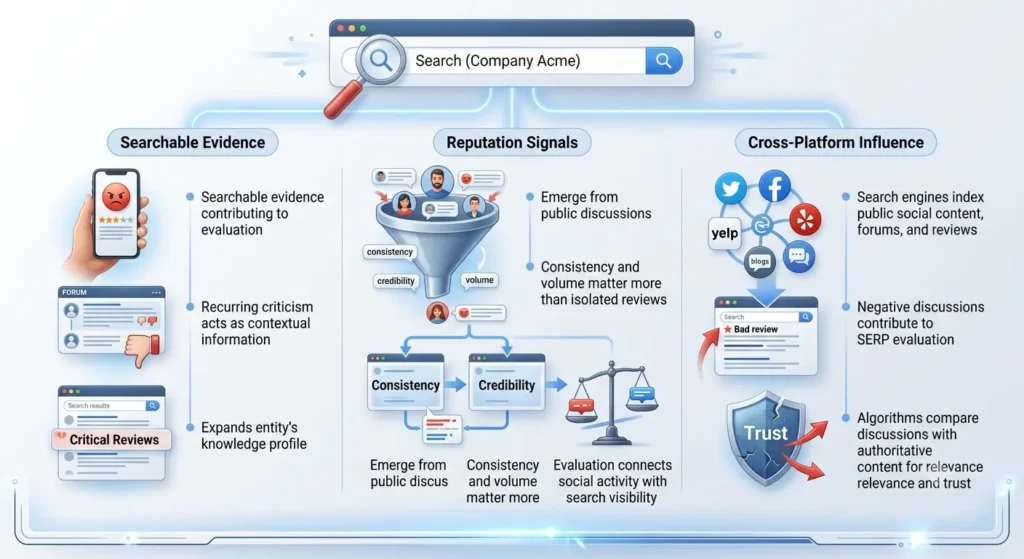
Negative comments influence online reputation because they provide searchable evidence that contributes to entity evaluation across digital platforms. Search engines interpret recurring criticism as contextual information that expands an entity’s knowledge profile. Reputation signals emerge from the consistency, credibility, and volume of publicly accessible discussions rather than from isolated reviews. This evaluation process connects social media activity with broader search visibility and online credibility.
The influence extends beyond individual platforms because search engines index publicly available social content alongside websites, forums, and review platforms. When users search for an organisation or individual, indexed negative discussions contribute to SERP evaluation. Search algorithms compare these discussions with authoritative content to determine overall relevance and trust. This relationship demonstrates that reputation depends on the entire information ecosystem instead of one platform alone. Digital trust therefore develops through balanced, credible, and context-rich information.
How do search engines interpret social media reputation signals?
Search engines interpret social media reputation signals by analysing indexed content, authority indicators, engagement patterns, and semantic relationships between entities. Reputation signals refer to measurable indicators that define how trustworthy and relevant information appears within search ecosystems. Algorithms examine language, publication frequency, topical consistency, and content freshness to understand the context surrounding an entity. These evaluations contribute to entity perception without assigning value to isolated keywords alone. Semantic analysis enables search systems to connect discussions across multiple sources.
What role does content indexing play?
Content indexing is the process through which searchable information becomes stored and organised for retrieval. Public social media posts, reviews, and comments that permit crawling become eligible for inclusion within search indexes. Indexed content remains available for SERP evaluation until updated, removed, or replaced by newer information. Search visibility therefore depends on how efficiently search engines process and classify content. Indexing establishes the foundation upon which reputation signals are interpreted.
How is sentiment interpreted?
Sentiment interpretation analyses the emotional and contextual meaning of language rather than counting positive or negative words. Search systems evaluate linguistic relationships, topic consistency, and contextual relevance to understand overall perception. Repeated negative sentiment connected to the same entity strengthens specific reputation associations. Balanced discussions containing factual responses introduce additional context that influences semantic understanding. Sentiment therefore functions as one component within broader reputation analysis rather than an isolated ranking factor.
How does a digital footprint affect reputation over time?
A digital footprint is the cumulative collection of online content associated with an entity across websites, social media platforms, reviews, forums, and search indexes. Every indexed interaction contributes to an expanding information profile that search engines analyse for consistency and relevance. This footprint includes published posts, public responses, reviews, media references, and archived discussions. Entity perception develops from the combined interpretation of these interconnected information sources. The digital footprint therefore becomes a long-term representation of online credibility.
Search ecosystems prioritise information continuity because repeated references strengthen semantic associations. Older negative reviews remain discoverable when newer authoritative content fails to provide additional context. Updated information gradually changes the balance of indexed content by expanding topical coverage and demonstrating information freshness. Reputation evolves through continuous indexing rather than sudden changes in perception. This explains why long-term information management influences search visibility more effectively than isolated actions.
Why do some negative reviews remain highly visible?
Negative reviews remain highly visible because search algorithms evaluate relevance, authority, user engagement, and query satisfaction. Visibility is determined through ranking systems that compare content quality rather than assigning preference to positive or negative opinions. Reviews containing detailed explanations often receive stronger engagement signals, increasing their prominence within platform algorithms. Search engines recognise these interactions as indicators of user interest during SERP evaluation. The ranking process therefore reflects information value instead of sentiment alone.
Freshness also influences visibility because recently active discussions continue attracting engagement and indexing activity. Reviews that receive replies, reactions, or references remain contextually relevant for longer periods. Platform algorithms interpret these interactions as evidence of ongoing discussion. Search systems incorporate these signals into broader reputation analysis while comparing competing sources. Visibility therefore reflects both content quality and continued interaction.
How does responding to negative comments influence perception?
Responding to negative comments introduces additional contextual information into the public information environment. Responses define how search engines and users interpret accountability, transparency, and communication quality. Public replies become part of indexed discussions when platforms permit search engine access. These additions enrich the semantic context surrounding existing reviews rather than replacing original content. Entity perception therefore develops from the complete conversation instead of a single statement.
Well-structured responses clarify factual information, address inaccuracies, and improve contextual balance within reputation signals. Search systems evaluate the expanded discussion for topical completeness and information relevance. Consistent communication strengthens online credibility because it demonstrates active information maintenance rather than content avoidance. Search visibility benefits from richer semantic coverage that explains disputed topics more clearly. Reputation therefore becomes increasingly defined by information quality and contextual completeness.
Within broader reputation strategies, related educational resources often discuss Social Media Reputation Management Service concepts to explain how reputation signals are monitored and interpreted across search ecosystems.
What factors define authority and trust in search ecosystems?

Authority and trust are evaluated through the quality, consistency, and reliability of indexed information. Authority refers to the recognised expertise associated with an entity, while trust reflects the credibility of available content within search ecosystems. Search algorithms compare multiple information sources to determine whether published content demonstrates consistency across the web. Contradictory information weakens entity perception because semantic confidence decreases during evaluation. Reliable information strengthens search visibility by improving contextual certainty.
How does information consistency strengthen trust?
Information consistency refers to the alignment of facts, descriptions, and public discussions across indexed sources. Consistent information enables search engines to establish stable entity relationships during semantic analysis. Repeated factual references reinforce topical authority because algorithms detect corroborating evidence across independent sources. Stable entity associations improve search confidence and contribute to stronger reputation signals. Consistency therefore represents a measurable characteristic of online credibility.
Why does authority affect reputation?
Authority affects reputation because search systems prioritise reliable information during SERP evaluation. High-authority sources strengthen semantic understanding by providing verified, context-rich content. Public discussions supported by authoritative references contribute positively to entity perception even when criticism exists elsewhere. Search engines analyse relationships between authoritative content and user-generated discussions to develop balanced interpretations. Authority therefore improves contextual accuracy within digital reputation systems.
How is sentiment analysis connected to reputation management?
Sentiment analysis is the systematic evaluation of emotional language and contextual meaning within digital content. Reputation management uses sentiment analysis to categorise discussions, identify recurring topics, and measure changes in public perception over time. Search ecosystems integrate semantic interpretation with broader ranking systems rather than relying solely on positive or negative terminology. This analytical process explains how recurring themes become associated with specific entities. Reputation signals therefore emerge from patterns of information instead of isolated comments.
Sentiment analysis also supports topic classification by identifying recurring concerns within indexed discussions. Search engines recognise thematic consistency as an indicator of content relevance. Concentrated criticism around a single subject establishes stronger semantic associations than unrelated isolated complaints. Structured analysis enables clearer interpretation of reputation trends while improving contextual understanding. This process strengthens the accuracy of entity perception across search environments.
What practices improve the quality of reputation information?
Improving reputation information focuses on increasing contextual accuracy, information completeness, and semantic consistency across digital channels. Search ecosystems evaluate comprehensive information more effectively because broader topical coverage reduces ambiguity during entity analysis. High-quality content strengthens search visibility by expanding authoritative references that support accurate interpretation. Reputation becomes increasingly stable when indexed information reflects factual consistency instead of fragmented discussions.
- Maintain factual consistency across public content by using identical core information that reinforces stable entity relationships during content indexing.
- Publish authoritative information that expands topical coverage, allowing search engines to compare user-generated discussions with verified explanations.
- Respond with contextual clarification that enriches semantic understanding instead of introducing unrelated information into reputation discussions.
- Monitor indexed content regularly to identify changes in reputation signals and evaluate how new discussions influence SERP evaluation.
These practices strengthen information quality rather than attempting to suppress criticism. Search engines evaluate complete and reliable information more effectively because semantic confidence increases through contextual depth. Reputation therefore develops from sustained information accuracy across the digital footprint.
Dive Deeper With Our Expert Guides:
How to Manage Your Online Reputation on Social Media Platforms
Social Media Reputation Management Services for Facebook, Instagram, and TikTok
Fixing negative comments and reviews on social media platforms begins with understanding how reputation systems process, interpret, and rank information. Online reputation is defined by digital footprints, reputation signals, content indexing, authority, sentiment interpretation, and SERP evaluation working together within search ecosystems. Negative content influences perception because it contributes contextual information that search engines analyse alongside authoritative sources. Information consistency, contextual completeness, and semantic relevance determine how credibility develops over time. Reputation management therefore represents the structured analysis of digital information and its influence on search visibility, entity perception, and long-term online credibility.
Answers to Key Questions
What is a Social Media Reputation Management Service?
A Social Media Reputation Management Service focuses on monitoring, analysing, and improving how a person or organisation is perceived across social media platforms. It includes managing reputation signals, addressing negative content, and supporting a credible online presence.
How do negative social media comments affect online reputation?
Negative comments influence public perception and contribute to an entity’s digital footprint. When publicly accessible, they can also affect search visibility by becoming part of indexed content and reputation signals.
Can social media reviews appear in Google search results?
Yes, public social media posts, reviews, and discussions can be indexed by search engines and appear in search results. Their visibility depends on factors such as content indexing, relevance, authority, and user engagement.
Why is monitoring social media reputation important?
Regular monitoring helps identify changes in sentiment, emerging reputation risks, and inaccurate information before they affect online credibility. It also provides insights into how search engines and users interpret reputation signals over time.