

Political communication trends affecting elections this year define how political information is created, interpreted, ranked, and evaluated across digital platforms and search engines. These trends directly influence public perception, search visibility, and entity credibility throughout the election cycle.
Reputation management is the process of monitoring, analysing, and understanding the information signals that shape public perception across digital environments. Online reputation refers to the collection of indexed content, search results, media references, public discussions, and engagement signals that search engines use to evaluate the credibility and authority of a political entity.
What are the political communication trends affecting elections this year?
Political communication trends affecting elections this year represent the evolving methods through which political messages are distributed, interpreted, and evaluated within digital ecosystems. These trends define how search engines organise political information and how users form opinions based on available digital evidence.
Search ecosystems increasingly evaluate information through relevance, authority, consistency, and entity relationships rather than isolated content pieces. Every published statement, interview, news article, policy document, social media update, and multimedia asset contributes to a broader digital footprint. Search engines connect these assets to form an entity profile that influences reputation signals across search results. The result is a search environment where political perception depends on structured information rather than isolated messaging.
For deeper insight, explore:
Which Political Communication Trends Should Campaign Teams Prioritise?
The following communication trends demonstrate how digital information shapes search visibility, trust evaluation, and online credibility throughout election periods.
How does digital-first campaigning influence political reputation?
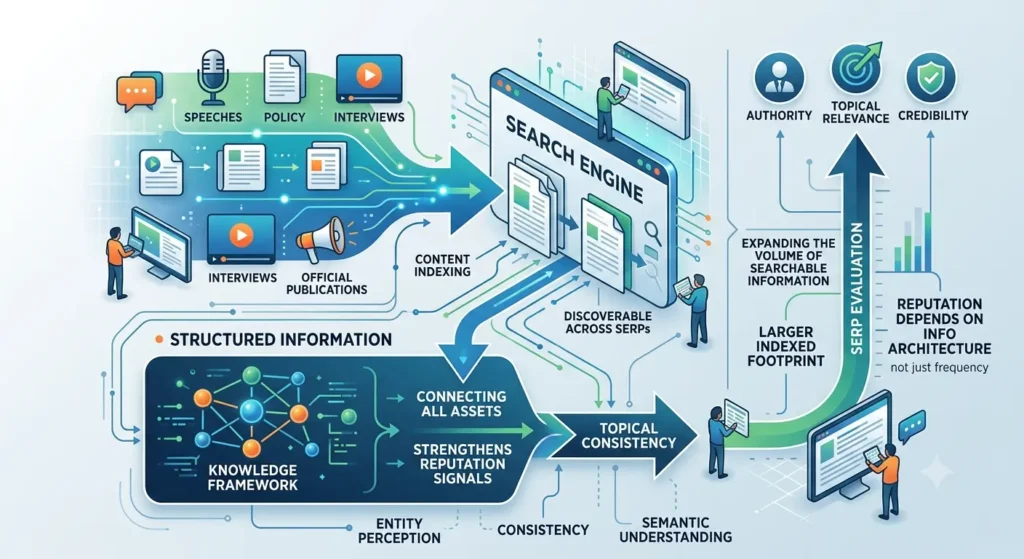
Digital-first campaigning places online communication at the centre of political visibility. Search engines interpret consistent publication patterns as indicators of an active and well-defined entity within search ecosystems.
Content indexing allows campaign information to become discoverable across search engine results pages (SERPs). Every indexed page contributes additional context that strengthens or weakens entity perception depending on topical consistency. Structured information improves semantic understanding by connecting speeches, policy documents, interviews, and official publications into one recognisable knowledge framework. Consistency across these assets strengthens reputation signals because search algorithms detect stable entity relationships.
Digital-first communication also increases SERP evaluation by expanding the volume of searchable information. A larger indexed footprint provides search engines with greater evidence when determining authority, topical relevance, and credibility. Reputation therefore becomes increasingly dependent on information architecture rather than communication frequency alone.
Why does search visibility affect political perception?
Search visibility determines which political information users encounter first when searching for candidates, parties, policies, or election topics. Higher visibility increases exposure to specific reputation signals during information retrieval.
Search engines organise results according to relevance, authority, freshness, and semantic relationships. Pages occupying prominent positions receive greater user interaction, which reinforces their importance within search ecosystems. Political communication therefore extends beyond publishing information because ranking position influences perception before users evaluate individual content.
SERP evaluation combines multiple signals including topical authority, structured content, content quality, and user engagement patterns. Search engines interpret these signals collectively rather than independently. This integrated assessment explains why consistent information architecture contributes directly to entity credibility throughout election periods.
How does video content change political communication?
Video content has become a primary information format because search engines increasingly integrate multimedia into search results. Video expands digital footprint while providing additional indexed assets linked to political entities.
Search algorithms analyse video titles, transcripts, metadata, descriptions, captions, and surrounding contextual information to understand topical relevance. Accurate semantic optimisation improves indexing quality and strengthens entity associations across multiple search surfaces. This process creates stronger reputation signals because information exists in complementary formats instead of isolated webpages.
Video also influences perception by increasing content accessibility. Users frequently consume visual explanations before reading detailed documents, allowing multimedia assets to become significant contributors to online reputation. Search ecosystems therefore evaluate video alongside written content when determining authority and topical expertise.
Why are entity-based search systems becoming more important?
Entity-based search systems organise information around identifiable people, organisations, policies, locations, and events rather than individual keywords. Political communication increasingly depends on entity recognition instead of keyword repetition.
Search engines construct knowledge relationships by analysing consistent references across authoritative sources. These relationships define how an entity connects with policies, election issues, public statements, and historical records. Strong semantic consistency strengthens entity perception because algorithms recognise stable contextual associations.
Entity optimisation also improves information retrieval accuracy. When search engines confidently identify an entity, they present richer search results that include knowledge panels, related topics, news coverage, and contextual references. This broader representation influences reputation because users evaluate comprehensive search evidence rather than isolated webpages.
How does sentiment analysis influence online reputation?
Sentiment analysis evaluates the emotional and contextual language surrounding political entities across digital content. Search ecosystems interpret positive, neutral, and negative language patterns as supplementary reputation signals.
Natural language processing enables search algorithms to recognise recurring themes, contextual meanings, and opinion clusters. Sentiment itself does not directly determine rankings, but it contributes to broader entity evaluation by helping search systems interpret public discourse. Consistent language patterns provide contextual evidence that strengthens semantic understanding.
Online reputation develops through accumulated sentiment across indexed sources instead of isolated opinions. Search engines compare language consistency, source authority, publication quality, and contextual relevance before integrating sentiment into broader entity perception. This systematic interpretation improves search quality by reducing reliance on individual viewpoints.
What role does authoritative content play in political credibility?

Authoritative content defines expertise through factual consistency, semantic completeness, and reliable information architecture. Search engines evaluate authority using evidence derived from indexed content rather than promotional language.
Authority develops when publications consistently explain policies, governance topics, election procedures, legislative issues, and institutional information with semantic accuracy. Comprehensive topical coverage strengthens search visibility because algorithms identify subject depth through interconnected information. Every supporting article expands topical authority within the broader search ecosystem.
Content quality also improves reputation signals by reducing ambiguity. Clearly defined concepts, structured headings, relevant terminology, and logical topic relationships enable search engines to understand information efficiently. Better understanding contributes directly to improved entity perception across search results.
How do social media discussions affect search ecosystems?
Social media discussions generate additional reputation signals by expanding the quantity and diversity of indexed references associated with political entities. Public conversations contribute contextual information that search engines analyse alongside traditional webpages.
Search ecosystems evaluate publicly accessible discussions through entity references, engagement patterns, publication frequency, and topical relationships. Consistent discussions strengthen entity recognition because repeated contextual associations reinforce semantic understanding. Inconsistent messaging creates fragmented information that weakens search interpretation.
Social platforms also accelerate information discovery. Newly published content spreads rapidly across multiple digital channels before becoming indexed by search engines. Faster information distribution influences search freshness, which forms one component of SERP evaluation during active election periods.
Why does misinformation alter reputation signals?
Misinformation introduces conflicting entity associations that reduce semantic clarity across search ecosystems. Search engines identify conflicting information through authority assessment, source evaluation, and contextual verification.
Content quality systems compare claims across multiple authoritative publications to establish informational consistency. Reliable sources strengthen verified entity relationships, while unsupported content reduces confidence in associated information. Reputation signals therefore depend upon the consistency and credibility of indexed evidence rather than publication volume alone.
Search engines continuously refine ranking systems to prioritise trustworthy information. This process improves search quality by reducing the visibility of unsupported claims and strengthening authoritative semantic relationships. Entity perception consequently becomes more stable when reliable information dominates indexed content.
How does artificial intelligence influence political communication?
Artificial intelligence improves content organisation, information classification, and semantic interpretation across digital search environments. AI systems analyse relationships between topics, entities, and contextual meanings with increasing precision.
Machine learning models evaluate content relevance through language patterns, topical depth, structured data, and contextual consistency. These systems improve content indexing by recognising semantic relationships beyond exact keyword matching. Political communication therefore relies increasingly on concept completeness rather than repetitive optimisation techniques.
Artificial intelligence also enhances SERP evaluation by identifying authoritative information structures. Well-organised content provides clearer entity definitions, improving search visibility through stronger semantic signals. Reputation becomes increasingly connected to information quality rather than publication quantity.
How do authority and trust signals strengthen political reputation?
Authority and trust signals define the credibility of digital information within search ecosystems. Search engines evaluate these signals collectively to determine which sources provide reliable and comprehensive information.
Trust develops through factual consistency, transparent publication practices, structured content, semantic relevance, and recognised expertise. Authority develops through sustained topical depth supported by interconnected content covering related political subjects. These combined signals improve entity perception because search algorithms detect stable informational quality across indexed assets.
Search visibility increases when trust signals reinforce semantic consistency. Search engines reward information that demonstrates expertise through comprehensive topic coverage instead of fragmented publications. The resulting reputation reflects accumulated evidence rather than isolated content performance.
How does a digital footprint shape election visibility?
A digital footprint represents the complete collection of searchable information associated with a political entity. Every indexed webpage, interview, document, social profile, media reference, and multimedia asset contributes to this searchable identity.
Search engines continuously update digital footprints through crawling and content indexing. Newly discovered information expands entity relationships while reinforcing existing semantic connections. A structured digital footprint improves search interpretation because related content consistently supports the same entity definition.
Digital footprints also influence long-term reputation. Historical publications remain searchable alongside current election content, allowing search algorithms to evaluate continuity across extended periods. This accumulated information strengthens entity understanding through persistent contextual evidence rather than temporary communication campaigns.
Which political communication trends should campaign teams prioritise?
Campaign teams benefit from prioritising communication trends that strengthen semantic clarity, search visibility, and reputation signals across digital ecosystems. Information quality consistently produces stronger search interpretation than communication volume.
- Develop structured content by organising policy information into clearly defined topics that improve content indexing and semantic relevance.
- Maintain entity consistency by using stable terminology, factual accuracy, and interconnected information that strengthens entity perception across search systems.
- Expand multimedia assets by publishing searchable videos, transcripts, and supporting documents that reinforce topical authority through multiple indexed formats.
- Strengthen authority signals by publishing comprehensive explanations that demonstrate expertise through semantic completeness rather than repetitive messaging.
- Monitor reputation signals by analysing indexed content, search visibility, sentiment interpretation, and SERP evaluation to maintain consistent digital credibility.
These priorities improve information architecture while helping search engines interpret political entities with greater semantic confidence. Strong entity definition contributes directly to more accurate search representation throughout election periods.
Dive Deeper With Our Expert Guides:
The Role of Social Media in Political Reputation Formation
9 Online Sources Voters Use to Research Politicians
Political communication trends affecting elections this year demonstrate that reputation is increasingly defined through digital information systems rather than individual communication channels. Search engines evaluate entity perception using content indexing, semantic relationships, authority signals, trust indicators, sentiment interpretation, and digital footprint analysis.
Understanding these mechanisms explains how political information gains visibility, how credibility develops within search ecosystems, and how search engine results influence public perception. Reputation emerges from the combined effect of structured information, semantic consistency, authoritative content, and comprehensive entity relationships across indexed digital environments.
Answers to Key Questions
What is reputation management for politicians?
Reputation management for politicians is the process of monitoring, analysing, and improving how political figures are perceived across search engines, news coverage, and digital platforms. It focuses on maintaining accurate information and strengthening online credibility.
Why is online reputation important for politicians?
Online reputation influences how voters, journalists, and stakeholders interpret publicly available information. Strong reputation signals and accurate search results help present a clear and consistent digital presence.
How do search engines affect a politician’s reputation?
Search engines rank content based on relevance, authority, and credibility. News articles, official statements, social media profiles, and other indexed content all contribute to how a politician is perceived in search results.
Can negative online content impact political reputation?
Yes, prominent negative content can shape public perception when it appears in search engine results. Reputation management for politicians focuses on monitoring reputation signals and ensuring accurate, authoritative content remains visible.