

Reputation management is the process of defining, analysing, and maintaining how an entity is interpreted across search ecosystems through indexed content, review signals, and digital references.
Online reputation refers to the collection of information, opinions, structured data, and content that search engines and users evaluate to determine credibility, authority, and trust.
A business reputation is no longer defined by a single website or customer opinion. Search engines aggregate information from review platforms, social profiles, news publications, business directories, and indexed web pages to construct an entity profile. Every indexed source contributes reputation signals that influence both search visibility and public perception. Understanding how these systems organise and evaluate information explains why reputational changes appear gradually rather than instantly.
Google, Facebook, and independent review websites each contribute distinct reputation signals. Search engines interpret these sources differently because each platform contains unique forms of structured and unstructured content. Reviews, user-generated content, business information consistency, and external references collectively shape how algorithms evaluate trustworthiness. Rather than functioning independently, these systems create interconnected digital evidence that influences overall entity perception.
What is business reputation in search ecosystems?
Business reputation is the measurable perception of an organisation created through indexed information, review content, authority signals, and user interactions across digital platforms.
Search engines interpret reputation as an accumulated collection of evidence rather than a single metric. Every indexed document contributes semantic relationships that define an entity’s credibility. Review platforms, knowledge panels, websites, business listings, and media references collectively establish searchable identity. Algorithms evaluate consistency between these sources before determining trust signals. This process creates a reputation profile that evolves continuously as new information enters search indexes.
Reputation also refers to the relationship between content quality and user interpretation. Search systems analyse textual relevance, source authority, structured data, freshness, and engagement signals. These factors influence how prominently information appears within search visibility. A consistent reputation profile strengthens entity recognition because algorithms identify recurring relationships across trusted sources. The result is improved contextual understanding rather than simple keyword association.
How do Google, Facebook, and review sites shape online reputation?
Google, Facebook, and review platforms shape online reputation by publishing different categories of indexed information that contribute independent reputation signals.
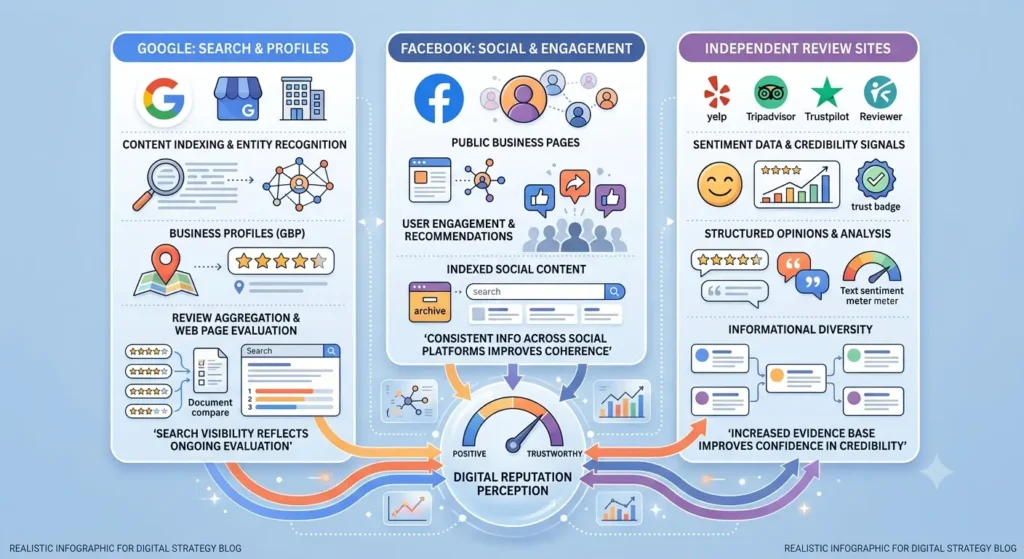
Google primarily organises information through content indexing, entity recognition, business profiles, review aggregation, and web page evaluation. Search algorithms compare multiple documents to determine factual consistency and authority. Structured business information strengthens entity associations, while inconsistent information weakens semantic confidence. Search visibility reflects this ongoing evaluation rather than isolated content performance.
Facebook contributes reputation through publicly accessible business information, user engagement, recommendations, and indexed content. Although not every interaction becomes searchable, public pages create additional entity references. Search engines interpret these references as supporting contextual evidence when evaluating overall entity perception. Consistent business information across social platforms improves digital coherence because algorithms identify matching organisational attributes.
Independent review websites contribute sentiment data and credibility signals. Reviews provide structured opinions that algorithms interpret using sentiment analysis, textual relevance, reviewer authenticity, and content quality. Multiple review platforms increase informational diversity, allowing search systems to compare independent references. This broader evidence base improves confidence when evaluating business credibility within search ecosystems.
How is a business reputation formed online?
A business reputation is formed through continuous content creation, indexing, interpretation, and evaluation across interconnected digital platforms.
Every published page, customer review, directory listing, social profile, image, video, and citation becomes potential indexed information. Search engines discover this content through crawling before evaluating semantic relevance and authority. Content relationships define entity understanding because algorithms connect identical business identifiers across multiple sources. Reputation therefore develops from cumulative digital evidence rather than isolated publications.
Content freshness also influences reputation formation. Recently indexed information provides updated context that complements historical references. Search engines continuously reassess entity relationships as new documents enter the index. Reputation therefore represents an evolving knowledge structure that reflects current digital evidence instead of permanent historical snapshots.
Digital footprints strengthen this process because each indexed asset expands searchable identity. A complete digital footprint contains business information, customer interactions, editorial references, multimedia assets, structured data, and review content. Together these elements define the semantic boundaries of an entity within search ecosystems.
Why do review signals influence search visibility?
Review signals influence search visibility because they provide structured evidence about quality, trust, credibility, and user satisfaction.
Search engines analyse reviews beyond numerical ratings. Algorithms interpret review frequency, linguistic relevance, reviewer diversity, recency, authenticity, and topical consistency. These signals contribute additional semantic information about an entity. Positive and negative sentiment both become searchable evidence because indexing focuses on informational completeness rather than emotional preference.
Review consistency strengthens entity confidence. Similar themes appearing across independent platforms demonstrate stable informational patterns. Contradictory reviews create broader sentiment variation, requiring algorithms to evaluate credibility through source authority and reviewer behaviour. Search systems therefore interpret reviews as contextual evidence instead of isolated opinions.
Review content also expands searchable vocabulary. Customers naturally describe products, services, locations, and experiences using diverse terminology. These descriptions increase semantic relevance because they introduce additional entity associations recognised by search engines. Consequently, review ecosystems influence both perception and discoverability simultaneously.
How do search engines evaluate trust and credibility?
Search engines evaluate trust and credibility by comparing authority signals, content consistency, entity relationships, and information quality across indexed sources.
Authority refers to the reliability of information based on recognised sources, structured references, and established entity associations. Algorithms compare websites, directories, reviews, media publications, and structured business data to identify consistent factual relationships. Strong alignment strengthens confidence because identical information appears across trusted environments.
Credibility also depends on content quality. Search systems evaluate originality, informational completeness, topical relevance, and semantic accuracy. Duplicate, conflicting, or incomplete information reduces contextual clarity because entity relationships become less reliable. High-quality information improves interpretation by defining precise organisational identity.
Trust emerges from accumulated evidence rather than individual documents. Search ecosystems continuously update entity understanding as additional content becomes available. Reputation therefore reflects ongoing algorithmic evaluation instead of permanent classification.
What role does content play in reputation management?
Content defines reputation by creating searchable evidence that explains an entity, establishes topical authority, and strengthens semantic relationships.

Every indexed page contributes information that search engines interpret within broader knowledge networks. Educational resources, factual business information, editorial publications, multimedia assets, and structured documents collectively define entity perception. Content therefore functions as searchable evidence instead of promotional material.
Content quality influences indexing efficiency. Clear information architecture, semantic relevance, structured headings, and topical completeness improve contextual understanding. Algorithms identify relationships between documents more effectively when information follows logical topical structures. This improves search visibility because search engines recognise stronger subject expertise.
Reputation management for business represents one example of terminology that naturally connects discussions about content quality, trust evaluation, and entity development within search ecosystems.
How does sentiment analysis affect online reputation?
Sentiment analysis evaluates the emotional and contextual meaning of published content to identify positive, neutral, and negative reputation signals.
Search engines use natural language processing to interpret review language, comments, editorial references, and public discussions. Algorithms identify recurring expressions that describe reliability, quality, responsiveness, or credibility. These patterns contribute semantic context that extends beyond numerical ratings.
Sentiment interpretation also depends on linguistic consistency. Repeated descriptive themes strengthen algorithmic confidence because identical concepts appear across independent sources. Mixed sentiment produces balanced evaluation rather than automatic negative classification. Search systems analyse the overall informational landscape before determining entity perception.
Sentiment therefore functions as contextual evidence rather than direct ranking input. Its primary contribution lies in improving algorithmic understanding of public perception across interconnected information sources.
What factors influence business reputation across review platforms?
Business reputation across review platforms depends on measurable reputation signals that search ecosystems interpret collectively.
- Maintain information consistency by presenting identical business names, addresses, and contact details across platforms. This improves entity matching during content indexing.
- Publish complete business profiles because structured information increases semantic understanding through clearly defined organisational attributes.
- Generate authentic customer feedback over time. Natural review frequency creates reliable sentiment datasets that strengthen reputation signals.
- Update factual information regularly so search engines recognise current entity relationships through refreshed indexed content.
- Strengthen authoritative references by ensuring external sources accurately describe the organisation using consistent terminology and structured information.
These factors operate collectively because search engines compare multiple evidence sources before evaluating credibility. Reputation therefore reflects cumulative informational quality instead of isolated platform performance.
Why does a digital footprint determine long-term reputation?
A digital footprint determines long-term reputation because it represents the complete indexed history associated with an entity across search ecosystems.
Digital footprints include websites, reviews, business directories, news references, images, documents, videos, social profiles, and archived pages. Search engines connect these assets through entity recognition systems that identify recurring organisational attributes. Larger, more consistent footprints improve semantic certainty because algorithms detect stronger informational relationships.
Historical information remains relevant after publication because indexed documents continue contributing contextual evidence. New information complements existing references rather than replacing them entirely. Reputation therefore develops through continuous accumulation of searchable content instead of isolated updates.
Entity perception becomes more stable as digital footprints expand. Consistent informational patterns strengthen algorithmic confidence, enabling search engines to interpret organisational identity with greater precision across changing search environments.
Dive Deeper With Our Expert Guides:
How to Get More Positive Reviews for Your Business
Online Reputation Management for Small Businesses Made Simple
Business reputation within search ecosystems is defined by indexed information, review signals, authority indicators, and entity relationships rather than isolated opinions. Google, Facebook, and independent review platforms each contribute distinct evidence that search engines evaluate through semantic analysis, content indexing, and trust assessment. Review sentiment, digital footprints, structured information, and authoritative references collectively shape search visibility and online credibility. Understanding these interconnected mechanisms explains how reputation develops, evolves, and remains measurable across modern search environments.
Answers to Key Questions
What is reputation management for business?
Reputation management for business is the process of monitoring, analysing, and improving how a business is perceived across search engines, review platforms, and social media. It focuses on online reputation, search visibility, and digital trust through accurate and credible information.
How do Google reviews affect a business reputation?
Google reviews influence business reputation by providing trust signals that search engines and potential customers evaluate. Review quality, recency, and authenticity contribute to online credibility and local search visibility.
Can negative reviews impact search visibility?
Negative reviews contribute to overall reputation signals, but search engines evaluate review patterns, authenticity, and content quality rather than isolated comments. Consistent positive engagement and accurate business information strengthen long-term search perception.
Why is online reputation important for businesses?
Online reputation determines how a business is perceived through search results, review sites, and digital content. A strong reputation improves credibility, supports entity recognition, and enhances trust across search ecosystems.