

Getting more positive Google reviews depends on creating a consistent review collection process that encourages genuine customer feedback through ethical and transparent methods. Positive reviews strengthen online credibility, improve search visibility, and contribute to stronger reputation signals within search ecosystems.
Reputation management is the structured process of monitoring, analysing, and influencing how an entity is interpreted across digital platforms. Online reputation refers to the collection of content, reviews, mentions, and engagement signals that search engines evaluate when determining credibility, authority, and relevance.
Why do Google reviews matter for online reputation?
Google reviews are structured reputation signals that help search engines evaluate the credibility and trustworthiness of a business. They contribute to the broader digital footprint by providing indexed user-generated content that search algorithms interpret alongside website content, business information, and external references. Every published review becomes part of the information ecosystem surrounding an entity, creating additional context that supports entity perception.
Search engines analyse reviews beyond numerical ratings. They evaluate language, sentiment, topical relevance, freshness, consistency, and user engagement to understand public perception. These signals influence SERP evaluation because search algorithms prioritise content that demonstrates authenticity and satisfies user intent. Reviews therefore function as both information assets and trust indicators within search ecosystems.
How are positive Google reviews created naturally?
Positive Google reviews are generated through authentic customer experiences followed by structured opportunities for customers to share feedback. Review quality depends on genuine satisfaction rather than artificial incentives or manipulated content. Search engines recognise naturally occurring review patterns because authentic feedback develops over time and reflects diverse language, experiences, and perspectives.
A consistent review acquisition process produces stable reputation signals. Businesses that maintain accurate information, deliver predictable customer experiences, and provide simple review access accumulate content that strengthens online credibility. Search algorithms interpret this consistency as evidence of reliability because recurring positive sentiment demonstrates ongoing customer satisfaction rather than isolated activity.
Which actions support natural review growth?
- Request feedback after a completed customer interaction to create a logical review opportunity that reflects a recent experience.
- Simplify access by providing a direct review link that reduces unnecessary navigation and increases genuine participation.
- Maintain consistency across customer interactions so review sentiment reflects repeated service quality rather than isolated events.
- Respond professionally to published reviews because visible engagement contributes additional trust signals and demonstrates active reputation management.
How do search engines interpret Google review signals?
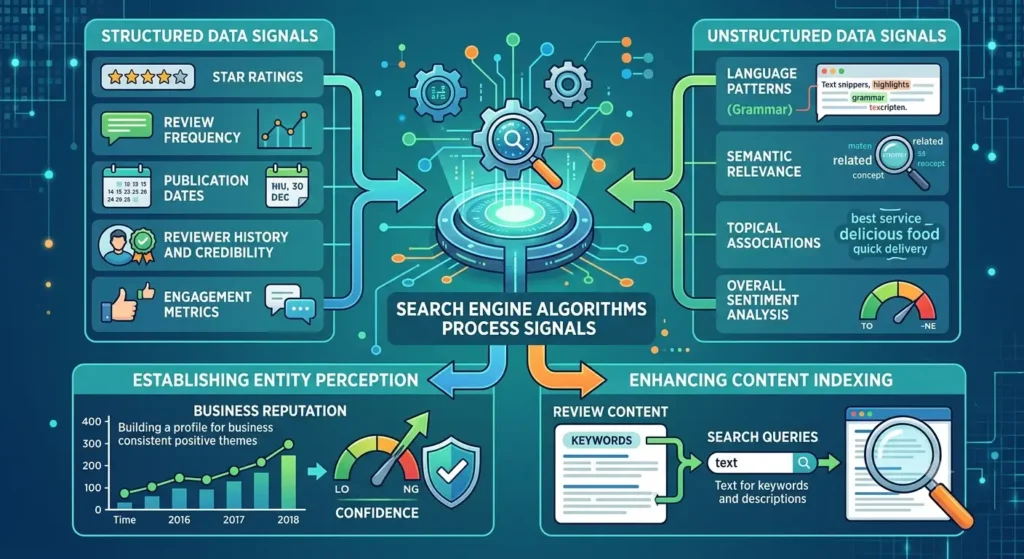
Search engines interpret Google reviews by analysing structured and unstructured information contained within review content. Structured information includes ratings, review frequency, publication dates, reviewer history, and engagement metrics. Unstructured information includes language patterns, semantic relevance, topical associations, and overall sentiment. Together, these elements create measurable reputation signals that influence search visibility.
Entity perception develops through repeated evaluation of these signals. When reviews consistently describe similar qualities using relevant terminology, search algorithms establish stronger confidence in the entity’s characteristics. This process supports content indexing because review content reinforces topical relationships between the business, its products or services, and the search queries users enter.
What reputation signals do search engines evaluate?
- Analyse review freshness because recently indexed content reflects current public perception and improves information accuracy.
- Measure sentiment consistency by comparing positive, neutral, and negative language across the complete review profile.
- Evaluate topical relevance through recurring keywords and semantic relationships that strengthen entity understanding.
- Assess reviewer authenticity using behavioural patterns that distinguish genuine user activity from manipulated submissions.
- Compare rating distribution across time to identify natural reputation development instead of sudden abnormal changes.
What factors influence the quality of Google reviews?
Review quality refers to the informational value contained within customer feedback. High-quality reviews describe specific experiences, relevant details, and clear observations that provide useful information for both users and search engines. Detailed reviews increase semantic depth because they expand the searchable context surrounding an entity.
Search algorithms favour informative content because it improves search result relevance. Reviews containing descriptive language, natural keywords, and contextual explanations strengthen content indexing by increasing the number of meaningful associations connected to a business profile. This process supports more accurate SERP evaluation while reinforcing digital trust through transparent user-generated information.
Short reviews containing only generic praise contribute limited semantic information. In contrast, reviews explaining product quality, customer support, response time, or service outcomes create stronger topical relationships that search engines can classify with greater precision.
How does review frequency affect search visibility?
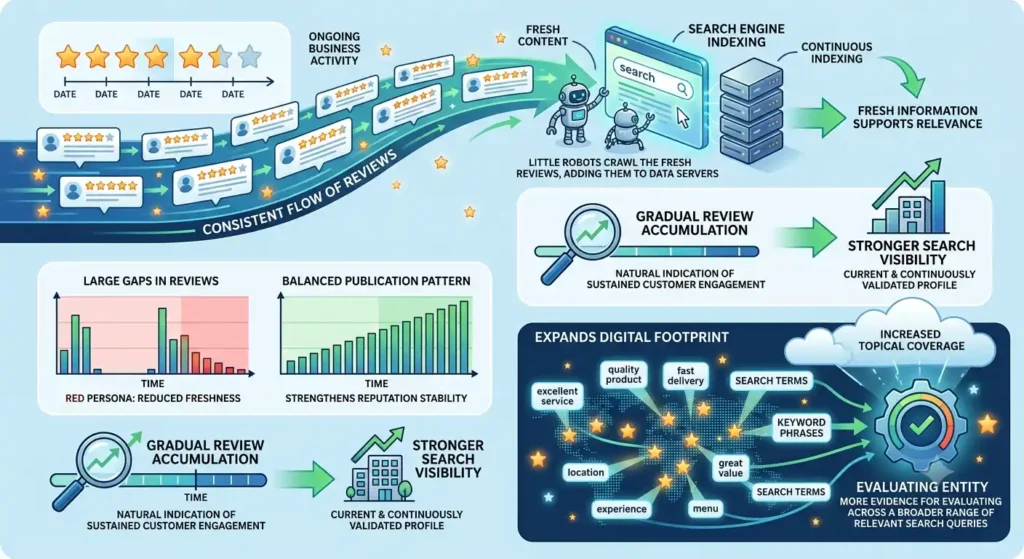
Review frequency refers to the regular publication of new customer feedback over time. A consistent flow of reviews demonstrates ongoing business activity and provides search engines with fresh content for continuous indexing. Fresh information supports relevance because search ecosystems prioritise recently updated signals when evaluating entity credibility.
Large gaps between reviews reduce content freshness, while a balanced publication pattern strengthens reputation stability. Search engines interpret gradual review accumulation as a natural indication of sustained customer engagement rather than artificial activity. This contributes to stronger search visibility because the reputation profile remains current and continuously validated through new information.
Dive Deeper With Our Expert Guides:
How to Manage Customer Reviews and Improve Your Online Image
Fix Bad Reviews on Google, Yelp, and Facebook Step by Step
Review frequency also expands the digital footprint. Every additional review introduces new language, new search terms, and additional semantic relationships that increase topical coverage. As indexed content grows, search algorithms gain more evidence for evaluating the entity across a broader range of relevant search queries.
Can responding to Google reviews improve online credibility?
Responding to Google reviews strengthens online credibility by expanding publicly available reputation information. Responses demonstrate that customer feedback becomes part of an active communication process rather than static content. Search engines index these interactions as additional textual information that contributes to the entity’s digital footprint.
Professional responses reinforce trust signals because they provide transparency, consistency, and accountability. Responses to positive reviews confirm appreciation for customer engagement, while responses to negative reviews demonstrate structured issue management without altering the original review content. This balanced communication supports stronger entity perception because users and search algorithms evaluate both customer opinions and organisational responses together.
What makes review responses valuable?
- Acknowledge feedback to demonstrate active engagement with customer-generated content.
- Address concerns using factual language that maintains transparency within the public record.
- Maintain consistency across responses so communication reflects stable organisational standards.
- Expand topical relevance by naturally referencing the reviewed experience without repeating promotional language.
Answers to Key Questions
How does Google Reviews management improve online reputation?
Google Reviews management helps maintain an accurate and trustworthy review profile by monitoring, responding to, and encouraging genuine customer feedback. A well-managed review profile strengthens online reputation, trust signals, and search visibility.
How can I get more positive Google reviews for my business?
The most effective approach is to ask satisfied customers for honest feedback after completing a transaction or service. Consistent review requests and excellent customer experiences naturally increase positive Google reviews over time.
Do Google reviews affect local search rankings?
Yes, Google reviews contribute to local SEO by providing reputation signals that search engines use to evaluate credibility and relevance. Review quality, freshness, quantity, and overall sentiment all influence local search visibility.
Why is responding to Google reviews important?
Responding to Google reviews demonstrates active engagement and helps build trust with both customers and search engines. Professional responses also support a stronger online reputation by showing transparency and accountability.