
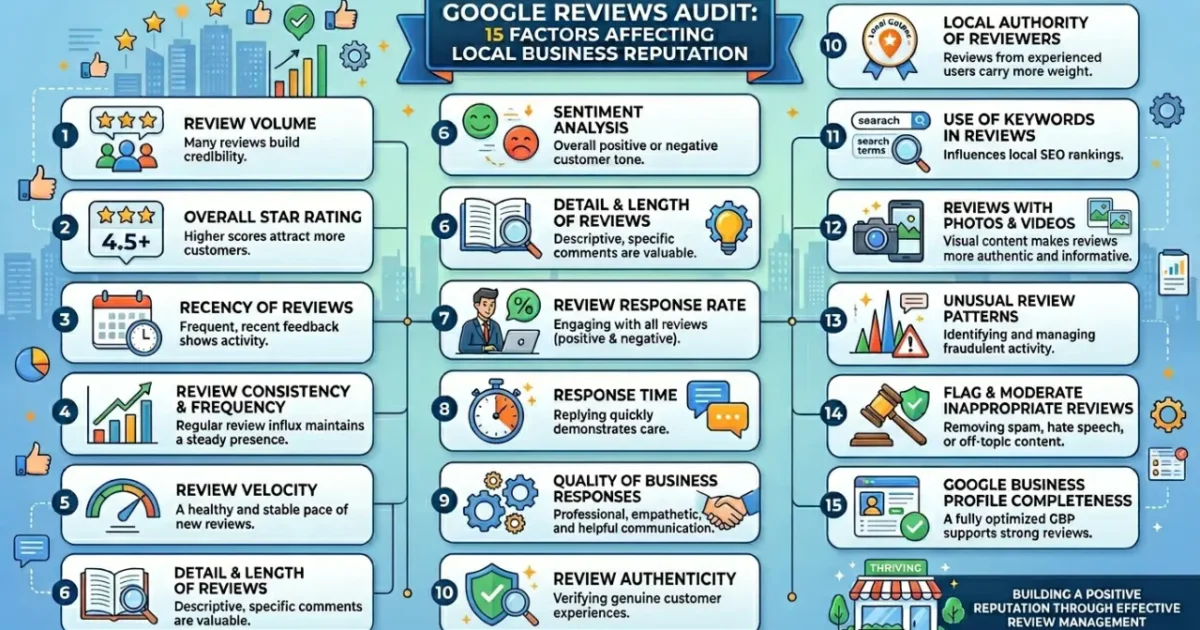
Google Reviews audits evaluate how review-related reputation signals influence local search visibility, customer trust, and perception. A structured audit measures review quality, sentiment distribution, response behaviour, and credibility indicators that contribute to local reputation performance.
Reputation management strategies differ based on how review signals are generated, interpreted, and displayed across search ecosystems. Online reputation control methods are evaluated through their impact on entity credibility, search ranking influence, trust signals, and long-term sentiment distribution.
How does review volume compare with review quality in reputation assessment?
Review volume is a quantitative reputation signal, while review quality is a qualitative reputation signal. Review volume measures the total number of reviews associated with a business entity. Review quality evaluates the depth, specificity, and informational value of review content.
Search engines analyse both factors simultaneously. A high review count strengthens entity recognition and market presence signals. Detailed reviews containing service descriptions, contextual information, and authentic experiences contribute stronger credibility indicators.
The limitation of volume-focused reputation growth is that numerical expansion alone does not improve sentiment understanding. Quality-focused review profiles provide richer contextual signals but require consistent customer participation. A balanced profile combines sufficient review volume with detailed sentiment-rich content that supports search interpretation.
How does review recency compare with historical review accumulation?
Review recency evaluates how recently customers have submitted reviews. Historical accumulation measures the long-term collection of review signals across time.
Recent reviews operate as freshness indicators. Search ecosystems interpret active review generation as evidence of ongoing customer interaction. Historical reviews establish stability and reputation continuity.
A profile dominated by old reviews reflects historical performance but provides limited insight into current customer experience. A profile consisting exclusively of recent reviews lacks long-term reputation validation. Effective reputation assessment analyses both dimensions to measure sustainability and current market perception.
How does average rating compare with sentiment distribution?
Average rating is an aggregated numerical score. Sentiment distribution analyses the proportion of positive, neutral, and negative feedback across review content.
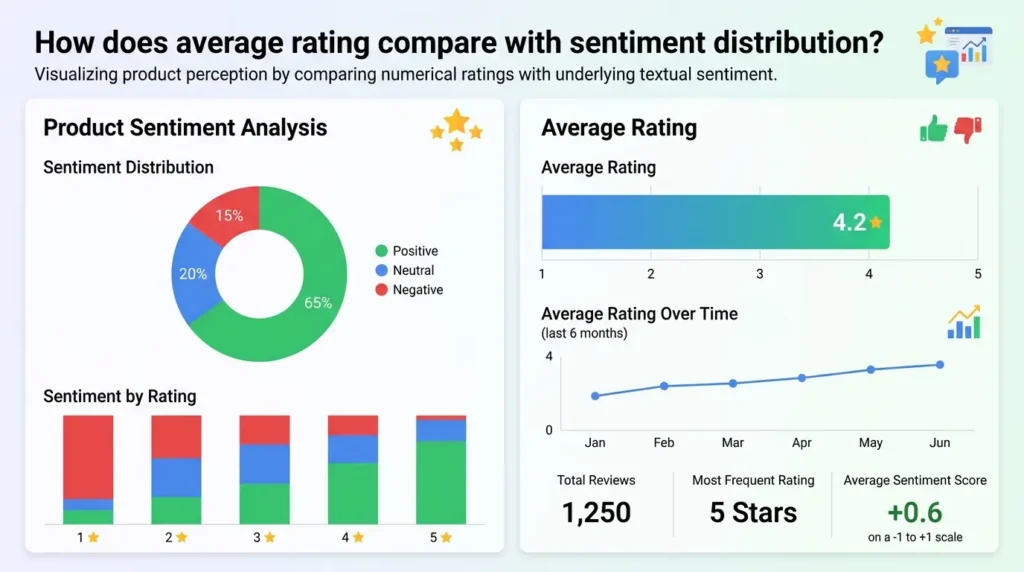
A high rating creates an immediate trust signal. Sentiment distribution provides deeper insight into operational strengths and weaknesses. Search engines increasingly interpret textual sentiment alongside star ratings to understand customer experiences.
Rating-focused analysis overlooks recurring themes hidden within reviews. Sentiment-focused analysis identifies patterns affecting reputation stability. Comparing both factors reveals whether positive scores align with actual customer feedback themes.
How does reviewer credibility influence reputation signals?
Reviewer credibility measures the authenticity and trustworthiness of review contributors. It operates by evaluating user activity patterns, review history, profile consistency, and behavioural legitimacy.
Authentic reviewers strengthen entity credibility because their content provides reliable reputation signals. Search ecosystems analyse contributor behaviour to identify unusual activity and potential manipulation.
Low-credibility reviews weaken trust indicators and increase risk exposure. High-credibility review sources improve confidence in sentiment accuracy. Reputation audits evaluate reviewer authenticity to determine the reliability of overall reputation metrics.
How does review response management compare with non-response strategies?
Review response management is the process of publicly engaging with customer feedback. Non-response strategies leave reviews without business interaction.
Responses operate by creating additional reputation signals visible to customers and search systems. Engagement demonstrates active management of customer sentiment and operational transparency.
Non-response preserves resources but reduces opportunities to contextualise negative feedback. Response management increases visibility into issue resolution processes. Comparative analysis shows that engagement contributes additional trust signals while revealing organisational responsiveness.
How do positive reviews compare with negative reviews in search perception analysis?
Positive reviews reinforce trust signals and strengthen favourable sentiment distribution. Negative reviews highlight dissatisfaction indicators and operational concerns.
Search ecosystems interpret both categories as informational signals rather than isolated reputation outcomes. Positive reviews improve perception efficiency and credibility. Negative reviews reveal areas requiring evaluation and often influence customer decision-making behaviour more heavily.
An exclusively positive profile can trigger authenticity concerns if sentiment diversity is absent. A balanced profile containing genuine mixed sentiment appears more representative of real customer experiences. Reputation analysis therefore evaluates sentiment composition rather than positive review quantity alone.
How does review consistency compare with reputation spikes?
Review consistency measures stable review acquisition across time. Reputation spikes occur when reviews appear in concentrated periods.
Consistent activity operates as a reliability signal. It demonstrates continuous customer interaction and stable business performance. Search ecosystems often interpret steady review patterns as indicators of authentic engagement.
Review spikes generate visibility but also attract scrutiny regarding legitimacy and review generation methods. Consistency provides stronger long-term reputation sustainability. Comparative evaluation favours predictable sentiment growth over isolated review surges.
How does review content depth compare with short-form feedback?
Content depth evaluates informational richness within reviews. Short-form feedback consists of limited comments or rating-only submissions.
Detailed reviews provide context regarding products, services, customer interactions, and outcomes. Search engines extract semantic information from detailed content to strengthen entity understanding.
Short-form reviews contribute numerical sentiment but provide limited contextual evidence. Deep review content improves reputation signal interpretation and supports perception analysis. Audits measure review richness to determine how effectively customer experiences are communicated.
How does keyword relevance affect local reputation visibility?
Keyword relevance measures the alignment between review language and business-related search topics. It operates through semantic associations identified within review content.
When customers naturally reference products, services, locations, or business attributes, reviews contribute contextual relevance signals. These signals support search ecosystem understanding of business specialisation.
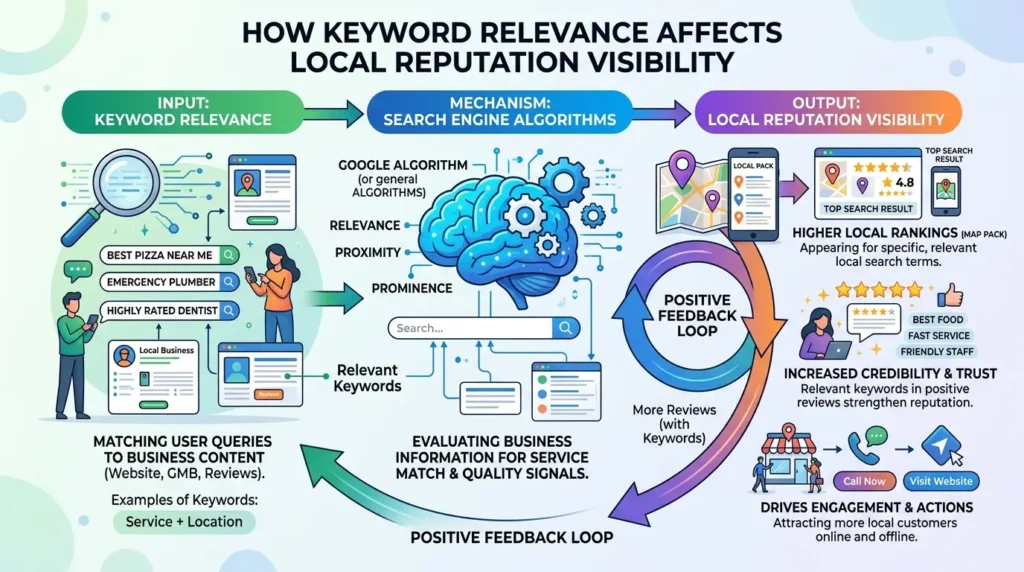
Keyword-focused evaluation differs from rating analysis because it measures topical relevance rather than sentiment. Reviews containing clear contextual language improve entity association while enhancing informational depth within search environments.
How does location relevance compare with general reputation signals?
Location relevance evaluates geographic references contained within reviews. General reputation signals assess overall sentiment without geographical context.
Local search ecosystems rely heavily on location-specific information to determine relevance for nearby searches. Reviews mentioning service areas, local experiences, and geographic identifiers strengthen local entity associations.
General reputation indicators influence trust perception broadly. Location-specific references improve local visibility interpretation. Reputation audits therefore compare both categories to understand local search effectiveness.
How does review authenticity compare with review manipulation risks?
Review authenticity measures whether feedback originates from genuine customer experiences. Review manipulation refers to artificial attempts to influence reputation metrics.
Authentic reviews strengthen credibility and improve sentiment reliability. Manipulative practices distort reputation signals and reduce confidence in performance measurements.
Search ecosystems continuously analyse behavioural patterns to identify suspicious review activity. Manipulation introduces significant risk exposure because detection affects trust indicators and reputation integrity. Authentic review generation provides sustainable reputation development compared with artificial reputation inflation.
How does issue resolution visibility compare with unresolved complaint exposure?
Issue resolution visibility reflects how customer concerns are addressed publicly. Unresolved complaint exposure measures the presence of visible dissatisfaction without corrective action.
Resolution-focused engagement transforms negative sentiment into evidence of operational responsiveness. Customers evaluate both the complaint and the response when forming trust assessments.
Unresolved complaints create persistent negative perception signals. Visible resolution efforts improve transparency indicators and demonstrate accountability. Reputation audits analyse complaint management patterns to evaluate risk containment effectiveness.
How does review platform diversity compare with dependence on a single platform?
Platform diversity evaluates reputation signals across multiple review environments. Single-platform dependence concentrates reputation influence within one ecosystem.
Google Reviews remain a dominant local reputation source, but diversified review ecosystems provide broader credibility validation. Cross-platform consistency strengthens entity credibility because sentiment patterns appear across multiple sources.
Dependence on one platform increases vulnerability to isolated reputation fluctuations. Platform diversity improves resilience and strengthens reputation verification mechanisms. Comparative evaluation measures consistency between sources to assess reputation stability.
How does customer engagement frequency affect reputation sustainability?
Customer engagement frequency measures the rate at which customers interact through reviews, ratings, and feedback mechanisms. Reputation sustainability evaluates long-term trust maintenance.
Frequent engagement creates ongoing reputation signals that reflect current customer experiences. Search ecosystems interpret active interaction as evidence of operational continuity.
Low engagement weakens freshness indicators and limits sentiment evolution. Continuous engagement improves review recency, content diversity, and perception accuracy. Sustainability therefore depends on maintaining consistent customer participation rather than isolated feedback campaigns.
How does audit-based monitoring compare with reactive reputation management?
Audit-based monitoring is a proactive evaluation framework. Reactive reputation management responds after negative signals become visible.
Audit processes identify sentiment trends, credibility issues, review gaps, and perception risks before they affect broader reputation performance. Reactive approaches focus on damage control after visibility declines or trust concerns emerge.
Proactive monitoring improves scalability because reputation signals are measured continuously. Reactive management addresses immediate issues but often operates after perception impacts occur. Comparative analysis demonstrates that ongoing measurement provides stronger visibility into reputation dynamics and risk exposure.
What evaluation framework helps analyse all 15 Google Reviews reputation factors?
A structured audit framework measures reputation performance through interconnected signals rather than isolated metrics.
- Assess review volume to measure market participation signals.
- Analyse review quality to evaluate informational depth and credibility.
- Measure recency to identify freshness indicators.
- Evaluate sentiment distribution to understand perception patterns.
- Verify reviewer authenticity to strengthen trust assessment.
- Examine response behaviour to analyse engagement transparency.
- Compare rating trends against review narratives.
- Monitor consistency to detect abnormal reputation fluctuations.
- Review keyword relevance to measure topical associations.
- Analyse location references to evaluate local search relevance.
- Detect manipulation indicators to assess risk exposure.
- Measure complaint resolution visibility to evaluate accountability.
- Compare platform consistency to validate reputation stability.
- Track engagement frequency to analyse sustainability.
- Conduct recurring audits to monitor perception evolution.
This framework evaluates reputation as an interconnected ecosystem where trust signals, entity credibility, sentiment distribution, and search ranking influence operate together.
A Google Reviews audit evaluates reputation through a combination of quantitative and qualitative signals. Review volume, ratings, and recency provide measurable performance indicators, while sentiment distribution, reviewer credibility, and content depth explain how search ecosystems interpret trust and relevance.
The comparison between proactive and reactive approaches demonstrates significant differences in sustainability, risk exposure, and perception control. Consistent review acquisition, authentic engagement, transparent responses, and structured monitoring contribute distinct reputation signals that influence local search visibility and customer trust. Effective reputation evaluation therefore depends on analysing interconnected factors rather than relying on individual metrics, creating a more accurate understanding of local business reputation performance.
Why does my business have a 4.8-star rating but still get fewer customers than competitors?
Star ratings are only one part of local reputation. A Google Reviews audit also examines review recency, response quality, review volume, and customer sentiment to identify factors that may influence customer decisions and local search performance.
Can a few recent negative reviews outweigh hundreds of older positive reviews?
Yes. Recent reviews often have a stronger impact on customer perception because they reflect the current customer experience. A review audit helps identify whether recent feedback is creating trust issues despite a strong historical rating.
Why are customers mentioning the same complaint in multiple Google reviews?
Repeated complaints usually indicate an operational issue rather than isolated incidents. Identifying recurring themes during a Google Reviews audit can help businesses address root causes that affect reputation and customer satisfaction.
Does replying to Google reviews actually improve local business reputation?
Review responses demonstrate customer engagement and accountability. Consistent, professional replies can improve trust signals, show responsiveness, and provide valuable context for prospective customers reading reviews.
How can I tell if my Google reviews are hurting my local SEO rankings?
Signs include declining visibility in local search results, reduced customer engagement, and an increase in negative sentiment. A Google Reviews audit evaluates reputation factors that may be affecting local search performance and customer trust.