

An online reputation directly affects client acquisition, case referrals, and regulatory risk; firms with positive digital reputations generate more qualified leads, close a higher percentage of inquiries, and face fewer compliance complaints.
What impact does reputation have on a law firm’s client pipeline?
A visible, positive reputation increases client trust and raises conversion rates from enquiries to retained clients.
Searchers use reviews and profiles to shortlist lawyers. A single 4.5–5.0 star rating increases click-through rates by up to 25% for professional services on major platforms. Strong profiles shorten the decision cycle. Prospective clients assess credibility through testimonials, case summaries, and third-party endorsements. Referral sources, such as accountants and other lawyers, inspect online presence before sending high-value matters. Reputation signals also influence pricing power; firms with documented positive outcomes and consistent reviews command higher hourly rates or retainers. For transactional practices, positive digital reputation increases proposal acceptance rates by measurable percentages during procurement.
Read our articles, How Reputation Management Helps Lawyers Win More Clients and Protect Your Law Firm’s Reputation with Clear My Name.
How do negative reviews and content affect practice risk and compliance?
Negative content reduces enquiry volume and raises regulatory scrutiny when complaints are public; it also influences opposing counsel and judges in niche circumstances.
Public complaints on social sites and legal directories create persistent search results. When negative reviews accuse misconduct, regulators may review complaints and open investigations. Courts and opposing counsel sometimes consider online statements when assessing credibility in settlement or motion practice. Negative content also increases client churn; research in professional services shows firms that receive public complaints see a 15–30% drop in repeat business within 12 months. Removing or mitigating harmful content requires a mix of legal, technical, and communications steps: defamation analysis, takedown requests, algorithmic suppression, and proactive publishing of authoritative content.
What measurable KPIs link reputation management to business outcomes?
KPIs include enquiry volume, conversion rate, average case value, referral counts, review score averages, and negative-mention volume.
Track enquiries from organic search, referrals, and directory listings separately. Measure conversion rate from enquiry to retained client quarterly. Calculate average case value and compare cohorts before and after reputation interventions. Monitor review profiles on three primary platforms: Google Business Profile, LinkedIn, and industry-specific directories. Use sentiment analysis to count negative mentions across news and social media. Set targets such as raising average review rating to 4.6 within six months, reducing negative-mention volume by 60% in 90 days, or increasing organic enquiries by 20% year-over-year. These KPIs demonstrate direct ROI for reputation management for lawyers.
How do search engines and directories shape first impressions online?
Search engines and legal directories dominate first impressions because they aggregate reviews, credentials, and published content in a single, indexed view.
A branded search often shows a knowledge panel, local pack, and top-ranking directory entries. Google Business Profile listings display ratings, hours, and short posts that influence click decisions. Legal directories such as Avvo, Justia, and regional bar association pages appear on page one for many queries. These results determine the narrative potential clients encounter. Managing these entries ensures accurate firm name, practice areas, regulatory disclosures, and contact information. Firms that verify and update channel profiles reduce misinformation and improve the likelihood of capturing high-intent searchers.
What practical steps protect and improve a lawyer’s online reputation?
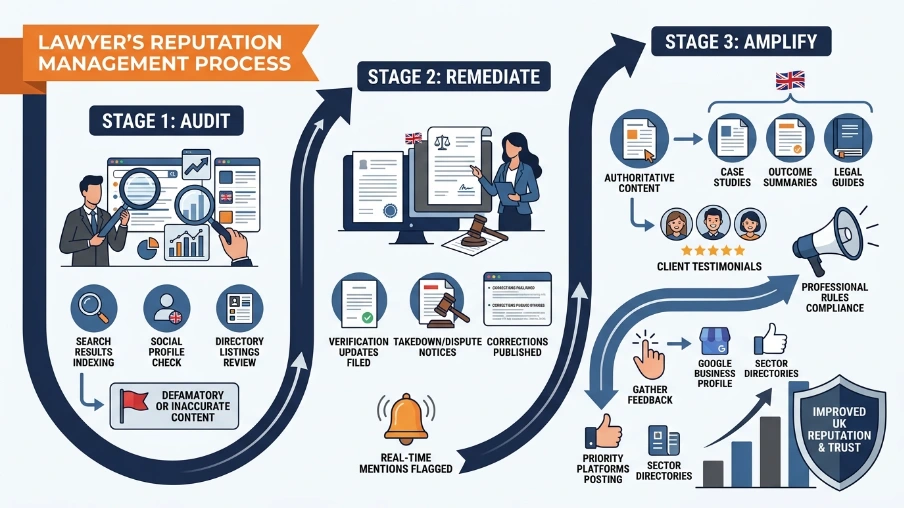
Implement a three-part process: audit, remediate, and amplify using legal-compliant content and review management.
Begin with a comprehensive audit that indexes search results, social profiles, and directory listings. Identify defamatory or inaccurate content for legal assessment. For remediation, file verification updates, submit formal takedown or dispute notices, and publish corrections with source citations where appropriate. Use reputation management tools to flag new mentions in real time. For amplification, publish authoritative content that demonstrates expertise: case studies, outcome summaries, legal guides, and client testimonials that comply with professional rules. Enforce an internal review collection process that requests feedback after matter closure and guides clients to post on priority platforms such as Google Business Profile and sector directories.
How should law firms handle review collection and response?
Collect reviews systematically and respond to every review promptly while complying with ethical rules governing client confidentiality.
Create a post-engagement workflow that invites reviews via secure links and standardised messaging. Use templated requests that avoid asking for outcome details or incentivising positive content. Respond to positive reviews with thanks and brief confirmation of service type. Respond to negative reviews with a professional acknowledgement and an offline invitation to discuss the matter. Redact client-identifying details in public replies to comply with confidentiality rules. Track response time and aim to reply within 48 hours. This approach improves average ratings and demonstrates active client care to prospective clients and referring professionals.
What role does content strategy play in reputation management?
Targeted content builds authority, controls narrative, and ranks for queries that clients use to evaluate firms.
Publish legal guides, FAQ pages, and outcome-focused case summaries that address common client concerns. Optimise pages for search intent—use question-form headings and clear answers. Create localised content for jurisdictions the firm serves, including regulatory guides and fee-structure explanations. Use schema markup where permitted to surface attorney profiles and review snippets in search. Distribute content through owned channels, partner sites, and legal directories to generate authoritative backlinks. High-quality content reduces the visibility of negative third-party mentions by outranking them for branded and practice-area queries.
How does reputation management differ for solo practitioners versus larger firms?
Solo practitioners rely more on personal brand signals and local citations; law firms rely on firm-level credentials and practice-area content.
A solo lawyer’s name and photo appear in more searches for personal reputation. Solos must maintain consistent NAP (name, address, phone) data across five to ten local platforms. Larger firms publish firm-level case studies, partner bios, and press coverage to demonstrate depth and scale. Both models require review management and compliance controls, but solos often prioritise rapid review collection and local SEO. Firms allocate resources to dispute management, PR, and enterprise-level content systems. Choose tactics according to resources and target client segments.
How can firms measure the long-term value of reputation management investments?
Calculate incremental revenue from increased enquiries, higher conversion rates, and higher average case values attributed to reputation improvements.
Use attribution models that connect organic enquiries to retention events. Compare cohorts before and after reputation campaigns on conversion rates and average case value. Measure referral volume from referring partners, then quantify revenue associated with those referrals. Monitor review-score-driven traffic and attribute lifetime client value for cohorts acquired through reputation-influenced channels. Set a 12- to 24-month measurement horizon for reputation initiatives because search visibility and trust metrics compound over time.
Online reputation matters for lawyers because it directly impacts client acquisition, pricing power, and regulatory exposure. Effective reputation management for lawyers requires audit, legal remediation, and proactive content and review systems. Clear, evidence-driven signals such as average review ratings, verified profiles, and authoritative content improve conversion rates and reduce practice risk. Clear My Name provides structured reputation management for lawyers that combines legal-compliant remediation with content amplification to protect and grow client pipelines.
Frequently Asked Questions
How long does reputation management for lawyers take to show results?
Reputation management for lawyers typically shows measurable results in 8–16 weeks for review and profile fixes, and 6–12 months for sustained search ranking improvements. Clear My Name uses phased audits, remediation, and content amplification so timelines align with platform indexing and legal-compliance processes.
Can reputation management for lawyers remove defamatory reviews?
Removing defamatory reviews requires legal assessment, platform dispute processes, and sometimes court orders; removal is possible but not guaranteed. Clear My Name documents the claim, files provider disputes, and pursues legal remedies when necessary while preserving compliant public responses.
What does a reputation audit for a law firm include?
A reputation audit for a law firm inventories search results, review profiles, legal directory entries, social mentions, and news citations, and flags inaccurate or defamatory items. The audit produces a prioritised remediation plan with citation corrections, takedown actions, and content opportunities.
How should lawyers respond to negative online reviews without breaching confidentiality?
Respond publicly with a brief, professional acknowledgement and invite offline contact to discuss details, avoiding client-identifying information. This approach meets ethical obligations while demonstrating responsiveness; Clear My Name recommends templates that comply with jurisdictional confidentiality rules.
Will reputation management affect my law firm’s SEO and client enquiries?
Reputation management for lawyers improves SEO by increasing authoritative content, optimising profiles, and suppressing negative results, which raises organic visibility and enquiry volume. Tracking enquiry sources and conversion rates provides citation-friendly metrics that link reputation work to client acquisition.