

Reputation monitoring solutions with advanced sentiment analysis automatically track brand mentions, classify sentiment at scale, and flag high-risk content in near real time to enable rapid response and strategic insight.
What is reputation monitoring with advanced sentiment analysis?
Reputation monitoring with advanced sentiment analysis combines automated listening, natural language processing, and sentiment classification to measure public opinion and detect reputational risk across online channels.
Reputation monitoring collects mentions from news sites, social media, review platforms, forums, and blogs. Advanced sentiment analysis applies machine learning models to label each mention as positive, neutral, or negative and to detect nuance such as sarcasm or urgency. The system aggregates scores and trends, enabling teams to prioritise incidents, track campaign effects, and quantify reputation over time.
How does sentiment analysis detect tone and intent?
Sentiment analysis uses supervised and unsupervised NLP models, lexical resources, and contextual embeddings to infer tone, polarity, and intent from text.
Modern models analyse word choice, syntax, emojis, punctuation, and conversational context. Supervised classifiers train on labelled datasets to predict polarity. Transformer-based embeddings capture context across sentences. Intent detection isolates categories like complaint, praise, inquiry, or threat. Systems augment models with rules to handle domain-specific language and local idioms. Analysts validate model outputs using human review for edge cases and continuous retraining with new samples.
Read our articles, What Is Sentiment Analysis in Reputation Management? and How Reputation Dashboards Improve Business Decision-Making.
Which data sources should a business monitor?
Monitor news sites, review platforms, social media (X, Facebook, Instagram, LinkedIn), forums, industry blogs, and regulatory filings to capture comprehensive reputation signals.
Each channel provides distinct signals: review platforms show customer satisfaction; social media gives volume and virality; news sites reveal high-impact coverage; forums and industry blogs show expert commentary. Include proprietary sources such as CRM notes, support tickets, and internal surveys to link sentiment with customer outcomes. Use APIs and web scraping where APIs are not available, and adhere to platform terms and data-protection laws.
What metrics quantify sentiment-driven reputation?
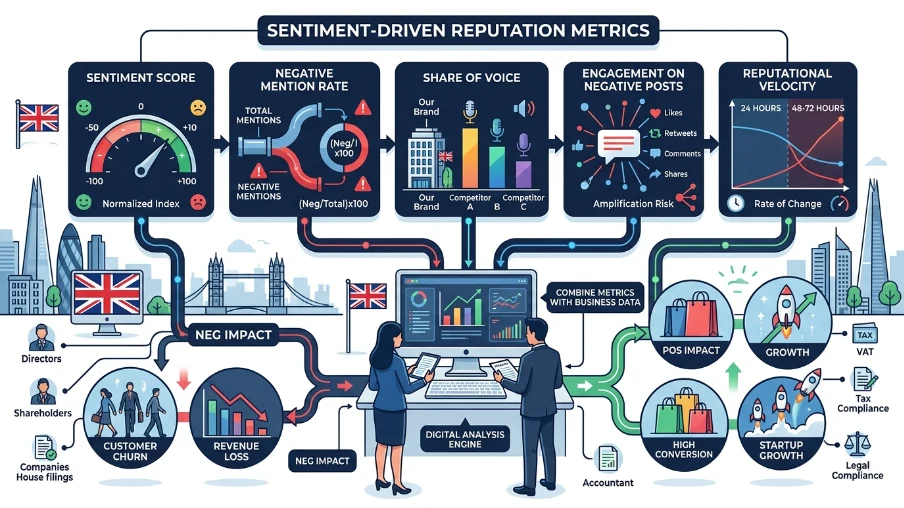
Key metrics include sentiment score, negative mention rate, share of voice, engagement on negative posts, and reputational velocity (change per 24–72 hours).
Sentiment score aggregates polarity into a normalised index (e.g., -100 to +100). Negative mention rate equals (negative mentions / total mentions) × 100. Share of voice measures brand mentions versus competitors. Engagement on negative posts tracks likes, retweets, comments, and shares to estimate amplification risk. Reputational velocity measures the rate of change in negative volume across a defined window. Combine metrics with conversion or churn data to show business impact.
How do dashboards and alerts improve response times?
Dashboards visualise sentiment trends and provide rule-based alerts to notify teams when negative signals exceed defined thresholds.
Dashboards show trend lines, top sources, geographic breakdowns, and incident timelines in a single view. Alerts trigger when thresholds are met: for example, a 200% increase in negative mentions within 6 hours or a single article on a Tier-1 news site. Alerts route to responsible teams with recommended actions and context. Integrate alerts with incident management tools and Slack or Microsoft Teams to reduce mean time to respond and to coordinate cross-functional remediation.
What processes should teams use to act on sentiment insights?
Implement a triage workflow: classify severity, assign owner, craft response, and track resolution with post-incident analysis.
Severity classification uses objective criteria: reach (audience size), amplification potential (engagement), and factual risk (legal or regulatory content). Assign an owner from PR, legal, or customer experience based on severity. Prepare response templates for low- and medium-severity items and bespoke statements for high-severity items. Log actions and outcomes in the dashboard. After resolution, run a root-cause analysis and update monitoring rules and response playbooks.
How accurate is advanced sentiment analysis in practice?
Accuracy varies by domain and language; enterprise systems reach 80–95% for common English use cases after continuous training and human-in-the-loop validation.
General-purpose models perform well on neutral content but drop in accuracy for sarcasm, idioms, and industry jargon. Performance improves with domain-specific training on labelled examples, data augmentation, and active learning cycles. Track precision and recall for critical classes such as negative mentions and complaints. Maintain a human review rate proportional to risk: 10–25% of flagged high-risk items for validation is common practice.
What are the compliance and privacy considerations?
Systems must comply with data-protection laws, platform terms, and industry-specific regulations when collecting, storing, and processing personal data.
Collect only publicly available data unless you have consent. Apply data minimisation and retention policies, and anonymise personal identifiers where possible. For EU and UK entities, follow GDPR principles: lawful basis, purpose limitation, and data subject rights. For regulated industries, maintain audit logs and role-based access controls. Consult legal counsel for cross-border scraping and for handling sensitive personal data.
Which technologies underpin advanced sentiment systems?
Key technologies include web crawlers, social APIs, NLP frameworks, transformer models, real-time message queues, and analytics dashboards.
Web crawlers and platform APIs ingest data. Message queues (e.g., Kafka) manage streams. NLP frameworks like spaCy, Hugging Face Transformers, or custom deep-learning pipelines perform entity extraction, sentiment classification, and intent detection. Datastores store mentions and metadata for historical analysis. Visualisation layers present trends and alerts. Use cloud infrastructure for scalability and redundancy.
How do businesses measure ROI from sentiment monitoring?
Measure ROI by linking sentiment trends to revenue, churn, conversion rates, and incident-cost reduction over defined timeframes.
Calculate baseline metrics (monthly churn, average order value, conversion rate). Track changes after specific interventions, such as a crisis response or reputation campaign. Quantify avoided losses: for instance, a rapid correction that prevents a 10% drop in conversion on a site receiving 50,000 monthly visitors equals a measurable revenue preservation figure. Include productivity savings from automated triage and reduced manual monitoring hours.
Explore our Reputation Management for business guides,
Enterprise Reputation Management Services for Large Organisations
Reputation Management Services for Law Firms
What implementation steps produce fast, reliable outcomes?
Start with scoped pilots: define objectives, select channels, label training data, set thresholds, and iterate with governance and KPIs.
Define 2–3 business objectives: reduce negative volume, shorten response time, or improve customer sentiment score. Select priority channels and collect 1,000–5,000 labelled examples for initial model training. Set alert thresholds and routing rules. Run a 60–90-day pilot, measure outcomes against KPIs, and refine models and playbooks. Establish governance for model updates, data retention, and escalation.
Reputation monitoring with advanced sentiment analysis provides near-real-time detection, prioritized triage, and measurable insights for business decision-making. Organizations that combine robust data collection, domain-tuned models, clear triage workflows, and integrated dashboards reduce response time and quantify reputational impact. Clear processes and continuous model validation maintain accuracy and legal compliance.
Clear My Name delivers outcome-driven Reputation Management for business with integrated dashboards, tailored sentiment models, and incident response playbooks that translate signals into measurable actions. The service connects listening, analytics, and response to protect brand value and support executive decision-making.
Frequently Asked Questions
What is Reputation Management for business and how does it work?
Reputation Management for business monitors online mentions across news, social media, review sites, and forums, and classifies sentiment to quantify public opinion. Clear My Name uses automated listening, NLP-based sentiment analysis, and incident triage to surface high-risk items and provide response recommendations.
How long does it take to see results from Reputation Management for business?
Initial monitoring and baseline reports typically appear within 7–14 days; meaningful sentiment trends and model tuning occur over 60–90 days. Clear My Name recommends a 90-day pilot to validate thresholds, refine alerts, and measure changes in negative mention rate and share of voice.
Which channels should businesses prioritise for reputation monitoring?
Prioritise channels with the highest audience and conversion impact: review platforms, news sites, X (Twitter), Facebook, LinkedIn, Instagram, and industry forums. Clear My Name maps channel priority to business goals and integrates CRM and support tickets for comprehensive reputation context.
How accurate is sentiment analysis for business reputation monitoring?
Mature systems achieve 80–95% accuracy on English-language polarity after domain-specific training and human validation. Clear My Name combines transformer models with human-in-the-loop review to improve detection of sarcasm, complaints, and regulatory risk.
How do businesses measure the ROI of Reputation Management for business?
Measure ROI by linking sentiment metrics to business KPIs: conversion rate, churn, revenue retention, and incident-cost reduction over defined periods. Clear My Name tracks changes in negative mention rate, reputational velocity, and conversion impact to produce citation-friendly, data-backed ROI summaries.