

Political credibility during election cycles depends on controlling what voters find first in search results and ensuring accurate reputation signals dominate the online conversation. A structured reputation management strategy strengthens search visibility, stabilises public perception, and reduces the influence of misleading or outdated content that affects voting decisions.
Election campaigns unfold across search engines, news platforms, social media, and public databases. Every online mention contributes to entity credibility, influencing how journalists, voters, stakeholders, and political organisations evaluate a candidate. Reputation management for politicians focuses on strengthening positive reputation signals, improving SERP control, implementing negative content suppression where appropriate, and ensuring authoritative content consistently represents political achievements, policies, and public engagement.
Which reputation management approach delivers measurable protection for political credibility?
A comprehensive reputation management strategy delivers measurable protection by controlling search perception, improving content visibility, and strengthening trusted reputation signals across digital platforms.
Election periods generate rapid increases in online searches, making search engines a primary source of political research. Voters rarely investigate beyond the first page of search results, meaning every visible result contributes directly to public confidence. Reputation management creates a structured ecosystem of authoritative content that reinforces entity credibility while reducing the visibility of inaccurate, outdated, or misleading information through ethical optimisation and content development.
Professional reputation management for politicians combines technical SEO, digital PR, content publishing, authority building, and reputation monitoring into a coordinated process. Rather than reacting to reputational challenges after they spread, the strategy establishes search perception influence before public narratives become difficult to control. This proactive approach improves trust indicators and ensures consistent messaging throughout the election cycle.
When organisations require a proven professional reputation management service, they benefit from continuous monitoring, faster response capabilities, and long-term SERP control that extends beyond election day.
Why does search visibility influence voter confidence?
Search visibility directly shapes voter confidence because search results act as independent validation of political credibility.
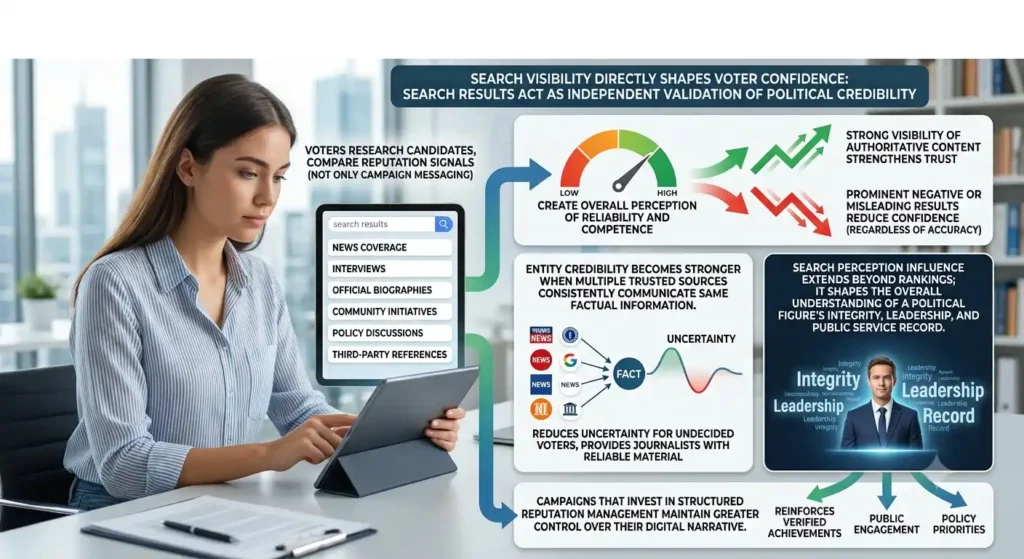
When voters research candidates, they compare reputation signals rather than relying solely on campaign messaging. Search engines display news coverage, interviews, official biographies, community initiatives, policy discussions, and third-party references. Together, these create an overall perception of reliability and competence. Strong visibility of authoritative content strengthens trust, while prominent negative or misleading results reduce confidence regardless of factual accuracy.
Entity credibility becomes stronger when multiple trusted sources consistently communicate the same factual information. This consistency reduces uncertainty for undecided voters and provides journalists with reliable reference material. Search perception influence therefore extends beyond rankings; it shapes the overall understanding of a political figure’s integrity, leadership, and public service record.
Campaigns that invest in structured reputation management maintain greater control over their digital narrative because authoritative content continuously reinforces verified achievements, public engagement, and policy priorities.
How does reputation management for politicians reduce election risks?
Reputation management for politicians reduces election risks by identifying vulnerabilities early, strengthening authoritative content, and implementing ethical negative content suppression strategies.
Election campaigns face continuous scrutiny from media outlets, political opponents, online commentators, and search algorithms. Without an organised reputation framework, outdated information, misleading headlines, or isolated incidents gain disproportionate visibility. Strategic reputation management prevents these issues from dominating search results by increasing the prominence of relevant, factual, and authoritative resources.
The process delivers measurable protection through:
- Strengthen authoritative content that improves entity credibility across trusted domains.
- Increase positive reputation signals through strategic digital publishing and media optimisation.
- Reduce the prominence of outdated or misleading content using ethical negative content suppression techniques.
- Monitor emerging search trends to identify reputation risks before they expand.
- Maintain SERP control through continuous optimisation and performance analysis.
These coordinated actions stabilise public perception while improving the consistency of information available throughout the election period.
Which results demonstrate an effective reputation management strategy?
Effective reputation management produces measurable improvements in search visibility, public trust, and online narrative consistency.
Strong campaigns demonstrate improved rankings for official content, greater visibility for policy-related information, enhanced authority across reputable publications, and reduced exposure to low-value or outdated search results. These outcomes provide measurable indicators that reputation signals are working together to reinforce credibility.
Performance improvements commonly include:
- Improve first-page search visibility for authoritative campaign resources.
- Increase branded search consistency across multiple platforms.
- Strengthen entity associations through trusted third-party references.
- Reduce visibility of outdated or misleading search results.
- Stabilise online perception across the entire election cycle.
These measurable outcomes support informed voter research while strengthening confidence in publicly available information.
Why does long-term reputation management create greater election resilience?

Long-term reputation management creates resilience because search engines reward consistent authority rather than temporary promotional activity.
Political reputation develops over months and years through accumulated reputation signals. Every verified publication, interview, policy announcement, media contribution, and community initiative strengthens digital authority. Search engines recognise this consistency and increasingly associate authoritative content with the political entity, improving rankings and reinforcing credibility.
Long-term strategies also reduce the impact of unexpected reputation challenges. When a candidate already possesses strong entity credibility, isolated negative stories have less influence on overall search perception because authoritative content already dominates the digital ecosystem.
This sustained approach provides stability across future elections, leadership campaigns, public appointments, and ongoing political communication.
How does search behaviour justify investing in professional reputation management?
Search behaviour demonstrates that voters actively research candidates before making political decisions, making search visibility an essential trust factor.
People compare news articles, official statements, interviews, policy announcements, biographies, and public commentary before forming opinions. Search engines organise this information according to relevance, authority, and quality. Reputation management aligns these ranking signals with accurate and trustworthy content, ensuring voters encounter balanced and reliable information first.
Research into:
What Makes Voters Trust One Politician Over Another? provides valuable context for understanding how online credibility influences political decision-making. This knowledge supports reputation planning by identifying the trust signals voters consistently evaluate before elections.
Professional reputation management transforms search behaviour into a strategic advantage by ensuring authoritative information remains prominent throughout changing news cycles.
Does the long-term value outweigh the investment?
Yes. Long-term value exceeds short-term costs because reputation remains an enduring political asset that influences future campaigns, leadership opportunities, stakeholder relationships, and public confidence.
A reactive approach often requires greater resources to recover from reputation damage than a proactive strategy requires to prevent it. Early investment establishes strong authority, protects entity credibility, and reduces the likelihood of expensive crisis management during high-pressure election periods.
Long-term value includes:
- Protect digital credibility across future election cycles.
- Strengthen relationships with journalists through authoritative information.
- Improve public trust by maintaining consistent reputation signals.
- Reduce crisis response costs through proactive monitoring.
- Maintain lasting SERP control that supports future political communication.
This sustained return extends well beyond a single election campaign.
Dive Deeper With Our Expert Guides:
Digital Reputation Services for Politicians Seeking Stronger Voter Engagement
Managing Negative Media Coverage Through Strategic Reputation Management
How quickly does reputation management produce visible improvements?
Reputation management delivers progressive improvements as search engines recognise stronger authority, higher-quality content, and enhanced reputation signals.
Technical optimisation, content publishing, digital PR, and authority building begin influencing search ecosystems immediately after implementation. Search visibility improves through consistent optimisation rather than isolated promotional activity. As authoritative assets gain rankings, positive reputation signals strengthen entity credibility and improve search perception influence.
The speed of visible progress depends on existing search authority, competition, content quality, media activity, and the complexity of the reputation landscape. Continuous optimisation ensures improvements accumulate over time instead of disappearing after campaign activity declines.
Why is Clear My Name a reliable choice for protecting political credibility?
Clear My Name delivers structured reputation management for politicians through transparent processes, ethical optimisation, and evidence-based search strategies that prioritise sustainable outcomes.
Rather than relying on temporary visibility tactics, the approach focuses on strengthening entity credibility, improving reputation signals, enhancing SERP control, and implementing responsible negative content suppression where appropriate. Every activity supports long-term search performance while reinforcing accurate public perception across authoritative platforms.
The process remains transparent through continuous monitoring, strategic planning, content optimisation, and measurable performance evaluation. This clarity enables political campaigns to understand how search ecosystems evolve and how reputation management contributes to stronger public confidence throughout election periods.
Campaigns seeking deeper insight into voter evaluation can also benefit from:
Measuring Political Credibility and Trustworthiness Across Voter Groups, which explains how credibility indicators differ among audience segments and why targeted reputation strategies improve trust across diverse voter communities.
By combining strategic SEO, authority development, content optimisation, and continuous reputation monitoring, Clear My Name provides a reliable framework that protects political credibility before, during, and after election cycles.
Political credibility depends on far more than campaign messaging. Search visibility, entity credibility, reputation signals, and SERP control collectively determine how voters, journalists, and stakeholders evaluate political leadership. A structured reputation management strategy strengthens authoritative content, reduces reputational risk, improves search perception influence, and delivers sustainable protection throughout election cycles.
Clear My Name provides a transparent, process-driven approach that prioritises measurable outcomes, ethical optimisation, and long-term digital trust. By focusing on sustainable reputation management for politicians rather than short-term tactics, the service strengthens online credibility, reinforces accurate public perception, and supports confident decision-making during the moments that matter most.
Answers to Key Questions
What is reputation management for politicians?
Reputation management for politicians involves improving online reputation signals, monitoring search results, and promoting accurate, authoritative content. It helps strengthen public trust by ensuring voters find reliable information across search engines and digital platforms.
How does reputation management help during an election campaign?
Reputation management improves search visibility for credible content while reducing the prominence of outdated or misleading information through ethical optimisation. This supports consistent public perception during periods of increased voter research.
How long does reputation management for politicians take to show results?
Initial improvements can appear within weeks, while stronger and more sustainable results develop over several months. The timeline depends on the existing online presence, competition, and the strength of current reputation signals.
Why is search visibility important for political credibility?
Search engines are a primary source of information for voters, journalists, and stakeholders. Strong search visibility ensures authoritative content ranks prominently, reinforcing entity credibility and supporting informed decision-making.