
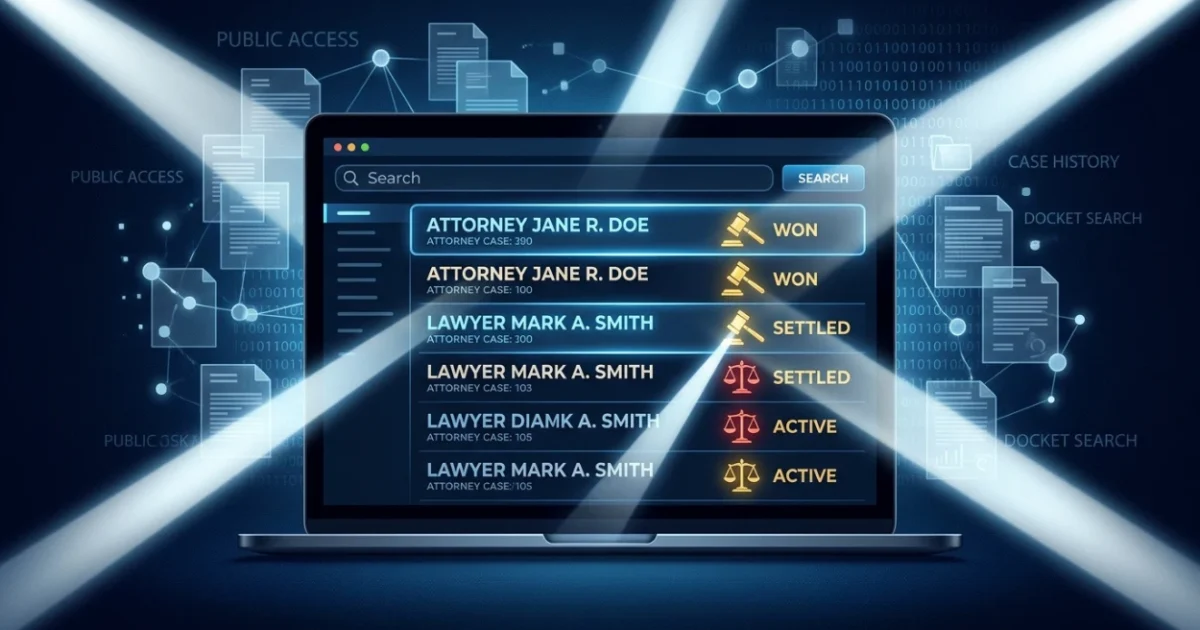
Court docket websites expose attorney case outcomes by publishing searchable records containing case details, procedural events, judgements and other outcome-related information. Reputation management is the process of understanding and influencing how information associated with an individual or entity is represented across digital search ecosystems.
How do court docket websites make attorney case outcomes searchable?
Court docket websites make attorney case outcomes searchable by converting court information into structured or indexed web content. A docket record can contain case numbers, filing dates, party names, attorney information, hearing events, motions, orders and final outcomes. When these pages are accessible to search engines, their text and metadata become part of the searchable digital footprint associated with an attorney. Content indexing therefore connects legal records with name-based search queries. The result is a search environment where case information can appear alongside professional biographies, law-firm pages, legal directories and other reputation-related sources.
Court records have a distinct relationship with online reputation because their primary purpose is documentation rather than professional evaluation. A docket entry can describe an outcome without explaining the wider legal context, the attorney’s role, the complexity of the dispute or the distinction between allegations and findings. Search engines process the available textual information rather than independently reconstructing every contextual detail behind a record. This creates a difference between factual publication and perceived meaning. Entity perception is therefore influenced not only by whether a record exists but also by which information appears prominently around the attorney’s name.
Search visibility determines how easily a person encounters a particular docket record. A highly indexed page with strong relevance to an attorney’s name can appear prominently when the name is searched with terms such as “case”, “lawsuit”, “court” or “attorney”. Lower-ranking records remain accessible but receive less immediate attention from searchers. SERP evaluation therefore determines the practical visibility of court-related information. The ranking position becomes part of the reputation system because prominence affects what users encounter first.
Why do court outcomes influence an attorney’s online reputation?
Court outcomes influence an attorney’s online reputation because searchers interpret visible information as part of the professional entity associated with a name. Online reputation refers to the accumulated perception created by searchable information, including professional profiles, reviews, publications, directories and public records. A court docket represents one category of reputation signal within that broader digital footprint. Its influence depends on relevance, visibility, context and the relationship between the record and the attorney. Search perception therefore develops through the interaction of different information sources rather than through one page alone.
The attorney’s role within a case also affects interpretation. A docket can identify an attorney as counsel, a party, or a representative connected to proceedings without presenting a complete professional assessment. Searchers who encounter an outcome without examining the underlying record can interpret the visible information according to the wording and context presented on the indexed page. This makes contextual completeness important when analysing entity perception. Reputation analysis therefore distinguishes factual case information from assumptions about professional performance.
Search algorithms do not assign professional credibility simply because a court page contains legal terminology. They evaluate pages through signals such as relevance, authority, content quality, links, indexing status and relationships between entities. A court database with strong domain authority can therefore receive substantial search visibility even though the page was not created as a reputation asset. The resulting ranking can increase exposure to case information without implying that the search engine endorses the underlying interpretation. Understanding this distinction is central to analysing legal reputation in search ecosystems.
How does content indexing affect the visibility of attorney case outcomes?
Content indexing determines whether searchable court information enters a search engine’s available document set. When a crawler discovers an accessible docket page, the page can be processed, indexed and associated with relevant queries. Indexing does not guarantee a prominent ranking, but it creates the technical foundation for search visibility. The indexed content can then compete with other pages covering the same attorney or legal entity. This process explains why older court records can remain discoverable long after the original proceedings have ended.
Indexing also creates connections between related information. An attorney’s name appearing across docket pages, legal directories, firm biographies and professional publications provides search systems with repeated entity references. These references help establish relationships between the person and the subject matter represented by each page. Repetition alone does not establish negative credibility, but it increases the quantity of information available for SERP evaluation. The digital footprint therefore becomes a network of connected content rather than a collection of completely independent pages.
Search visibility is affected by whether indexed pages satisfy the intent behind a query. A docket page containing an attorney’s full name and case information has strong lexical and contextual relevance for searches involving that attorney and a particular case. If the page also receives external links or belongs to an authoritative legal database, its ranking strength can increase. This combination can give court-related pages a prominent position in name-based searches. Content indexing consequently acts as the gateway through which public case information becomes part of searchable reputation signals.
What role do search rankings play in attorney case perception?
Search rankings determine the order in which users encounter information about an attorney. A high-ranking court docket can receive greater attention because searchers often examine prominent results before exploring lower-ranking pages. This does not mean ranking position changes the factual content of a case record. It means visibility changes the practical influence of that information on initial perception. SERP evaluation therefore matters when analysing how public records contribute to online credibility.
Ranking dynamics are influenced by the relationship between the search query and the indexed page. A search containing an attorney’s name and a case identifier creates strong relevance for a matching docket page. A broader search for the attorney’s name alone produces a competitive result set containing professional and informational content from different sources. The relative authority and relevance of these pages determine their positions. Reputation signals therefore emerge from how information competes within the same search environment.
A court docket can also remain visible because of the authority of its source rather than the significance of the underlying case. Established legal databases, government websites and recognised court systems possess strong source-level credibility for factual legal information. Search engines can therefore treat the page as authoritative for the subject it documents. This distinction is important because source authority and professional reputation are separate concepts. A highly authoritative court page does not automatically establish that an attorney lacks credibility; it establishes that the page is a strong source for the information it contains.
How do reviews and sentiment signals interact with court records?

Reviews and sentiment signals provide a different type of reputation information from court docket records. A court record documents legal proceedings, while a review expresses an individual’s experience, assessment or opinion about a professional service. Search systems process both types of content as part of the wider information environment surrounding an attorney. Their meanings differ, but their visibility can overlap within branded or name-based search results. Entity perception is therefore shaped by the combined presentation of factual records, opinions and professional information.
Sentiment interpretation becomes particularly relevant when review pages appear near court-related results. A searcher can encounter positive professional profiles, neutral legal records and negative reviews within the same results page. The resulting perception depends partly on which sources receive prominence and how clearly each source communicates its purpose. Search engines do not simply calculate one universal reputation score from these pages. Instead, ranking systems organise content according to relevance, authority, quality and other signals.
Review content also carries contextual limitations. A single review represents one person’s account and does not provide the same evidential function as a court record. Conversely, a docket entry does not provide a complete measure of client satisfaction or professional quality. Accurate reputation analysis therefore avoids treating different content categories as interchangeable. Comparing source type, authority, sentiment and context provides a more precise understanding of the attorney’s digital reputation.
How do authority and trust signals shape search perception?
Authority and trust signals influence which information receives visibility and how users assess its reliability. Authority refers to the strength and credibility associated with a source or page within its relevant information environment. Trust signals include factors that help establish whether content comes from a credible source, accurately represents its subject and provides useful information. These concepts operate at the content and source level rather than functioning as a simple reputation score. Search systems use a combination of signals when evaluating which pages deserve visibility for a query.
Legal websites and court databases often possess strong topical relevance for case-related searches. Professional law-firm websites possess different forms of relevance, particularly for searches concerning an attorney’s qualifications, services and professional background. Review platforms provide another type of information, focused on user experiences and sentiment. Each source therefore contributes a distinct reputation signal. A balanced search environment reflects the interaction between these content categories.
The strength of a source can also affect how long information remains visible. Authoritative domains tend to maintain stronger search positions when their content remains relevant and accessible. This explains why historical case records can continue appearing in searches years after proceedings conclude. Content freshness does not automatically eliminate established pages from search results. Search visibility depends on the continuing relationship between relevance, authority, indexing and query intent.
How does the digital footprint connect court records with attorney identity?
The digital footprint connects court records with attorney identity through repeated names, professional references, case associations and linked content. A person’s name can appear across court databases, firm websites, legal directories, social profiles, publications and review platforms. Search systems analyse these references to understand which pages relate to the same entity. Entity perception therefore develops from the structure and consistency of information surrounding an identity. The broader the searchable footprint, the more sources become available for SERP evaluation.
This relationship does not mean every page receives equal ranking influence. A government court database can carry stronger source authority for case information than a personal profile, while a professional website can provide stronger relevance for credentials and services. Search systems determine ranking based on the query and the signals associated with each page. The same attorney can therefore appear differently across searches focused on qualifications, cases, reviews or professional services. Reputation analysis requires examining the query-specific search environment.
A structured understanding of managing how court docket and case-outcome sites rank in search provides a useful framework for analysing this relationship. The focus is not on changing factual court information but on understanding how public records compete with other sources for visibility. Examining ranking position, indexing, source authority and entity associations reveals why certain pages dominate specific searches. This provides a clearer explanation of how legal information contributes to online reputation.
What does court docket visibility mean for online credibility?
Court docket visibility means that searchable legal records form part of the information users encounter when evaluating an attorney online. Online credibility refers to the perceived reliability and professional trustworthiness created by the available digital evidence surrounding an entity. Court records contribute factual information, while professional profiles, credentials, publications and reviews provide additional context. The credibility signal emerges from the combined search environment rather than from a docket alone. This distinction prevents legal records from being treated as automatic indicators of professional quality.
The practical significance of visibility lies in prominence and context. A docket that appears on the first page for an attorney’s name receives greater exposure than a record several pages deeper in the results. If the visible page contains limited contextual information, searchers receive a narrower representation of the underlying event. Other authoritative sources can provide additional context by explaining professional qualifications, legal expertise or current practice information. Search perception therefore depends on the composition of the results page as well as the existence of individual records.
Understanding these mechanisms clarifies why attorney reputation is closely connected to search ecosystems. Court databases document events, search engines organise information, and users interpret the resulting SERP according to the content they encounter. Reputation signals arise through this interaction between publication, indexing, ranking and perception. The digital footprint consequently functions as an information environment rather than a single reputation statement. Analysing that environment provides a more accurate basis for understanding attorney case-outcome visibility.
What are the key principles for analysing attorney case-outcome visibility?
The visibility of attorney case outcomes is best understood through the relationship between source authority, content indexing, search relevance and entity perception. A court docket provides factual legal information, but its position within search results determines how prominently that information enters public attention. Reviews, professional profiles and other sources add different reputation signals to the same search environment. Search engines evaluate these pages according to their relevance and authority rather than according to a single concept of professional reputation. This creates a complex but identifiable system for analysing online credibility.
A useful analysis follows a defined sequence:
- Identify indexed court pages by examining the attorney’s name, case references and ranking positions in relevant searches.
- Evaluate source authority by distinguishing government records, legal databases, professional websites, directories and review platforms.
- Compare content context by examining whether each result presents factual records, professional information, opinions or commentary.
- Analyse sentiment signals by separating objective case information from subjective reviews and other evaluative content.
- Assess entity perception by examining how the complete SERP represents the attorney across relevant name-based queries.
These principles demonstrate that court docket websites are part of a broader reputation ecosystem. Their influence depends on visibility, authority, relevance, indexing and their relationship with other content associated with the attorney. Understanding these mechanisms provides a more precise view of how case outcomes enter public search perception. It also explains why digital reputation cannot be evaluated from one URL or one ranking position. Search reputation is ultimately an interaction between information, algorithms and user interpretation.
Dive Deeper With Our Expert Guides:
Why Law School Alumni Networks Influence a Firm’s Online Standing
How Contingency-Fee Lawyers Are Scrutinised Harder in Reviews
How should attorney case outcomes be understood within search ecosystems?
Court docket websites expose attorney case outcomes by making legal records accessible to search engines and users through indexed, searchable content. Their reputation influence comes from the interaction between content indexing, ranking dynamics, source authority and entity associations. A case outcome can therefore become a visible reputation signal without functioning as a complete assessment of the attorney’s professional credibility. Search perception depends on the wider SERP composition surrounding the person’s name. Understanding that distinction creates a more accurate framework for evaluating legal information online.
The key principle is that visibility and meaning are related but not identical. A highly ranked court record demonstrates strong search visibility for the underlying information, while professional credibility requires interpretation across the wider digital footprint. Reviews, professional profiles, publications and legal records each contribute different forms of evidence. Search engines organise these sources according to relevance, authority and other ranking signals. Users then form perceptions from the resulting information environment.
How do court docket websites affect an attorney’s online reputation?
Court docket websites can place case details, legal proceedings and outcomes into search results associated with an attorney’s name. Their visibility contributes to reputation signals and can influence how searchers perceive an attorney’s digital footprint.
Can court case outcomes appear when someone searches for an attorney?
Yes, searchable court records can appear when an attorney’s name is included in a case record and the page has been indexed by a search engine. Ranking position, source authority and query relevance influence how prominently the record appears in the SERP.
Why do court records rank highly in attorney name searches?
Court records often come from authoritative legal or government sources, giving them strong source credibility and topical relevance for case-related searches. Content indexing, entity associations and query relevance also influence their search visibility.
Do court docket records affect an attorney’s credibility?
Court records contribute factual information to an attorney’s online reputation but do not independently establish professional credibility. Search perception develops through the combined effect of court records, professional profiles, reviews, publications and other reputation signals.
How can attorneys understand how court records influence search results?
Attorneys can analyse indexed docket pages, ranking positions, source authority, case-related queries and the surrounding search results. This reveals how court information contributes to entity perception and the wider digital footprint associated with the attorney’s name.