

Litigation and press stories affect executive search firm selection by adding publicly visible information that decision-makers evaluate alongside expertise, references, leadership credentials and recruitment capability. Their influence depends on source authority, factual accuracy, search visibility, relevance and how prominently the information appears in search results.
Reputation management strategies differ based on the type, source and visibility of information affecting an organisation’s digital footprint. Online reputation control methods are evaluated through search visibility, reputation signals, entity credibility, content relevance and sentiment distribution rather than through the existence of a single positive or negative result.
How Does Litigation Become a Reputation Signal for Executive Search Firms?
Litigation becomes a reputation signal when legal information enters publicly accessible sources that search engines index and associate with an executive search firm’s entity. Court reporting, legal publications, regulatory documents and professional commentary can create searchable records that become part of the firm’s digital footprint.
Litigation-related content operates differently from ordinary reviews because it frequently contains formal claims, procedural information or references to legal proceedings. Search engines index the page according to relevance and authority rather than determining the legal merits of every statement contained within it. Users therefore encounter the content as part of a broader SERP composition that requires contextual interpretation.
The reputation effect depends on the nature of the source and its relationship to the search query. An authoritative legal publication has a different information value from an unsourced discussion post, while a current court report differs from an outdated reference. Evaluating litigation-related reputation signals therefore requires separating documented legal information from commentary, allegations and interpretation.
How Do Press Stories Differ From Litigation Records?
Press stories differ from litigation records because editorial coverage adds journalistic framing, context and interpretation to an event or organisation. A litigation record can document procedural facts, while a press article can connect those facts with business activity, leadership decisions or industry developments.
Press coverage operates through content indexing and search ranking. Once an article is indexed, its title, text, publication authority and surrounding relevance contribute to how the page appears for related queries. Prominent editorial coverage therefore has the capacity to influence what information prospective clients encounter during online research.
The distinction matters because press coverage does not represent a uniform reputation signal. An investigative article, an industry announcement, a legal report and an opinion piece contain different forms of information. Assessing their effect requires identifying the source type, publication standards, factual basis and relationship between the article and the executive search firm’s entity.
How Does Search Visibility Change the Effect of Litigation and Press Coverage?
Search visibility determines how easily litigation and press information can be encountered during research. A document positioned prominently within a relevant SERP receives greater exposure than an equivalent document located substantially further down the results.
Search ranking influence operates through relevance, authority, content quality and query alignment rather than through a simple reputation score. A litigation article can therefore remain indexed without appearing prominently for every search involving the firm. Its practical influence changes according to the queries for which the page ranks and the information surrounding it.
SERP composition provides the relevant comparison point. A branded search containing predominantly corporate pages produces a different information environment from one containing prominent legal reports, reviews or critical articles. This distinction explains why the same underlying event can have different visibility and perception effects across search queries.
Which Reputation Management Approach Addresses Litigation and Press Stories?
Content analysis addresses the information itself, while search-oriented reputation management evaluates how that information is positioned within the wider SERP. Removal strategies focus on whether content meets a platform, publisher or legal removal criterion, whereas content enhancement focuses on improving the visibility of accurate, relevant and authoritative information.
Content removal operates by seeking the deletion, correction or de-indexing of eligible material through the party controlling that content or its distribution. Its limitation is structural: a third-party publisher or platform retains authority over whether the requested action is permitted. Removal also depends on the applicable policies, evidence and legal basis.
Content enhancement operates differently by developing or strengthening relevant information that contributes to the entity’s digital footprint. This approach does not necessarily eliminate existing content. Instead, it changes the composition of available information by increasing the presence and visibility of relevant material.
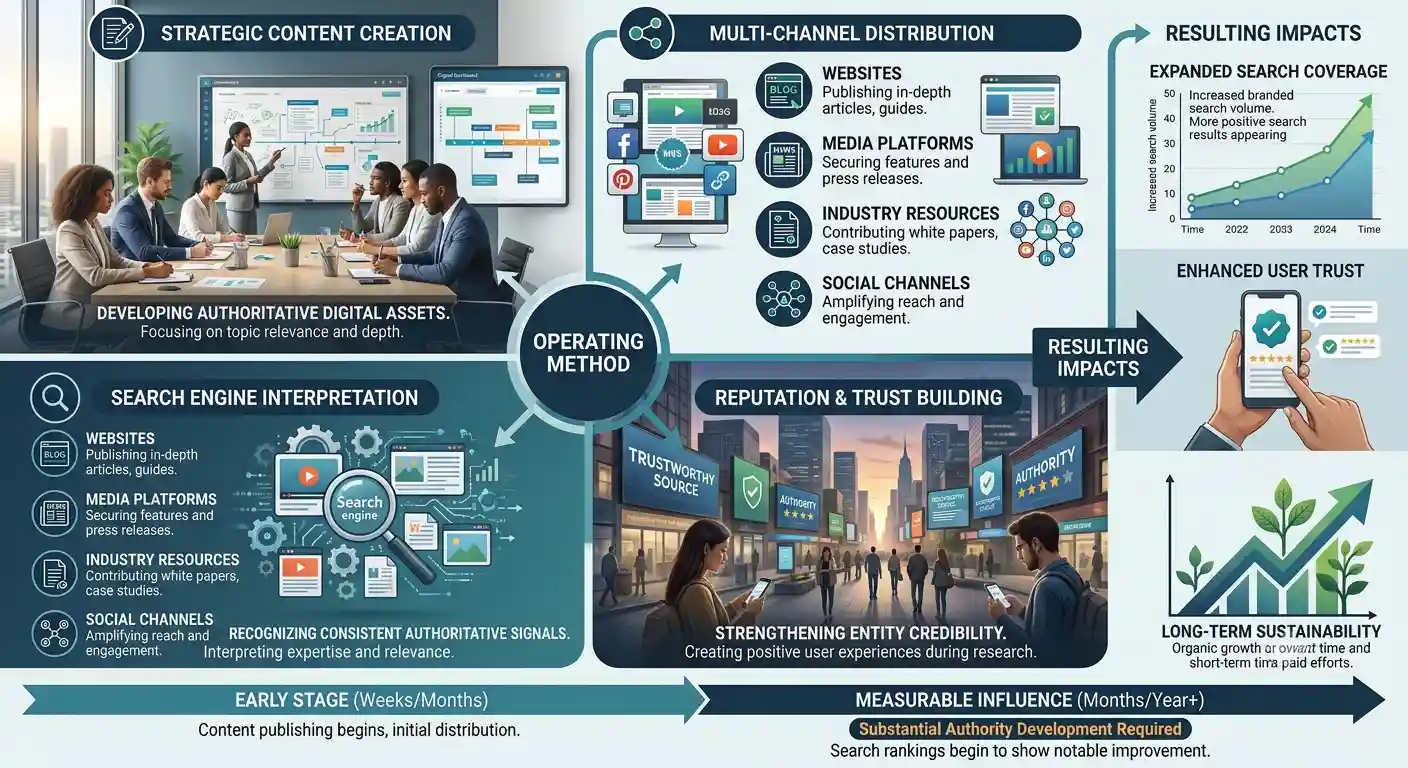
The distinction between content suppression vs content enhancement is therefore important. Suppression focuses on reducing the prominence or accessibility of particular content within permissible search mechanisms, while enhancement focuses on establishing stronger competing information. Neither approach guarantees control over independent publisher decisions or search-engine rankings.
Is Content Removal More Effective Than Content Creation for Reputation Issues?
Content removal and content creation address different mechanisms, so their effectiveness depends on the underlying problem. Removal targets an identified item directly when a valid policy, legal or editorial basis exists, while content creation establishes additional information within the searchable entity environment.
Removal provides a direct response when content qualifies for deletion or correction. Its limitation arises when the publisher has no obligation to remove the material or when the content does not breach applicable rules. A successful removal also addresses the specific item rather than necessarily resolving wider search-perception issues.
Content creation provides a broader mechanism for developing an accurate digital footprint. Authoritative corporate pages, professional profiles, expert publications and relevant industry content can add context to the search environment. The limitation is that new content competes within existing ranking systems and does not automatically displace established pages.
A comparative evaluation therefore considers eligibility, control, scalability and sustainability. Removal depends heavily on third-party authority, while content enhancement depends on content quality, relevance and search ranking dynamics. Combining source assessment with SERP analysis provides a clearer basis for determining which mechanism addresses the specific reputation signal.
How Do Organic and Reactive Reputation Strategies Compare?
Organic reputation management is a proactive approach that develops credible digital information before a specific reputation problem becomes prominent. Reactive reputation management responds to an existing issue such as litigation coverage, a negative article, an inaccurate statement or a sudden change in search visibility.
Organic strategies operate through sustained content development and entity consistency. Maintaining accurate leadership profiles, authoritative corporate information and relevant professional publications creates a structured digital footprint over time. The limitation is that organic development requires continuing content relevance and does not directly control independent publications.
Reactive strategies operate through targeted analysis of an existing reputation signal. The process can involve classifying the content, assessing its source, determining whether correction or removal mechanisms exist and analysing its position within the SERP. Reactive work provides greater issue specificity but can involve tighter time constraints and greater risk exposure.
The approaches therefore differ in timing and mechanism. Organic activity builds information depth and entity clarity, while reactive activity addresses a defined reputation event. Their effectiveness is measured through different indicators, including content quality, search visibility, source authority and changes in SERP composition.
What Is the Difference Between Short-Term and Long-Term Reputation Impact?
Short-term reputation impact is associated with the immediate visibility and prominence of information following publication or increased search interest. Long-term impact relates to the continued indexing, ranking and reference of that information within the firm’s digital footprint.
A newly published press story can initially receive attention because it directly matches current search interest. Search ranking systems subsequently evaluate the page within their broader information environment, meaning visibility can change as competing content is indexed and user queries evolve. The initial exposure therefore does not necessarily define the permanent search environment.

Long-term reputation effects depend on persistence and relevance. An authoritative article that remains indexed and relevant to branded queries can continue forming part of the firm’s search landscape. Conversely, outdated information can retain visibility while becoming less representative of the organisation’s current circumstances.
This distinction makes monitoring an important analytical mechanism. Short-term analysis identifies immediate SERP changes, while long-term analysis examines whether the information continues to influence search visibility and entity perception. Neither timescale independently establishes the factual significance of the underlying event.
How Does Sentiment Distribution Affect Executive Search Firm Selection?

Sentiment distribution describes how positive, neutral, negative and informational content is distributed across the search environment surrounding an entity. It provides a structured view of the information users encounter rather than reducing reputation to a single sentiment classification.
Reviews, press coverage, professional references and corporate content contribute different sentiment signals. A legal article can contain neutral factual reporting while still appearing in a SERP associated with a negative event. Similarly, a positive review can contribute favourable sentiment without establishing comprehensive evidence about the firm’s capabilities.
Search engines do not simply rank content according to whether it is positive or negative. Ranking systems assess relevance and other document-level characteristics, meaning sentiment interacts with rather than replaces conventional ranking factors. Human perception then adds another layer as users interpret the visible information.
Sentiment analysis is therefore most useful when combined with source classification. Identifying who published the information, what evidence it contains, how relevant it is and where it appears provides greater analytical value than counting favourable and unfavourable mentions alone.
How Should Executive Search Firms Evaluate Reputation Risk Before Selection?
Executive search firm reputation risk can be evaluated by separating factual evidence, source authority, visibility and perception effects. This approach prevents an indexed article, review or legal reference from being treated as a complete representation of the organisation.
A structured evaluation can:
- Classify each relevant result by source type, such as legal publication, news outlet, review platform, corporate page or professional directory, to establish the nature of the reputation signal.
- Verify factual claims against authoritative documentation, such as published court information or direct organisational records, to distinguish documented information from unsupported assertions.
- Measure search visibility for relevant branded queries, such as the firm’s name combined with leadership, litigation or recruitment terms, to identify the content users encounter prominently.
- Compare positive, neutral and negative information across the SERP, such as corporate content alongside independent reporting, to understand the overall sentiment distribution.
- Assess available responses according to control and sustainability, such as removal eligibility, correction opportunities, content enhancement and ongoing monitoring, to identify the mechanism relevant to the specific issue.
This framework separates reputation analysis from an overall judgement about the firm. It examines the information environment and identifies how each component functions within search ecosystems.
How Do Litigation and Press Stories Compare With Reviews as Reputation Signals?
Litigation and press stories generally provide a different evidence structure from reviews because they can contain legal, editorial or documentary information. Reviews primarily represent individual user experiences and subjective assessments, while press and litigation sources can address events, disputes or organisational activity.
Reviews operate through sentiment and experience signals. Their relevance depends on platform credibility, reviewer context, specificity and relationship to the service being evaluated. Litigation and press content instead requires attention to factual accuracy, publication authority, legal status and editorial framing.
The search impact also differs according to query intent. A review can rank for searches concerning customer experience or service quality, while legal or press content can appear for queries combining an organisation’s name with an event or dispute. The same firm’s SERP can therefore contain multiple reputation-signal types simultaneously.
Comparing these sources requires evaluating information quality rather than treating one category as inherently more significant. Source authority, relevance, prominence and factual basis determine how each item contributes to entity credibility and search perception.
Dive Deeper With Our Expert Guides:
Which Executive Search Firms Rank Highest on Google and Why?
How Does a 1-Star Review Spiral Cost Sales Recruiters New Clients?
How Does Crisis Communications Relate to Search Reputation Management?
Crisis communications addresses how an organisation communicates information during a reputational event, while search reputation management analyses how information is indexed, ranked and interpreted across search ecosystems. The two disciplines overlap because public statements can become searchable content that contributes to the entity’s digital footprint.
Crisis communications operates through message development, factual clarification, stakeholder communication and media interaction. Search reputation analysis operates through SERP evaluation, content classification, indexing analysis and reputation-signal monitoring. Each addresses a different stage of information management.
Public communication can therefore influence the available information environment without guaranteeing a particular ranking outcome. Statements published on authoritative organisational channels provide additional source material for users and search engines to encounter. Their effect depends on relevance, accessibility, content quality and how they interact with existing indexed information.
Understanding crisis communications support helps define this distinction because communication strategy concerns the organisation’s response, while search analysis concerns the visibility and composition of information surrounding that response.
Litigation and press stories affect executive search firm selection primarily through the information they introduce into the public search environment. Their influence depends on factual basis, source authority, relevance, content indexing, search visibility and position within the SERP rather than the existence of negative information alone.
Content removal and content enhancement operate through different mechanisms. Removal addresses eligible material directly, while enhancement develops additional authoritative information that contributes to the entity’s digital footprint. Organic strategies build reputation signals over time, whereas reactive strategies respond to specific events and existing search results.
Short-term and long-term analysis also produce different insights. Immediate monitoring identifies changes in SERP composition, while sustained evaluation measures whether particular information continues to influence search visibility and entity perception.
A structured approach therefore compares the source, evidence, visibility, sentiment and available response mechanisms for each reputation signal. This creates a clearer distinction between litigation records, press coverage, reviews, factual information and editorial interpretation when evaluating the digital reputation of an executive search firm.
How do litigation stories affect executive search firm selection?
Litigation coverage can influence how executive search firms assess a candidate’s reputational risk, particularly when the reporting concerns leadership conduct or business disputes. Search firms may review the context, recency and reliability of the available information rather than relying on a headline alone.
Do press stories affect an executive’s chances of being considered for a senior role?
Negative press coverage can become part of an executive reputation assessment when it appears prominently in search results or receives sustained media attention. Its relevance depends on the subject matter, evidence available and connection to the role being considered.
What do executive search firms look for in online reputation checks?
Executive search firms can examine news coverage, litigation records, professional profiles and other publicly available information when conducting reputation due diligence. The review helps identify reputation signals that could affect stakeholder confidence or create role-specific risk.
Can old litigation reports still affect executive recruitment?
Older litigation stories can remain relevant when they continue to appear prominently in search results or lack clear contextual information. Search visibility, accuracy and the relationship between the historical matter and the executive’s current professional profile can affect how the information is interpreted.
How can executives manage negative press before an executive search?
Executives can review search results, identify inaccurate or misleading coverage and ensure that authoritative professional information is clearly represented online. Services such as Clear My Name can help assess online reputation signals and address eligible reputation-related content without treating every negative result as removable.