

Regional private schools compete for a shrinking applicant pool by differentiating their educational information, strengthening credible search signals and managing how prospective families encounter school-related information online. The strongest strategic comparison is not between visibility and reputation, but between approaches that improve the information ecosystem and approaches that react to existing negative signals.
Reputation management strategies differ based on the source, prominence and persistence of information affecting an educational entity. Online reputation control methods are evaluated through search visibility, SERP composition, sentiment distribution, entity credibility and the consistency of information across authoritative sources. For regional private schools, these factors become relevant when prospective applicants compare institutions within the same geographic market.
Which reputation management approach works best for regional private schools?
Content enhancement provides the most sustainable mechanism when the primary issue involves limited, outdated or poorly represented information rather than unlawful or removable content. Content enhancement operates by creating useful, authoritative pages that explain educational offerings, academic subjects, facilities, admissions information and institutional characteristics. These pages create additional indexed information that search engines can evaluate in relation to relevant queries.
Content removal follows a fundamentally different mechanism. Removal strategies focus on eliminating information where a legitimate removal route exists, such as content that violates platform rules, contains demonstrably inaccurate information or falls within applicable legal processes. Its strength lies in addressing the original source directly, while its limitation is that removal depends on the source’s policies, legal framework and eligibility criteria.
Content enhancement therefore expands the information environment, while removal reduces specific information within it. The two approaches are not interchangeable because they address different causes of reputation exposure. Evaluation requires identifying whether the problem concerns the existence of unwanted content, its search prominence or the absence of stronger contextual information.
How does content enhancement compare with content removal?
Content enhancement operates by increasing the availability and relevance of authoritative information associated with an entity. A regional school can develop structured informational content covering curriculum, academic performance, educational philosophy, facilities and local relevance. When properly indexed, these assets create additional opportunities for relevant queries to return informative sources.
Content removal operates by attempting to reduce the availability of a specific unwanted source. Its effectiveness is therefore dependent on whether the source qualifies for deletion, amendment or de-indexing. Removing one page also does not automatically remove references replicated across other websites, databases or social platforms.
The distinction between content suppression vs content enhancement is therefore central to reputation analysis. Suppression focuses on reducing the prominence or visibility of unwanted information, whereas enhancement focuses on increasing the relevance and authority of competing information. A complete evaluation measures the effect of both approaches on the composition of the SERP rather than treating a single ranking movement as the final outcome.
Is an organic reputation strategy more sustainable than a reactive approach?
Organic reputation management is generally more sustainable because it builds an information environment before reputation problems become concentrated in search results. An organic approach operates through continuous publication, factual consistency, authoritative references and structured entity information. Its effect accumulates through indexed content and repeated relevance signals rather than depending on individual incidents.
Reactive reputation management begins after a negative review, article, complaint or search result becomes prominent. The approach analyses the source, determines its impact and selects an appropriate response based on its nature. Reactive action provides targeted intervention but creates greater dependency on individual incidents and external platform conditions.
The difference is therefore one of information-system development versus incident response. Organic activity establishes a broader base of relevant information, while reactive activity addresses a defined reputation exposure. Regional schools operating in competitive search environments require evaluation of both approaches because prevention and response address different stages of reputation development.
How does proactive content affect a school’s search visibility?
Proactive content affects search visibility by establishing relevant information around the school before prospective applicants conduct comparative searches. Search engines process the subject relationships, entities and terminology contained within indexed pages. Content addressing curriculum, location, educational standards and institutional characteristics creates a clearer semantic representation of the school.
The mechanism differs from simply publishing a high volume of articles. Search ranking influence depends on relevance, content quality, source authority, search intent and the relationship between a page and the entity it describes. Repetitive pages with weak informational value provide less useful signals than authoritative content addressing distinct information needs.
Proactive content also influences the breadth of queries for which an entity has relevant information. A school with well-structured informational coverage can appear across branded and non-branded searches relating to its educational category and geographical area. This expands search visibility while contributing additional context to entity perception.
How does reactive reputation management influence SERP composition?
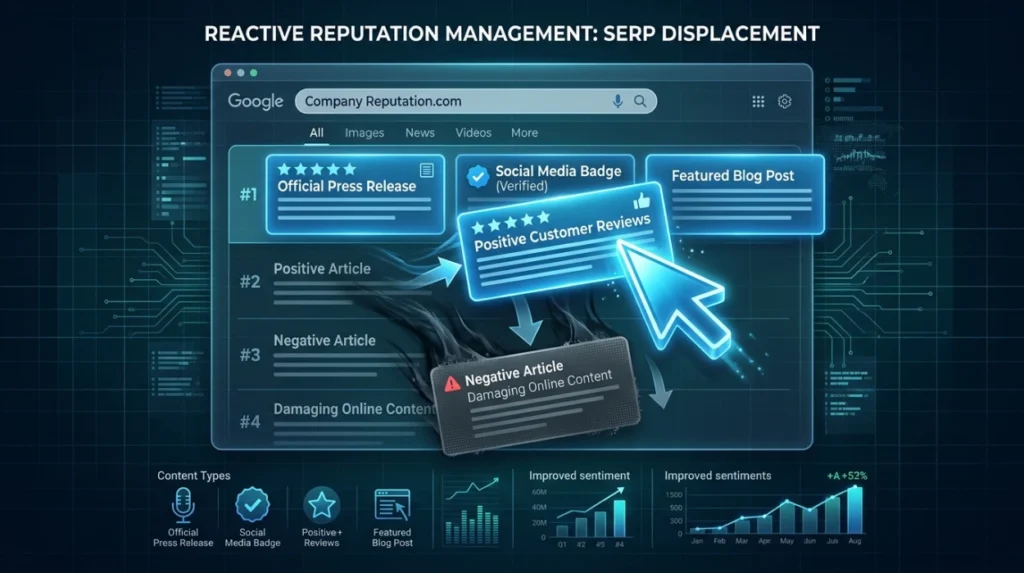
Reactive reputation management influences SERP composition by responding to specific information that has already gained visibility. The first stage involves identifying the source, ranking position, sentiment, authority and relationship to the school’s entity. The resulting assessment determines whether removal, correction, response, suppression or content enhancement represents the relevant mechanism.
Reactive action can have a direct effect when an eligible source is removed or amended. Where removal is unavailable, content suppression focuses on strengthening relevant competing pages so that unwanted information occupies less prominent positions. This does not guarantee a predetermined ranking outcome because search engines independently evaluate and rank indexed content.
SERP composition therefore provides a more meaningful measurement than ranking position alone. Analysts examine which source types appear, what information they communicate and how prominently they are displayed. This approach identifies whether the overall search environment has changed rather than simply recording whether one page moved up or down.
Which approach provides faster reputation improvement?
Reactive intervention generally addresses an identified reputation exposure more directly, while content enhancement requires time for content discovery, indexing and ranking development. Removal can produce a comparatively immediate change when the source accepts a legitimate request and takes the relevant content out of circulation. However, removal does not address independent copies or related discussions that remain indexed elsewhere.
Content enhancement has a different time profile because new information enters a search ecosystem through publication, crawling, indexing and ranking processes. Its effect develops as search engines evaluate relevance and authority over time. This makes it less dependent on a single intervention but more dependent on sustained information quality.

Speed and sustainability therefore represent separate evaluation criteria. A strategy that produces a rapid change in one search result does not automatically create a stable reputation environment. Long-term assessment requires examining whether the underlying information ecosystem has become more authoritative, consistent and contextually relevant.
How do reputation signals influence prospective applicants?
Reputation signals influence prospective applicants by shaping the information available during research and comparison. Reviews, educational publications, institutional pages, inspection information and third-party directories each contribute signals with different levels of authority and context. Users interpret these signals collectively when assessing an unfamiliar educational entity.
Sentiment distribution provides one important measurement. It identifies how positive, neutral and negative themes are represented across relevant sources rather than treating one review as a complete reputation assessment. Authority provides another measurement because information from established educational sources carries a different evidential role from anonymous or weakly sourced commentary.
Entity credibility emerges from the interaction of these signals. A consistent set of authoritative sources creates a clearer information environment than conflicting descriptions across unrelated platforms. Reputation management therefore evaluates the complete signal network rather than attempting to optimise one isolated metric.
How should private schools compare short-term and long-term reputation strategies?
Short-term strategies focus on resolving immediate visibility problems, while long-term strategies focus on developing a durable information environment. A short-term intervention can target a prominent negative result, inaccurate information or concentrated review issue. Its effectiveness is measured through changes in visibility, source prominence and sentiment distribution.
Long-term reputation development focuses on content architecture, entity consistency, authoritative references and sustained publication. These mechanisms establish a broader information base that continues to support search relevance across multiple queries. The limitation is that long-term development requires continuous maintenance and does not guarantee uniform ranking outcomes.
The comparison therefore requires four criteria: effectiveness, scalability, risk exposure and sustainability. A strategy that performs strongly against one criterion can perform differently against another. Evaluating these dimensions together provides a more accurate basis for selecting a reputation approach.
Which reputation strategy scales better across regional schools?
Content enhancement generally scales more efficiently because one structured content framework can address multiple informational queries and geographic contexts. A school can organise content around curriculum, academic outcomes, facilities, admissions, local relevance and institutional information. Each topic creates a distinct opportunity to establish relevant search signals without relying on an individual reputation incident.
Removal strategies scale less predictably because each source requires separate assessment and eligibility analysis. A single negative reference can also appear across multiple domains, creating additional investigation requirements. The process therefore depends heavily on source ownership, platform rules and the nature of the information.
Scalability also depends on information architecture. Well-organised content allows related pages to reinforce the same entity relationships without duplicating information. This creates a more coherent semantic network and makes ongoing reputation monitoring easier to evaluate.
What are the risks of relying only on content suppression?
Relying only on content suppression creates exposure because reducing the prominence of one result does not eliminate the information ecosystem surrounding an entity. New references can appear, existing sources can remain indexed and search rankings can change independently. Suppression therefore addresses visibility rather than necessarily addressing the underlying reason users encounter negative information.
Another limitation involves dependency on external ranking systems. Search engines determine rankings through their own algorithms, meaning no reputation strategy can guarantee that a specific page remains above another page indefinitely. Continuous monitoring is therefore required to distinguish temporary ranking fluctuations from durable changes.
Content suppression also provides limited contextual development when no stronger authoritative information exists. Without relevant information supporting the entity’s broader representation, reducing one negative source leaves a weaker search environment. This explains why suppression and enhancement are often evaluated as distinct but complementary mechanisms.
Dive Deeper With Our Expert Guides:
Reputation Audit vs PR Agency: Which Fixes School Enrolment Decline Faster?
How Do Private Schools Recover Enrolment After a Reputation Crisis?
How does local search change reputation strategy for regional private schools?
Local search changes reputation strategy by connecting an educational entity with geographical, community and service-related search contexts. Prospective applicants frequently use location-based queries when comparing schools, which creates additional relationships between the school, its region and competing institutions. Search results then combine institutional information with local directories, reviews, publications and geographic signals.
Local relevance also affects entity credibility because inconsistent location information creates ambiguity. School names, addresses, contact details, educational categories and institutional descriptions need to remain factually aligned across relevant sources. Search engines use these relationships to interpret which entity satisfies a location-specific query.
This makes local reputation analysis broader than branded search monitoring. A school can appear in searches that contain its town, region or educational category without including its exact name. Evaluating these non-branded results provides insight into how the school is positioned within its regional education market.
How should reputation management effectiveness be measured?
Reputation management effectiveness is measured through changes in search visibility, SERP composition, reputation signals, sentiment distribution and entity-level information consistency. Ranking position provides one measurement but does not represent the entire search environment. A negative result moving from position two to position eight produces a different outcome from its complete removal from the first page.
Evaluation also compares the visibility of unwanted information against authoritative and controlled information. Analysts track source types, ranking positions, content themes, review sentiment and changes in indexed pages over defined periods. These measurements demonstrate whether the information ecosystem is becoming more balanced and coherent.
A useful evaluation framework therefore measures both immediate and cumulative outcomes:
- Compare ranking visibility before and after intervention to identify changes in the prominence of specific sources.
- Evaluate sentiment distribution across reviews and public references to identify shifts in recurring reputation themes.
- Measure authoritative-source prominence to determine whether stronger information occupies relevant SERP positions.
- Analyse entity consistency across digital sources to identify conflicting institutional information.
- Assess sustainability over time by monitoring whether improvements persist across priority branded and local queries.
How can regional schools balance reputation improvement with admissions competition?
Regional schools can balance these objectives by separating reputation measurement from admissions performance while analysing where the two information systems intersect. Reputation management evaluates how an entity is represented online, whereas admissions performance measures applicant behaviour and enrolment outcomes. Treating them as identical metrics creates an inaccurate assessment of strategic effectiveness.
Search visibility remains relevant because prospective applicants use digital information during research. A school appearing consistently across authoritative local and educational queries has a more structured information presence than one represented primarily through isolated reviews or unrelated references. However, search visibility alone does not establish applicant preference.
The strongest evaluation therefore connects search data with broader institutional evidence without assuming direct causation. Changes in SERP composition, sentiment distribution and entity credibility provide reputation indicators, while enquiry and enrolment data provide separate commercial indicators. Analysing both systems creates a clearer understanding of how reputation and applicant competition interact.
What role does local reputation management play in regional school admissions?
Local reputation management operates by evaluating how a school is represented within geographically relevant search ecosystems. Local reviews, educational directories, regional publications, institutional pages and location-specific queries collectively influence the information available to prospective applicants. These sources create reputation signals that extend beyond the school’s own website.
How Does Local Reputation Management Win Admissions for Regional Schools? is therefore closely connected to the evaluation of local search perception. The relevant question is not simply whether a school ranks for its own name, but whether authoritative, accurate and contextually relevant information appears when users research schools within the region.
Local reputation management also requires continuous SERP evaluation because local search results change according to query intent, location and source relevance. Measuring these changes provides evidence about the composition of the information environment without treating rankings as guaranteed or permanent outcomes.
Regional private schools operate within competitive information environments where a shrinking applicant pool increases the importance of how institutions are represented across search ecosystems. Content enhancement, content removal, suppression and reactive intervention each operate through different mechanisms and therefore require separate evaluation.
Content enhancement provides broader informational coverage, while removal directly targets eligible unwanted sources. Organic strategies build cumulative authority and entity consistency, whereas reactive strategies address defined reputation exposures. Short-term interventions can address immediate visibility issues, but long-term sustainability depends on the quality, authority and consistency of the wider information ecosystem.
Effective evaluation therefore combines search visibility, SERP composition, reputation signals, sentiment distribution, entity credibility, scalability and risk exposure. This framework distinguishes reputation improvement from admissions performance while identifying the points where local search perception influences the information available to prospective applicants.
How can regional private schools attract more applicants in a shrinking market?
Regional private schools can improve applicant interest by clearly communicating their academic strengths, pastoral support, facilities, extracurricular opportunities and local community benefits. Understanding changing parent priorities can also help schools refine their admissions and outreach strategies.
Why are private schools facing a smaller pool of applicants?
A shrinking applicant pool can result from demographic changes, lower birth rates, rising education costs and increased competition between schools. Regional economic conditions and changes in family preferences can also influence private school enrolment.
What can private schools do to stand out from competitors?
Schools can differentiate themselves through distinctive academic programmes, specialist subjects, student support, extracurricular activities and clearly defined educational outcomes. Consistent communication across websites, search results and other digital channels can strengthen how prospective families perceive the school.
How does digital marketing help regional private schools increase enrolment?
Digital marketing helps schools reach prospective parents through search engines, social media, email and informative website content. SEO, local search visibility and useful admissions content can make it easier for families to discover and compare regional private schools.
How important is a private school’s online reputation during admissions?
A school’s online reputation can influence how prospective parents assess its credibility before making an admissions decision. Reviews, search results, published information and third-party discussions can all contribute to the overall perception of a school, making reputation management an important consideration.